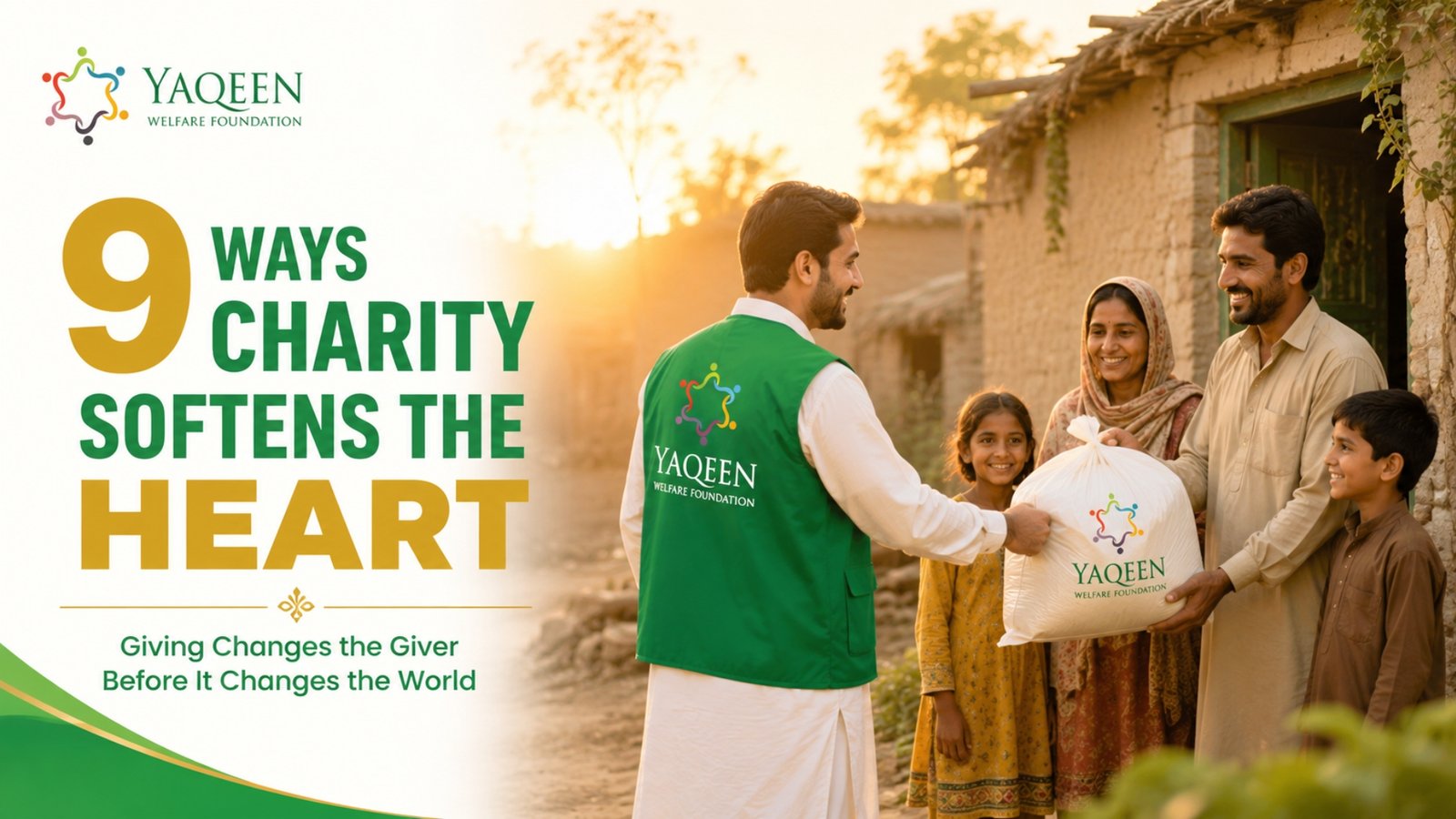
There is something no one tells you about charity: it changes you more than it changes the one who receives. Not immediately. Not visibly. But in the quiet that follows an act of sincere charity, something in the chest is different. A softness where there was hardness. A stillness where there was noise. A nearness to Allah that cannot be manufactured by will alone — only by the act of opening the hand.
The scholars of Islam spoke of the heart as something that hardens and softens in response to what we do. Not to what we feel, or intend, or believe in the abstract, but to what we actually do. And among the acts most reliably spoken of as softening the heart, the Prophet ﷺ placed charity: the physical, tangible act of releasing what you have toward someone who needs it.
This is not metaphor. This is the mechanics of how the soul works, and in this article we’ll walk through nine distinct ways charity reshapes the heart of the one who gives. If you’d like to read more reflections like this one, you can also visit our post on the spiritual rewards of Sadaqah Jariyah or browse the full collection on the Yaqeen Welfare Foundation blog.
Why Charity Is the Heart’s Quiet Teacher
Before listing the nine ways, it helps to understand the underlying principle. Charity is not simply a transaction of money or food. It is a repeated act of resistance against the self’s instinct to hold on. Every time a person gives, they are training the soul to release rather than grasp. This is why charity, more than almost any other act of worship, is described by scholars as having a direct and measurable effect on the condition of the heart.
H6: The Hadith That Started It All
The Prophet ﷺ said:
“If you want your heart to be soft, feed the poor and pat the head of the orphan.” (Ahmad)
Feed the poor. Not theorise about poverty. Not feel sorrow about it from a distance. The act is physical. The hand opens. The food moves. And something in the chest opens with it.
The 9 Ways Charity Softens the Heart
1. Charity Breaks the Grip of Scarcity Thinking
The first and most immediate effect of charity is on the giver’s relationship with fear. The nafs (the lower self) instinctively treats every act of giving as a loss. But those who practise charity consistently report the opposite experience over time: what once felt precarious begins to feel sufficient. The hand that has practised opening finds it easier to open the next time.
2. Charity Trains the Soul to Expand Rather Than Contract
Ibn al-Qayyim, writing on the diseases of the heart, observed that the soul has two fundamental tendencies: to expand and to contract. It expands in the presence of what is true and good; it contracts in the presence of what is false and harmful. Among the acts most consistently associated with expansion of the soul, he placed charity, not for sentimental reasons, but because of what it does structurally to the nafs.
3. Charity Extinguishes the Weight of Sin
There is a teaching that should be held alongside every act of giving, not as its motivation, but as its larger context:
“Charity extinguishes sin as water extinguishes fire.” (Tirmidhī)
The image is vivid and precise. Fire and water do not negotiate. When water meets fire, the fire is extinguished, not gradually reduced while retaining its structure. This is what the Prophet ﷺ said charity does to the sins of the one who gives. Every soul carries weight, and charity moves directly against that weight.
4. Charity Deepens Trust in Allah’s Provision
There is a particular quality of trust, tawakkul, that cannot be argued into existence. It is built through repeated experience of giving and then watching provision return, not always immediately, and not always in the same form, but consistently enough that the heart begins to rest in a different way. This is one of the quieter but most lasting effects of regular charity.
5. Charity Increases Awareness of Others
A person who gives regularly begins to notice need where they previously did not. The eyes adjust. The neighbour who has gone quiet. The family member who deflects questions about money. The stranger in the market whose clothing speaks of scarcity. Charity, practised consistently, produces a person who sees differently and feels more responsible for what they see.
6. Charity Multiplies Rather Than Diminishes
The Prophet ﷺ said:
“Charity does not decrease wealth.” (Muslim)
This hadith is sometimes understood only as a promise about material provision, that Allah will return what is given. But scholars read it more deeply: charity does not decrease the person who gives. The one who gives does not become less. They become more — more expansive, more open, more capable of receiving both provision and mercy.
7. Charity Sets in Motion Prayers You Will Never Hear
One of the most overlooked effects of charity is the duʿa it produces in someone you will never meet. A mother who was given food for her children when there was nothing raises her hands in the night and asks Allah to bless the one who sent it. She does not know your name. She calls you “the one who gave,” and Allah, who knows every name, knows exactly who she means.
“Indeed, Allah is Ḥayyū, Karīm. He is too generous to let His servant raise hands to Him and return them empty.” (Abū Dāwūd)
8. Charity Builds a Habit of Giving That Outlasts a Single Moment
The long work of charity is not the single act, however significant, but the accumulated effect of a life in which giving is a regular practice. Small, repeated charity, given consistently over months and years, shapes character in a way that one large but isolated gift rarely does. This is why scholars often encourage believers to give little and often rather than waiting for a single grand gesture.
9. Charity Draws the Giver Closer to Allah
Every act of sincere charity is, at its core, an act of worship. It is an orientation of the self away from accumulation and toward Allah. In that orientation, the mercy of Allah, which is always closer than we imagine, responds. This nearness is the cumulative result of everything above: the broken fear, the expanded soul, the extinguished sin, the deepened trust, the sharpened awareness, the multiplied reward, the unseen prayers, and the steady habit.
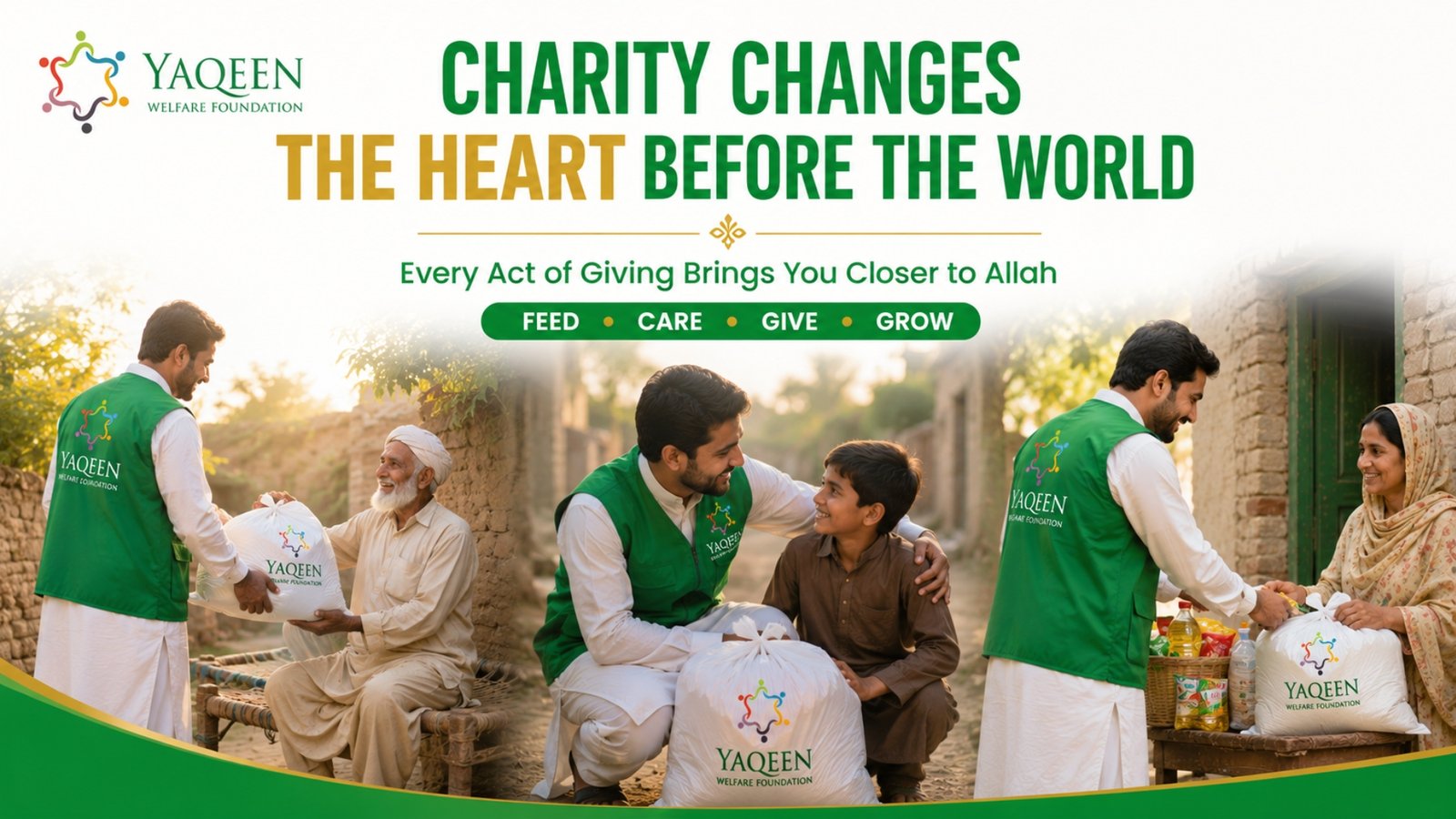
A Quick Summary: The 9 Effects of Charity on the Heart
| # | Effect of Charity on the Giver | Spiritual Source |
|---|---|---|
| 1 | Breaks the grip of scarcity thinking | Practical experience of giving |
| 2 | Trains the soul to expand rather than contract | Ibn al-Qayyim’s teachings on the heart |
| 3 | Extinguishes the weight of sin | Hadith, Tirmidhī |
| 4 | Deepens trust (tawakkul) in Allah | Repeated experience of provision |
| 5 | Increases awareness of others’ needs | Observed character change |
| 6 | Multiplies rather than diminishes wealth | Hadith, Muslim |
| 7 | Sets unseen prayers in motion | Hadith, Abū Dāwūd |
| 8 | Builds a lasting habit of generosity | Scholarly consensus on consistency |
| 9 | Draws the giver closer to Allah | Cumulative spiritual effect |
Where Yaqeen Welfare Foundation Carries Your Charity
Every programme at Yaqeen Welfare Foundation is designed for the moment of genuine need: the family that has reached the edge of what they can carry, the household where the calculation of flour has been running for three days, the widow managing entirely alone. Your charity, given through any of the following programmes, becomes part of the cycle described above.
- Emergency Food Parcels — A family in acute crisis receives two weeks of food essentials, dispatched within days of your donation.
- Ramadan Food Distribution — A fasting stranger breaks their fast through your generosity, a moment of gratitude that carries particular weight with Allah.
- Ongoing Family Food Support — For families where poverty is permanent rather than acute, monthly support rebuilds hope as something reliable, month after month.
- Widow and Vulnerable Household Support — The households most often passed by receive, through your charity, the message that they have not been forgotten.
To read more about how Yaqeen Welfare Foundation works on the ground, see our post on how your donations reach families in Pakistan and our explanation of Zakat-eligible giving programmes.
If you’d like to better understand the broader scholarly tradition behind these teachings, the Yaqeen Institute’s research library is a respected external resource for deeper study on Islamic spirituality and the science of the heart. You can also explore general guidance on charitable giving in Islam through Islamic Relief’s resources on Sadaqah, an established and reputable external organisation.
Charity Is Not What You Lose. It Is What You Become.
The nafs will always present charity as a loss. The money leaves. The food goes. The resource, whatever it was, is no longer in your hand. This is the calculation the lower self makes, and it is, in every important sense, wrong.
What you give enters into the accounting of Allah, which does not follow the arithmetic of the world. What you release is multiplied in ways invisible to the eye but written in the records that matter. And what happens to you, to your heart, your soul, your capacity for mercy and trust and nearness to Allah, is not diminishment.
It is enlargement.
Every meal given. Every parcel sent. Every stranger fed across a distance you will never cross and through a face you will never see. Each one works on you, in the invisible architecture of what Allah arranges, softening what was hard, opening what was closed, writing in your scales what no act of self-preservation could ever place there.
You do not need to feel generous to give charity. You do not need to feel ready, or certain, or free of fear about what you have. You need only to give, for the sake of Allah. And He, who made the heart and knows exactly what softens it, will do the rest.
“Charity extinguishes sin as water extinguishes fire.” (Tirmidhī)
One act. One family. One heart changed — yours.
DONATE NOW — Give One Meal. Soften One Heart. Forever.
Frequently Asked Questions
Q: Does giving charity really change the person who gives, or is that just a saying? The Prophet ﷺ described it as a physical act with a real effect on the heart. The scholars of Islam, from Ibn al-Qayyim to al-Ghazālī, wrote about the softening of the heart through charity as a reliable, observable spiritual phenomenon, not metaphor. The practice of giving changes the one who practises it.
Q: I feel like I don’t have enough to give. Is a small amount of charity worth giving? “Protect yourself from the Fire, even with half a date.” (Bukhārī and Muslim). The Prophet ﷺ did not set a minimum. Small, consistent charity may carry more weight, and do more for a family, than a single larger gift given once. The softening of the heart does not require a large amount; it requires the act.
Q: Can I give charity in memory of someone who has passed? Yes, and this is among the most beautiful gifts you can offer a loved one who is gone. Charity given on their behalf reaches them. Every duʿa raised by the stranger whose meal was provided in their name carries a portion of that mercy to them.
Q: Can food charity count as Zakāt? Yes. Families in acute food poverty fall within the eligible categories for Zakāt. Please indicate your intention when giving so that we can allocate your donation to Zakāt-eligible programmes.
Q: How do I know the family receiving my charity is genuinely in need? We work exclusively with verified on-the-ground partners who identify families facing genuine acute need: those with no alternative source of food, no safety net, and no one else to turn to. When you give charity through Yaqeen Welfare Foundation, it reaches a real family that would otherwise go without.
Q: How can I contact Yaqeen Welfare Foundation to ask more questions before donating? You’re welcome to reach out any time through our online contact page, and our team will respond with details about current programmes and how your charity will be used.