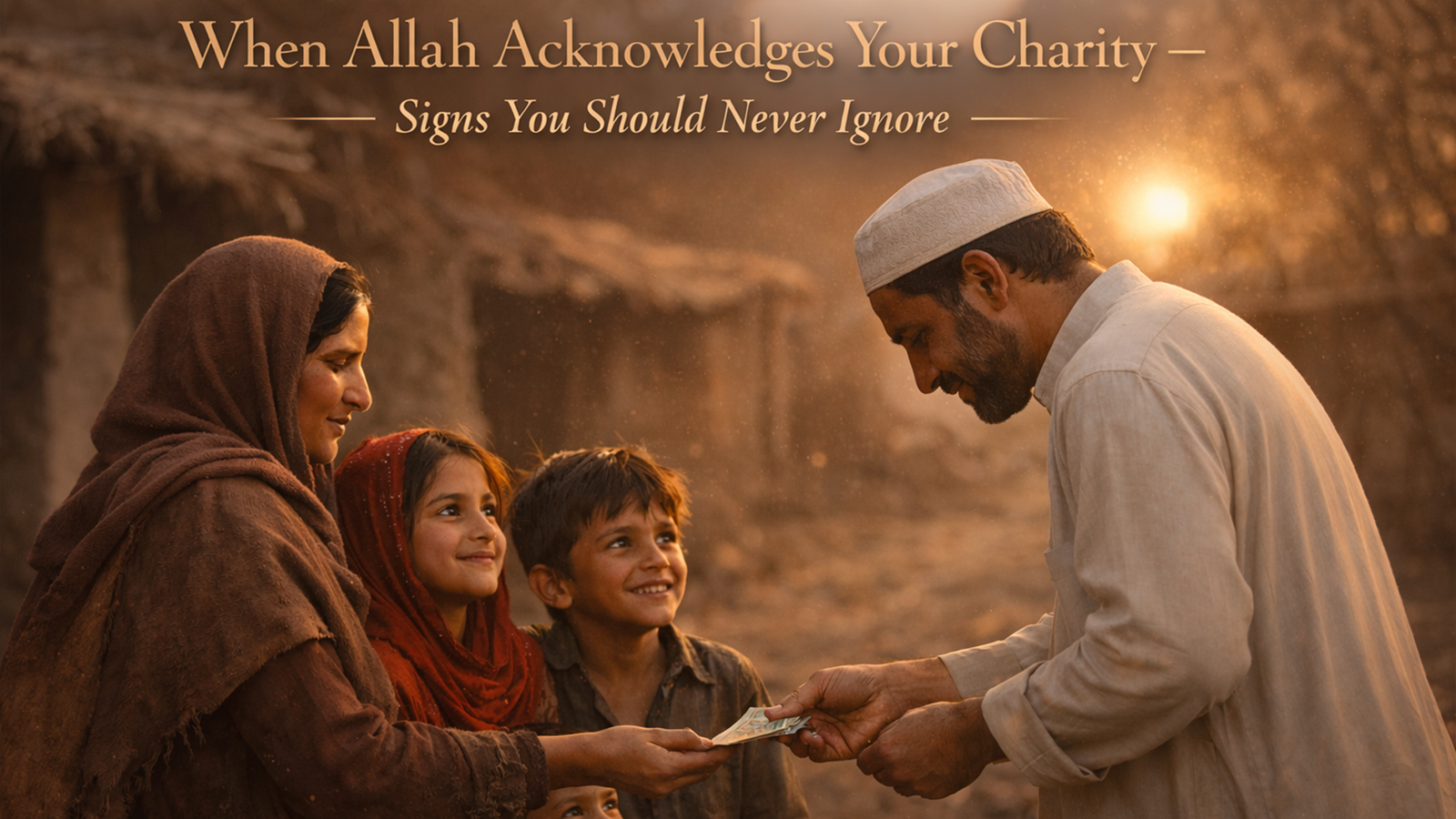
Allah acknowledges charity in ways that transcend the visible world. Every act of giving carries an invisible weight — not measured in currency, but in sincerity. When you open your hand for the sake of Allah, a quiet question settles in your soul: Did it reach Him?
In Islam, the acknowledgment of a deed carries far greater significance than the deed itself. The Companions of the Prophet ﷺ used to fear that their worship might be rejected more than they feared committing a sin. They understood something we must rediscover: that giving without acceptance is like planting seeds in concrete. The action is there, but the growth never comes.
Allah reminds us in the Quran:
“Indeed, Allah only accepts from the righteous.”
— Surah Al-Ma’idah 5:27
Understanding what divine acknowledgment looks like is not spiritual arrogance. It is spiritual awareness — and it is something every sincere Muslim should actively seek.
In this blog, we walk through five profound signs that Allah has accepted your charity, explore the timeless legacy of Islamic giving, and show you how your donation today continues a tradition that has shaped civilisations for over fourteen centuries.
Why the Question of Acceptance Matters So Deeply in Islam
Before we explore the signs, we must understand why the concept of qabool (acceptance) holds such weight in Islamic thought.
The Quran does not simply command us to give. It commands us to give rightly — from what we genuinely love, with intentions aimed entirely at Allah, free from the desire to be seen or praised. This is why two people can give identical amounts in identical circumstances, yet stand in vastly different positions before Allah.
The Prophet ﷺ said:
“Actions are judged by intentions, and every person will get the reward according to what he has intended.”
— Sahih al-Bukhari
This hadith is not merely a theological footnote. It is the foundation upon which the entire edifice of accepted worship is built. Charity given to be praised, to feel superior, or to trend on social media carries almost no spiritual value. Charity given in the quiet hours — for no audience but Allah — is elevated to a form of worship that can surpass donations of far greater monetary value.
When Allah acknowledges charity, He does not announce it with fanfare. He whispers it into the heart of the giver through signs that only the sincerely attentive believer will recognise.
Sign 1: A Deep, Unexplainable Calm Settles in Your Heart
The first and perhaps most intimate sign is a stillness that arrives uninvited.
This is not the temporary rush of being publicly thanked. It is not the brief satisfaction of watching your donation confirmation email arrive. It is something far quieter — a warmth that wraps around your chest like morning light, a completeness that was not there before you gave.
Many believers describe this feeling after giving truly and sincerely: a sense as though a gap they never knew existed has been filled. This peace is not manufactured by the mind. It does not respond to logic or effort. It simply settles — and it waits.
This is the Sakinah — the divine tranquillity — that Allah sends down into the hearts of His sincere servants. The Quran refers to this peace repeatedly, always tying it to nearness to Allah and righteous action.
If you experience this after giving, do not dismiss it as a mood or a coincidence. It is one of the most intimate signs between a servant and his Lord — a quiet confirmation that your sincerity was seen.
Related reading: The Importance of Charity in Islam – A Complete Guide
Sign 2: Your Heart Is Pulled Toward Giving Again
There is a beautiful pattern in the lives of the genuinely charitable: one good deed opens the door to another.
This is not coincidence. It is divine generosity responding to human sincerity.
When Allah acknowledges charity, He often rewards the giver by making it easier — and more beloved — to give again. The Prophet ﷺ said:
“When a servant does a good deed, a white dot is placed on his heart.”
— Ibn Majah
That dot grows. That light multiplies. A heart that once hesitated before giving now gives freely — not because the act became financially easier, but because Allah made generosity beloved to it.
If you find yourself drawn back to supporting causes — clean water projects, medical care for the poor, education for children who have nothing — not out of social obligation or habit, but from a genuine pull in your chest, recognise that as a profound blessing. The cycle of giving has become woven into your spiritual character.
This is exactly the kind of sustained generosity that allows organisations like Yaqeen Welfare Foundation to continue transforming lives in Pakistan and beyond.
Related reading: How to Give Sadaqah the Right Way and Maximise Your Rewards
Sign 3: Pride Finds No Room in Your Heart
Accepted charity does not celebrate itself.
It does not remind you how much you gave. It does not compare your contribution to others. It does not wait anxiously to be thanked by those you helped.
Instead, it leaves behind a quiet, unexpected humility — a calm recognition that you were simply chosen as a vessel for Allah’s mercy to reach another human being.
- The wealth was always Allah’s.
- The opportunity to give was His to grant or withhold.
- You were the instrument, not the source.
This understanding — that the true Provider is Allah alone — strips pride away at its root. The ego finds nothing to grip when the heart truly believes that it contributed nothing of its own.
If after giving you find yourself thinking less about your generosity and more about Allah’s — that is a sign your charity has traveled exactly where it was meant to go.
This is precisely why the Prophet ﷺ advised giving with your right hand so privately that your left hand does not know. Even your own sense of self should ideally remain unaware of your generosity. That level of sincerity is what earns the shade of Allah’s Throne on the Day of Judgment.
Sign 4: You Release the Memory of the Act
One of the most paradoxical yet powerful signs of accepted charity is the gentle forgetting of it.
Not because it was unimportant — but because the soul that has truly given for Allah does not need to cling to the memory for reassurance.
You do not replay the moment in your mind.
You do not bring it up in conversation, even subtly.
You do not return mentally to calculate how much you gave.
You simply gave — and let it go.
Meanwhile, Allah records it with perfect accuracy: full context, full sincerity registered, full reward assigned.
This detachment from the deed is a mark of spiritual maturity. It mirrors the Quranic ideal of giving in the way of Allah and then making no mention of it and causing no harm — the standard of those for whom the reward with their Lord shall not be diminished.
Related reading: Sadaqah Jariyah for the Deceased – Their Rewards Can Still Grow
Sign 5: Unexplained Ease and Barakah Enter Your Life
The Quran and the Sunnah are consistent and emphatic on this point: charity does not decrease wealth. It multiplies it. But the multiplication frequently arrives in forms we do not expect.
- A persistent problem quietly resolves itself.
- A relationship that was strained begins, slowly, to heal.
- An anxiety that felt permanent becomes lighter almost overnight.
This is Barakah — divine blessing — the sacred multiplier that flows from sincere giving. It does not always appear as more money in your account. It appears as peace in your home, clarity in your decisions, and strength in your body when you expected exhaustion.
Allah says in the Quran:
“The example of those who spend their wealth in the way of Allah is like a seed of grain which grows seven spikes; in each spike is a hundred grains. And Allah multiplies His reward for whom He wills.”
— Surah Al-Baqarah 2:261
Allah opens doors through charity that remain sealed to every other key. And most of the time, we never trace the ease in our lives back to the act of giving — which is precisely how He designed it to work.
The Timeless Legacy of Islamic Charity
To understand why Allah acknowledges charity with such profound spiritual reciprocity, we must understand the civilisational weight that giving has carried in Islamic history.
Charity was never a peripheral act of goodwill in Islamic societies. It was the foundational infrastructure of justice, welfare, and human dignity.
The First Waqf: A Gift That Outlasts Its Giver
When Umar ibn al-Khattab (RA) acquired fertile land in Khaybar, he approached the Prophet ﷺ asking how best to use it. The Prophet’s guidance gave birth to the world’s first recorded Waqf — a permanent endowment whose assets could never be sold or inherited, but whose produce would serve the poor, travellers, and those in need for generations to come.
That single act planted a tree whose shade still falls on Islamic institutions worldwide. According to the World Bank’s research on Islamic Finance, Waqf endowments today manage significant assets globally, continuing this fourteen-century tradition of sustainable charitable giving.
The Bayt al-Mal: Charity as Governance
Under the rightly-guided Caliphs, the Bayt al-Mal operated as the world’s first systematic welfare treasury — centuries before such concepts existed anywhere else. It distributed resources to the elderly, orphans, widows, and the disabled. It paid stipends to scholars and ensured that no citizen of the Islamic state would sleep hungry while the treasury had anything to give.
Specialised Charitable Institutions of the Abbasid Era
By the Abbasid period, Islamic civilisation had developed Waqf-funded institutions of remarkable specificity. Some were established solely to provide dowries for young women from impoverished families. Others funded the repair of public wells, bridges, and roads. There were even endowments for the care of stray animals.
This was not charity as an afterthought. It was charity as engineering — building the moral and material bones of a civilisation.
As UNICEF’s research on community welfare systems confirms, sustainable giving structures rooted in community values produce generational change — a truth the Islamic world discovered over a thousand years ago.
At Yaqeen Welfare Foundation, we carry this fire forward. Each donation made through our platform is not a transaction — it is a thread in a tapestry of kindness stretching back fourteen centuries.
Related reading: Sadaqah Jariyah for a Water Well in Pakistan
Charity in Pakistan – Where Your Giving Lands
In 2026, Pakistan stands at a critical crossroads. Its population has grown faster than its infrastructure. Its disease burden has shifted dramatically. And its future depends heavily on one factor above nearly all others: education — and the charitable giving that makes it accessible.
Health Literacy and the Disease Burden
Pakistan currently carries a dual burden of disease — battling infectious illnesses like polio, typhoid, and tuberculosis alongside a surging wave of non-communicable conditions such as diabetes, hypertension, and cardiovascular disease.
The primary weapon against both is not pharmaceutical. It is knowledge. A mother who understands nutrition can protect her child from stunting. A young man who understands blood sugar management can prevent a lifetime of complications. Education is life-saving infrastructure — and charity funds it.
Maternal Education and Child Survival
Decades of research across South Asia confirm a striking pattern: when a mother’s level of education rises, child mortality falls. According to UNICEF Pakistan, educated mothers are significantly more likely to seek pre-natal care, complete vaccination schedules, and make informed decisions about nutrition and sanitation.
In rural Punjab and Sindh, this difference can mean the gap between a child’s survival and death before the age of five.
Women’s Education as a Force Multiplier
When a woman in Pakistan is educated, the ripple effects extend across three generations:
- Her children are healthier.
- Her family is more financially stable.
- Her daughters are more likely to be educated in turn.
- Her community’s health outcomes improve overall.
Investing in girls’ education is arguably the single highest-return investment available in global development today — and every scholarship funded through charity is a Sadaqah Jariyah that multiplies across lifetimes.
Related reading: How Your Charity in Pakistan Can Transform Lives Across Communities
How Allah Acknowledges Charity Through Its Impact on Others
There is a dimension to divine acknowledgment that extends beyond the giver’s personal experience. When charity is accepted, it does not merely transform the one who gave — it transforms those who received.
A child who accesses clean water because of your donation does not fall ill this winter. That child attends school. That child grows up to give in turn.
A family that receives medical care because of your Sadaqah does not lose its breadwinner to an untreated illness. That family remains intact. That family gives their children a future.
This chain of cause and effect — invisible to the giver, registered in full by Allah — is why the Prophet ﷺ described certain forms of Sadaqah as continuous rivers of reward, flowing even after the giver has passed from this world.
Your contribution to Yaqeen Welfare Foundation’s clean water projects, healthcare programmes, and education initiatives is exactly this kind of giving. Each hand pump installed in a waterless village provides life every single day. Each scholarship removes poverty’s veto over a child’s potential.
How to Give in a Way That Invites Acknowledgment
Sincerity is the gateway. But sincerity is also cultivable — it can be nurtured through practice and intention-setting before you give.
Before making any donation, pause. Ask yourself honestly: Who am I really giving this for? If the answer is genuinely Allah, proceed. If there is any performance in the intention — any audience you are imagining, any praise you are anticipating — pause longer, until the giving becomes truly private between you and Him.
Give from what you love. The Quran says:
“You will never attain righteousness until you spend from that which you love.”
— Surah Aal-Imran 3:92
Give consistently, even in small amounts. The Prophet ﷺ said that the most beloved deeds to Allah are those done consistently, even if small. A monthly standing donation, however modest, may carry more weight than a large one-time gift given impulsively.
And give with shukr — gratitude — that Allah has chosen you as a means of His mercy reaching others. Not everyone is given the wealth, the health, and the opportunity to give. Being chosen as a vessel is itself a gift.
FAQ: Allah Acknowledges Charity – Your Questions Answered
Q1: How can I tell if Allah has accepted my charity?
Look inward rather than outward. The signs are not external praise but internal transformation — growing humility, a renewed desire to give again, and a peace that does not depend on any confirmation from others. Your heart becomes the only receipt that truly matters.
Q2: Does my intention really change the value of my charity?
Entirely. The Prophet ﷺ said actions are judged by intentions. Charity given for praise or visibility carries minimal spiritual weight. Charity given sincerely for Allah’s sake — especially in private — is elevated to a form of worship that can surpass far larger sums given without sincerity.
Q3: Does the amount of my gift matter to Allah?
Not in the way we often assume. Allah weighs sacrifice, not arithmetic. Give what truly costs you something, and its value before Allah will exceed any calculation you could make.
Q4: Is it better to give charity publicly or privately?
Both have their place. Private giving is generally purer because it guards sincerity and preserves the dignity of the recipient. But public giving, when done with the right intention, can inspire a community and ignite a culture of generosity. The key question is always: for whom am I truly giving this?
Q5: What is Sadaqah Jariyah and how does it relate to divine acknowledgment?
Sadaqah Jariyah is a continuous charity whose rewards flow even after the giver has passed away — like a water well, a school, or a Quran given to someone who reads it for years. Allah acknowledges charity of this kind across time, rewarding the giver long after their hands have rested. Read more: Sadaqah Jariyah for the Deceased – Their Rewards Can Still Grow.
Q6: Why should I be concerned about whether my charity is accepted?
Because concern for acceptance is itself a form of worship. It keeps pride at bay and keeps you returning to Allah with humility rather than certainty. The Companions would perform a good deed and then spend months fearing it had not been accepted — not from despair, but from deep reverence for Allah. That fear purifies the act.
Q7: Can I give charity on behalf of a deceased loved one?
Yes, and scholars of Islam agree that the reward of charity given on behalf of the deceased reaches them. It is one of the most powerful gifts you can offer someone who has passed. Read more: Sadaqah Jariyah for the Deceased – Their Rewards Can Still Grow.
Contact Yaqeen Welfare Foundation
Have questions about a specific cause, want to set up a recurring donation, or need guidance on how to give in a way that maximises your spiritual and material impact?
We are here for you.
Contact us online: https://yaqeen.org/contact/
Our team responds to every message. Whether you are giving for the first time or looking to deepen an existing relationship with a cause, we will walk with you.
Never Ignore What Allah Is Telling You
When Allah acknowledges charity, He does not send a notification. He does not email a receipt. He speaks directly into the heart of the believer — through a stillness that was not there before, through a generosity that grows rather than diminishes, through a humility that quietly replaces pride, and through an ease that arrives from directions you did not anticipate.
These signs are not coincidences. They are conversations — intimate, private, and immeasurably meaningful — between you and your Lord.
To ignore them is to miss the most important feedback you will ever receive in this life.
Give with sincerity. Give with consistency. Give for Him alone. And watch what He places in your heart in return.
May Allah accept every act of sincere giving from us, make our charity a light in our graves, a weight on our scales, and a source of mercy for those we have never met. Ameen.