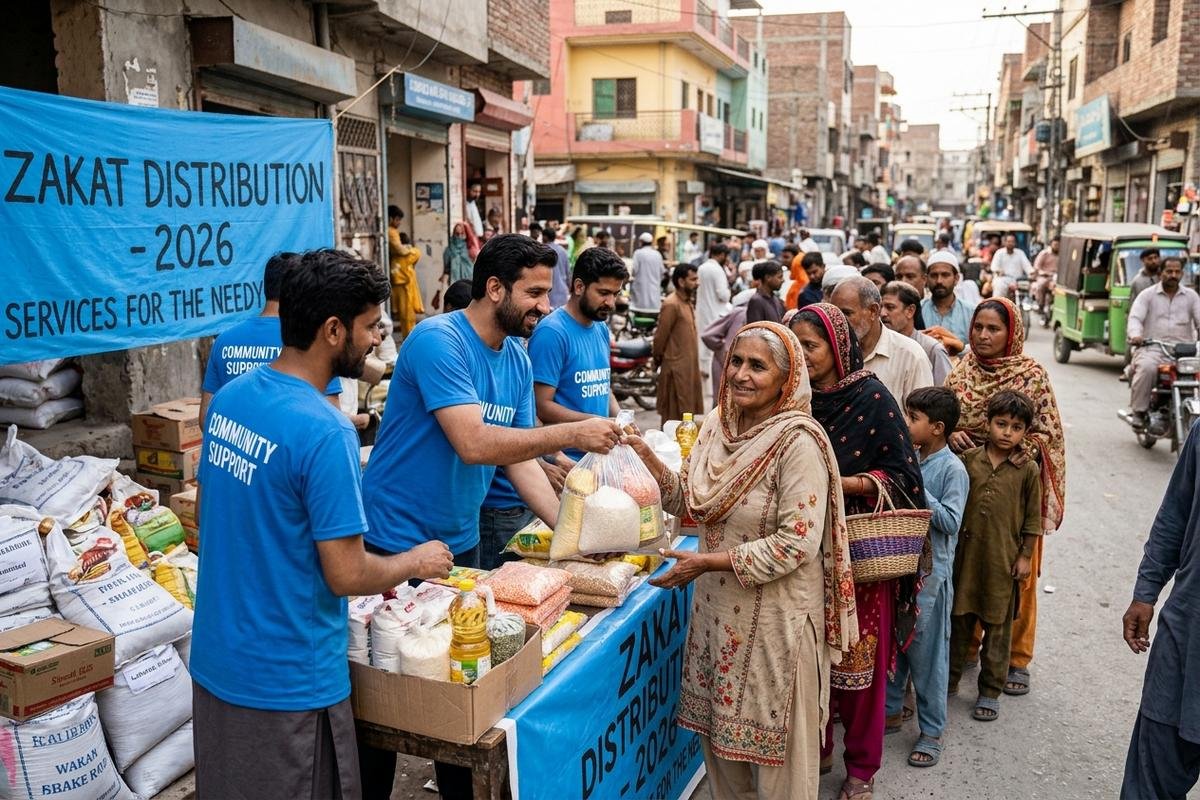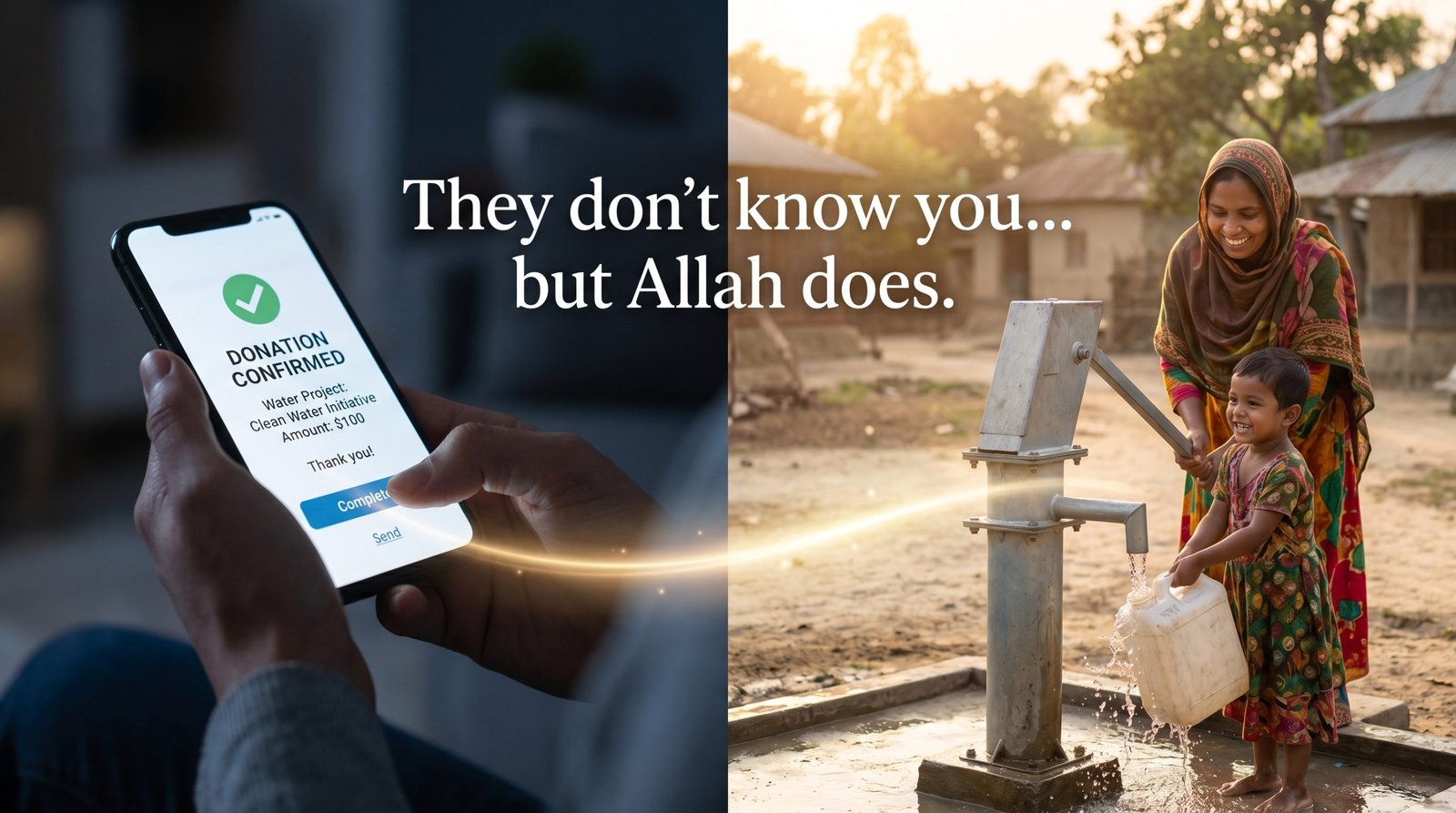
There is the charity only Allah sees — a kind of giving the world never praises. No camera captures it. No name is engraved on a plaque. No crowd gathers to witness the moment. It moves like water through soil — invisible on the surface, yet feeding everything beneath it.
It happens in the predawn quiet, when a hand slips something into a tin without anyone watching. It happens in a browser window opened alone, a donation completed, and then closed — no screenshot taken, no story shared. It is giving stripped of performance, offered purely for One.
At Yaqeen Welfare Foundation, we are humbled to be the vessel through which thousands of such acts flow. Donors reach us from every corner — some vocal, some invisible. And while every form of generosity is honored, we have come to understand something important: the charity only Allah sees carries a spiritual gravity unlike any other. It is not simply a transfer of wealth. It is a conversation between the servant and the Creator, held entirely in private.
What Is “The Charity Only Allah Sees” in Islam?
At its core, this form of giving — often called silent or secret charity — is the act of giving without seeking any return from the world: not praise, not gratitude, not even acknowledgment. The left hand truly does not know what the right hand has done. The deed is completed, and the giver walks away without leaving a trace.
This is not merely an act of humility. In Islamic teaching, it is a spiritual discipline — a way of purifying the deed from the one contamination that can quietly destroy it: the desire for human approval.
Allah (SWT) speaks about this directly in the Qur’an:
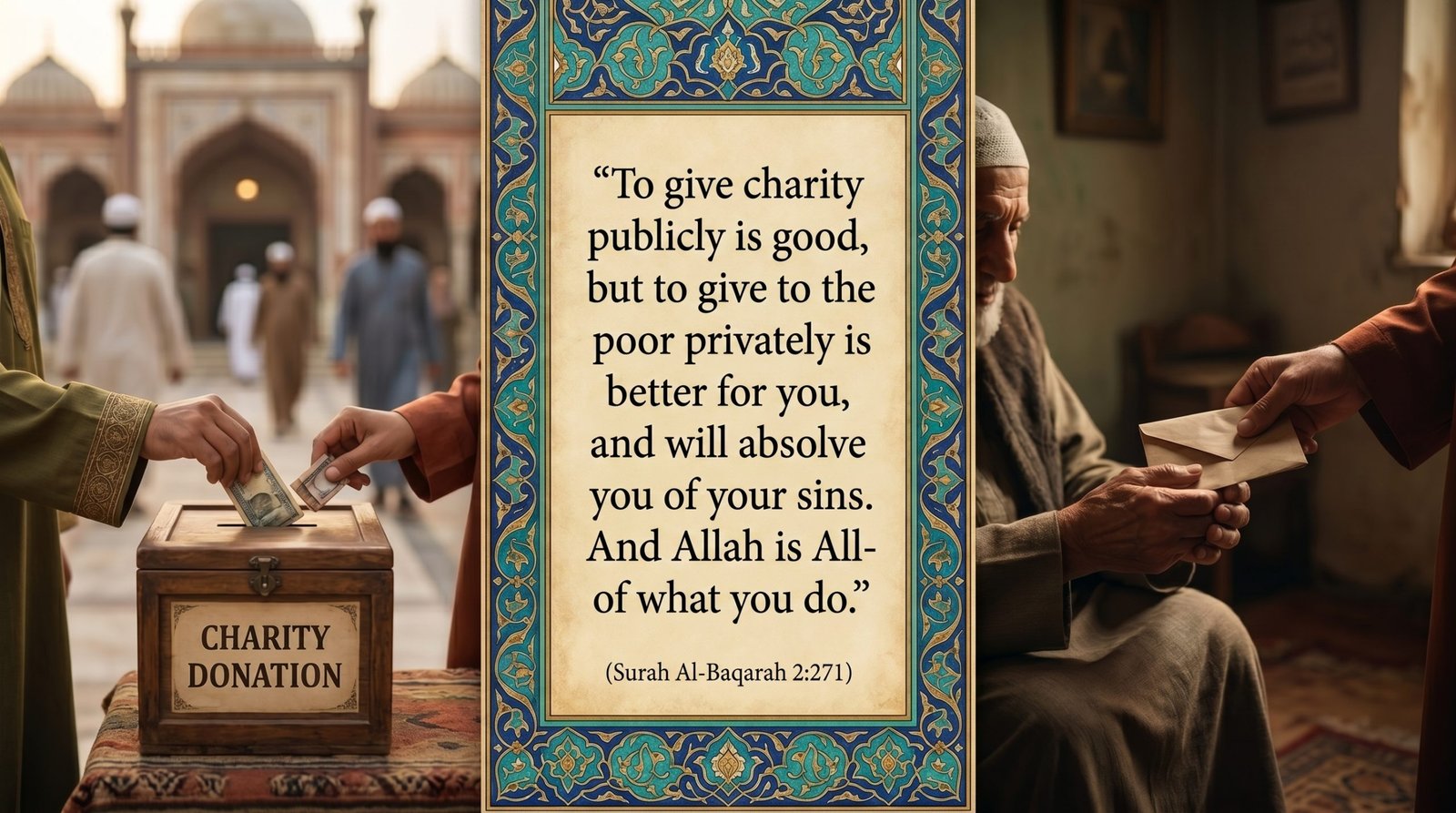
“To give charity publicly is good, but to give to the poor secretly is better for you, and will absolve you of your sins. And Allah is All-Aware of what you do.” (Surah Al-Baqarah, 2:271)
Notice the precision of this verse. It does not say public giving is wrong — it says private giving is better. The comparison is not between permissible and forbidden, but between good and greater, between the acceptable and the elevated. This distinction matters deeply, because it reveals that Islam is not just concerned with whether we give, but with the inner state we bring to the act of giving. Recognizing the charity only Allah sees asks us to answer a difficult question honestly: who am I really doing this for?
If you’d like to explore the broader spiritual economy of giving, our earlier piece on the Islamic blessings of helping the poor lays out the foundational rewards tied to charity in general.
Why Giving in Silence Feels Different
Most of us have felt it — that quiet pull after doing something kind. The subtle urge to mention it, share it, let it be known. It is entirely human; we are social beings wired for affirmation. There is no shame in feeling it. But Islam asks us to notice that pull, and then release it.
The Prophet ﷺ described one of the seven types of people who will be shaded under Allah’s throne on the Day of Judgment — a day when the sun will be brought so close that people will drown in their own sweat — as:
“A person who gives charity so secretly that his left hand does not know what his right hand has given.” (Bukhari & Muslim)
What strikes you about this description is not just the act, but the degree of hiddenness. It isn’t simply “don’t post about it.” It is a level of inner secrecy so complete that even the giver’s own awareness of the deed barely lingers. Give, and let it go. Donate, and forget. Give as though the act belongs entirely to Allah — because it does.
When you give in silence, you are not suppressing your humanity. You are elevating it. You are choosing the eternal witness over the temporary audience. That choice — that single moment of spiritual courage — is what makes the charity only Allah sees feel so profoundly different: lighter, somehow, yet weightier at the same time.
The Hidden Impact: Protection You Cannot See
We tend to measure the value of charity by what it builds: a well dug, a family fed, a child educated. Those outcomes are real and deeply important. But Islamic wisdom teaches us that the ripple of sincere giving moves in directions we cannot observe, touching the life of the giver just as much as the life of the recipient.
The Prophet ﷺ said:
“Give in charity without delay, for it stands in the way of calamity.” (Tirmidhi)
This is not metaphor. It is a spiritual principle: hidden acts of generosity become a barrier between you and hardship that has not yet arrived. They deflect what you never even saw coming. To learn more about this protective dimension of giving, see our related article on how Sadaqah shields against unseen hardship.
Beyond protection, silent charity works on the inner landscape of the soul in ways no other act quite replicates.
It Dismantles the Ego
The ego thrives on recognition. It wants a record, a receipt, a reputation. When you give and tell no one, you deny the ego its currency. Over time, this practice makes the heart softer, more open, and less cluttered with self-importance.
It Invites Barakah — Divine Increase
Barakah is not just abundance in money; it is effectiveness in all things. The home where it resides feels calm. The time in it stretches. The relationships inside it hold. Many people live with unexplained ease and contentment — and their secret, perhaps, is a long history of quiet, anonymous generosity.
It Strengthens Your Connection to Allah
When no human can credit you for a good deed, only One remains who knows of it. That awareness — that Allah alone has seen this — builds a relationship of closeness with the Divine unlike anything else. You begin to live more consciously in the presence of the One who misses nothing.
A Story of Hidden Connection
Somewhere in a flood-affected area, there is a woman named Noor. She has never heard your name. She does not know you exist. Yet her life has been quietly rewritten by a decision you made one evening — perhaps while sitting in your car, or lying in bed before sleep — when you gave to a cause you would never speak of again.
Because of that act, a mobile medical unit reached her village. Her youngest child, burning with fever for three days, received treatment in time. The child recovered.
Every morning when Noor rises and hears that child’s laughter, a du’a — an unspoken prayer from a grateful heart — rises. She does not know who to thank by name. So she thanks Allah. And Allah, who knows every name, credits it to you.
This is the hidden economy of silent giving. It does not run on visibility. It runs on sincerity. And its returns are not calculated in this world.
Where Your Silent Charity Goes
At Yaqeen Welfare Foundation, we carry the trust of those who donate without needing to be known. Every gift — large or small, named or anonymous — is channeled with care and accountability into programs that create lasting change:
- 💧 Clean Water Access — We install sustainable hand pumps and filtration systems in communities where clean water is a daily struggle. Each pump serves hundreds of families and becomes a source of ongoing Sadaqah Jariyah — continuing reward — for the donor long after the giving is forgotten.
- 🏥 Free Medical Care — Through the Yaqeen Indus Health Clinic, thousands of patients receive diagnostics, treatment, and medicine at no cost. Many would otherwise go without care entirely.
- 🌊 Emergency Relief — When floods strip families of everything — shelter, food, records, hope — we mobilize. Your contribution becomes the blanket around a shivering child, the food on a displaced family’s table.
- 📚 Education Support — Scholarships, school supplies, and literacy programs carry your anonymous generosity forward into the next generation.
For a closer look at how these programs run day to day, visit our page on where your donation goes at Yaqeen Welfare Foundation.
Is Public Charity Ever Acceptable?
It is worth pausing here, because the charity only Allah sees does not mean public charity is forbidden or inferior in every situation. The Quran’s comparison is between good and better — not between permitted and impermissible. Public giving has its own legitimate place: it can normalize generosity within a community, encourage hesitant givers to take their first step, and set an example for children watching their parents give.
The distinguishing factor is intention. If the public act is done to inspire others toward charity, the reward remains intact. If it is done to be seen and praised, the sincerity that fuels real reward is compromised. This is why scholars consistently advise that, where there is a genuine choice between public and private giving with no communal benefit at stake, choosing the hidden path is the safer and more elevated option. Our article on understanding intention (niyyah) in acts of worship explores this principle in greater depth.
How to Begin Practicing Silent Giving
For many people, the idea of the charity only Allah sees is appealing in theory but difficult in practice, especially in an age of social sharing. Here are a few practical starting points:
- Set up a recurring anonymous donation. Removing the moment-by-moment decision also removes the temptation to mention it.
- Choose causes where you will never meet the recipient. Distance naturally protects sincerity.
- Resist the urge to “just mention it” in conversation. Notice the urge, and let it pass without acting on it.
- Make dua privately for the recipient, rather than publicly framing your concern for them.
- Start small. The scholars teach that action can precede feeling, and that sincerity is often cultivated through consistent practice rather than waiting for the perfect emotional moment.
Final Thought
The next time the urge to give arises in you, try something that may feel unfamiliar: act on it completely and quietly. No post. No mention. No hint dropped in conversation. Make the donation, close the page, and let it go.
Not because generosity should be hidden out of shame — but because the most sacred things in life are often the ones we protect from noise.
The Prophet ﷺ said:
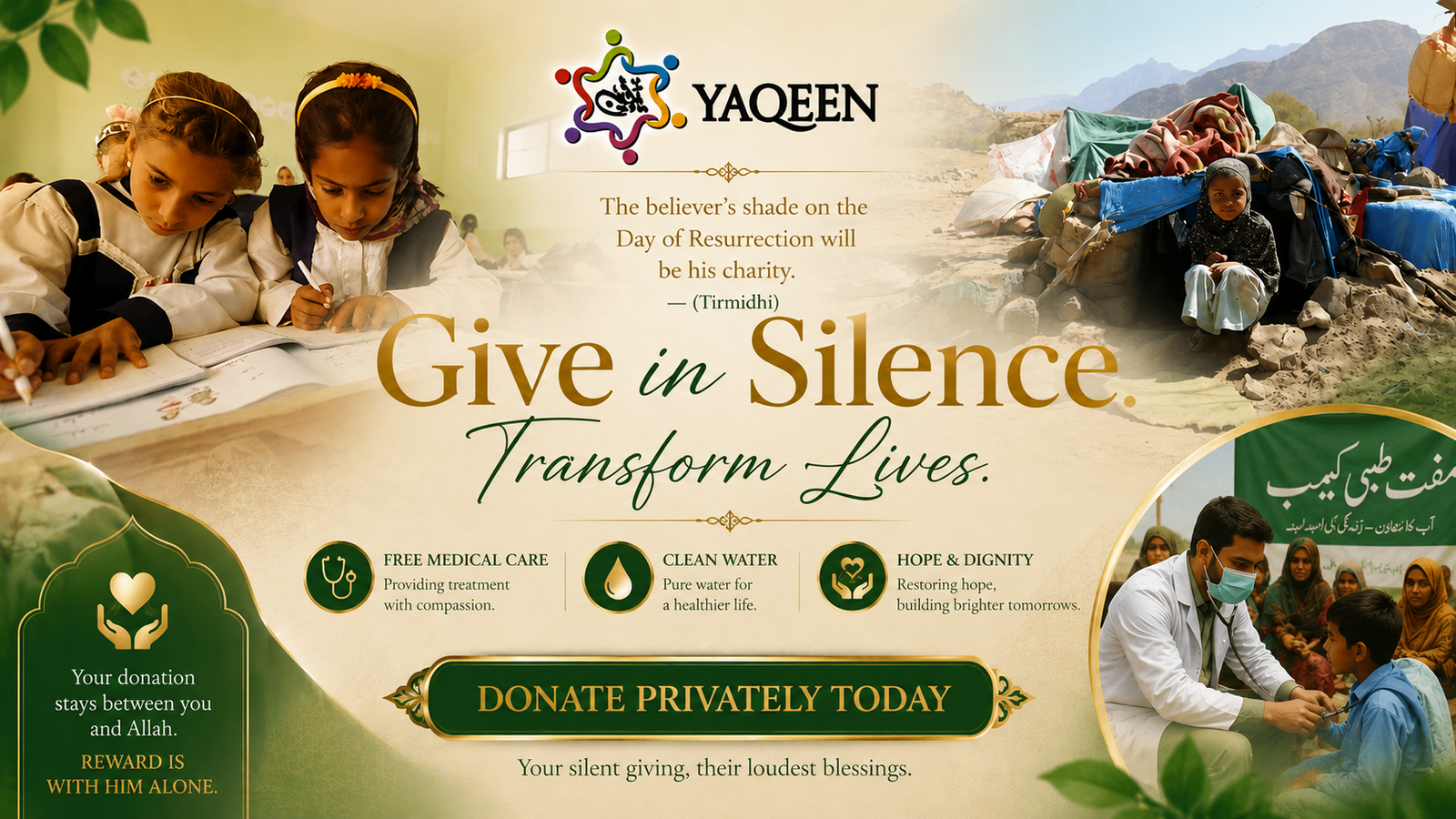
“The believer’s shade on the Day of Resurrection will be his charity.” (Tirmidhi)
That shade will not come labeled with your social media handle. It will not reference the praise of friends. It will simply be there — grown from seeds you planted quietly, in soil only Allah could see.
Give, and let Allah keep the record. He is the best of record-keepers.
FAQs About the Charity Only Allah Sees
Is giving secretly always the superior choice?
In most personal settings, yes — because secrecy better protects sincerity, which is the soul of any act of worship. However, public generosity is not discouraged when the intention is to encourage others, normalize giving within a community, or inspire a culture of charity. The distinction lies entirely in the heart: are you giving to be seen, or giving freely so that others may be moved to give as well?
Can I dedicate a private donation on behalf of someone who has passed away?
Yes. You may give in charity with the intention that its reward reach a deceased parent, friend, or loved one. Allah (SWT) knows both the giver and the one for whom the reward is intended. This form of giving is one of the most beautiful ways to honor those we have lost and maintain a bond of love that transcends death.
Does keeping a donation hidden genuinely increase its spiritual reward?
Islamic scholarship is consistent on this point: the more a deed is concealed from human awareness for the sake of Allah alone, the purer it becomes. And purity of deed is directly tied to the weight it carries on the Day of Judgment. A small act, perfectly sincere, may outweigh a grand one tainted by pride. This is why the charity only Allah sees — even in modest amounts — is so highly regarded.
What if I feel no emotional motivation to give right now?
Give anyway. The scholars teach that action can precede feeling, and that sincerity can be cultivated through practice. Start with even a small amount, given quietly, with the intention of pleasing Allah. The heart often follows the hand.
How is silent charity different from Zakat?
Zakat is an obligatory, calculated portion of wealth that Muslims must pay annually, and its eligible recipients and amount are defined by Islamic law. Silent charity is typically a form of voluntary Sadaqah, given without a fixed amount or public disclosure. For a deeper comparison, read our guide on the difference between Zakat and Sadaqah.
Does Yaqeen Welfare Foundation accept fully anonymous donations?
Yes. Donors can choose not to have their name associated with any public record, report, or acknowledgment. Every contribution, named or anonymous, is tracked internally for accountability and impact reporting, while remaining private from public view.
Get in Touch
Have questions about giving anonymously, our programs, or how your donation is used? Contact Yaqeen Welfare Foundation online — our team is happy to help.