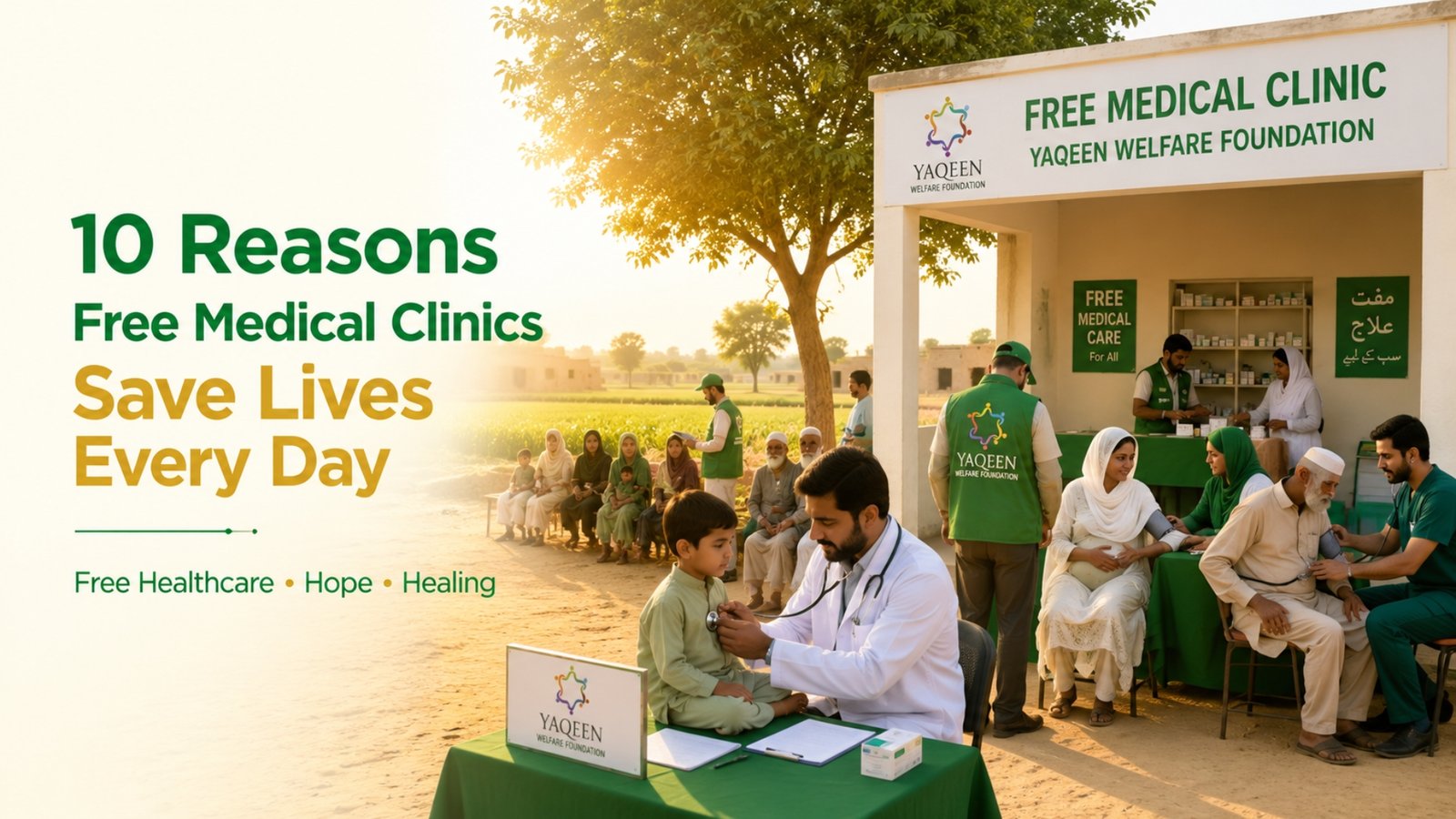
Free medical clinics are often the only barrier standing between a family in rural Pakistan and a health crisis they cannot afford to face alone. For millions of people, the nearest hospital is hours away, the cost of a single consultation is unreachable, and a treatable illness can quietly become fatal simply because no one could get help in time. Free medical clinics change that equation completely — and they do it every single day, in ways that rarely make headlines but that permanently alter the course of a family’s life.
At Yaqeen Welfare Foundation, we operate on the front lines of this reality. Our work providing free medical treatment, clean water, and emergency assistance across Pakistan has shown us firsthand what happens when a community finally gains access to care it never had before. This article walks through ten concrete reasons free medical clinics save lives every day, why that impact matters so much in underserved regions, and how you can be part of keeping that care available.
Why Free Medical Clinics Matter So Much in Pakistan
According to the World Health Organization’s Pakistan country feature, half of Pakistan’s population still lacks access to most essential health services, despite notable progress toward universal health coverage in recent years. Most existing health services remain concentrated in tertiary and secondary hospitals in urban centers, leaving rural communities with little to no nearby infrastructure. Free medical clinics fill precisely this gap, bringing consultations, diagnosis, and medication directly to people who would otherwise go without any care at all.
This is not a small or occasional problem — it is a structural one, and it is exactly why free medical clinics function as lifesaving infrastructure rather than a convenience. Below are ten specific ways they save lives every single day.
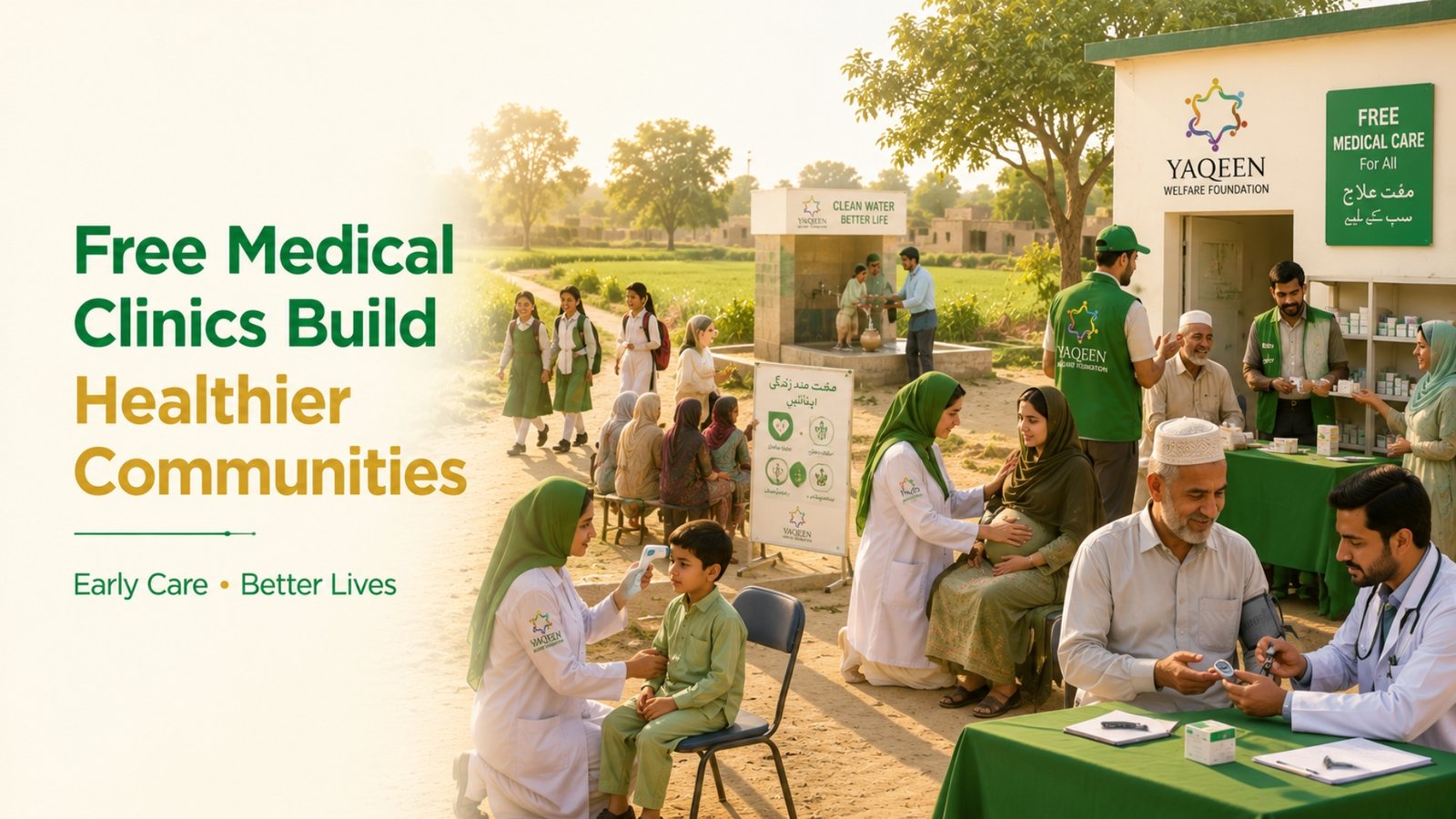
1. Free Medical Clinics Catch Illness Before It Becomes an Emergency
Without regular access to a doctor, minor symptoms often go unchecked until they become life-threatening. A persistent cough becomes advanced tuberculosis. A treatable infection becomes sepsis. Free medical clinics interrupt this pattern by giving people a place to be seen early, when treatment is simplest, cheapest, and most effective. Early detection is consistently one of the most powerful predictors of survival for nearly every serious illness.
2. Free Medical Clinics Provide Care Families Could Never Otherwise Afford
For a family living on a subsistence income, a single doctor’s visit can represent an impossible expense. Free medical clinics remove the financial barrier entirely, meaning the decision to seek care is never weighed against feeding the household that week. This single shift — removing cost as an obstacle — is often the difference between a family seeking help immediately or waiting until a condition becomes critical.
3. Free Medical Clinics Bring Care Closer to Home
In much of rural Pakistan, the nearest hospital can be hours away by foot or unreliable transport. Free medical clinics are typically established directly within or near underserved communities, dramatically shortening the distance between a person and the care they need. For a mother in labor, a child with a high fever, or an elderly patient with chest pain, that shorter distance can be the deciding factor in survival.
4. Free Medical Clinics Manage Chronic Disease Before It Becomes Fatal
Conditions like diabetes, hypertension, and asthma are manageable when treated consistently — but dangerous when left unmonitored. Free medical clinics give patients ongoing access to check-ups and medication refills rather than a single one-time consultation. This continuity of care is what keeps a chronic condition from quietly progressing into organ failure, stroke, or another life-threatening complication.
5. Free Medical Clinics Protect Mothers and Newborns
Maternal and newborn health depends heavily on access to prenatal checkups, safe delivery support, and postnatal care. In areas without nearby hospitals, complications during pregnancy or childbirth can become fatal within hours. According to UNICEF Pakistan, 75% of newborn deaths in the country are caused by three preventable and treatable conditions — complications from premature birth, complications during labour and delivery, and infections such as sepsis and pneumonia. Free medical clinics that offer maternal health services give mothers a far safer path through pregnancy and delivery, directly addressing the leading causes of these preventable deaths.
6. Free Medical Clinics Treat Waterborne and Infectious Disease Outbreaks
Communities without clean water access are especially vulnerable to waterborne illnesses such as diarrhea, typhoid, and hepatitis. Free medical clinics are frequently the first line of response when these outbreaks occur, treating patients quickly enough to prevent an isolated illness from spreading through an entire village. This is one of the reasons clean water initiatives and free medical clinics work so closely together — you can read more about the connection between water access and community health in 5 Reasons a Water Well Is the Best Sadaqah Jariyah.
7. Free Medical Clinics Reduce Preventable Child Mortality
Children are especially vulnerable to conditions that are entirely treatable with timely intervention — malnutrition, respiratory infections, and dehydration among them. Free medical clinics give children in underserved areas a real chance at early diagnosis and treatment, closing a gap that otherwise contributes heavily to preventable childhood deaths. Our related post, 9 Diseases Free Clinics in Pakistan Help Treat Every Day, breaks down several of the specific conditions clinics like ours treat most often.
8. Free Medical Clinics Provide Mental and Emotional Relief, Not Just Physical Care
The presence of a nearby, trustworthy clinic reduces the chronic anxiety that comes with having no safety net. Parents living in constant fear of what would happen if their child fell seriously ill experience real psychological relief once a free medical clinic becomes available nearby. This sense of security allows families to focus on work, education, and daily life rather than living in a persistent state of health-related crisis.
9. Free Medical Clinics Multiply the Impact of Every Other Form of Aid
Clean water, food assistance, and shelter support all work better when paired with accessible healthcare. A family that receives clean water but has no way to treat an illness that emerges is still vulnerable. Free medical clinics act as the connective layer that allows every other form of assistance to actually translate into a healthier, more stable life. You can see how these different forms of aid intersect in real family stories shared in Your Charity Saved Lives: 8 Heartwarming Stories and One Meal, One Prayer: 5 Incredible Reasons One Life Changed Forever.
10. Free Medical Clinics Are Sustained by Community Support, Including Zakat and Sadaqah
Free medical clinics do not run on hope alone — they run on consistent donations, including Zakat and Sadaqah from people who understand the weight of their impact. Every contribution funds staff salaries, medication, equipment, and the daily operations that keep a clinic’s doors open. Understanding the distinction between these two forms of giving can help you decide how best to support ongoing clinic operations; our post Sadaqah vs. Zakat: 6 Key Differences Every Muslim Should Know explains exactly how each type of giving works and where it can be directed.
The Real Impact of Free Medical Clinics: By the Numbers
The table below illustrates how access to a free medical clinic changes outcomes for a typical underserved family compared to having no nearby healthcare access at all.
| Health Factor | Without a Nearby Free Medical Clinic | With Access to a Free Medical Clinic |
|---|---|---|
| Time to treatment for illness | Often delayed by days or weeks due to cost/distance | Same-day or next-day consultation |
| Chronic disease management | Irregular or nonexistent monitoring | Ongoing check-ups and medication access |
| Maternal health outcomes | Higher risk during pregnancy and delivery | Prenatal and postnatal support available |
| Financial burden of illness | Can consume a family’s entire monthly income | Removed entirely through free treatment |
| Outbreak response time | Slow, allowing illness to spread | Rapid, containing illness locally |
How Yaqeen Health Clinic Puts This Into Practice
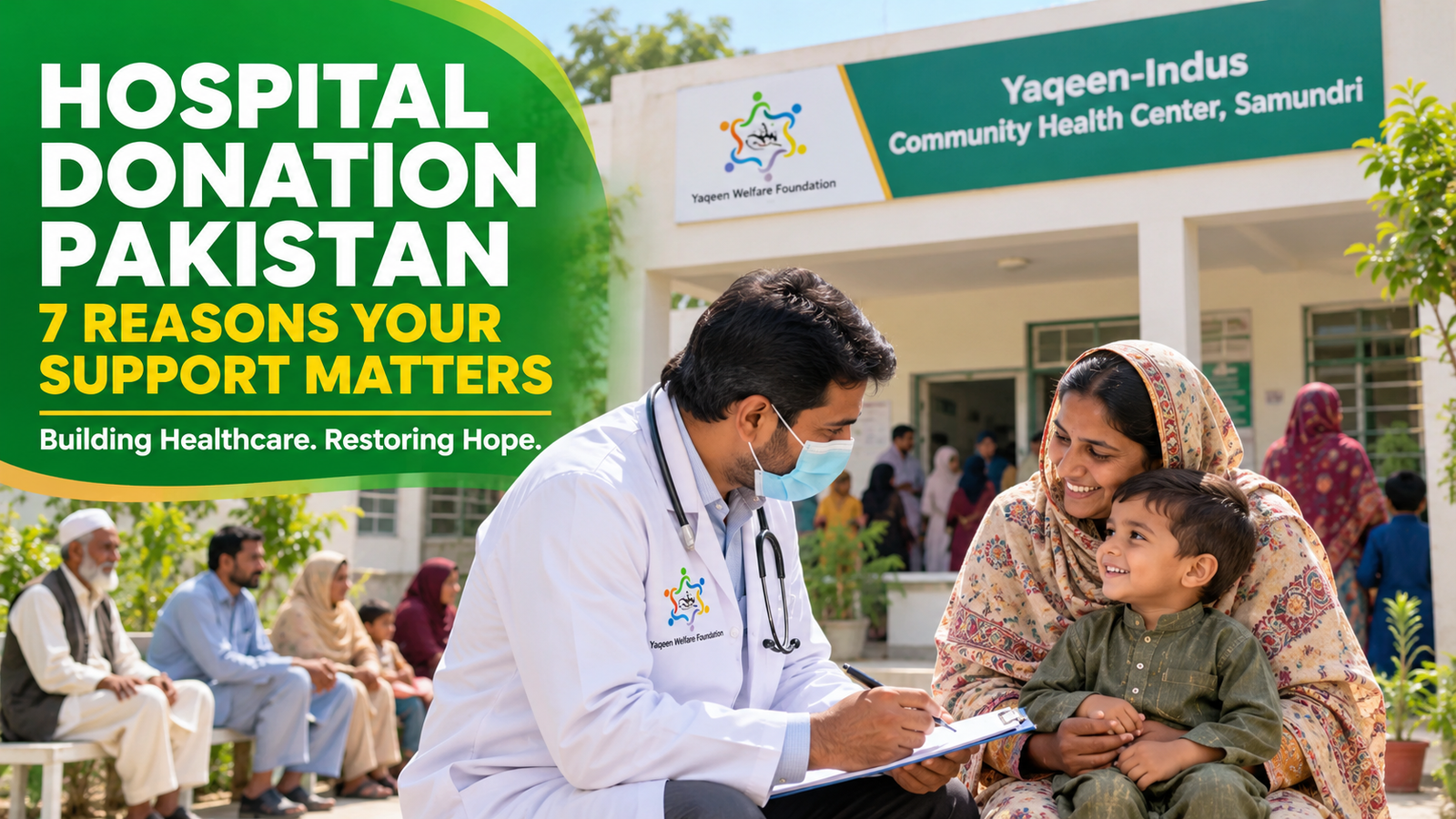
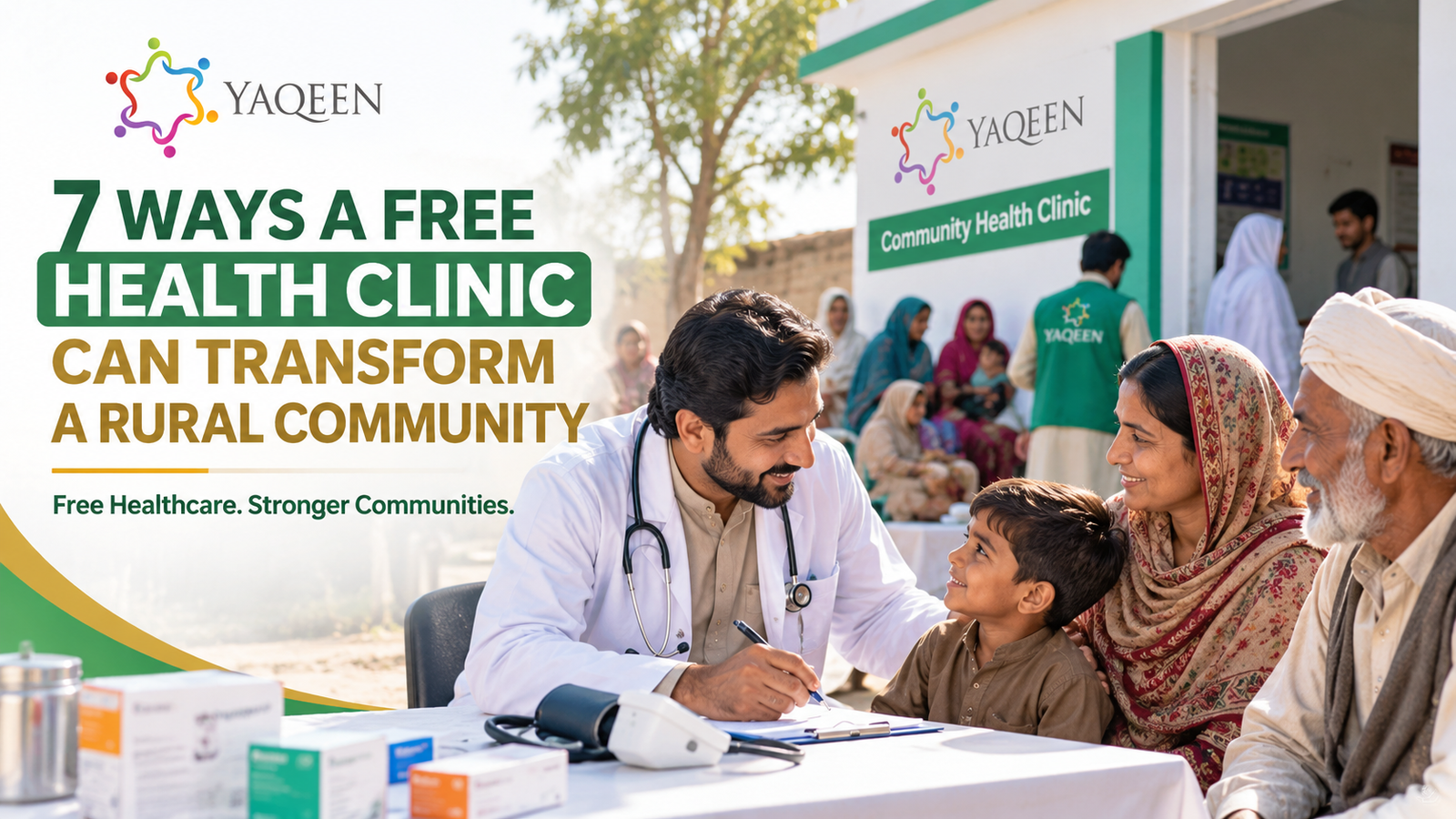
At the Yaqeen Health Clinic, this ten-point impact isn’t theoretical — it is the daily reality for the patients we serve. Every consultation, diagnosis, and medication provided at no cost is made possible by donors who understand that free medical clinics are not a luxury service but a survival mechanism for communities with no other option. Patients arrive with conditions ranging from routine check-ups to serious chronic illness, and every one of them leaves with care they could not otherwise have accessed.
This is the same model referenced by global health authorities working to close Pakistan’s healthcare access gap — the WHO’s ongoing work to advance universal health coverage in Pakistan highlights exactly the kind of primary care expansion that free medical clinics like ours provide at the community level.
What Makes a Free Medical Clinic Effective
Not every clinic delivers the same level of impact, and understanding what separates an effective free medical clinic from one that struggles to sustain itself helps explain why consistent funding matters so much. Effective free medical clinics tend to share several characteristics:
- Reliable staffing, including qualified doctors and support staff who are present consistently rather than intermittently.
- A stocked pharmacy, so a diagnosis can be followed immediately by treatment rather than a prescription the patient cannot afford to fill elsewhere.
- Community trust, built over time through consistent, respectful, and judgment-free care.
- Integration with other services, such as clean water access and nutritional support, which compound the clinic’s overall health impact.
- Transparent funding, so donors and the community alike can see exactly how contributions are being used.
Free medical clinics that meet these standards do not just treat isolated symptoms — they become a dependable part of a community’s infrastructure, the same way a school or a water source does. This is the model Yaqeen Health Clinic has worked to build: a place patients can return to again and again, knowing the same standard of care will be there each time.
The Long-Term Ripple Effect of Free Medical Clinics on a Community
The impact of a free medical clinic rarely stops with a single patient. When a parent recovers from an illness that would have otherwise gone untreated, they are able to keep working and providing for their household. When a child receives treatment for a preventable disease, they are able to stay in school instead of missing weeks of education while sick or caring for a sick relative. When a mother receives safe prenatal care, an entire family’s trajectory shifts, because the risk of losing a parent or newborn drops dramatically.
Multiply this across hundreds of patients a month, and a free medical clinic becomes something larger than a single building offering treatment — it becomes a stabilizing force for an entire region. Communities with reliable access to healthcare see reduced rates of preventable death, fewer families pushed into poverty by medical costs, and a measurable increase in overall quality of life. This ripple effect is precisely why organizations focused on long-term community development, including Yaqeen Welfare Foundation, treat free medical clinics as a foundational priority rather than a secondary program.
It is also why free medical clinics pair so effectively with other forms of sustained giving. A well that provides clean water reduces the illnesses a clinic has to treat in the first place; a clinic that treats illness quickly prevents a family from falling into the kind of financial hardship that undermines everything else. Each service reinforces the other, and Zakat or Sadaqah directed toward any one of them strengthens the whole system.
Why Supporting Free Medical Clinics Deserves Your Attention
It is easy to overlook how much difference a single clinic visit can make when you have never had to live without one. But for the families free medical clinics serve, that single visit can mean the difference between a manageable illness and a life-altering one — or, in the most serious cases, the difference between life and death. Every donation, whether Zakat, Sadaqah, or a general contribution, keeps clinic doors open for one more patient who has nowhere else to turn.
If you have ever wondered whether your giving truly changes anything, the story of free medical clinics answers that question clearly: yes, every single day, in ways that are quiet, consistent, and profoundly real. A single donation may feel small when measured against the scale of need across Pakistan, but to the one family whose child is treated because of it, that donation is everything.
Frequently Asked Questions About Free Medical Clinics
What services do free medical clinics typically offer? Most free medical clinics offer general consultations, diagnosis, basic diagnostic testing, medication, maternal health support, and treatment for common illnesses such as respiratory infections, waterborne disease, and chronic conditions like diabetes and hypertension.
Who is eligible to receive care at a free medical clinic? Free medical clinics generally serve anyone in the surrounding community who cannot otherwise afford healthcare, with priority often given to the most vulnerable, including children, pregnant women, and the elderly.
How are free medical clinics funded? Free medical clinics are typically funded through donations, including Zakat, Sadaqah, and general charitable contributions, which cover staffing, medication, equipment, and daily operational costs.
Can Zakat be used to fund a free medical clinic? Yes. Zakat can be directed toward organizations that provide healthcare and relief to those in need, provided the funds reach eligible recipients as defined in Islamic law. Many donors use tools like the Yaqeen Zakat Calculator or the Yaqeen Fitrana Calculator to calculate their obligation before giving.
Why are free medical clinics especially important in rural Pakistan? Rural areas often lack nearby hospitals, and half of Pakistan’s population still lacks access to most essential health services according to the World Health Organization. Free medical clinics close this gap by bringing care directly into underserved communities.
How can I support a free medical clinic? You can support ongoing clinic operations through direct donations, Zakat, or Sadaqah contributions. Every donation helps fund consultations, medication, and equipment that keep clinics running for the families who depend on them.
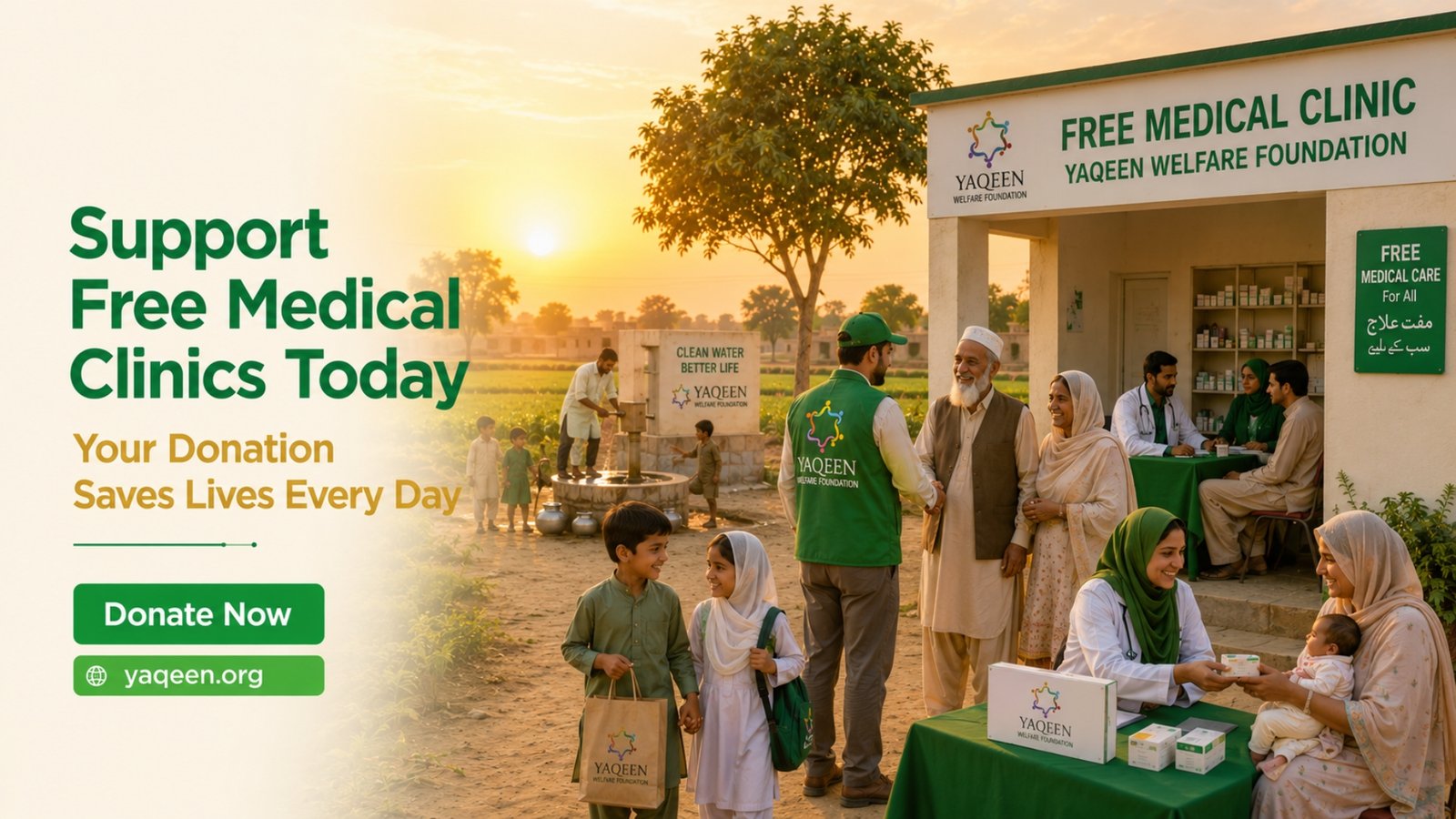
Help Keep Free Medical Clinics Open
Every patient treated at a free medical clinic represents a life that could have gone a very different direction without access to care. Your support keeps that possibility alive for the next family who walks through the door.
📩 Contact Yaqeen Welfare Foundation online with any questions about our clinics or how your donation is used, or visit our Donate page to support free medical treatment, clean water, and emergency relief for families across Pakistan.