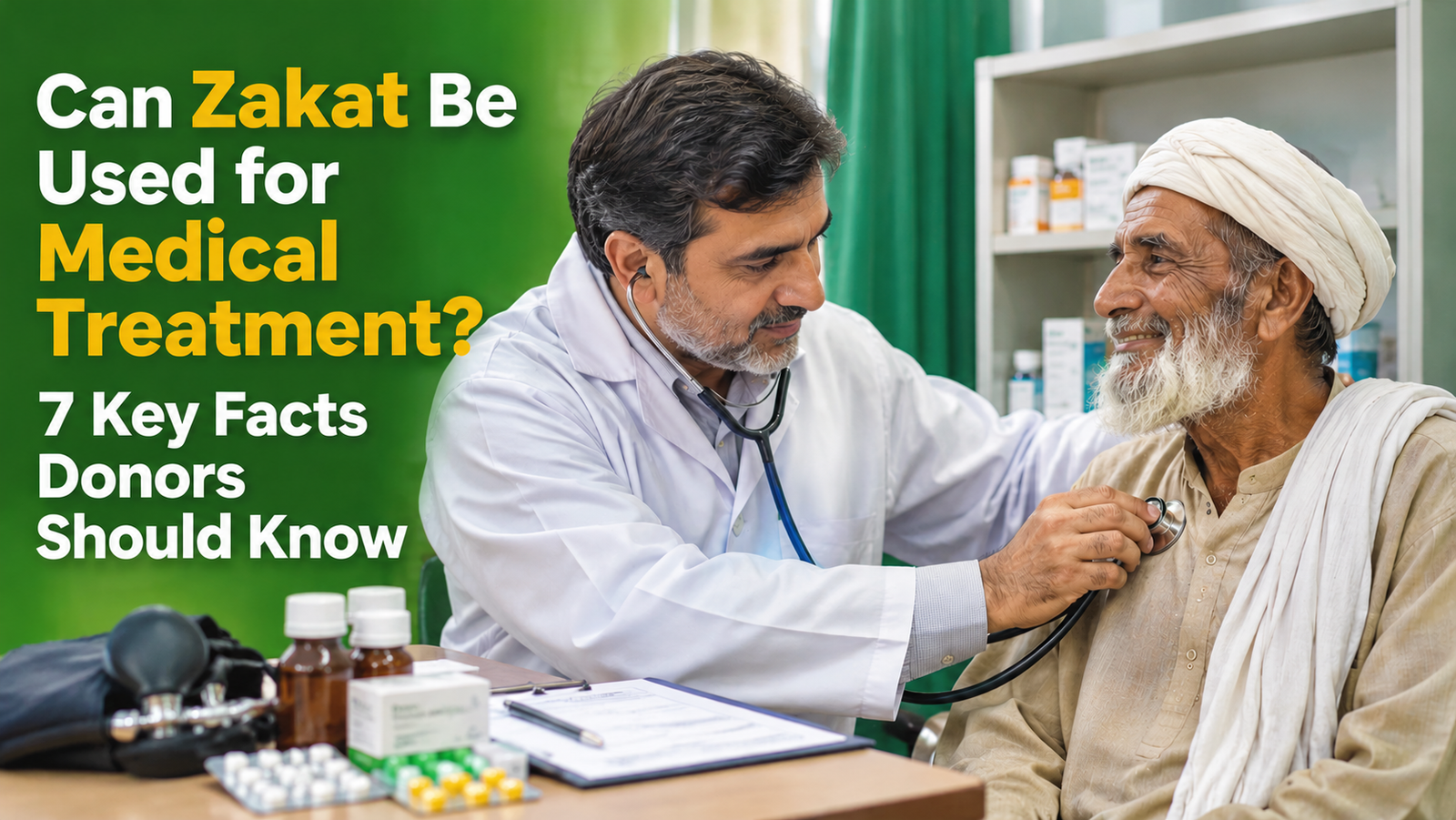
Can Zakat Be Used for Medical Treatment? 7 Key Facts Donors Should Know
Can Zakat be used for medical treatment? It is one of the most common questions donors ask before giving, and the answer matters because Zakat is not ordinary charity. It is a religious obligation with defined recipients and conditions. The short answer is that Zakat can help pay for medical care when the patient is eligible to receive Zakat, usually as a poor or needy person who cannot afford necessary treatment. The patient’s financial situation decides the matter, not the type of illness.
This guide explains the principle behind that answer, the situations where Zakat healthcare support is generally accepted, the situations where scholars urge caution, and why verifying every recipient protects both the donor and the patient. At Yaqeen Welfare Foundation, our aim is to provide free medical treatment, clean water and various types of assistance to the people of Pakistan, and we believe donors deserve clear, careful information before they give.
This article is for general education and is not a religious ruling (fatwa). For your own circumstances, please consult a qualified scholar.
Can Zakat Be Used for Medical Treatment? The Short Answer
Yes, with an important condition. Zakat may be given to a person who qualifies under one of the eight categories named in the Quran (Surah At-Tawbah, 9:60). Two of those categories, al-fuqara (the poor) and al-masakin (the needy), are the ones most relevant to patients. If a patient cannot meet basic needs and cannot afford the care they require, they may be a rightful recipient, and Zakat can be used to meet their treatment costs.
The National Zakat Foundation’s guide to who receives Zakat explains each of the eight categories in plain language. Notice that illness is not itself a Zakat category. A wealthy patient who can easily pay for treatment is not eligible simply because he or she is ill. A poor patient who cannot afford a prescription may be eligible because of poverty, with illness being the reason that poverty becomes urgent.
This is the central idea behind the question “can Zakat be used for medical treatment”: need creates eligibility, and treatment is the way the need is met.
Why Medical Need Is So Often Linked to Poverty
Healthcare is one of the biggest drivers of poverty in low-income households. A single illness can mean lost wages, repeated travel, tests, medicines and sometimes hospital stays. Families who have no savings often borrow, sell assets or delay care until a condition becomes an emergency. By then, it is more dangerous and more expensive to treat.
In Pakistan, many rural families live far from clinics and cannot afford regular visits even when a clinic exists. Chronic conditions such as diabetes, high blood pressure and high cholesterol need ongoing care, and a missed month of medicine can undo months of progress. That is why Zakat healthcare programs often focus on follow-up care, medicine, diagnostics and vaccinations, not just single emergency visits.
You can see how this plays out in our posts Free Medical Treatment in Pakistan 2026 Guide and Free Medicine in Pakistan: 9 Reasons It Saves Families.
7 Key Facts About Zakat Medical Treatment
1. Eligibility Is Based on the Patient’s Financial Situation
The first question for any Zakat-funded patient is whether they are poor or needy under Islamic guidelines. A responsible assessment looks at household income, assets, dependents, debts and the cost of care. It does not rely on appearance, assumptions or a claim that someone is “in need.” Reputable hospitals and clinics in Pakistan use welfare officers to carry out this assessment, and the Indus Hospital & Health Network’s FAQ explains that patients go through an assessment with a welfare officer to determine their eligibility.
2. Zakat Can Support Different Kinds of Care
When the recipient is eligible, Zakat can generally be applied to the real costs of care. For a qualifying patient, these may include:
- Check-ups and consultations with a doctor
- Treatment for acute and chronic conditions
- Medicines and ongoing prescriptions
- Diagnostics, such as laboratory tests and imaging
- Immunizations for infants, toddlers and others who qualify
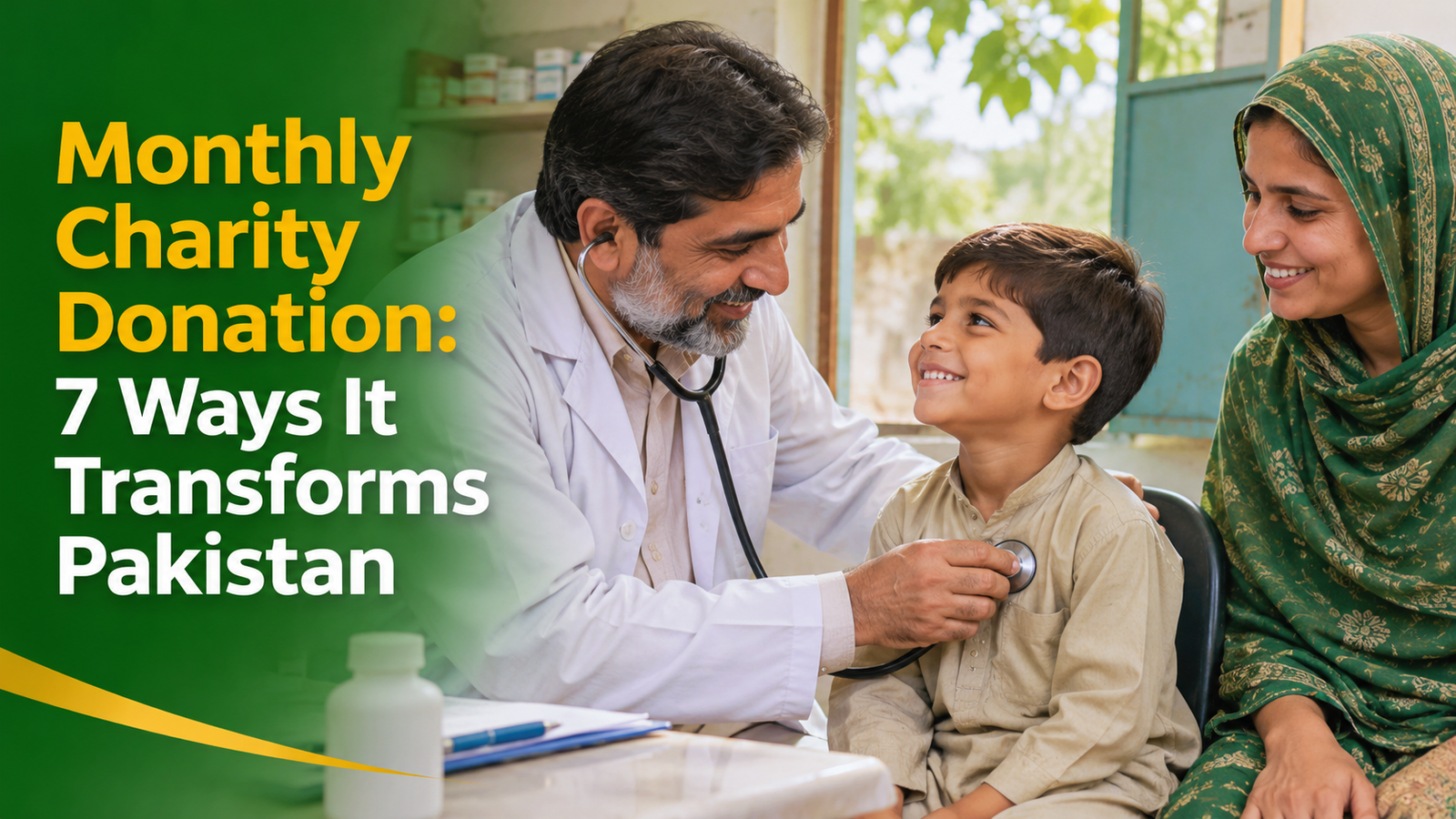
This is the model many charitable clinics follow. For example, Yaqeen’s public campaign describes follow-up care for diabetes, hypertension and hyperlipidemia, free medication as needed, and immunizations and vaccinations for infants and toddlers at the health clinic being developed with Indus Hospital, as shown on the Yaqeen campaign page on GoFundMe.
3. A Clinic Often Acts as Your Agent
Many donors cannot meet each patient personally, so they give through a clinic or charity. A Hanafi fatwa from Darul Iftaa explains that, in this arrangement, the clinic acts as your agent (wakeel) to deliver your Zakat to the poor and needy. In plain terms, you are trusting the clinic to give your Zakat only to eligible people. That is why a donor should ask how a clinic decides who qualifies.
4. Not Every Medical Cost Is Treated the Same Way
Scholars distinguish between giving Zakat to a poor patient and using Zakat for general operations. Paying for a poor patient’s medicine is widely accepted. Using Zakat to pay for buildings, equipment, administration or the treatment of patients who are not eligible is more debated, and many organizations fund those costs from Sadaqah and general donations instead. If you want your Zakat to be used in the most careful way, choose an organization that separates the two funds clearly.
5. Wealthy Patients Are Not Eligible Just Because They Are Sick
Illness does not change the rule that a Zakat recipient must be poor or needy, or fall under another named category. This is why a good program will offer subsidized or free treatment to eligible patients and charge other patients through ordinary channels.
6. Verification Protects Everyone
Verification is not a barrier. It is a safeguard. Without it, Zakat could reach people who are not eligible, and the donor’s obligation may not be fulfilled as intended. We cover this in detail below.
7. Records and Transparency Build Trust
A trustworthy organization can explain its process, show leadership and answer questions. You can meet the people behind Yaqeen on our Board Members page and read our Mission & Vision.
Who Is an Eligible Patient? A Quick Reference Table
The table below gives a general guide to how common situations may relate to Zakat medical treatment. It is a simplified summary, not a ruling, so please consult a scholar and the organization you give through.
| Patient Situation | May Be Zakat-Eligible? | Reason |
|---|---|---|
| Low-income parent who cannot afford diabetes medicine | Often yes | Likely poor or needy, and treatment is essential |
| Child from a poor household needing vaccinations | Often yes | Household cannot afford preventive care |
| Patient with savings or income that easily covers treatment | Generally no | Not in financial need |
| Patient who has taken heavy loans for hospital bills | Possibly yes | May also fall under those in debt |
| Wealthy patient with a serious illness | No | Illness alone does not create eligibility |
| Your own spouse or child whom you must support | No | You are responsible for their maintenance |
| Poor widow caring for children who needs a check-up | Often yes | May be poor or needy; see Zakat for Widows guidance for details |
In the last row, replace “#” with the URL of your Zakat for Widows article once it is published.
Why Proper Recipient Verification Matters
When people ask whether Zakat can be used for medical treatment, the practical follow-up is almost always “how do we know the patient is genuinely eligible?” Verification answers that question, and it matters for several reasons.
It protects the donor’s obligation. Zakat is a trust. If it is given to someone who is not eligible, the donor may need to give it again, according to many scholars. A clear process reduces that risk.
It protects genuine patients. Funds are limited. Every rupee that goes to someone who does not need it is a rupee that does not reach a patient who does.
It protects dignity. Good verification is private and respectful. A trained welfare officer can assess need without making patients feel exposed, which is much better than asking people to prove poverty in public.
It prevents misuse. Clear records, written criteria and independent review make it harder for funds to be misdirected. For example, The Patients’ Behbud Society for the Aga Khan University Hospital publishes Zakat eligibility criteria and describes the kinds of care provided to eligible patients, which shows what transparent practice can look like.
What a Good Verification Process Looks Like
When you look at any charity that offers Zakat healthcare, check for these features:
- Written eligibility criteria that explain who qualifies.
- A trained person (such as a welfare officer) who assesses cases.
- Documentation, kept confidentially, of how decisions were made.
- Separation of funds, so Zakat is tracked apart from other donations.
- A way for donors to ask questions and get clear answers.
- Scholarly guidance, so that practices match Islamic rules.
Yaqeen’s approach, as described on our Yaqeen Health Clinic page, includes eligibility checks so that Zakat supports qualifying patients with check-ups, treatment, medicines, diagnostics and immunizations. If you want to understand the details of how your gift is handled, you are welcome to ask the team directly.
Zakat Healthcare in Pakistan: Why It Matters
For many families, the choice is stark: pay for medicine or pay for food. That is why a medical Zakat donation can have such a large effect. When a poor patient can see a doctor and receive the medicine they need, the whole household benefits. A parent can return to work, a child can return to school and the family avoids falling into debt.
Preventive care adds even more value. Vaccinations protect babies and toddlers from serious disease, while follow-up care for chronic conditions prevents complications that are much harder and more expensive to treat later. Spending on prevention and early treatment is often the most effective use of limited funds.
Yaqeen’s work in healthcare connects to its wider mission to help heal, educate and house families in need. You can read about that commitment on our Help Heal page. For donors who want to see how hospital support works, Hospital Donation Pakistan: 7 Reasons Your Gift Saves Lives goes into more depth.
How to Give a Medical Zakat Donation Responsibly
If you have decided to give Zakat for medical treatment, these steps will help you do it with confidence.
- Calculate your Zakat. Work out your wealth, subtract eligible debts and check the nisab. Use our Zakat Calculator for an estimate, and the Fitrana Calculator at Ramadan.
- Choose a reliable organization. Read Zakat Accepting Organizations in Pakistan 2026 and Best Charity in Pakistan for Healthcare in 2026 to learn what to look for.
- Ask about eligibility checks. Find out how patients are assessed and who makes the decision.
- Confirm Zakat handling. Ask whether Zakat is kept separate and which services it supports.
- Give on time. Do not delay without a good reason, since patients may be waiting for care.
- Keep your receipt. Record your gift and the date.
- Consider your tax position. US donors may also want to explore the Donor Advised Fund for Charity in USA: 2026 Guide and speak with a tax adviser.
When you are ready, you can give through our donation page.
Zakat and Sadaqah in Healthcare: What Is the Difference?
Zakat and Sadaqah can both support healthcare, but they work differently.
| Feature | Zakat | Sadaqah |
|---|---|---|
| Nature | Obligatory for those above the nisab | Voluntary |
| Who can receive it | The eight categories in the Quran | Anyone in need, and many causes |
| Amount | Calculated from your wealth | Any amount, any time |
| Typical medical use | Care for eligible poor patients | Any healthcare costs, equipment, staff and operations |
| Verification | Strongly important | Flexible |
Because of this difference, many donors give Zakat to directly support eligible patients and give Sadaqah to strengthen the organization’s operations. That way, both are used in the way that suits them best.
Frequently Asked Questions About Using Zakat for Medical Treatment
Can Zakat be used for medical treatment?
Yes, when the patient is an eligible Zakat recipient, usually as a poor or needy person who cannot afford necessary care. The patient’s financial situation determines eligibility, not the illness itself. Always confirm the rules with a scholar and the organization you give through.
Can Zakat pay for a patient’s medicine and tests?
Many scholars accept that Zakat can pay for the medicine, diagnostics and treatment of eligible poor patients. Charitable clinics often act as the donor’s agent in delivering this support. Ask the clinic how it verifies patients.
Can Zakat be used to build or equip a hospital?
This is more debated. Many scholars say Zakat should go directly to eligible people, and they advise funding buildings, equipment and administration from Sadaqah or general donations. If you want to be careful, give your Zakat to a program that supports individual eligible patients and use Sadaqah for infrastructure.
Can I give Zakat for a relative’s medical bills?
You can give to needy relatives who are eligible, but you cannot give Zakat to people you are obliged to support, such as your spouse and children, and in many views your parents. Scholars may differ on details, so ask a trusted scholar.
Why does a charity verify patients before giving Zakat?
Verification confirms that the patient is truly eligible. It protects your Zakat obligation, ensures funds reach those in need and treats patients with dignity.
Is a medical Zakat donation tax-deductible in the USA?
Tax rules depend on the organization and your own situation. A public campaign notes that donations to Yaqeen are typically tax-deductible in the US, but you should confirm with a tax adviser and keep your receipt.
How can I be sure my Zakat reaches eligible patients?
Choose an organization that explains its criteria, separates Zakat funds, answers questions and has visible leadership. You can also look up public information, such as the foundation’s GuideStar profile.
Contact Yaqeen Welfare Foundation
Have a question about Zakat for medical treatment, how patients are verified or which programs your Zakat supports? Please reach out.
- Contact online: Email our team at info@yaqeen.org
- Support: support@yaqeen.org
- Donate online: yaqeen.org/donate
Giving Zakat for Healthcare With Confidence
So, can Zakat be used for medical treatment? Yes, when it reaches eligible poor and needy patients through a process that is careful and transparent. The principle is simple: Zakat follows need, and healthcare is one of the most urgent needs a poor family can face. Medicine, check-ups, diagnostics and vaccinations can change the course of a life, and Zakat can make that possible for people who would otherwise go without.
What makes the difference is how the gift is handled. Look for clear eligibility checks, honest answers and good records. Donate your Zakat with Yaqeen Welfare Foundation and help bring free medical care to families across Pakistan.