The 7 Blessings of Helping a stranger for the sake of Allah represent one of the most profound acts a Muslim can perform — a deed witnessed fully only by the One who sees all things. When you reach out to someone you have never met and will never meet again, with no expectation of gratitude or recognition, you place your trust entirely in Allah. And Allah, as the Prophet ﷺ assured us, never leaves such trust unrewarded.
At Yaqeen Welfare Foundation, we carry your giving to families across Pakistan — families you will never meet, in cities you may never visit. Every donation, however small, becomes an act of helping a stranger for the sake of Allah alone. This article explores the spiritual weight and divine rewards behind that act, drawing directly from the Quran and the Sunnah of the Prophet ﷺ.
What Does It Mean to Help a Stranger for the Sake of Allah?
To help someone “for the sake of Allah” (fi sabilillah) means your intention is directed purely toward pleasing Allah — not gaining praise from others, not building a social reputation, and not even witnessing the outcome of your generosity. The stranger you help does not know your name. They do not know what it cost you — whether you gave from abundance or from the little that remained. Yet Allah knows all of it: every hesitation, every sacrifice, every silent intention held within the heart.
This kind of giving stands apart from ordinary charity. It is charity at its most sincere because the human scaffolding of reward — gratitude, recognition, reciprocity — has been entirely removed. What remains is the act, the intention, and Allah.
The Quran speaks directly to this quality of giving:
“Those who spend their wealth in the way of Allah and do not follow up what they have spent with reminders of it or hurt, they will have their reward with their Lord, and there will be no fear concerning them, nor will they grieve.” (Surah Al-Baqarah, 2:262)
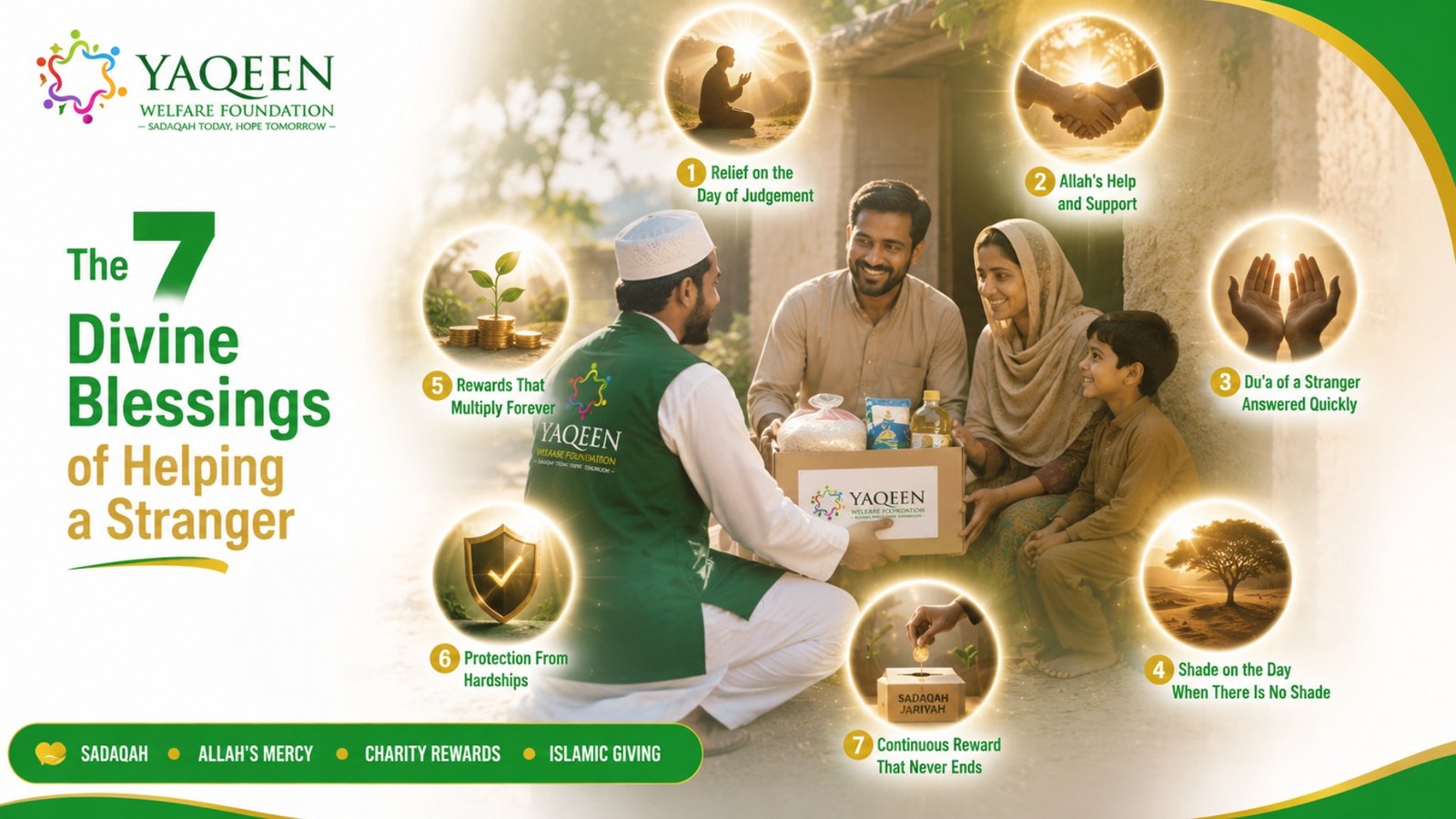
The 7 Blessings of Helping a Stranger for the Sake of Allah
Blessing 1: Allah Relieves Your Burden on the Day of Judgement
The first and most extraordinary of the 7 Blessings of Helping is a divine promise of relief when it matters most. The Prophet Muhammad ﷺ said:
“Whoever relieves a Muslim of a burden from the burdens of the world, Allah will relieve him of a burden from the burdens on the Day of Judgement.” (Sahih Muslim)
When you carry someone else’s hardship — even partially, even for a moment — Allah carries yours on the Day when no human helper can reach you. The stranger you fed, clothed, or supported in this world becomes, through the mercy of Allah, a source of relief for you in the next. This transaction cannot be replicated by any act done purely for human reward.
Blessing 2: Allah Becomes Your Aid as Long as You Aid Others
Among the most beautiful of the 7 Blessings of Helping is the continuous divine support that follows a generous heart. The Prophet ﷺ said:
“Allah is in the aid of His servant as long as His servant is in the aid of his brother.” (Sahih Muslim)
This is not a one-time reward but an ongoing state. The moment you turn toward a stranger in their need, something turns toward you. Allah’s help surrounds you in proportion to your willingness to help others. Those who give consistently — through monthly charity, regular food support, or sustained welfare programmes — live continuously within this promise.
At Yaqeen Welfare Foundation, our Ongoing Family Food Support programme embodies exactly this principle: consistent help, month after month, for families where poverty is not a crisis but a permanent condition.
Blessing 3: The Du’a of a Stranger Is Among the Swiftest to Be Answered
When a person in genuine need lifts their hands and makes du’a — for their children, for themselves, and for the stranger who helped them — the scholars of Islam noted that such a supplication carries special weight. The Prophet ﷺ confirmed:
“The supplication of the oppressed is not veiled from Allah, even if the person is a sinner.” (Tirmidhi)
The stranger you help does not know your name. But their du’a carries you within it — unnamed, unrecognised by any human, yet known to Allah in complete detail. Every prayer they make for “the one who helped me” reaches the One who knows precisely who that is. You receive a share of every word.
This is the invisible dimension of charitable giving that human accounting cannot measure — and it is one of the most powerful of all the 7 Blessings of Helping.
Blessing 4: Shade on the Day When There Is No Shade But Allah’s
The Prophet ﷺ described seven categories of people who will be shaded by Allah on the Day of Judgement — a day so intense that the sun will be brought close to mankind. Among them:
“A man who gives in charity so secretly that his left hand does not know what his right hand has given.” (Sahih Bukhari)
Helping a stranger is, by its very nature, secret giving. The stranger cannot publicise your generosity. They cannot name you in praise. They received your giving and walked on — and you walked on too. The act was between you and Allah alone. And that shade, on the Day when every other form of comfort will be stripped away, is the return of an act that no one else witnessed.
Blessing 5: Your Sadaqah Returns to You Multiplied
The Quran uses one of its most vivid images to describe what happens to wealth given in the way of Allah:
“The example of those who spend their wealth in the way of Allah is like a seed of grain which grows seven spikes; in each spike is a hundred grains. And Allah multiplies for whom He wills.” (Surah Al-Baqarah, 2:261)
A single seed — one act, one donation — does not simply disappear. It multiplies in ways invisible to the giver: in the life of the stranger, in the du’a that rises, in the mercy that returns. The multiplication is not always financial; it comes in health, in ease, in blessings within the family, in protection from difficulty, and ultimately in reward on the Day of Judgement. This is among the most tangible of the 7 Blessings of Helping.
You can learn more about how your giving is multiplied through Islamic charity in our article on Sadaqah Jariyah: 5 Forms of Forgotten Charity Allah Never Forgets.
Blessing 6: Charity Protects Against Calamity and Disease
The scholars of Islam have long cited a famous principle derived from prophetic teaching: “Give Sadaqah, for it wards off calamity.” The Prophet ﷺ is reported to have said:
“Treat your sick with charity.” (Abu Dawud)
Sadaqah — voluntary giving — is understood in Islamic tradition not merely as a transfer of wealth but as a spiritual shield. It moves between the giver and harm in ways that cannot be measured by human observation. Families across Pakistan who have been supported through Yaqeen Welfare Foundation’s free medical services and food programmes know this reality from the other side — but the giver too receives this protection as one of the 7 Blessings of Helping.
For more on how charitable giving and healthcare connect in Islam, read our piece on Free Healthcare: 10 Reasons for Donation in Pakistan.
Blessing 7: A Legacy That Outlives the Act
The final of the 7 Blessings of Helping is perhaps the most enduring. When you provide clean water to a community that had none, or food to a family that would otherwise go without, or medical treatment to someone who could not afford it — the effects of that act ripple forward beyond the moment of giving.
The child who is fed grows and learns. The mother who receives support raises her family with greater stability. The community served by a clean water source becomes healthier, more productive, and more able to care for one another. Your act — completed and forgotten — continues to move through the world long after you have walked away.
The Prophet ﷺ said:
“When a person dies, all their deeds end except three: a continuing charity (Sadaqah Jariyah), knowledge that others benefit from, or a righteous child who prays for them.” (Sahih Muslim)
Giving to strangers, especially when it enables ongoing wellbeing, becomes a Sadaqah Jariyah — a charity that continues to earn reward even after you are gone.
Read more about the power of lasting charity in our blog: 1 Drop Clean Water Donation – A Sea of Reward.
A Comparison: Types of Charity and Their Blessings
The table below summarises the spiritual dimensions of different forms of giving in Islam, showing why giving to a stranger — anonymously, without expectation — holds such particular weight.
| Type of Giving | Recognition Possible? | Du’a From Recipient | Shade on Judgement Day | Sadaqah Jariyah Potential |
|---|---|---|---|---|
| Giving to a family member | Yes — by name | Yes — personal | Possible | Possible |
| Giving to a known neighbour | Yes — by name | Yes — personal | Possible | Possible |
| Public charity with name attached | Yes — publicly | May include praise | Less likely (riya risk) | Possible |
| Anonymous giving to a stranger | No | Yes — general du’a for the helper | High (secret charity) | High |
| Giving through a welfare organisation to unknown families | No | Yes — on behalf of those helped | High | High — ongoing impact |
This comparison shows that the 7 Blessings of Helping are most fully activated when giving is anonymous, consistent, and directed toward those in genuine need — precisely the model that Yaqeen Welfare Foundation operates on.
What Passes Between You and Someone You Will Never Know
There is a moment that happens in every act of helping a stranger that no human eye captures in full. A donation is made. Money moves from one hand to an organisation, which carries it to a family. A parcel of food is placed on a table. A child eats a meal they would not otherwise have had. A mother makes du’a — not knowing the name of the person who helped her, but knowing that someone, somewhere, chose to help.
In that du’a, the stranger and the giver are briefly connected across every distance — geographical, cultural, linguistic — by a thread that runs through the mercy of Allah. The giver does not know about the du’a. The receiver does not know about the giver. But Allah holds both ends of the thread.
This is what makes helping a stranger for the sake of Allah one of the most complete acts of worship a Muslim can perform. It is a deed that requires nothing from the recipient except that they exist in need — and nothing from the giver except the intention to help for the sake of Allah alone.
How the 7 Blessings of Helping Come Alive Through Yaqeen Welfare Foundation
Every programme at Yaqeen Welfare Foundation is built around the stranger — the family you will not meet, the child whose name you will not learn, the mother whose du’a you will never hear. We carry your giving to them so that the act of helping a stranger remains exactly that: sincere, anonymous, and for the sake of Allah.
Emergency Food Parcels
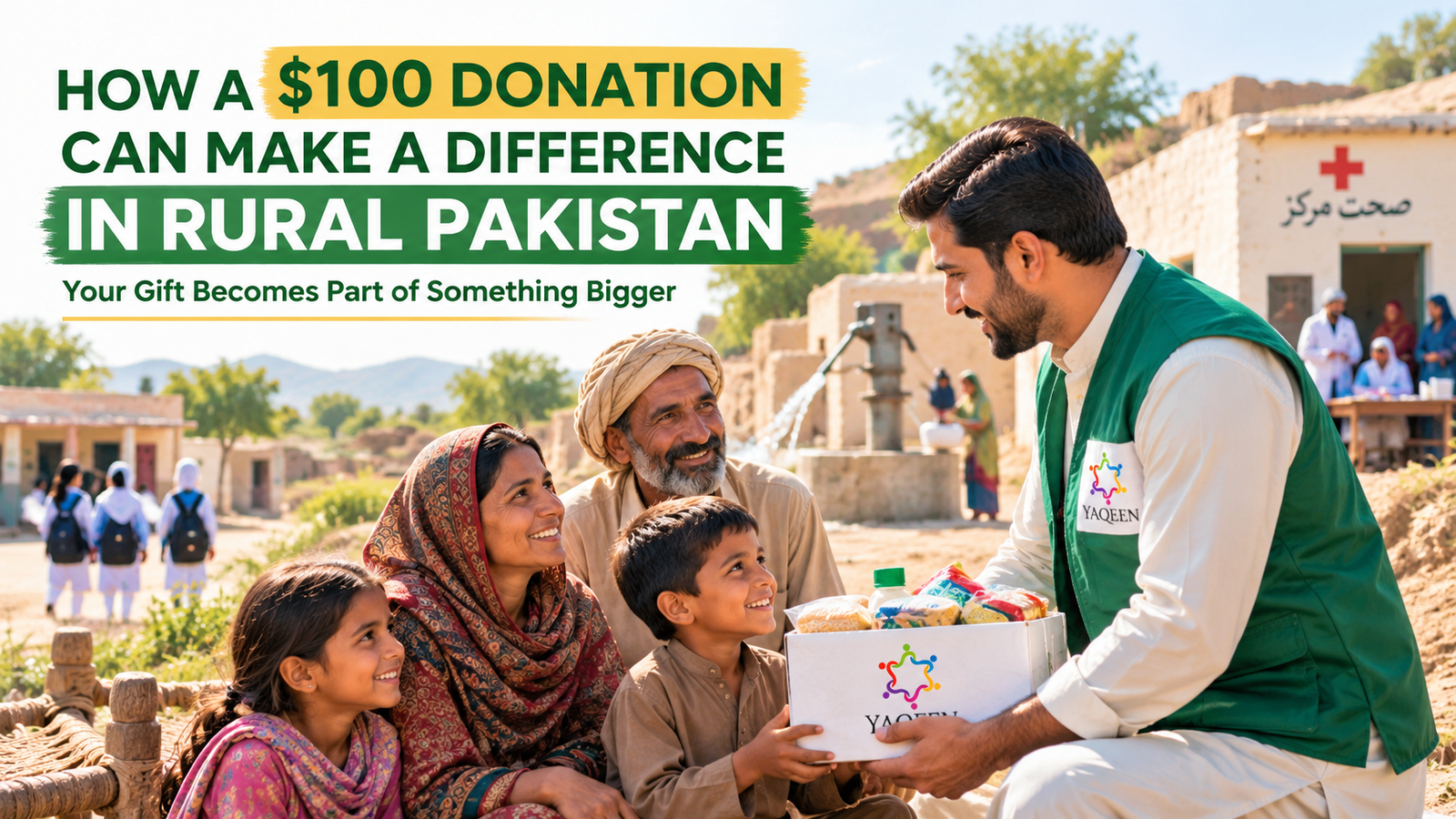
A family in sudden crisis receives two weeks of food essentials. A stranger you helped without knowing their name. A meal placed on a table you will never sit at.
Ramadan Food Distribution
Feeding a fasting stranger in Ramadan carries particular weight in the most generous of all months. Your giving becomes their iftar. Their gratitude to Allah includes a prayer for the one who helped them.
Ongoing Family Food Support
For families where poverty is not a crisis but a condition — a state that does not lift between emergencies — regular monthly support walks alongside them through the difficulty. Consistent giving, month after month, accumulates all 7 Blessings of Helping and becomes a form of Sadaqah Jariyah.
Widow and Vulnerable Household Support
The Prophet ﷺ described those who care for widows and the poor as equal in reward to those who strive in the path of Allah. We carry your giving to those most often passed by — the households no one else has stopped for.
Free Medical Treatment
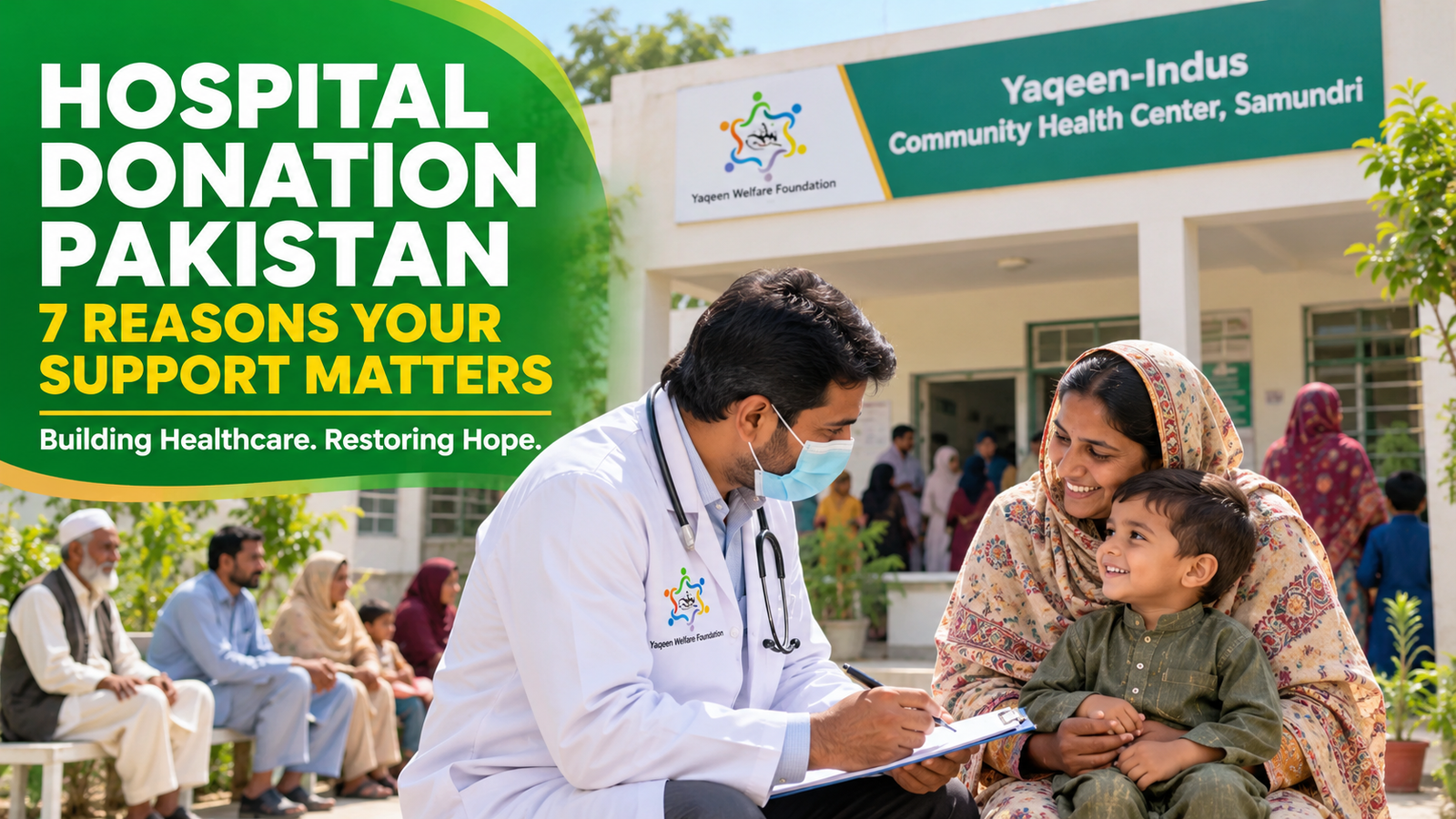
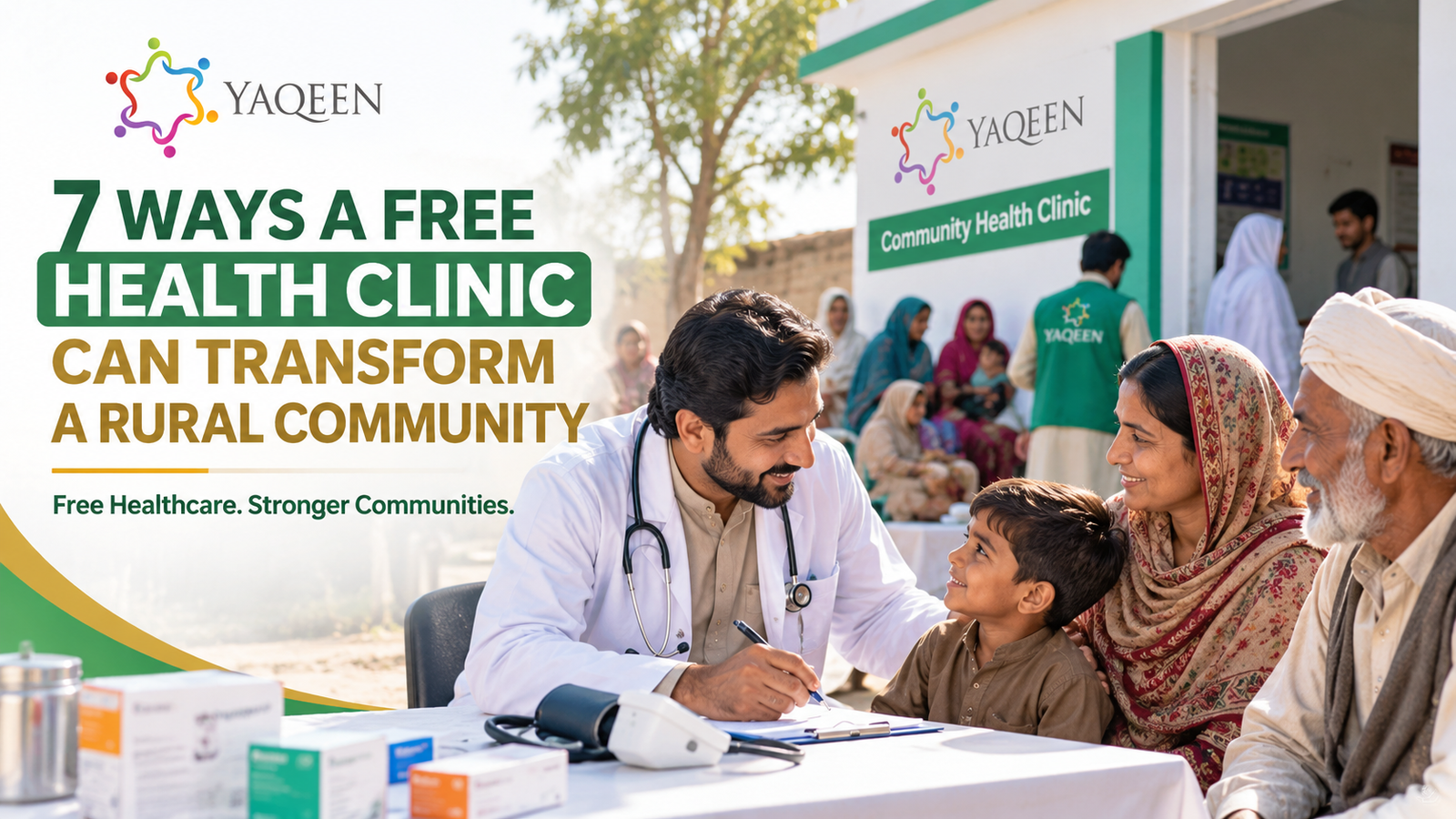
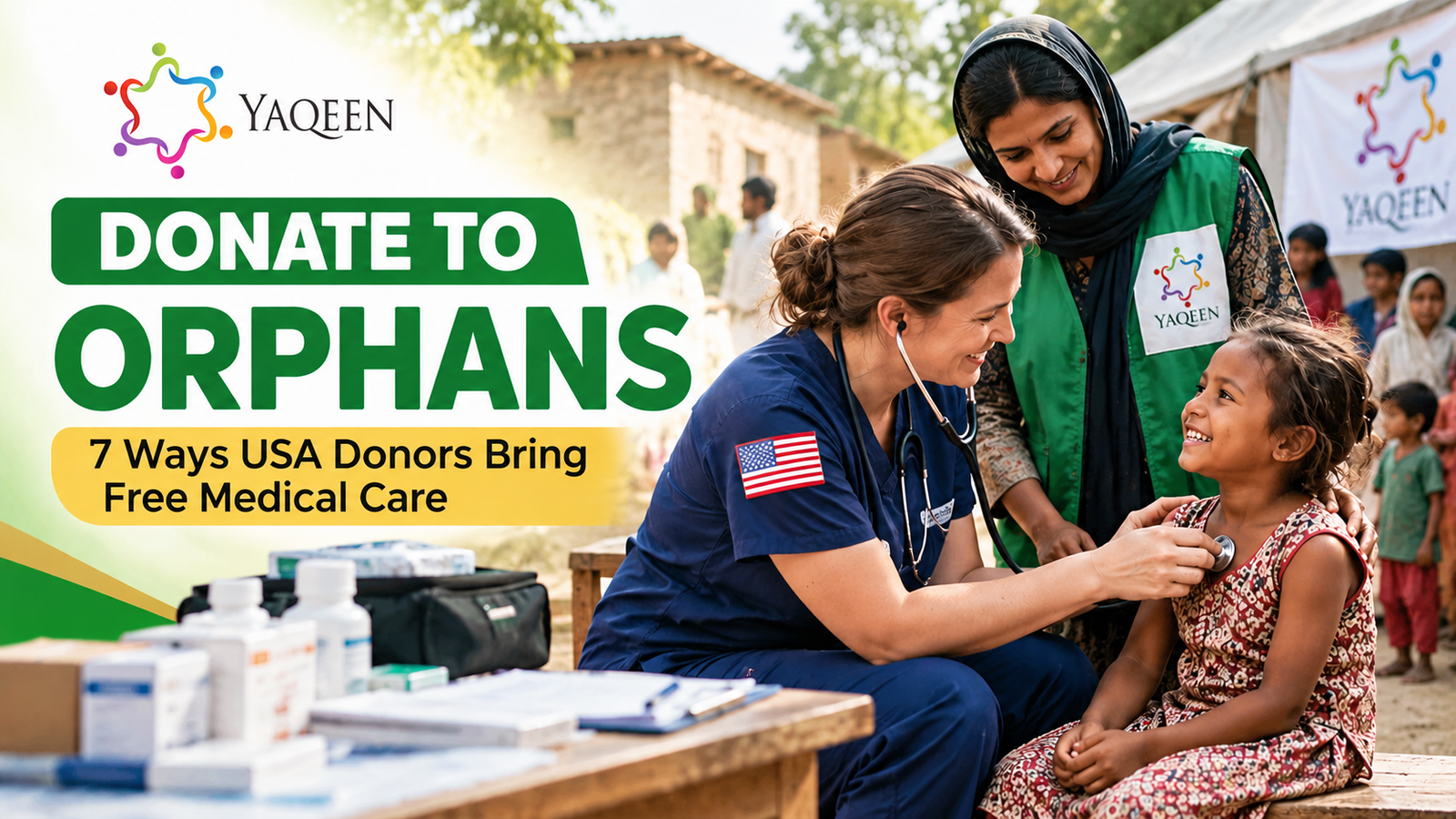
Access to healthcare is a basic right that millions in Pakistan cannot afford. Through the Yaqeen Health Clinic, your donation provides free consultations, medicines, and treatment to patients who would otherwise go without. Read more at: Yaqeen Health Clinic.
Clean Water Projects
Providing clean water to a community is among the most enduring acts of Sadaqah Jariyah. Every cup of clean water drawn from a source your donation helped build carries reward long after the act of giving. Discover the impact of a clean water donation at Yaqeen Welfare Foundation.
The Stranger Is Waiting
Somewhere — in a city you have never visited, in a language you do not speak, on an ordinary weekday morning — a stranger is in difficulty. They do not know that you exist. They do not know that a decision is in front of you right now, or that your giving could reach them before the week is out.
You do not need to know them. You do not need to follow what happens next. You do not need their gratitude, their name, or any confirmation that your giving arrived. You need only to give — for the sake of Allah. And He sees everything that follows.
To understand which type of charity is best to give, explore our article: What Are the Best Charities to Give To in Islam?
External Resources on Islamic Charity
For further reading on the Islamic principles of charity, the following resources provide valuable, scholarly grounding:
- IslamQA — Principles of Sadaqah and Zakat: https://islamqa.info/en/answers/43101 — A comprehensive answer on the rules and blessings of voluntary charity in Islam.
- Sunnah.com — Hadith on Charity: https://sunnah.com/muslim:2699 — The direct source for the hadith “Whoever relieves a Muslim of a burden…” referenced throughout this article.
- Quran.com — Surah Al-Baqarah 2:261-262: https://quran.com/2/261-262 — The Quranic verses on the multiplication of charitable giving.
Frequently Asked Questions About the 7 Blessings of Helping
Q: Does it matter that I don’t know who receives my donation?
It does not diminish the act — it may deepen it. Giving to someone you will never know, with no possibility of personal recognition, is among the most sincere forms of charity in Islam. The 7 Blessings of Helping apply most powerfully when the giving is done purely for Allah, without any human recognition attached to it. Allah knows the recipient, the act, and the intention behind it in their entirety.
Q: Can I give on behalf of a deceased loved one?
Yes — and this is among the most beautiful gifts you can offer someone who has passed. Sadaqah given on their behalf reaches them. Every du’a made by the stranger who was fed in their name carries a portion of that mercy to them. The 7 Blessings of Helping extend not just to the giver but, through the intention of Sadaqah on behalf of another, to those who are no longer in this world.
Q: What if I can only give a small amount?
There is no minimum in Allah’s accounting. The Prophet ﷺ taught that the most beloved deeds to Allah are those done consistently, even when they are small. A modest, reliable monthly contribution may carry more weight — and do more for a stranger — than a single larger gift given once. All 7 Blessings of Helping are available to a giver who gives one meal, or one month’s support, sincerely for the sake of Allah.
Q: Can food charity count as Zakat?
Yes. Families in acute poverty and food insecurity fall within the eligible categories for Zakat. If you intend your donation as Zakat, please indicate this when giving so that it can be allocated to Zakat-eligible programmes. You can use our Zakat Calculator to determine your annual Zakat obligation.
Q: How do I know the giving reaches someone genuinely in need?
At Yaqeen Welfare Foundation, we work with verified on-the-ground partners who identify families in genuine acute need — those with no alternative source of food, no safety net, and no one else to turn to. When you give, your contribution reaches a real family that would otherwise go without. We are transparent about our work — view our latest activities at Yaqeen Media.
Q: Is there a difference between giving Sadaqah and giving Zakat to a stranger?
Both carry great reward, but they operate differently. Zakat is an obligation — one of the Five Pillars of Islam — and must be given to specific categories of recipients. Sadaqah is voluntary and can be given to anyone in need, with no restrictions on recipient category. Both activate the 7 Blessings of Helping when given with sincerity. For guidance on Zakat, visit our Zakat Calculator.
Q: What is the single most important thing to remember when giving to a stranger?
Intention. The Prophet ﷺ said: “Actions are by intentions, and every person will have what they intended.” (Sahih Bukhari). Before you give — through a donation platform, in cash, or through an organisation like ours — take a moment to set your intention: “I give this for the sake of Allah alone.” That intention is the key that unlocks all 7 Blessings of Helping.
Give to a Stranger Today — For the Sake of Allah
One act. One stranger. A return you will receive on the day it matters most.
“Allah is in the aid of His servant as long as His servant is in the aid of his brother.” (Sahih Muslim)
To donate now and put the 7 Blessings of Helping into action, visit: Yaqeen Welfare Foundation — Donate