Sadaqah vs. Zakat is one of the most searched questions among Muslims trying to give correctly — and understandably so. Both are described in the Qur’an, both are rewarded generously, and both are described using the same Arabic root that means “to purify” or “to be true.” Yet they are not interchangeable. One is a fixed, obligatory pillar of Islam. The other is an open, voluntary act of mercy with no ceiling and no fixed rules. Knowing the difference between Sadaqah and Zakat is not just an academic exercise — it determines whether your religious obligation has actually been fulfilled, who is legally entitled to receive your money, and how your giving is calculated each year.
This guide breaks the comparison of Sadaqah vs. Zakat down into six clear, practical differences, backed by the Qur’an and Sunnah, so you can give with confidence — whether you are settling your annual Zakat or looking for a way to give Sadaqah Jariyah that continues to benefit you long after you’ve given it.
What Is Zakat?
Zakat is the third pillar of Islam. It is an obligatory act of worship, not a voluntary donation, owed by every adult Muslim whose wealth has remained above a specific threshold — known as the nisab — for a full lunar year (called the hawl). Once those two conditions are met, 2.5% of qualifying wealth becomes due and must be distributed to specific categories of recipients defined in the Qur’an.
“Take, [O Muhammad], from their wealth a charity by which you purify them and cause them increase.” (Qur’an, Surah At-Tawbah 9:103)
Zakat is not charity in the everyday sense — it is a right that the poor have over the wealth of the rich. Withholding it, according to mainstream Islamic scholarship, is a sin, not simply a missed opportunity for reward.
What Is Sadaqah?
Sadaqah, by contrast, is voluntary charity. It has no minimum threshold, no fixed percentage, and no obligatory schedule. It can be given by anyone — rich or poor, at any time, in any amount, to almost anyone in need. It can take the form of money, food, a kind word, or even a smile.
“Charity extinguishes sin as water extinguishes fire.” (Tirmidhī)
Where Zakat is a legal duty with defined boundaries, Sadaqah is an open door. The Prophet ﷺ said to protect oneself from the Fire “even with half a date” (Bukhārī and Muslim) — a reminder that Sadaqah does not wait for surplus wealth. It works with whatever a person has.
Sadaqah vs. Zakat: 6 Key Differences Every Muslim Should Know
Once the basic definitions are clear, the real value of comparing Sadaqah vs. Zakat lies in the practical differences — the ones that determine what you owe, when you owe it, and who is entitled to receive it.
1. Obligation vs. Voluntary Giving
Zakat is fard — an obligation upon every Muslim who meets the wealth conditions. It is not left to personal discretion once nisab and hawl are satisfied. Sadaqah, on the other hand, is entirely voluntary (mustahabb). No one is sinful for not giving Sadaqah on a given day, though the Prophet ﷺ strongly encouraged it as a daily habit, even in small amounts.
2. The Nisab and Hawl Requirement
Zakat only becomes due once a person’s zakatable wealth reaches the nisab threshold — roughly the value of 612.36 grams of silver or 87.48 grams of gold, according to most calculations — and remains at or above that level for a full lunar year. Sadaqah has no such threshold. It can be given from any amount of wealth, at any point in the year, by someone above or below the nisab. If you are unsure whether your wealth currently meets the nisab, Yaqeen Welfare Foundation’s Zakat Calculator can help you work it out in a few minutes.
3. A Fixed Rate vs. An Open Amount
Zakat has a fixed, non-negotiable rate: 2.5% of qualifying wealth held for a full lunar year. There is no “extra” Zakat and no partial Zakat — it is calculated precisely. Sadaqah has no ceiling and no floor. It can be a single rupee or a lifetime’s savings; both are accepted, and both are rewarded according to sincerity and circumstance, not size.
4. Who Is Eligible to Receive It
This is one of the most important — and most overlooked — differences between Sadaqah and Zakat. Zakat can only be given to eight specific categories of people named directly in the Qur’an:
“Zakat expenditures are only for the poor and for the needy and for those employed to collect [zakat] and for bringing hearts together [for Islam] and for freeing captives [or slaves] and for those in debt and for the cause of Allah and for the [stranded] traveler.” (Qur’an, Surah At-Tawbah 9:60)
Sadaqah has no such restriction. It can be given to the eight Zakat categories, but also to family members, non-Muslims, community projects, mosques, orphanages, or animals — anywhere there is genuine need or benefit.
5. Timing and Frequency
Zakat is calculated and paid once per lunar year, on a fixed date the payer sets when their wealth first reaches nisab (their “Zakat anniversary”). Sadaqah has no calendar. It can be given daily, weekly, in Ramadan, on a Friday, or the moment a need is noticed. Many scholars encourage habitual, even daily, Sadaqah — however small — precisely because it carries no restriction of timing.
6. The Spiritual Function
Zakat purifies wealth. It is described in the Qur’an as the mechanism that cleanses what a person owns and removes the claim the poor have upon it. Sadaqah purifies something closer to the self — it is described in hadith as extinguishing sin, shading the giver on the Day of Judgment, and softening the heart.
“If you want your heart to be soft, feed the poor and pat the head of the orphan.” (Ahmad)
Both acts draw a person nearer to Allah. But Zakat settles an account; Sadaqah builds a relationship.

Sadaqah vs. Zakat at a Glance
| Feature | Zakat | Sadaqah |
|---|---|---|
| Ruling | Obligatory (Fard) — third pillar of Islam | Voluntary (Mustahabb) |
| Minimum threshold | Requires wealth above the nisab | No minimum amount required |
| Time condition | Wealth must be held for one full lunar year (hawl) | No time condition |
| Rate | Fixed at 2.5% of qualifying wealth | No fixed rate — any amount is valid |
| Eligible recipients | Only the 8 categories named in Surah At-Tawbah 9:60 | Anyone in genuine need, including family and non-Muslims |
| Frequency | Once per lunar year (on the payer’s Zakat anniversary) | Anytime, as often as desired |
| Consequence of non-payment | Sinful if withheld once due | No sin, though the reward of giving is missed |
| Primary spiritual function | Purifies wealth | Purifies the heart and self |
Can Sadaqah Replace Zakat?
No. This is a common misunderstanding worth addressing directly. However generous your Sadaqah is over the course of a year, it does not discharge an outstanding Zakat obligation unless it was specifically intended and calculated as Zakat at the time it was given. If your wealth has reached the nisab and remained there for a full lunar year, your 2.5% Zakat is owed regardless of how much Sadaqah you have already given. The two exist side by side — one settles a legal duty, the other is a continuous act of generosity that has no upper limit and no expiry.
That said, both are described in the same verse of the Qur’an as forms of charity that Allah loves:
“Allah destroys interest and gives increase for charities.” (Qur’an, Surah Al-Baqarah 2:276)
The wisdom of giving both, in their proper place, is that a household’s wealth stays purified through Zakat while its heart stays soft through the daily habit of Sadaqah.
Why the Difference Matters When You Give
Understanding the difference between Sadaqah and Zakat is not only a matter of correct practice — it directly affects how organisations like Yaqeen Welfare Foundation are able to use your donation. Because Zakat can only reach the eight categories defined in the Qur’an, we ring-fence Zakat contributions specifically for the poor, the needy, and those in genuine financial hardship, so that your obligation is discharged correctly. Sadaqah, by contrast, gives us the flexibility to respond immediately wherever the need is greatest — a medical emergency at Yaqeen Health Clinic, a family whose roof collapsed in the monsoon, or a widow whose household has quietly gone without for weeks.
This is also why, when you read stories like Your Charity Saved Lives: 8 Heartwarming Stories or One Meal, One Prayer: 5 Incredible Reasons One Life Changed Forever, you are seeing the combined result of both Zakat and Sadaqah working together — one guaranteeing that the poor receive their due, the other filling in every gap that a strict legal category cannot reach.
How Yaqeen Welfare Foundation Uses Your Zakat and Sadaqah
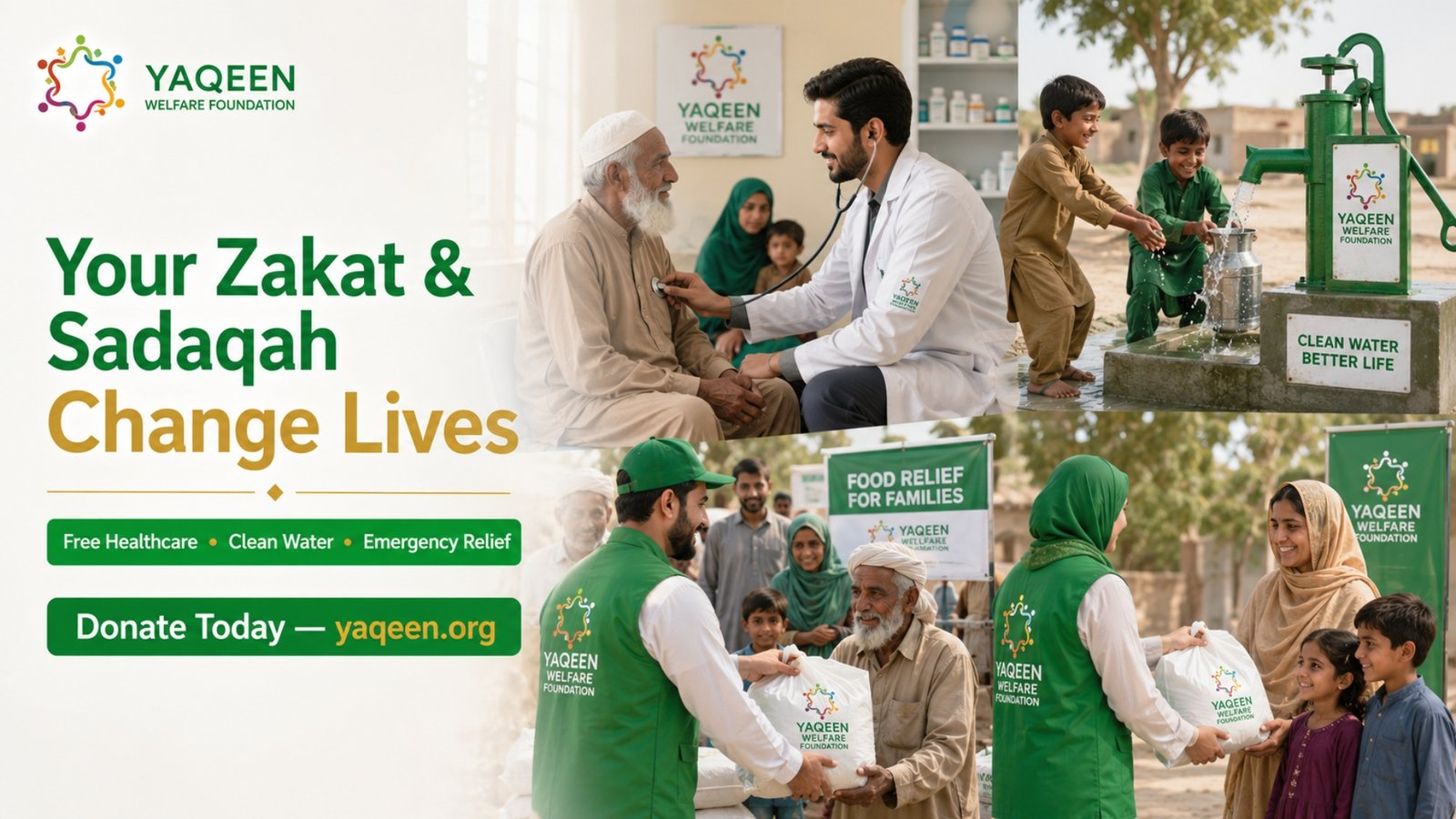
Yaqeen Welfare Foundation exists to provide free medical treatment, clean water, and essential assistance to underserved communities across Pakistan, particularly in villages that sit at the edges of every map and every survey. Every donation — whether given as Zakat or Sadaqah — is directed toward one of the following:
- 🏥 Free Medical Treatment — Consultations, medicines, and referrals through the Yaqeen Health Clinic for families who would otherwise go without care.
- 🍚 Emergency Food Parcels — Essential food delivered within days to families facing acute crisis.
- 🌙 Ramadan Food Distribution — Ensuring fasting families in remote villages are able to break their fast with dignity.
- 💧 Clean Water Access — Reducing preventable illness in communities without reliable water infrastructure.
- ♥️ Widow and Vulnerable Household Support — Ongoing assistance for households with no other means of support.
If you are calculating your obligatory Zakat this year, our Zakat Calculator and Fitrana Calculator can help you determine the exact amount owed before you give. And if you’d simply like to give Sadaqah today — in any amount, from wherever you are — you can read more about how consistent, everyday generosity changes both giver and receiver in 9 Ways Charity Softens the Heart and Changes the Soul and 7 Blessings of Helping a Stranger for the Sake of Allah.
Frequently Asked Questions About Sadaqah vs. Zakat
Q: What is the simplest way to remember the difference between Sadaqah and Zakat? Zakat is obligatory, calculated, and restricted to eight categories of recipients. Sadaqah is voluntary, unrestricted in amount, and can be given to almost anyone in need. If you remember “Zakat is a duty, Sadaqah is a gift,” you have the core of the Sadaqah vs. Zakat distinction.
Q: Do I have to pay Zakat if my income is low? Only if your total zakatable wealth — savings, gold, silver, business assets, and similar — meets or exceeds the nisab threshold and has remained there for a full lunar year. Many people with modest incomes and no savings above nisab are not liable for Zakat at all, and may instead be eligible to receive it.
Q: Can I give Zakat to my relatives? Zakat generally cannot be given to your direct dependents (such as your spouse, children, or parents), but it can be given to other relatives who are eligible recipients under the eight categories, such as a needy sibling or cousin. Sadaqah, by contrast, can be given freely to any family member in need, and often carries additional reward when given to relatives.
Q: Is Sadaqah still important if I already pay my Zakat every year? Yes. Zakat and Sadaqah serve different functions. Paying Zakat discharges a legal obligation on your wealth; it does not exhaust the spiritual benefit of ongoing, voluntary giving. The Prophet ﷺ described Sadaqah as something that softens the heart, extinguishes sin, and provides shade on the Day of Judgment — benefits that continue regardless of whether your Zakat has already been paid.
Q: What is Sadaqah Jariyah, and how is it different from regular Sadaqah? Sadaqah Jariyah refers to “ongoing charity” — a gift, such as funding a water well or a health clinic, that continues to benefit people (and continues to reward the giver) long after the initial donation. Regular Sadaqah can be a one-time act, while Sadaqah Jariyah is specifically structured to keep giving over time.
Q: How can I be sure my Zakat or Sadaqah reaches people who genuinely need it? Yaqeen Welfare Foundation’s on-the-ground partners work specifically in communities that other organisations do not reach — villages at the end of unpaved roads, households missed by formal surveys, and families whose need is real but whose story rarely makes it onto a donation platform. You can read more about our approach on our Mission & Vision page.
Give With Clarity: Zakat and Sadaqah, Rightly Placed
The comparison of Sadaqah vs. Zakat is not simply a matter of Islamic jurisprudence — it shapes how, when, and to whom your giving reaches. Zakat settles what is owed. Sadaqah gives freely, without limit, wherever a need is found. Together, they form a complete picture of what it means to give in Islam: precision where precision is required, and generosity where generosity is simply good.
Whether you are ready to calculate this year’s Zakat or want to give Sadaqah today, Yaqeen Welfare Foundation can help you give correctly and with confidence.
Donate Now — Give Your Zakat or Sadaqah Today
Have a question about how to calculate or direct your donation? Our team is happy to help — contact us at info@yaqeen.org.