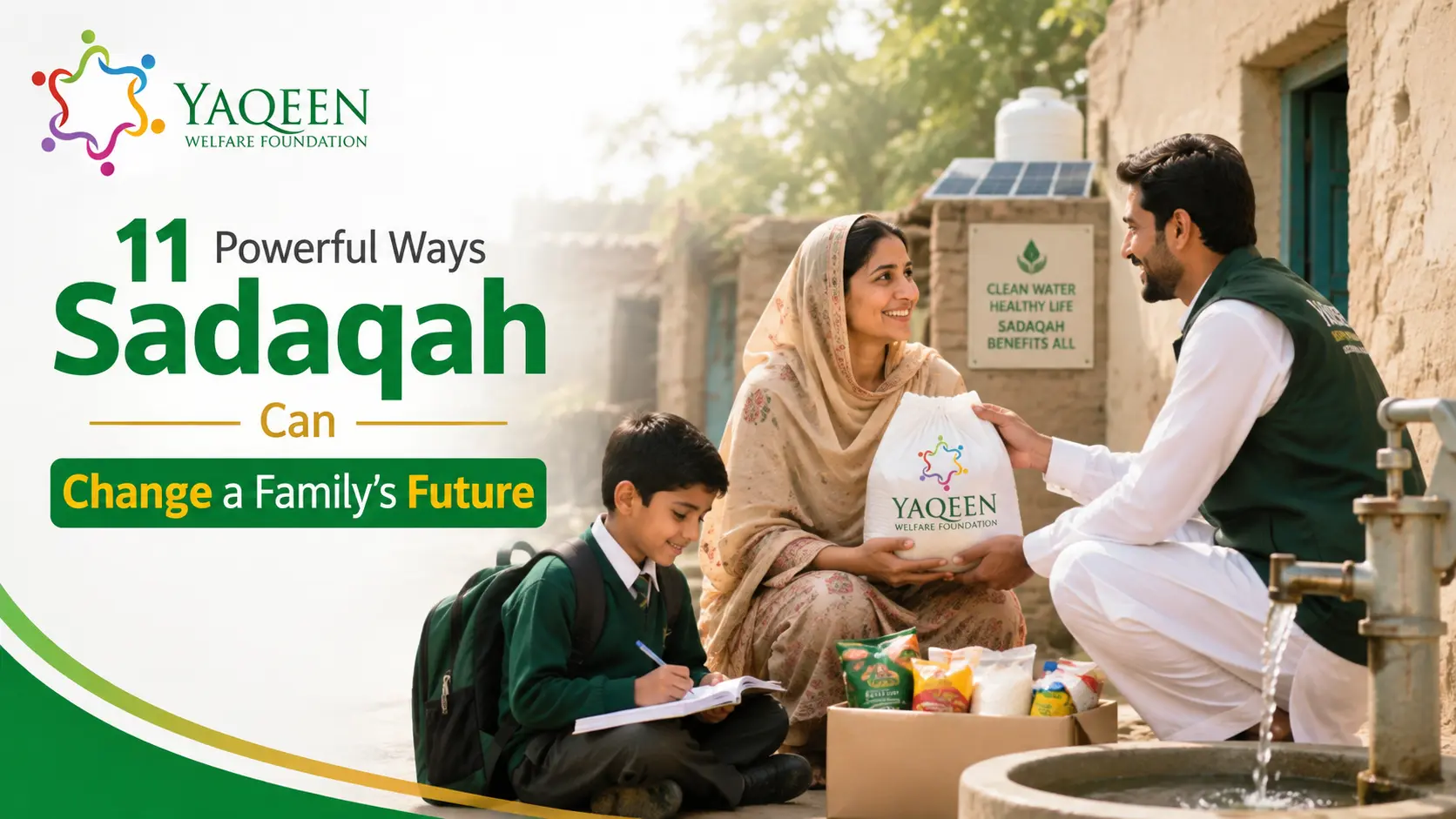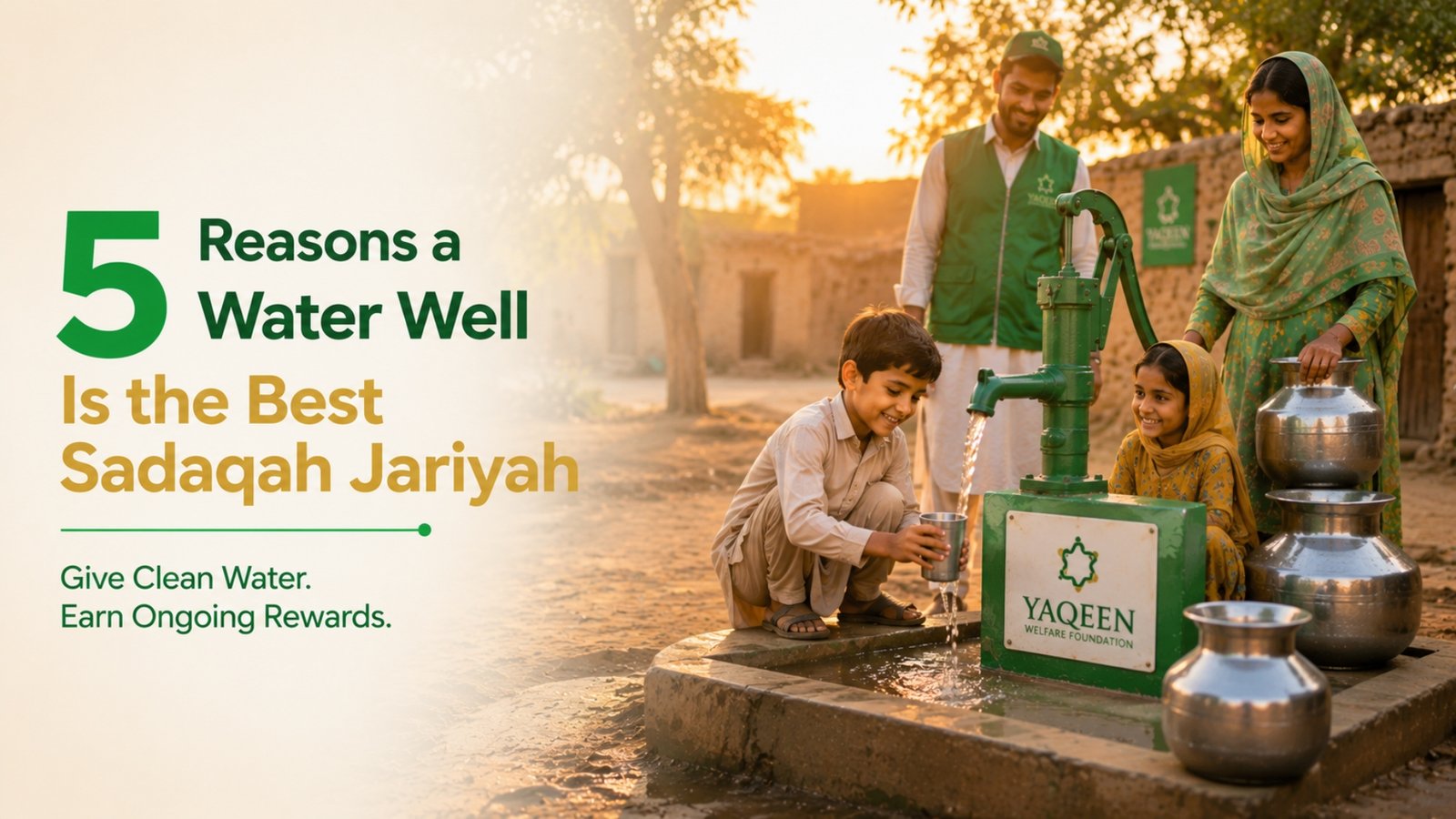
Sadaqah Jariyah is the one form of charity every Muslim wants their name attached to, because it is the rare deed that keeps writing reward into your book of good actions long after you’ve stopped thinking about it — even after you’ve left this world. Among all the ways to give Sadaqah Jariyah, one stands above the rest in scale, simplicity, and lifesaving impact: digging a water well for a community that has none. In villages across rural Pakistan, a single well can mean the difference between children walking three hours a day for dirty water and a household that finally has something clean to drink, cook with, and wash in.
This article walks through exactly what Sadaqah Jariyah means, why the Prophet ﷺ singled out water as the best charity, and five clear reasons a water well beats almost every other option when you’re deciding where your ongoing charity should go. Along the way, we’ll also show you how organizations like Yaqeen Welfare Foundation are already turning this exact idea into real wells for real families in Pakistan.
What Is Sadaqah Jariyah?
Sadaqah Jariyah literally translates to “ongoing” or “flowing” charity. Unlike a one-time donation — handing someone cash, buying a meal, or giving zakat during Ramadan — Sadaqah Jariyah refers to a charitable act whose benefit continues to reach people over time, and whose reward keeps reaching the giver even after death.
The concept comes directly from a hadith narrated by Abu Hurairah, in which the Prophet Muhammad ﷺ said that when a person dies, all their deeds come to an end except three: ongoing charity, beneficial knowledge, and a righteous child who prays for them (recorded in Sunan an-Nasa’i, Hadith 3651). Of these three, Sadaqah Jariyah is the one almost anyone can start today, regardless of age, health, or family circumstances, simply by funding something that keeps benefiting others.
Classical scholars explained this hadith to mean any project built as a lasting endowment (waqf) for public benefit — a mosque, a school, a bridge, a guesthouse, or, most famously, a well. In fact, one of the earliest recorded examples of Sadaqah Jariyah in Islamic history is a well: the Companion Uthman ibn Affan (may Allah be pleased with him) purchased the well of Ruma in Madinah and made its water free for the entire community, an act still cited today as the archetype of ongoing charity.
Why Water Wells Are Different From Other Sadaqah Jariyah
Every category of Sadaqah Jariyah has value — a Quran donated to a mosque, a scholarship for an orphan, a tree planted in a public space. But a water well has a few qualities that set it apart, and understanding them helps explain why it is so often described as the best Sadaqah Jariyah a person can give.
Water is not a luxury; it is the single most basic requirement for human survival, and its absence causes immediate, measurable harm. According to the World Health Organization’s fact sheet on drinking water, unsafe water and poor sanitation remain a leading cause of preventable illness and death among children under five worldwide. A well doesn’t just add convenience to daily life — in many parts of rural Pakistan, it removes a genuine, ongoing threat to health.
That single fact is why the reward tied to a well is thought to be so large, and it’s why so many Sadaqah Jariyah campaigns — including Yaqeen Welfare Foundation’s own clean water initiatives described on the Yaqeen Health Clinic page — prioritize wells before almost anything else.
5 Reasons a Water Well Is the Best Sadaqah Jariyah
1. It Matches the Prophet’s ﷺ Own Description of “the Best Charity”
When a companion once asked the Prophet ﷺ which charity was best, he answered plainly: giving water to drink. Scholars point to this narration, alongside the story of Uthman ibn Affan and the well of Ruma, as direct evidence that funding water access is not just a form of Sadaqah Jariyah — it may be the very form the Prophet ﷺ had in mind when he praised ongoing charity most highly. For a Muslim looking for the single project that carries the strongest textual backing as an act of Sadaqah Jariyah, a water well is difficult to beat.
2. The Reward Keeps Flowing for Decades, Not Days
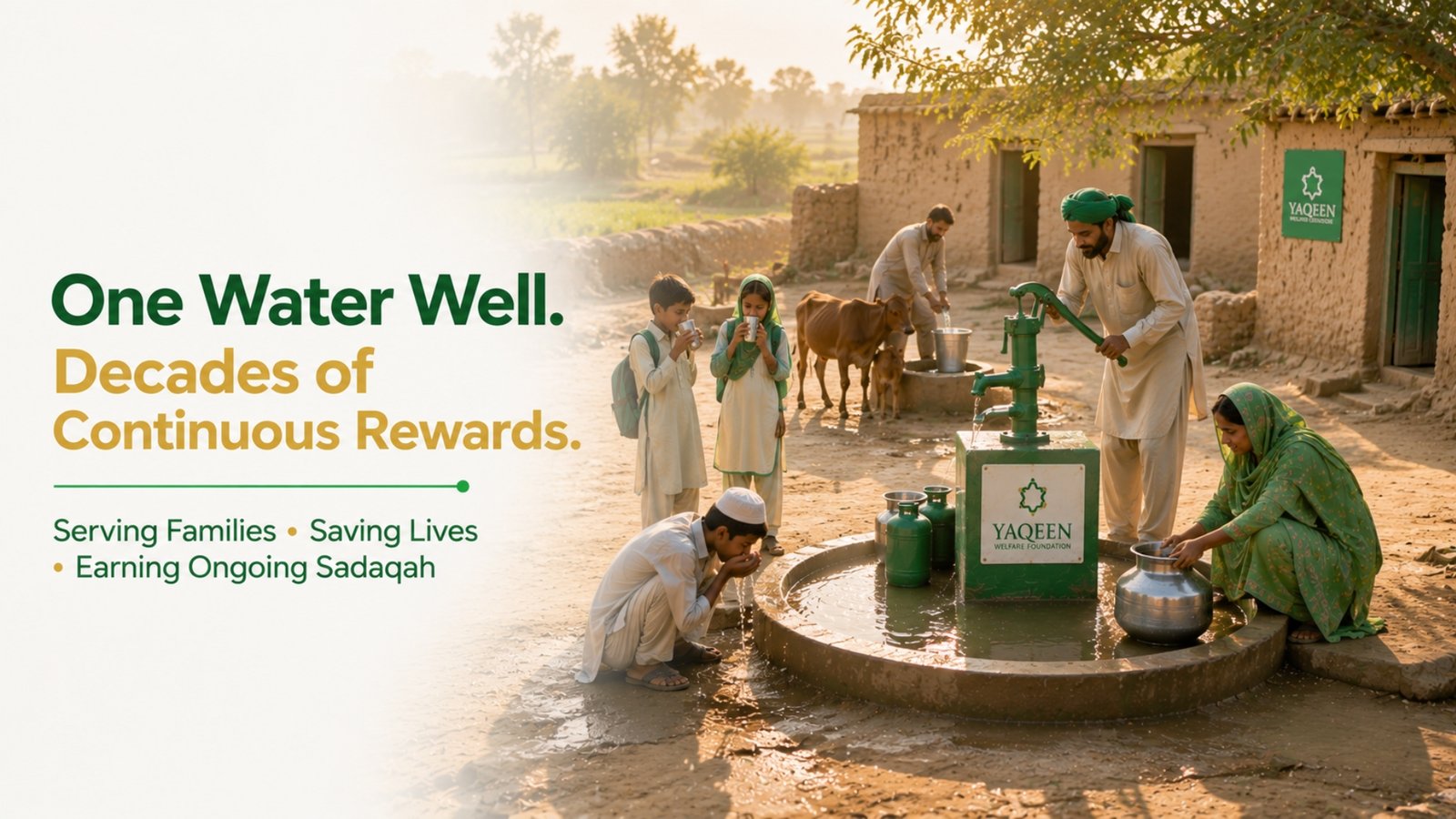
A meal you fund is eaten once. A blanket wears out. A water well, built properly with a durable hand pump or a bore system, can serve a village for twenty, thirty, or more years. Every single time someone drinks from it, cooks with it, gives their livestock water from it, or uses it to perform wudu before prayer, the reward is written for the donor — even long after they have passed away. This is the essence of Sadaqah Jariyah: a single act of giving that multiplies into thousands of moments of benefit over time, none of which require the donor to do anything further.
3. One Well Can Serve an Entire Community, Not Just One Family
Unlike sponsoring an individual or a single household, a well is a shared, public resource. A single hand pump or tube well in rural Pakistan can realistically serve dozens of families — often 100 to 250 people — for as long as it remains functional. That means the reward isn’t tied to one recipient’s dua or one family’s gratitude; it’s distributed across an entire community, day after day, which is part of why scholars regard public-benefit projects like wells and mosques as the strongest category of Sadaqah Jariyah.
4. Clean Water Directly Prevents Disease and Saves Lives
This reason moves beyond spiritual reward into something measurable: impact on human life. Communities relying on unprotected ponds, canals, or shallow open wells are exposed to waterborne diseases such as diarrhoea, typhoid, and hepatitis A — conditions that are especially dangerous for children. A properly built well with a sealed pump dramatically reduces this exposure. When you give Sadaqah Jariyah toward a well, you are not only investing in reward for the Hereafter; you are directly reducing preventable illness and death in this life, today. Few charitable acts combine spiritual and humanitarian impact this directly.
5. It’s Affordable, Transparent, and Easy to Track
Unlike large infrastructure projects that require years of planning, a single water well is a well-defined, relatively low-cost project that most donors can fund on their own or split among family members as a joint Sadaqah Jariyah — often in memory of a parent or loved one. Because the outcome (a functioning well, a GPS location, a beneficiary community) is concrete and verifiable, donors can see exactly where their charity went, something that is much harder to track with more abstract forms of giving.
Here’s a simple comparison of common Sadaqah Jariyah options, to show where a water well fits:
| Sadaqah Jariyah Option | Typical Lifespan of Benefit | People Reached | Ease of Verification |
|---|---|---|---|
| Water Well | 20–30+ years | 100–250+ per well | High — physical, location-based project |
| Quran Donation | 10–20 years (per copy) | Dozens of readers | Moderate |
| Tree Plantation | 15–40 years | Local community/environment | Moderate |
| Mosque Construction | Decades | Hundreds to thousands | High, but higher cost |
| Orphan Sponsorship (recurring) | Duration of sponsorship | 1 child/family | High |
As the table shows, a water well offers one of the strongest combinations of long-term impact, number of people reached, and low barrier to entry — which is exactly why so many Muslims choose it as their primary Sadaqah Jariyah.
How Yaqeen Welfare Foundation Builds Water Wells in Pakistan
Yaqeen Welfare Foundation exists to provide free medical treatment, clean water, and essential humanitarian assistance to underserved communities across Pakistan. Water wells sit at the center of that mission because clean water is inseparable from the health outcomes the foundation is working to improve through its clinics and outreach programs.
When you give Sadaqah Jariyah toward a Yaqeen well, the process typically follows a few steps: field teams identify villages with no safe water source, a well is drilled or a hand pump is installed at the site of greatest need, and the completed project is documented so donors can see exactly which community was served. This mirrors the same spirit shown in the foundation’s other work — you can read some of the real outcomes of that work in stories like Your Charity Saved Lives: 8 Heartwarming Stories and One Meal, One Prayer: 5 Incredible Reasons One Life Changed Forever, both of which show how a single act of giving ripples outward into a community.
The foundation’s broader approach to charity — treating every donation as an amanah (trust) that must reach the right people — is also reflected in posts like 9 Ways Charity Softens the Heart and Changes the Soul and 7 Signs A Simple Donation, Village Needs Your Help, which go into more detail on how rural communities in Pakistan are selected for support.
The Hadith on Sadaqah Jariyah and Water — What the Sources Say
It’s worth restating the core textual basis clearly, since so much of the motivation to give comes from understanding the sources properly:
- The three deeds that continue after death — ongoing charity, beneficial knowledge, and a righteous child’s prayer — are recorded in multiple authentic collections, including Riyad as-Salihin, Hadith 1383 and Sahih Muslim.
- The specific praise of water charity comes from a narration in which the Prophet ﷺ was asked which charity was best and answered that giving water to drink was among the most beloved forms of Sadaqah.
- Historical precedent is set by Uthman ibn Affan’s purchase of the well of Ruma, an act still referenced today by scholars as the model example of Sadaqah Jariyah in action.
Together, these sources form the foundation for why so many Islamic charities — Yaqeen Welfare Foundation included — treat water wells as a flagship Sadaqah Jariyah project rather than a side initiative.
The Real Cost of Not Having Clean Water in Rural Pakistan
To understand why this specific project carries so much weight, it helps to look at what daily life looks like without it. In many rural districts of Punjab, Sindh, and Balochistan, women and children still walk long distances — sometimes several hours round trip — to fetch water from open canals, ponds, or shared sources that are frequently used by livestock as well. That water is often carried home unfiltered and used for drinking, cooking, and bathing, exposing entire households to preventable illness.
The time cost alone is enormous. Hours spent fetching water each day are hours a child isn’t in school and a mother isn’t earning an income or resting. When a well is installed close to home, that time is returned to the family, often permanently changing the rhythm of daily life in ways that go well beyond hydration. This is one more reason charity built around water infrastructure tends to have such a wide, compounding effect — it touches health, education, and household income all at once, which is part of what makes it such a complete example of lasting charity.
How You Can Contribute to a Water Well Sadaqah Jariyah
Giving toward a well doesn’t require significant wealth or complicated paperwork. Most people choose one of the following approaches:
- Fund a full well individually — ideal for those who want a complete, dedicated project, sometimes given in memory of a parent or family member.
- Split a well with family or friends — several relatives contribute together, often as a joint reward project (especially popular during Ramadan or on behalf of a deceased loved one).
- Give a smaller recurring amount — some donors prefer to contribute steadily over months toward a larger well fund.
If you’re also exploring other obligatory giving alongside voluntary Sadaqah Jariyah, Yaqeen Welfare Foundation’s Zakat Calculator and Fitrana Calculator can help you work out what you owe before deciding how much you’d like to give toward a well on top of that.
To start or contribute toward a water well project, you can donate directly through Yaqeen Welfare Foundation, or reach out with questions before giving.
Frequently Asked Questions About Sadaqah Jariyah and Water Wells
Is a water well really considered the best Sadaqah Jariyah?
Many scholars point to water specifically because of how the Prophet ﷺ described it and because of the historical example of the well of Ruma. While all forms of Sadaqah Jariyah carry reward, water wells combine textual support, low cost, and life-saving impact in a way few other projects can match — which is why they are so frequently recommended as the best Sadaqah Jariyah to start with.
How much does it cost to fund a water well through Yaqeen Welfare Foundation?
Costs vary depending on the type of well (hand pump vs. deeper bore well) and the region in Pakistan where it’s installed. You can find current project details and give directly on the donation page, or contact the team for the latest figures.
Can I give Sadaqah Jariyah on behalf of a deceased parent?
Yes. Giving Sadaqah Jariyah on behalf of a parent or relative who has passed away is a well-established practice, and many families choose to fund a well specifically in a loved one’s name as a lasting legacy of good deeds.
How is Sadaqah Jariyah different from Zakat?
Zakat is an obligatory annual payment calculated on eligible wealth, while Sadaqah Jariyah is voluntary charity given at any time, in any amount, toward a project whose benefit continues over time. You can calculate your obligatory Zakat using Yaqeen’s Zakat Calculator separately from any Sadaqah Jariyah you choose to give.
How do I know my Sadaqah Jariyah well actually reaches people in need?
Reputable organizations document each well’s location and the community it serves. Yaqeen Welfare Foundation shares real outcomes of its projects through stories on its blog, and you can also reach out directly with any questions about a specific project before or after donating.
Where can I read more real stories about the impact of this kind of charity?
You can browse more accounts of how donations have changed lives in posts such as 7 Blessings of Helping a Stranger for the Sake of Allah and Allah Writes 7 Things When You Feed the Hungry on the Yaqeen Welfare Foundation blog.
Final Thoughts: Start Your Sadaqah Jariyah Today
Sadaqah Jariyah is one of the few investments that pays returns you’ll never see in this life but will hopefully find waiting for you in the next. A water well takes that promise and grounds it in something tangible: a pump, a pipe, clean water flowing into a bucket for a mother who used to walk miles for it. Every reason covered above — the hadith evidence, the decades-long benefit, the number of people reached, the direct health impact, and the affordability — points to the same conclusion. If you’re deciding where to place your next act of ongoing charity, a water well remains one of the clearest, most rewarding choices available.
Ready to give? Donate toward a water well today or contact Yaqeen Welfare Foundation to ask questions about current well projects in Pakistan before you give your Sadaqah Jariyah.