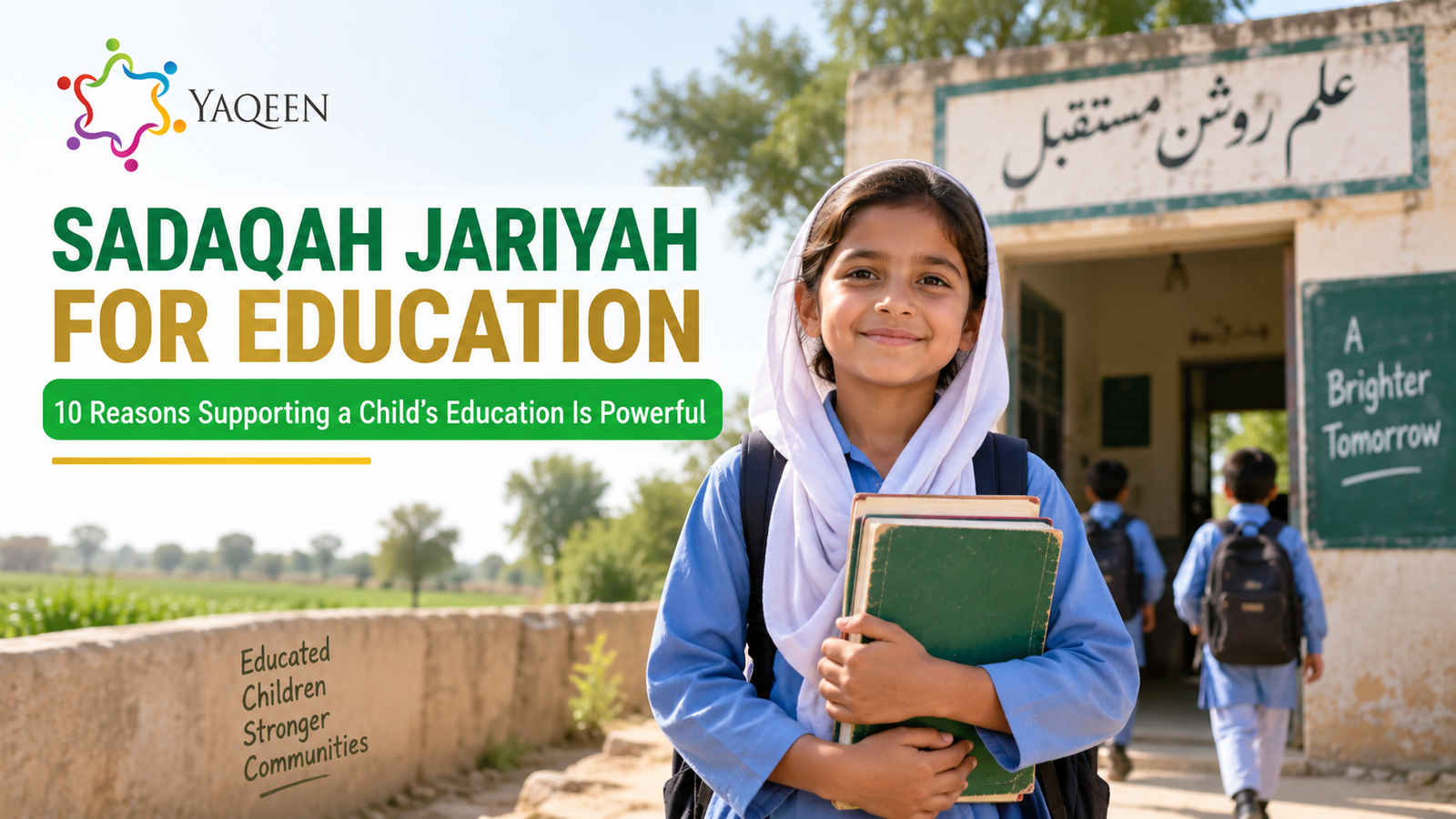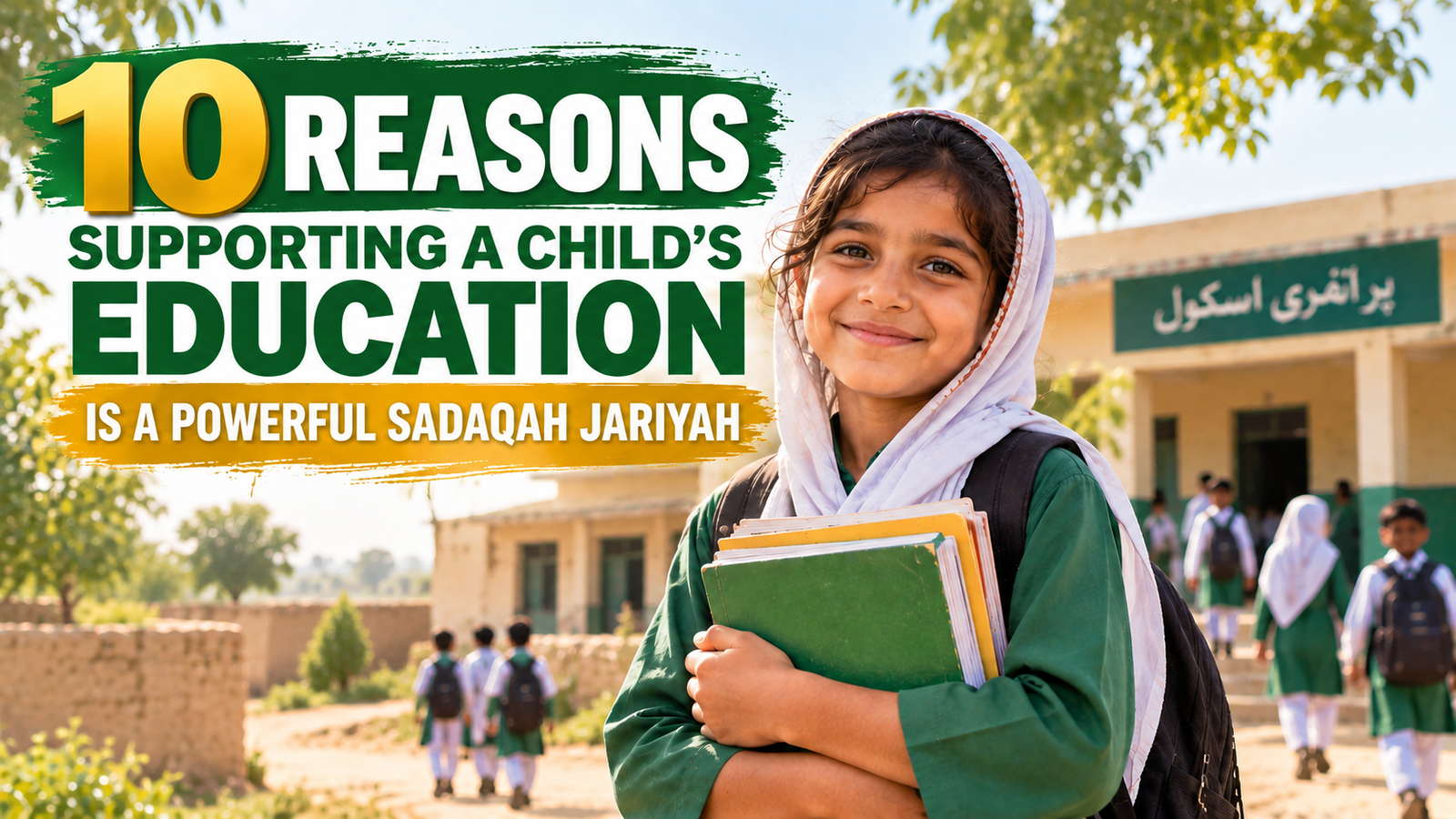
10 Reasons Supporting a Child’s Education Is a Powerful Sadaqah Jariyah
Sadaqah Jariyah for education is one of the most enduring and rewarding forms of charity a Muslim can give. When you fund a disadvantaged child’s schooling, you are not simply paying for books and a uniform — you are planting a tree of knowledge whose shade will fall on that child, their family, their children, and their community for generations. At Yaqeen Welfare Foundation, we believe Sadaqah Jariyah for education deserves the same attention Muslims give to water wells and mosques, because a mind that is opened by literacy never truly closes again.
In this guide, we’ll explain why education qualifies as ongoing charity in Islam, what poverty does to a child’s chances of ever entering a classroom, ten long-term benefits of funding a child’s schooling, and how you can turn your donation into a lifelong legacy. If you’ve ever wondered how to donate for education in a way that keeps earning reward long after you’ve given it, this article is for you.
If you’d like to see the impact of our other relief work first, read about our INTERNAL LINK: “How Clean Water Projects Save Lives in Rural Pakistan” or INTERNAL LINK: “Why Free Medical Camps Matter for Pakistan’s Poorest Families”.
Education and Islam
Islam did not simply permit learning — it commanded it. The very first word revealed to Prophet Muhammad ﷺ was “Iqra” (“Read”), and the Qur’an repeatedly elevates the status of those who possess knowledge. Scholars have long argued that seeking and spreading knowledge is not a luxury reserved for the wealthy; it is a communal obligation (fard kifayah) that believers are meant to fulfill for one another when some among them cannot fulfill it for themselves.
This is precisely where Sadaqah Jariyah for education fits into the picture. The Prophet ﷺ said:
“When a person dies, all his good deeds come to an end except three: ongoing charity (sadaqah jariyah), beneficial knowledge, or a righteous child who prays for him.” (Sahih Muslim 1631)
Notice that two of the three deeds mentioned in this hadith — ongoing charity and beneficial knowledge — converge directly in the act of funding a child’s education. When you sponsor a poor child’s schooling as an Islamic education charity donor, you are simultaneously giving sadaqah jariyah and spreading beneficial knowledge, doubling the weight of the deed. Every exam that child passes, every skill they use to earn an honest living, and every lesson they later teach their own children becomes a continuing source of reward that flows back to you, the donor, long after the transaction is complete.
Read the full hadith on Sunnah.com
Why Poverty Keeps Children Out of School
According to UNICEF, Pakistan currently has the world’s second-highest number of out-of-school children, with an estimated 25.1 million children aged 5–16 not attending school — roughly 35% of the entire school-age population. In some provinces, the crisis is even steeper: in Balochistan, nearly 69% of school-age children are out of school entirely.
The reasons are rarely about a lack of desire to learn. They are almost always structural:
- Direct costs — school fees, uniforms, textbooks, and transport are simply unaffordable for daily-wage families.
- Opportunity costs — many children are sent to work instead of school because every extra pair of earning hands matters for household survival.
- Distance and safety — rural families, especially those with daughters, often keep children home if the nearest school is far away or lacks basic safety and sanitation facilities.
- Disaster displacement — flooding, drought, and economic shocks regularly interrupt schooling for the poorest households first.
- Lack of adult literacy at home — when parents themselves never attended school, they often have no model for how education changes a family’s trajectory, and no one to help with homework.
This is exactly the gap that a Sadaqah Jariyah for education donation is designed to close. A relatively modest monthly sponsorship — often less than the cost of a few takeaway meals — can cover a child’s tuition, books, and uniform for an entire year, removing the single biggest barrier standing between a child and a classroom seat.
You can read more about the barriers facing families in crisis in our post INTERNAL LINK: “Understanding Poverty in Pakistan: The Real Numbers Behind the Headlines”.
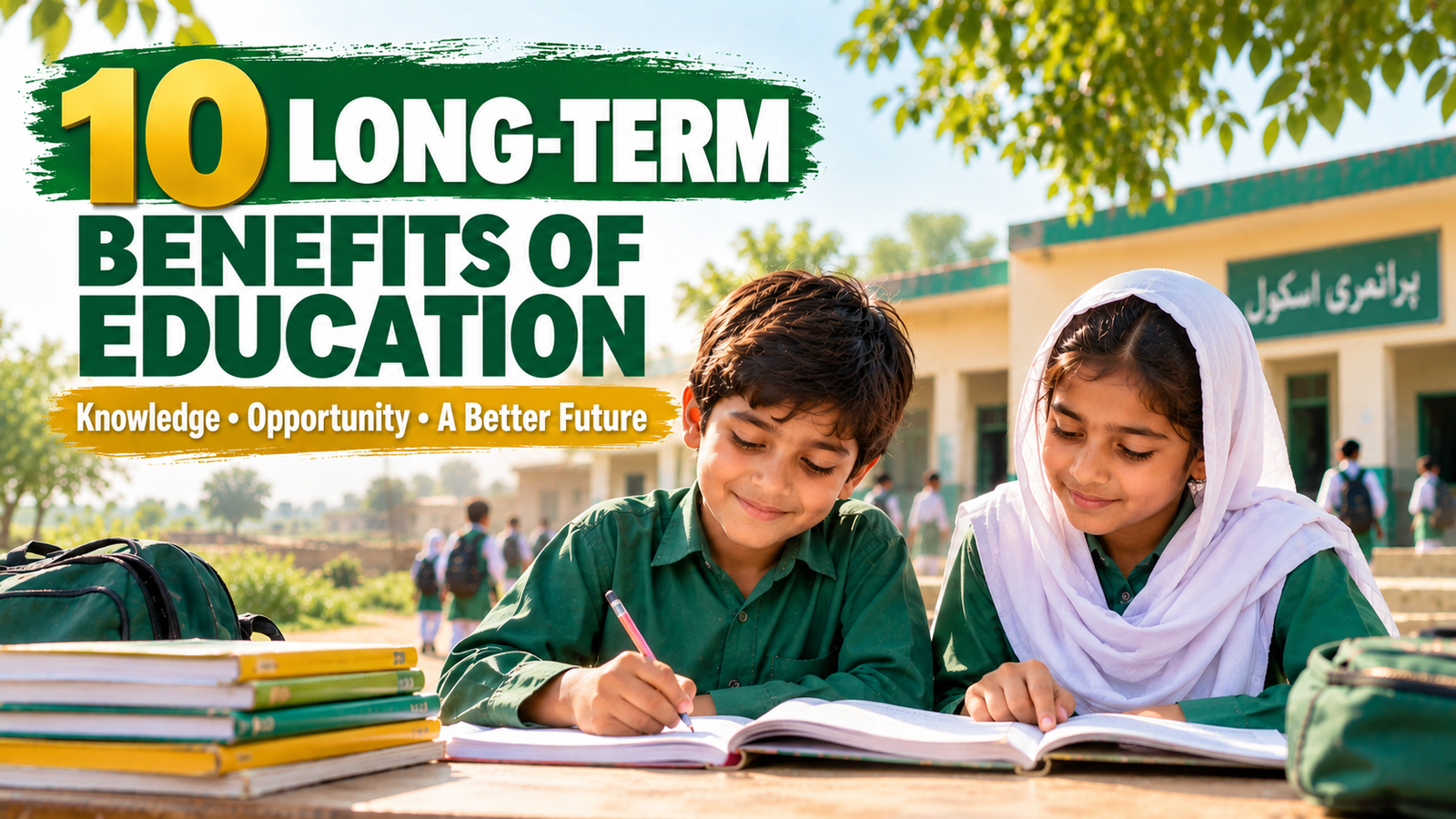
10 Long-Term Benefits of Education
When you give Sadaqah Jariyah for education, the return on that investment compounds in ways that few other forms of charity can match. Here are ten proven, long-term benefits:
- Higher lifetime earnings. The World Bank estimates that each additional year of schooling can raise an individual’s future earnings by up to 10%, giving a child a realistic path out of poverty.
- Reduced child labor. A child who is in school is a child who is not in a brick kiln, a farm field, or a workshop before sunrise.
- Improved family health outcomes. Educated individuals are more likely to understand nutrition, hygiene, and preventive healthcare, lowering illness and child mortality within the household.
- Delayed early marriage. Girls who stay in school past puberty are significantly less likely to be married off as children, protecting their health and futures.
- Stronger civic participation. Literate adults are more able to understand their rights, vote meaningfully, and engage with local governance.
- Greater economic resilience. Educated households recover faster from floods, droughts, and economic shocks because they have more diverse skills and options.
- Lower crime and extremism vulnerability. Communities with strong education access consistently show lower recruitment into criminal networks and extremist ideologies, which often prey on hopelessness and idle time.
- Intergenerational knowledge transfer. An educated parent almost always insists on educating their own children — the cycle becomes self-sustaining.
- Better mental health and self-esteem. Literacy and skill-building give children a sense of purpose and dignity that poverty alone cannot provide.
- A living, walking sadaqah jariyah. Perhaps most importantly for the donor: every skill that child uses for the rest of their life — as a teacher, nurse, engineer, or simply a literate parent — continues to generate reward for the person who funded that first year of school.
| Benefit Area | Life Without Education Access | Life With Sadaqah Jariyah for Education |
|---|---|---|
| Income Potential | Limited to daily-wage or informal labor | Up to 10% higher lifetime earnings per extra year of schooling |
| Health Awareness | Higher risk of preventable illness | Better hygiene, nutrition, and healthcare decisions |
| Marriage Age (Girls) | Higher risk of early/child marriage | Marriage typically delayed, health and safety improved |
| Family Cycle | Poverty often repeats across generations | Educated parents more likely to educate their own children |
| Community Role | Limited civic and economic participation | Greater ability to work, vote, lead, and contribute |
| Spiritual Reward for Donor | One-time reward for the initial gift | Continuous reward (Sadaqah Jariyah) for as long as knowledge is used |
Education and Breaking Generational Poverty
Poverty in Pakistan is rarely a single generation’s problem — it is usually inherited. A parent who never learned to read cannot help a child with homework. A household that cannot afford school fees for one child usually cannot afford them for the next either. This is how the same families remain trapped in the same economic bracket decade after decade, no matter how hard they work.
Sadaqah Jariyah for education interrupts that inheritance. Research consistently shows that the single strongest predictor of whether a child will attend school is whether their parents did. By funding just one child’s education today, donors are not only changing one life — they are very often changing the default expectation for every child that comes after them in that family. An educated older sibling frequently becomes the reason younger siblings are kept in school, even after the original sponsorship ends. A mother who learns to read a prescription label is more likely to make sure her own children are literate too.
This is why an education charity approach to giving is considered by many scholars to be among the most strategically powerful uses of zakat and sadaqah funds — it doesn’t just relieve poverty temporarily, it removes the mechanism that reproduces it.
For a deeper look at how we’re tackling this cycle directly, see INTERNAL LINK: “Breaking the Poverty Cycle: Yaqeen’s Approach to Sustainable Aid”.
Supporting Girls’ and Boys’ Education
While both boys and girls in Pakistan face real barriers to schooling, the data consistently shows that girls are pulled out of school earlier and in greater numbers, particularly once they reach secondary-school age. Distance to school, safety concerns, household chore expectations, and early marriage pressures disproportionately affect girls.
At the same time, boys are not exempt from the crisis — many are pulled into paid labor at a young age precisely because they are seen as the family’s primary future earners, ironically cutting short the very education that would have maximized their earning potential.
A responsible Islamic education charity does not choose between the two. Supporting both girls’ and boys’ education is essential:
- For girls: Every additional year of secondary schooling can raise a girl’s future earnings by 15–25%, delay early marriage, and improve outcomes for her own future children.
- For boys: Education reduces vulnerability to child labor, exploitation, and recruitment into harmful networks, while building the skilled workforce Pakistan needs.
When you give Sadaqah Jariyah for education, you can often choose to sponsor a girl, a boy, or a general education fund that goes wherever the need is greatest — but the underlying principle from Islam is the same: knowledge is a right owed to every child, regardless of gender.
Read more in INTERNAL LINK: “Why Girls’ Education Is One of the Most Urgent Causes in Pakistan Today”.
How Sadaqah Jariyah for Education Compares to Other Charitable Giving
At Yaqeen Welfare Foundation, we fund water wells, medical camps, and emergency food relief alongside education — and we’re often asked how these different forms of giving stack up against each other in terms of long-term impact. Every category of sadaqah jariyah matters, and none should be seen as competing with the others. But when donors ask us which cause offers the deepest, longest-running return on a single gift, education consistently stands out.
A water well can serve a village for a decade or two before it needs major repair. A medical camp treats patients for as long as it remains funded and staffed. A food package feeds a family for days or weeks. Each of these is a genuine, valuable sadaqah jariyah in its own right — but a child’s education is different in one crucial way: it doesn’t just serve the recipient, it reproduces itself. An educated child grows into an educated parent, who is statistically far more likely to insist their own children attend school too. The “well” of benefit doesn’t just keep flowing — it digs new wells of its own.
| Type of Sadaqah Jariyah | Immediate Need Met | Typical Duration of Benefit | Who Benefits Over Time | Generational Impact |
|---|---|---|---|---|
| Water Well | Clean drinking water, sanitation | 10–20+ years, until major repair is needed | An entire village, refreshed daily | Indirect — improves health and frees up time otherwise spent fetching water |
| Medical Camp / Clinic Support | Treatment for illness and injury | Ongoing, for as long as the clinic operates | Hundreds of patients per year | Indirect — healthier parents raise healthier children |
| Food / Ration Package | Relief from hunger | Days to weeks per package | One household per delivery | Minimal — short-term relief, rarely changes long-term trajectory |
| Mosque Construction | A place of worship | Decades, sometimes centuries | The whole community, indefinitely | Indirect — sustains spiritual continuity across generations |
| Sadaqah Jariyah for Education | Literacy, skills, and future opportunity | The child’s entire lifetime, and beyond | One child, then that child’s own children, then their community | Direct — actively breaks the cycle of generational poverty |
This is not an argument to give less toward water, medical care, or emergency food — all three remain urgent, life-saving needs, and we hope you’ll continue supporting them through our other appeals such as INTERNAL LINK: “How Ration Packages Provide Emergency Relief to Families in Need”. It is simply to say that Sadaqah Jariyah for education deserves a permanent place in every Muslim donor’s giving plan, precisely because its benefit compounds rather than depletes.
Can Education Be Sadaqah Jariyah?
The Short Answer: Yes — Education Is Among the Strongest Forms of Sadaqah Jariyah
Scholars across the four major schools of Islamic jurisprudence agree that any act whose benefit continues to flow to others over time qualifies as sadaqah jariyah — a well that keeps giving water, a mosque that keeps hosting prayer, or a book that keeps teaching readers long after the author has passed. Education fits this definition perhaps more completely than any other category of charity.
Why Sadaqah Jariyah for Education Outlasts Almost Any Other Gift
When you fund a water well, its benefit ends when the well eventually runs dry or falls into disrepair. When you fund a meal, its benefit ends when the meal is eaten. But when you fund a child’s education, the benefit multiplies rather than depletes. That child grows into an adult who uses their literacy every single day — to read a contract, teach their own child the alphabet, follow a doctor’s instructions, or start a small business. Each of those moments is, according to the hadith on continuous charity, a moment of “beneficial knowledge” still generating reward for the original donor.
This is why many scholars specifically encourage donors to think of school sponsorships, scholarship funds, and literacy programs as among the highest-value uses of sadaqah — the return on investment, spiritually and socially, simply does not stop compounding.
What Your Sadaqah Jariyah for Education Donation Can Cover
One of the most common questions we receive is simply: “What does my money actually pay for?” Transparency matters, especially for a gift as meaningful as Sadaqah Jariyah for education. While exact costs vary by region, school level, and the specific child or program you support, most education sponsorships are built around a few recurring categories of need. The table below gives a general sense of how contributions typically translate into real classroom impact.
| Contribution Level | Illustrative Coverage* |
|---|---|
| One-time gift | School uniform, bag, and basic stationery for one child |
| Monthly sponsorship (essentials) | Tuition fees and textbooks for one child, month to month |
| Monthly sponsorship (full support) | Tuition, books, uniform, and transport for one child |
| Annual sponsorship | A full academic year of schooling for one child, start to finish |
| Family / sibling sponsorship | Multiple children from the same household supported together |
*These categories are illustrative only. Please contact our team for Yaqeen Welfare Foundation’s current, exact sponsorship packages and costs before donating.
Whatever level you choose, the principle behind the gift stays the same: you are not paying for a single semester — you are funding a foundation the child will stand on for the rest of their life, and often pass on to their own children as well.
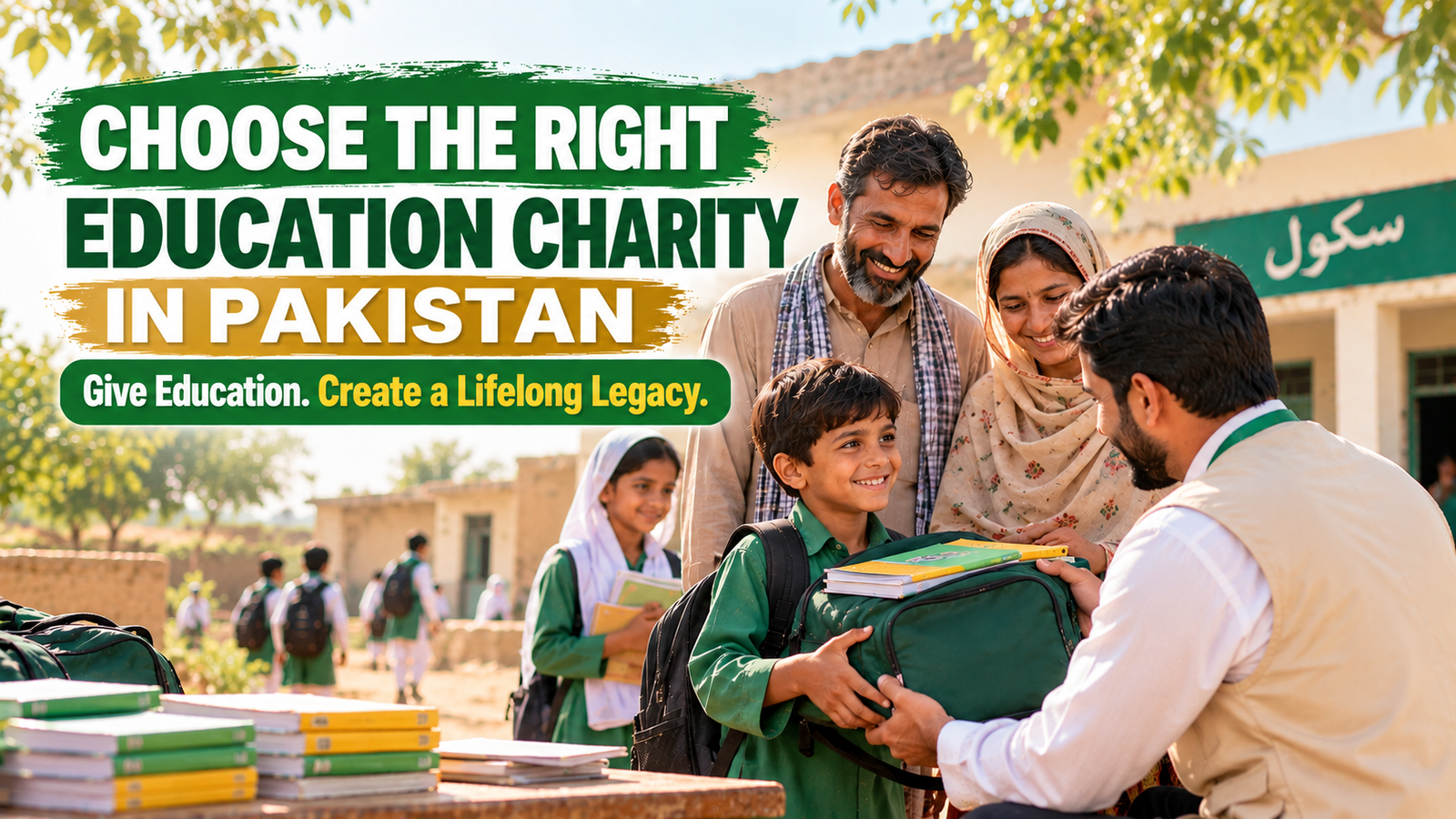
How to Choose the Right Education Charity in Pakistan
Not every education charity operates with the same transparency or long-term commitment, so it’s worth knowing what to look for before you donate for education. A few questions worth asking of any organization, including ours:
- Does the charity provide regular, verifiable updates? A trustworthy Islamic education charity should be willing to show you progress reports, photos, or attendance records tied to your specific contribution or program.
- Is the support ongoing, not one-off? A single term of tuition can help, but children who lose funding mid-year often drop out entirely. Look for organizations committed to multi-year support wherever possible.
- Does the program address the whole barrier, not just fees? The strongest programs to help poor children in Pakistan also account for uniforms, transport, books, and — where needed — nutrition, since any one of these gaps can pull a child out of school even if tuition itself is covered.
- Is the organization active where the need is greatest? Flood-affected districts, rural provinces with low female enrollment, and areas with minimal government school infrastructure should be genuine funding priorities, not afterthoughts.
- Can you ask questions and get a real answer? A charity confident in its work will make it easy to contact them directly rather than routing every question through a generic form.
Yaqeen Welfare Foundation was built around exactly these principles — pairing Sadaqah Jariyah for education with the same on-the-ground transparency we apply to our clean water and medical relief work in Pakistan.
FAQs
1. What exactly does “Sadaqah Jariyah” mean? Sadaqah Jariyah literally translates to “ongoing” or “flowing” charity. It refers to a charitable act whose benefit continues to reach people over time, meaning the spiritual reward for the giver also continues, even after death, as long as the benefit is still being used.
2. How is Sadaqah Jariyah for education different from a one-time donation? A one-time donation, like buying a meal, provides a single, immediate benefit. Sadaqah Jariyah for education continues to benefit the recipient — and generate reward for the donor — for as long as that child uses the skills and knowledge they gained, often for their entire life and even into the next generation.
3. How much does it cost to sponsor a child’s education through Yaqeen Welfare Foundation? Costs vary by program, level of schooling, and region, but many sponsorships are designed to be affordable on a monthly basis, covering tuition, books, and uniforms. Contact our team for exact, up-to-date sponsorship packages.
4. Can Zakat be used to fund a child’s education? In many cases, yes — provided the sponsorship reaches an eligible recipient (such as a child from a Zakat-eligible household). We recommend confirming eligibility details with our team before donating, since Zakat rulings can vary by school of thought and individual circumstance.
5. Is my donation tax-deductible? This depends on your country of residence and Yaqeen Welfare Foundation’s registered charitable status in that jurisdiction. Please reach out to our team for documentation relevant to your location.
6. Can I sponsor a specific child, or is it a general fund? Both options are typically available. Many donors prefer general education funds so resources go to the most urgent cases, while others prefer to sponsor and follow the progress of a specific child. Ask our team which options are currently open.
7. How do I know my donation is actually being used for education? Reputable education charity organizations provide regular updates, progress reports, and transparency on how funds are used. Feel free to request the latest impact report when you donate for education through Yaqeen Welfare Foundation.
8. Does Yaqeen Welfare Foundation only fund education, or also clean water and medical aid? Education is one pillar of our work, alongside clean water projects and free medical treatment for communities across Pakistan. Many donors choose to support more than one cause, since the needs are often connected — a family struggling with waterborne illness, for instance, may also be struggling to keep a child in school.
9. What age range of children can be sponsored? Sponsorship programs typically cover children from primary school age through secondary school, with some organizations extending support into vocational training or higher education for exceptional students. Contact our team for the specific age ranges currently open for sponsorship.
Ready to Give a Child a Lifelong Gift?
Sadaqah Jariyah for education is one of the few gifts you can give that keeps growing long after you’ve given it. A single sponsorship today can be the difference between a child spending their life in a brick kiln or a classroom — and between a family staying trapped in poverty or breaking free of it for good.
Contact Yaqeen Welfare Foundation online to donate for education today »