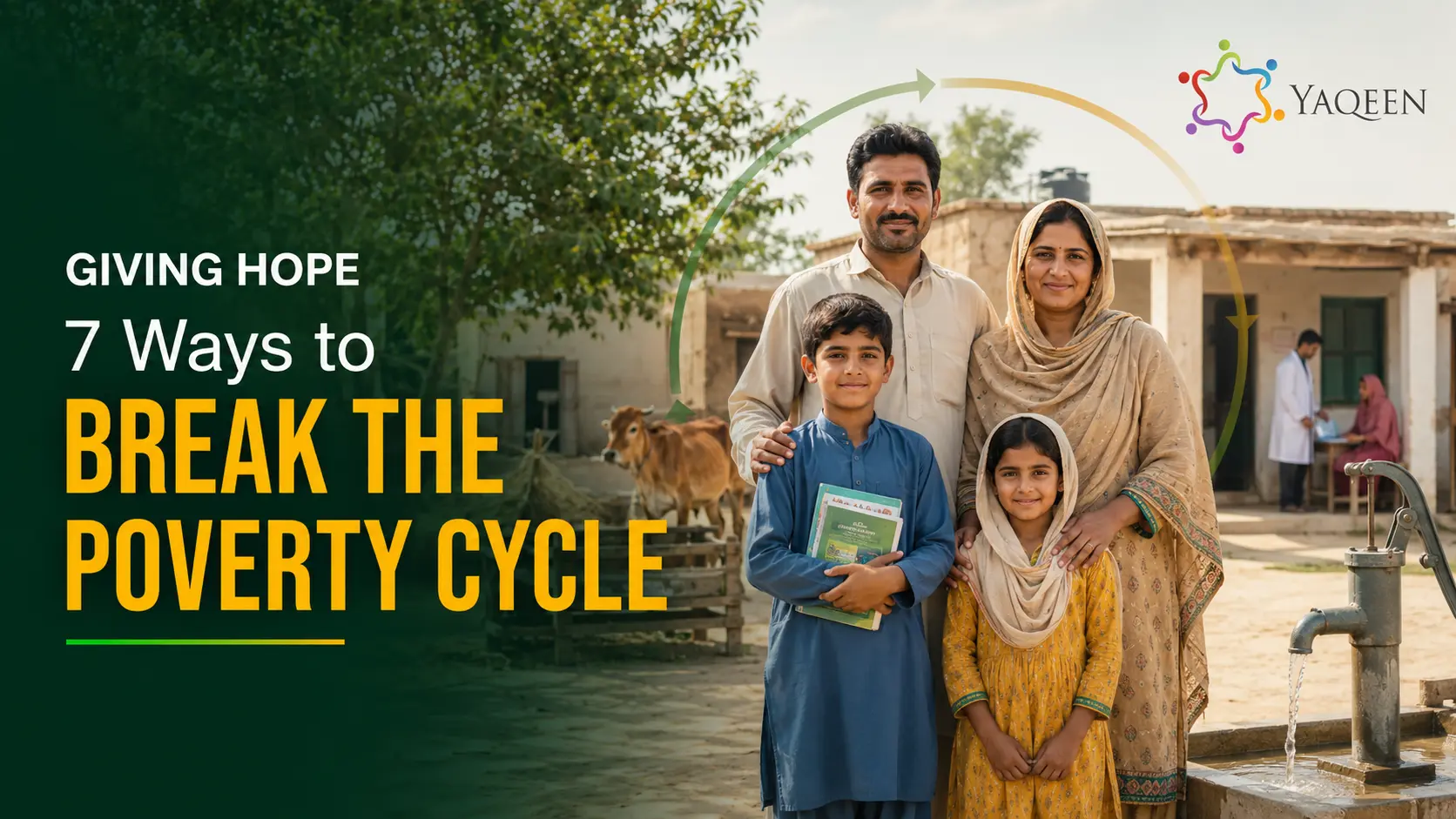
Giving Hope: 7 Ways to Break the Poverty Cycle
Poverty cycle — breaking it may sound like an enormous goal, but meaningful progress often begins with one thoughtful act of giving. A medical consultation, a month of food assistance, access to clean water, school supplies, safe housing, or a livelihood opportunity can help a vulnerable family move from repeated crisis toward greater stability.
Poverty is rarely the result of one problem. It is often a combination of illness, lost income, limited education, unsafe drinking water, food insecurity, poor housing, debt, and a lack of opportunities. These hardships can reinforce one another until a temporary emergency becomes a long-term struggle.
Imagine a rural family whose primary income earner becomes ill. Without affordable healthcare, the family may borrow money for treatment or delay medical care entirely. If the illness continues, the parent may be unable to work. Food quality may decline, children may miss school, and household savings may disappear. The family may then sell livestock, tools, or other productive assets simply to survive.
This is how the poverty cycle becomes difficult to escape: one challenge creates another, and every new challenge reduces the family’s ability to recover.
Giving creates hope when it does more than address the visible emergency. Responsible charitable support can protect health, preserve education, restore income, reduce future risks, and give families the resources they need to rebuild with dignity.
At Yaqeen Welfare Foundation, the focus includes accessible healthcare, maternal and child health, clean water and sanitation, health education, and community development for underserved communities in Pakistan. These areas are closely connected because a family needs more than one form of support to build a stable future.
This guide explores seven practical ways charitable giving can help break the poverty cycle while protecting dignity, encouraging independence, and creating sustainable impact.
Understanding the Poverty Cycle
The poverty cycle describes a situation in which a family’s current hardship creates conditions that make future hardship more likely.
Low income may limit access to healthcare. Poor health may then reduce a person’s ability to work. Lost income can prevent children from attending school. Limited education may reduce their future employment choices, allowing poverty to continue into the next generation.
The cycle may look like this:
Low income → unmet basic needs → poor health or interrupted education → fewer opportunities → continued low income
However, poverty is not simply a lack of money. It may include limited access to services, unsafe living conditions, social exclusion, vulnerability to emergencies, and an inability to recover from financial shocks.
The World Bank’s Pakistan Poverty and Equity Brief (October 2025) found that Pakistan’s growth remains too weak to meaningfully reduce poverty, and highlighted the vulnerability of rural households with limited savings, informal employment, and exposure to climate-related shocks.
These conditions mean that even a relatively small emergency can have long-term consequences. A medical bill, damaged roof, failed crop, unsafe water source, or interruption in employment can push a vulnerable household deeper into hardship.
Charity alone cannot solve every structural cause of poverty. However, well-planned charitable programs can help families overcome specific barriers, protect essential household resources, and build a stronger path toward independence.
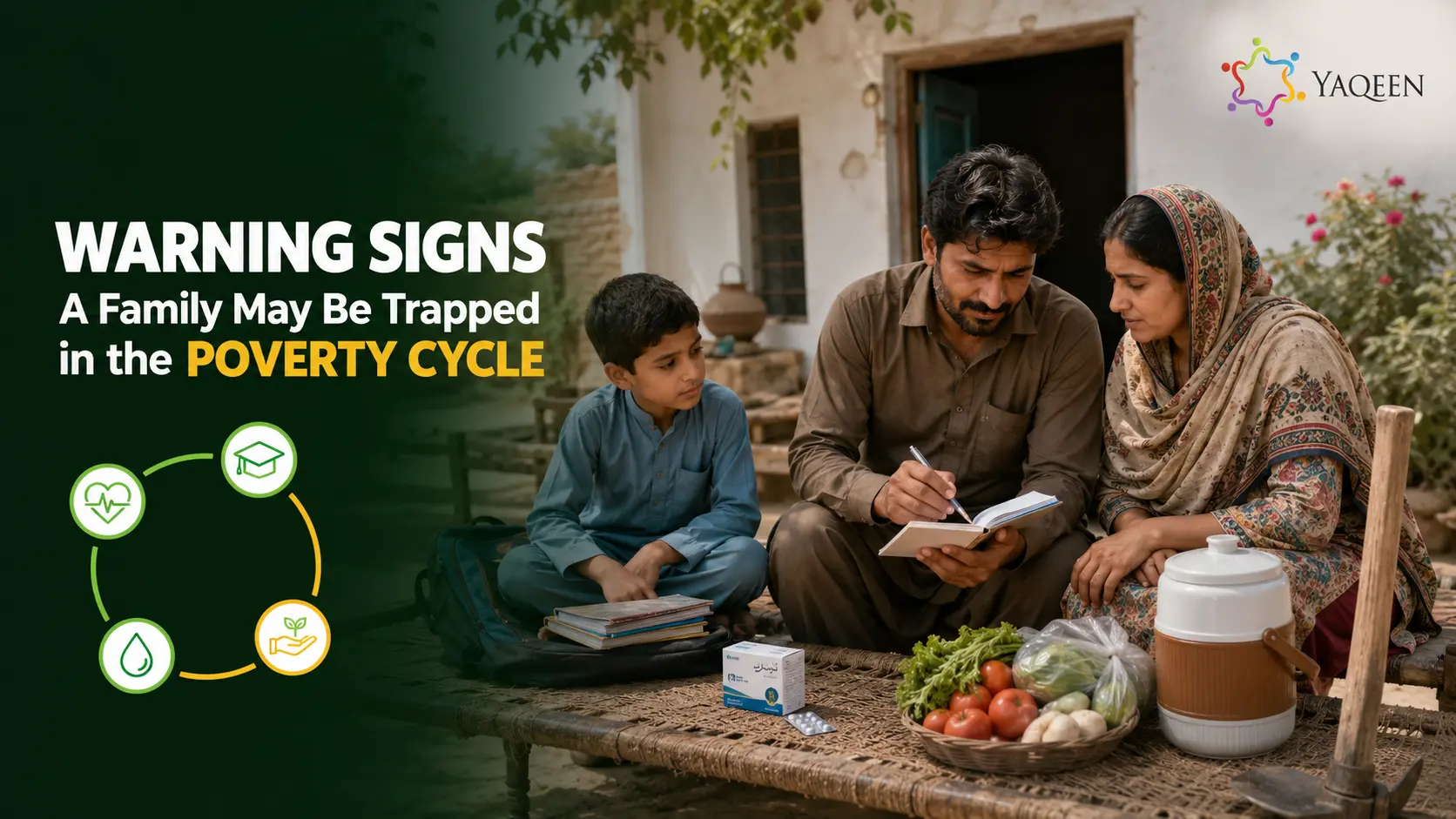
Warning Signs a Family May Be Trapped in the Poverty Cycle
Recognizing these signs early can help donors and organizations target the right kind of support before a temporary setback becomes permanent.
| Warning Sign | What It Often Signals | Type of Support That Can Help |
|---|---|---|
| Delaying or skipping medical treatment | Household cannot absorb healthcare costs without sacrificing other needs | Free or affordable healthcare |
| Children missing school or dropping out | Family needs the child’s labor or income, or cannot afford school costs | Education assistance, scholarships |
| Walking long distances for water | No safe water source nearby; time and health are both at risk | Community wells, water infrastructure |
| Reducing meals or meal quality | Income has been interrupted or diverted to another crisis | Emergency food assistance |
| Living in a damaged or unrepaired home | Repeated repair costs are consuming limited household savings | Housing repair or shelter support |
| Selling tools, livestock, or productive assets | The household is liquidating its future earning capacity to survive today | Livelihood support, emergency relief |
| Borrowing repeatedly for basic needs | Debt is replacing income as the main coping mechanism | Zakat, Sadaqah, or structured livelihood programs |
How Giving Can Break the Poverty Cycle
| Area of Support | Problem It Addresses | Immediate Benefit | Potential Long-Term Impact |
|---|---|---|---|
| Healthcare | Untreated illness and medical expenses | Consultation, medicine, screening, or treatment | Better health, fewer missed workdays, protected household income |
| Education | School costs and interrupted learning | Fees, supplies, uniforms, or scholarships | Better skills and wider future employment opportunities |
| Clean water | Waterborne illness and time spent collecting water | Safer, more accessible water | Improved health, school attendance, and productivity |
| Food assistance | Hunger and poor nutrition | Nutritious food during a crisis | Protected health and greater household stability |
| Safe housing | Unsafe shelter and repeated repair costs | Security and protection from weather | A stable environment for work, education, and family life |
| Livelihood support | Unemployment and lack of productive resources | Skills, tools, livestock, or small-business support | More reliable income and reduced dependence |
| Zakat and Sadaqah | Multiple urgent and long-term needs | Flexible and targeted assistance | Dignified recovery and sustainable community benefit |
1. Accessible Healthcare Protects Health and Household Income
Healthcare can play a central role in efforts to break the poverty cycle because illness affects far more than the body. It can interrupt employment, education, caregiving, and the financial stability of an entire household.
For a family with limited income, healthcare expenses may include consultation fees, medicines, diagnostic tests, transportation, and lost wages. When families cannot afford these costs, they may postpone treatment, reduce food spending, borrow money, or sell valuable household assets.
Delayed care can allow a manageable health condition to become more serious. A person who could have recovered with an early consultation and affordable medicine may later require more complex and expensive treatment.
The World Health Organization’s Universal Health Coverage fact sheet explains that healthcare should be available when and where people need it without creating financial hardship, and reports that 2.1 billion people faced financial hardship in 2022, including 1.6 billion people living in poverty or pushed deeper into it due to out-of-pocket health expenses.
Free or affordable healthcare programs can provide:
- Primary medical consultations
- Essential medicines
- Maternal and child healthcare
- Preventive screenings
- Immunizations
- Health education
- Diagnostic support
- Follow-up services
- Referrals for specialized treatment
Early evaluation can reduce avoidable complications and help patients return to normal life sooner. When a parent recovers, the benefits may include restored income, continued school attendance for children, improved nutrition, and reduced household debt.
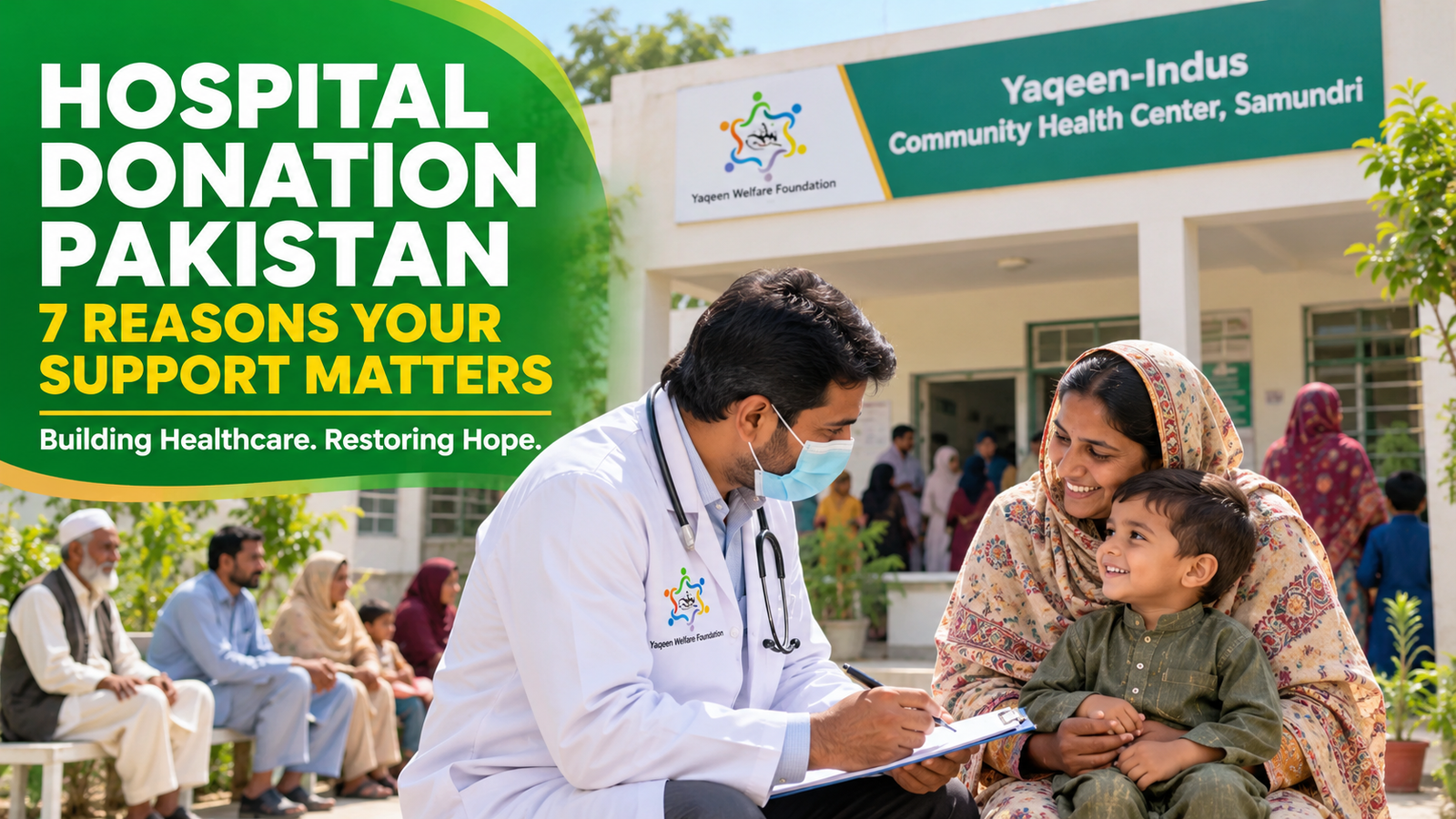
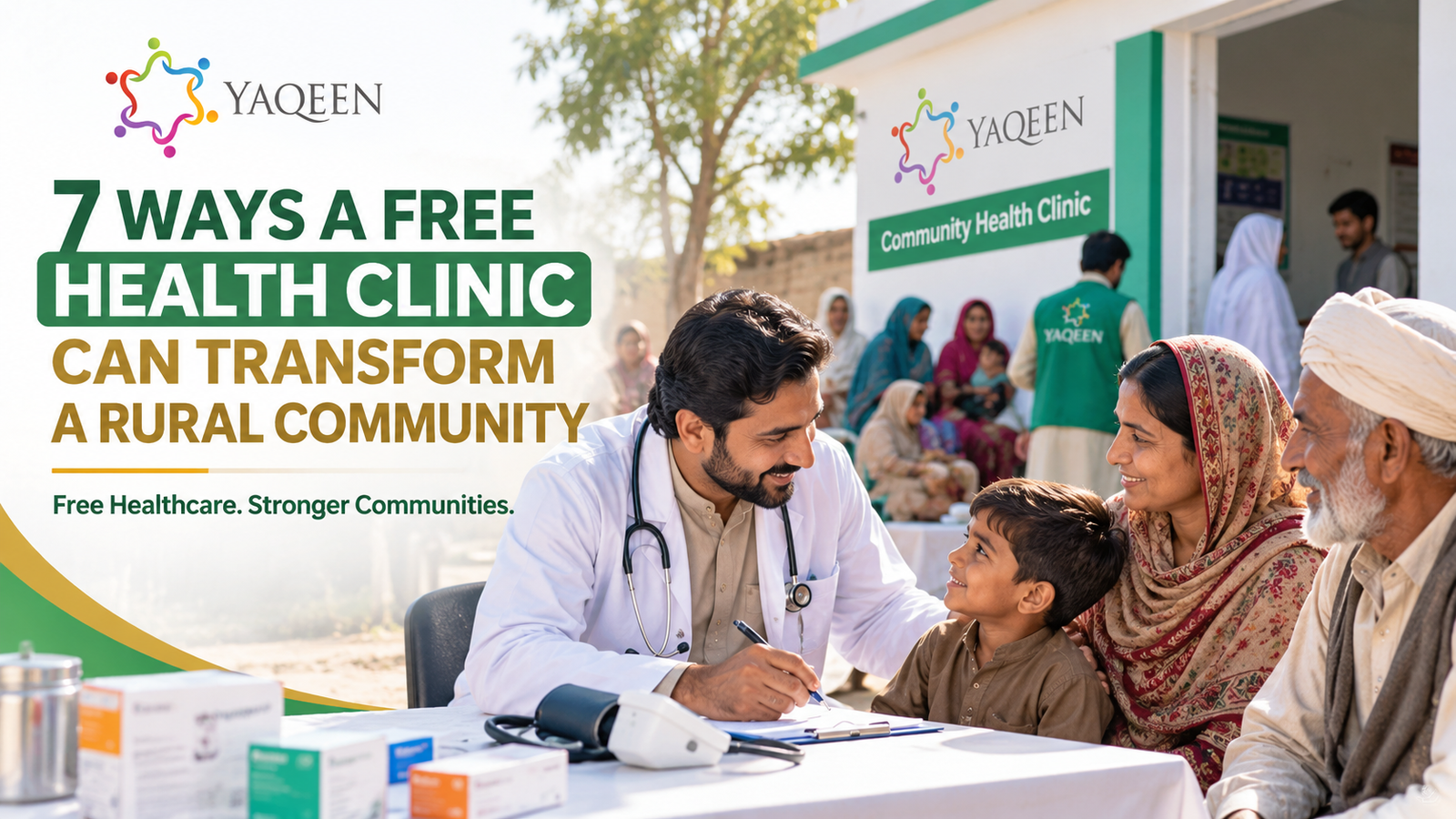
Yaqeen Welfare Foundation’s healthcare work includes free medical consultations, follow-up visits, treatment, essential medicines, and immunizations at the Yaqeen-Indus Community Health Center in Samundri, Faisalabad.
To understand the connection between illness and financial hardship in more detail, read 7 Ways Free Medical Care Can Break the Cycle of Poverty.
Healthcare giving is therefore not only about paying for treatment. It can help protect a family’s earning ability, preserve limited savings, and prevent a health emergency from becoming a long-term economic crisis.
Healthcare Is the First Link in the Poverty Cycle
When that link is protected, every other form of assistance — education, food, housing, livelihood — works better, because the household isn’t losing its main earner to an untreated illness.
2. Education Turns Limited Opportunity Into Future Possibility
Education is one of the most important long-term tools to break the poverty cycle. It gives children knowledge, confidence, problem-solving skills, and better opportunities to participate in the economy.
However, poverty can make regular school attendance difficult. Even when tuition is free, families may struggle to afford uniforms, books, stationery, transportation, examinations, digital resources, or other educational expenses.
Children may also leave school to work, care for siblings, collect water, or help manage household responsibilities. This may offer temporary help to the family, but it can reduce the child’s future earning opportunities.
UNICEF Pakistan’s Education overview reports that an estimated 25.1 million children aged 5-16 are out of school in the country, with disproportionate barriers affecting disadvantaged children, including girls in some regions.
Educational assistance can include:
- School-fee support
- Uniforms and shoes
- Books and stationery
- Transportation
- Scholarships
- Digital learning resources
- Tutoring
- Vocational education
- Practical skills training
When donors support education, they are not only paying for a child’s current lessons. They are helping protect the child’s ability to make future choices.
A child who stays in school may be better prepared to find stable employment, understand health information, manage finances, and support the next generation. Education can also reduce the likelihood that children will be forced into unsafe work or become permanently dependent on emergency assistance.
Educational programs should consider more than enrollment. Successful support also examines attendance, learning quality, family circumstances, safety, and whether children can complete each stage of education.
For young adults who are no longer in school, vocational training can offer another path. Training linked to realistic local employment opportunities may help individuals learn a trade, start a small business, or improve an existing livelihood.
When education is combined with food, healthcare, safe water, and family support, children have a much better chance of remaining in school and benefiting from the opportunity — one more way giving helps break the poverty cycle at its roots.
3. Clean Water Protects Health, Time, and Education
Access to clean water can help break the poverty cycle by reducing preventable illness and returning valuable time to families.
In communities without nearby safe water, women and children may spend hours collecting it. Time spent walking to a distant source is time that cannot be used for school, paid work, household production, rest, or caregiving.
The water they collect may still be unsafe. Contaminated water can contribute to diarrheal illness and other health problems, creating medical expenses and causing children and adults to miss school or work.
UNICEF Pakistan’s Water, Sanitation and Hygiene overview describes major challenges related to contaminated drinking water, sanitation, hygiene, and access to appropriate facilities in schools and healthcare settings, noting that an estimated 70 percent of households still drink bacterially contaminated water.
Charitable water initiatives may include:
- Community water wells
- Hand pumps
- Solar-powered water systems
- Water filtration
- Repairs to damaged water infrastructure
- Safe water-storage facilities
- Sanitation improvements
- Hygiene education
- Water facilities for schools and clinics
A properly planned water project can support many families every day. It may reduce the time required to collect water, improve hygiene, support school attendance, and reduce household spending on preventable illness.
However, building a water source is only the beginning. Sustainable projects require site assessment, suitable technology, water-quality considerations, community participation, maintenance planning, and follow-up monitoring.
When local communities understand how to use and maintain a water system, the benefits are more likely to continue.
Donors interested in supporting this essential need can read A Drop of Water Donation, a Sea of Reward in 5 Beautiful Ways and 5 Reasons a Water Well Is the Best Sadaqah Jariyah. Both articles explain how water projects can help underserved rural communities and how sustainable water access may become a form of continuing charity.
Clean water does not solve every dimension of poverty, but it removes a daily burden that affects health, education, income, and dignity at the same time — cutting off one more feeder into the poverty cycle.
4. Food and Nutrition Support Protect Families During Crisis
Food assistance can help break the poverty cycle by protecting families when income is interrupted or essential costs become unaffordable.
When a household faces a medical emergency, job loss, crop failure, flood, or other crisis, food spending may be reduced first. Parents may eat less so their children can eat. Families may choose cheaper but less nutritious foods or borrow money for groceries.
Hunger affects more than physical comfort. Poor nutrition can weaken the body, affect childhood development, reduce concentration, and make it harder for adults to work consistently.
For school-age children, hunger can contribute to poor attendance and difficulty focusing in class. A child may technically remain enrolled but be unable to benefit fully from education.
Responsible food support can include:
- Nutritious family food packages
- Emergency groceries
- Ramadan food assistance
- Meals for vulnerable children
- Maternal nutrition
- Support for elderly or disabled individuals
- Seeds, tools, livestock, or agricultural support
- Community food-production initiatives
Emergency food distributions are vital when families have nothing to eat. However, they are most effective when connected with a broader recovery plan.
For example, a family affected by illness may need food assistance while the patient receives treatment. Once health improves, livelihood support may help restore income. Educational assistance can keep the children in school throughout the crisis.
This combination prevents the family from making harmful survival choices, such as withdrawing children from school, taking high-interest loans, or selling the tools used to earn an income.
Food support should be delivered respectfully. Families should not be publicly identified, photographed without meaningful consent, or made to feel ashamed for seeking help.
The goal is not merely to distribute food. It is to protect health and dignity while helping the household reach a more stable position — and stay out of the poverty cycle once the immediate crisis passes.
5. Safe Housing Creates a Foundation for Recovery
Safe housing can help break the poverty cycle because a secure home affects almost every other part of family life.
A home provides protection from heat, cold, rain, unsafe environments, and displacement. It gives children a place to sleep and study and gives adults a stable base from which to work, care for family members, and plan for the future.
Families living in damaged or insecure housing may face repeated expenses. A leaking roof, unsafe walls, poor ventilation, lack of sanitation, or exposure to harsh weather can contribute to illness and require constant repairs.
Housing insecurity can also interrupt education. Children may frequently relocate, lose school materials, or struggle to study in an unsafe environment.
Housing assistance may include:
- Repairing roofs and damaged walls
- Improving sanitation facilities
- Providing weather protection
- Supporting emergency shelter
- Rebuilding disaster-damaged homes
- Providing essential household items
- Improving accessibility for elderly or disabled residents
The right response depends on the family’s circumstances. Some households need an entirely new home, while others may become safe and stable through essential repairs.
Yaqeen Welfare Foundation’s broader program work connects shelter and basic assistance with opportunities for people to rebuild their livelihoods.
This connection is important. A home can provide immediate protection, but families also need a way to maintain it. When safe housing is combined with employment, education, healthcare, water, and sanitation, it becomes a foundation for long-term stability.
Housing support should always protect privacy and dignity. A family’s hardship should never be used as entertainment or presented without context simply to attract donations.
The strongest housing initiatives see beneficiaries as partners in rebuilding — not passive recipients — which is essential to breaking the poverty cycle for good rather than temporarily interrupting it.
6. Livelihood Support Helps Replace Dependence With Income
Livelihood assistance can help break the poverty cycle by giving individuals the tools, skills, or opportunities needed to earn a more reliable income.
Many people experiencing poverty are willing and able to work. The problem may be a lack of training, equipment, startup resources, transportation, market access, or employment opportunities.
A farmer may need seeds, livestock, or irrigation support. A skilled woman may need a sewing machine to earn income from home. A young adult may need vocational training. A small shopkeeper may need basic equipment to restart after an emergency.
Effective livelihood support may include:
- Vocational training
- Agricultural tools
- Livestock
- Sewing machines
- Small-business equipment
- Employment preparation
- Mentorship
- Financial literacy
- Market connections
- Transportation assistance
- Support for home-based work
Livelihood programs must be designed carefully. Giving someone equipment without assessing local demand may not produce sustainable income. Training people for jobs that do not exist in their area can also create disappointment rather than opportunity.
Before providing livelihood support, organizations should ask:
- What skills does the person already have?
- What work is realistically available locally?
- Is there demand for the proposed product or service?
- What equipment or training is genuinely necessary?
- Are there barriers related to health, caregiving, transportation, or safety?
- What follow-up support will be available?
- How will progress be measured?
The objective is not to promise that one donation will instantly eliminate poverty. It is to remove a specific barrier that prevents a capable individual from moving forward.
When livelihood support succeeds, household income may become more stable. The family may be better able to afford food, healthcare, school expenses, repairs, and emergency savings without repeated assistance.
This creates a positive pathway:
Skills → opportunity → income → stability → greater independence
Livelihood support is especially powerful when it follows emergency assistance. First, the family is stabilized. Then, the individual receives a realistic opportunity to rebuild — and to permanently exit the poverty cycle.
7. Zakat, Sadaqah, and Continuing Charity Create Hope
Zakat and Sadaqah can help break the poverty cycle when they are distributed responsibly and according to genuine need.
Zakat is an obligatory act of worship for eligible Muslims. Its distribution must follow Islamic principles, including the eligible recipient categories identified in the Qur’an. Zakat can help qualifying families meet essential needs, address debt, and regain stability.
Sadaqah is voluntary charity that may be given at any time. It can support healthcare, food, education, clean water, shelter, emergency relief, livelihoods, and other beneficial causes.
Sadaqah Jariyah is continuing charity that can generate ongoing benefit. A water source, educational resource, healthcare facility, or sustainable community project may continue serving people long after the initial donation.
These forms of giving can work together:
- Zakat may help an eligible family meet urgent financial needs.
- Sadaqah may fund healthcare, food, education, or shelter.
- Sadaqah Jariyah may support infrastructure with long-term community benefit.
- General donations may help organizations respond where needs are greatest.
Zakat vs. Sadaqah vs. Sadaqah Jariyah at a Glance
| Zakat | Sadaqah | Sadaqah Jariyah | |
|---|---|---|---|
| Obligation | Obligatory for eligible Muslims | Voluntary | Voluntary |
| Timing | Calculated annually on qualifying wealth | Any time | Any time |
| Eligible recipients | Must meet specific Qur’anic categories | Any person or cause in genuine need | Any sustainable, benefit-generating project |
| Best suited for | Urgent financial needs of qualifying individuals | Healthcare, food, education, shelter, emergencies | Water wells, clinics, schools, and other lasting infrastructure |
| Role in breaking the poverty cycle | Provides dignified, rule-based relief to the eligible poor | Responds flexibly wherever the need is greatest | Keeps generating benefit long after the original gift |
For a detailed explanation of eligible Zakat recipients, read Zakat in 2026: A Complete Guide to Who Can Receive Your Zakat.
To explore how voluntary charity can affect multiple parts of family life, read 11 Powerful Ways Sadaqah Can Change a Family’s Future.
The value of giving is not determined only by the amount. A smaller donation used responsibly may protect a child’s education, provide medicine, contribute to a water project, or help a family survive a temporary crisis.
Regular giving can also help charities plan services more effectively. Predictable support allows organizations to maintain programs, purchase supplies, monitor projects, and respond before emergencies become more severe.
Zakat and Sadaqah Are the Glue That Holds the Poverty Cycle Response Together
Because they can move flexibly toward whatever a family needs most, they often connect healthcare, food, water, and livelihood support into a single, coordinated response.
Break the Poverty Cycle Through Connected Support
No single intervention can fully break the poverty cycle for every family. Poverty is interconnected, so meaningful solutions must also be connected.
Consider a household where a parent becomes seriously ill:
- Healthcare assistance provides evaluation and treatment.
- Food support protects the family while income is interrupted.
- Educational assistance keeps the children in school.
- Housing support prevents unsafe living conditions from worsening.
- Livelihood assistance helps restore income after recovery.
- Clean water reduces future health risks.
- Zakat or Sadaqah provides dignified financial support throughout the process.
Each intervention addresses a different point in the cycle. Together, they can prevent one medical emergency from becoming years of hardship.
This approach does not mean every family receives every service. It means assistance should be based on a careful understanding of the household’s needs, risks, abilities, and path toward stability.
Why Dignity Must Be Central to Giving
Efforts to break the poverty cycle must protect the dignity of the people receiving assistance.
People living in poverty are not defined by their financial situation. They are parents, children, workers, caregivers, students, and community members with skills, relationships, and ambitions.
Ethical charitable work should include:
- Respectful communication
- Careful verification of need
- Meaningful consent
- Protection of personal information
- Appropriate use of photographs and stories
- Fair distribution processes
- Qualified professionals
- Clear financial accountability
- Follow-up and monitoring
- Opportunities for beneficiary feedback
Images of suffering may attract attention, but they should never exploit a family’s most difficult moment. Organizations should explain why information is being collected, how it will be used, and whether the individual is comfortable participating.
Donors should also look beyond the number of items distributed. A stronger measure of impact asks whether the support improved health, protected education, reduced risk, restored income, or helped a family move toward independence.
How Donors Can Give More Responsibly
If you want your contribution to help break the poverty cycle, consider the following principles.
Support verified needs. Choose organizations that assess needs before distributing assistance. This helps ensure that support reaches appropriate individuals and addresses real priorities.
Balance immediate relief with long-term recovery. Emergency food, medicine, and shelter are essential. Whenever possible, these should be connected with education, healthcare, livelihood support, or sustainable infrastructure.
Look for transparency. Responsible charities should clearly explain their programs, donation methods, and approach to accountability.
Prioritize dignity. Choose organizations that protect beneficiary privacy, obtain consent, and avoid using humiliating or exploitative messaging.
Consider regular giving. A monthly contribution can help maintain healthcare, education, water, and community programs throughout the year.
Share reliable information. Encouraging others to learn about verified needs can expand the impact without pressuring or misleading them.
Understand the form of charity. Before giving Zakat, confirm that the organization has an appropriate process for identifying eligible recipients. For Sadaqah Jariyah, consider whether the project is designed to provide ongoing benefit.
Building Hope Through Yaqeen Welfare Foundation
Yaqeen Welfare Foundation is a US-based nonprofit working in Pakistan through sustainable healthcare and community development.
Its stated focus areas include:
- Healthcare access
- Maternal and child health
- Clean water and sanitation
- Health education
- Community development
At the Yaqeen-Indus Community Health Center in Samundri, Faisalabad, patients can receive free medical consultations, follow-up visits, treatment, essential medicines, and immunizations regardless of their ability to pay.
This model recognizes that healthcare is closely connected to financial stability. When families receive care without facing unaffordable medical expenses, they may be better able to protect food, housing, education, and other essential household needs.
The broader goal is not simply to respond to poverty after it occurs. It is to strengthen the services and opportunities that can prevent families from becoming trapped in the poverty cycle in the first place.
Your Giving Can Become Someone’s Turning Point
To break the poverty cycle, families need more than sympathy. They need access to healthcare, education, safe water, food, shelter, livelihoods, and respectful support.
One donor may help fund a medical consultation. Another may contribute toward a clean-water system. Someone else may help a child remain in school or provide tools that allow a parent to earn an income.
Individually, these actions may seem small. Together, they can create a path from hardship to stability.
A thoughtful donation may help:
- A patient receive treatment before an illness becomes more serious
- A parent return to work
- A child continue attending school
- A rural family access safer water
- A vulnerable household receive nutritious food
- A family repair an unsafe home
- A skilled individual start earning an income
Giving creates hope because it tells families that their hardship is seen and that recovery is possible. When compassion is combined with careful planning, transparency, and dignity, charitable support can become a genuine turning point in the poverty cycle.
Donate or Contact Yaqeen Welfare Foundation Online
Your Zakat, Sadaqah, Sadaqah Jariyah, or general donation can support essential services for underserved families and communities in Pakistan.
Donate Online Through Yaqeen Welfare Foundation
For questions about programs, donations, bank transfers, or other ways to help, contact Yaqeen Welfare Foundation online:
Give today. Create hope. Help break the poverty cycle.
Frequently Asked Questions
What does it mean to break the poverty cycle? To break the poverty cycle means addressing the conditions that cause hardship to continue across time or generations. These may include poor health, interrupted education, unsafe water, food insecurity, unstable housing, unemployment, and a lack of productive resources.
How can giving help break the poverty cycle? Responsible giving can remove specific barriers that prevent families from recovering. Healthcare can restore a person’s ability to work, education can improve future opportunities, clean water can reduce illness, and livelihood assistance can support stable income.
Can one donation permanently end poverty for a family? One donation may not solve every challenge, but it can become an important turning point. Its impact depends on the family’s needs, the type of assistance, the quality of implementation, and whether follow-up support is available.
Why is healthcare important in reducing poverty? Untreated illness can cause lost wages, medical debt, missed education, and the sale of household assets. Free or affordable care may prevent complications and protect a family from financial hardship.
How does education help families escape poverty? Education can improve literacy, skills, confidence, and future employment opportunities. Keeping children in school may also help prevent poverty from continuing into the next generation.
How does clean water reduce poverty? Clean water can reduce water-related illness, medical expenses, missed work, and missed school. A nearby water source can also reduce the time women and children spend collecting water.
What is the difference between Zakat and Sadaqah? Zakat is an obligatory form of Islamic giving for eligible Muslims and has specific rules regarding its calculation and recipients. Sadaqah is voluntary charity that may be given at any time for a broader range of beneficial purposes.
Can Zakat be used to help families in poverty? Yes, qualifying poor and financially vulnerable individuals are among the eligible categories of Zakat recipients. Distribution should follow Islamic requirements and involve an appropriate assessment of eligibility.
What is Sadaqah Jariyah? Sadaqah Jariyah is continuing charity that keeps providing benefit. Examples may include water systems, educational resources, healthcare facilities, and other sustainable projects.
Is a small donation useful? Yes. Smaller donations can be combined to fund medicines, food packages, educational supplies, water infrastructure, and other services. The value of a contribution is not determined only by its size.
Is monthly giving better than a one-time donation? Both are valuable. One-time donations can respond to urgent needs, while monthly giving may help organizations maintain programs and plan services more consistently.
How can donors identify a responsible charity? Look for clear program information, transparent donation methods, careful needs assessments, dignity-centered communication, qualified professionals, monitoring, and responsible financial practices.
How does Yaqeen Welfare Foundation help underserved communities? Yaqeen Welfare Foundation works in areas including healthcare access, maternal and child health, clean water and sanitation, health education, and community development. Its healthcare center in Samundri provides free consultations, follow-up care, treatment, essential medicines, and immunizations.
Where can I read more about giving and poverty? You can read 7 Ways Free Medical Care Can Break the Cycle of Poverty, 11 Powerful Ways Sadaqah Can Change a Family’s Future, and Zakat in 2026: A Complete Guide to Who Can Receive Your Zakat.
How can I contact Yaqeen Welfare Foundation online? You can email Yaqeen Welfare Foundation, visit the official Yaqeen Welfare Foundation website, or use the online donation page to support current programs.