11 Powerful Ways Sadaqah Can Change a Family’s Future
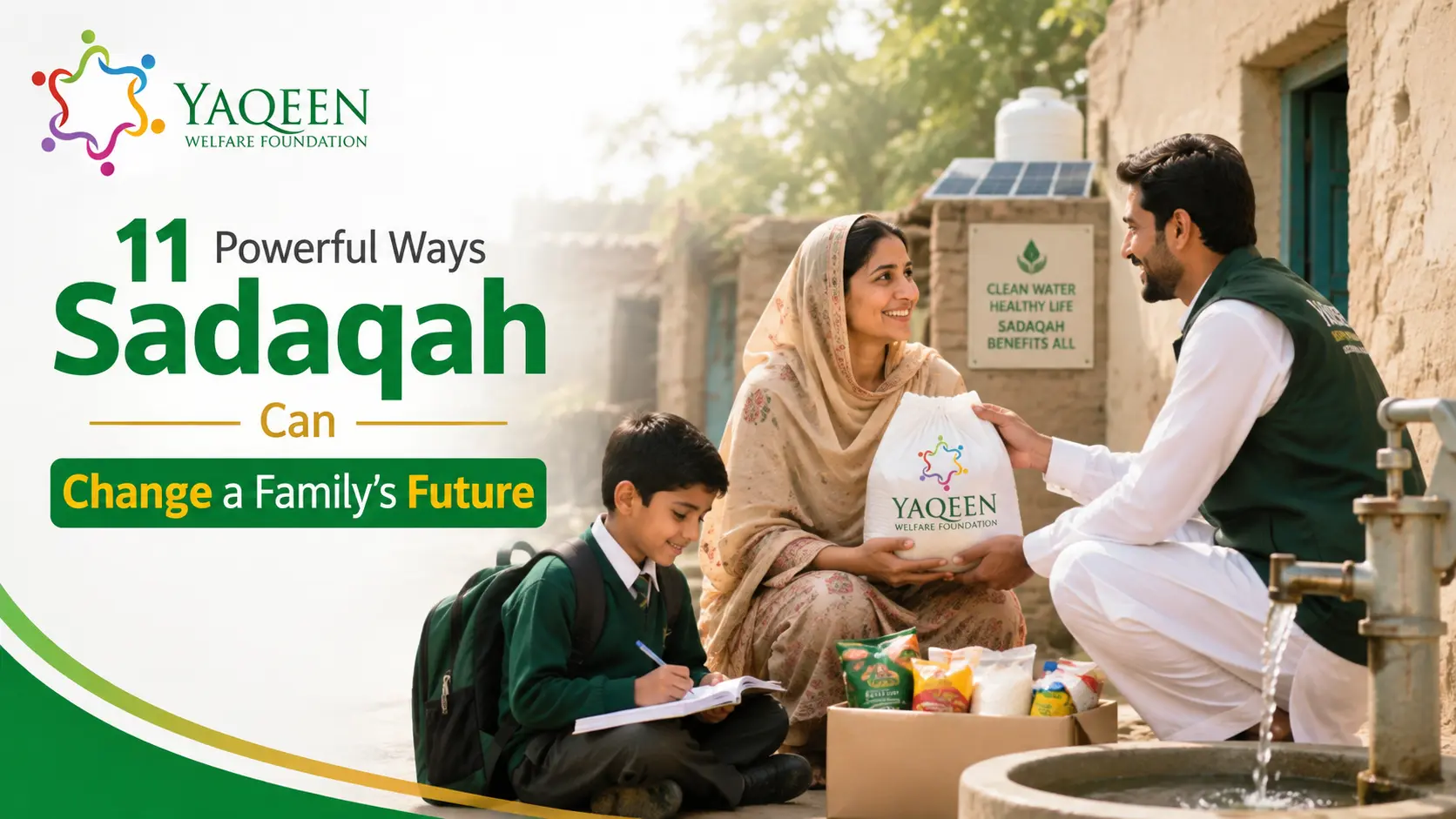
Sadaqah rarely looks dramatic from the outside. It looks like a mother finally able to take her sick child to a doctor. It looks like a bucket of clean water carried home without a two-hour walk. It looks like a school bag bought instead of returned to the shelf. Yet for the family receiving it, that single act of Sadaqah can be the difference between a future that stays stuck and one that finally moves forward.
Financial hardship rarely knocks on just one door. A parent may be forced to choose between medicine and rent. A child may be pulled out of school to help earn income. A household may still be hauling water from an unsafe source because there is no other option. Food may take up nearly every rupee the family has left, and unsafe housing may quietly create new health risks on top of everything else. These pressures don’t arrive one at a time — they arrive together, and they compound.
This is where Sadaqah becomes more than a temporary gesture. When it is directed toward genuine needs — healthcare, clean water, food, education, shelter — it can offer immediate relief while also helping a family build something more stable for the years ahead. That is the central idea behind this article: Sadaqah can provide relief today while helping create opportunities for tomorrow.
Yaqeen Welfare Foundation exists to put that idea into practice. Through healthcare, clean water, food assistance, education support, and help for vulnerable families, Yaqeen works to turn everyday Sadaqah into lasting change for underserved communities, particularly in Pakistan. Below are 11 powerful ways that a single act of charity can ripple through a family’s life — and, eventually, an entire community.
What Is Sadaqah?
Sadaqah is voluntary charity given by Muslims to help others and seek the pleasure of Allah. Unlike some other religious obligations, it is not confined to a fixed amount, a fixed schedule, or even a fixed form.
Giving Sadaqah does not have to mean handing over cash. It can take many practical shapes, including:
- Providing food to a family in need
- Helping someone access clean drinking water
- Supporting a person’s medical treatment
- Helping a child stay in school
- Assisting a vulnerable family through a hard season
- Supporting safe, stable shelter
- Providing emergency relief during a crisis
- Contributing toward a community project, such as a well or clinic
- Helping someone gain skills or resources that improve their future
One of the most practical things to understand about Sadaqah is that it is not restricted to Ramadan or any single season. It can be given at any point in the year, whenever a need arises or whenever a person feels moved to give. The Prophet Muhammad ﷺ is reported to have described charity as something that does not diminish wealth (a hadith recorded in Sahih Muslim), and the Qur’an speaks of charitable spending being multiplied in reward, as in Surah Al-Baqarah (2:261) on Quran.com. For specific rulings or deeper study, readers are encouraged to consult a qualified scholar or a reliable Islamic reference such as Sunnah.com.
Sadaqah vs. Zakat — What Is the Difference?
People often use these two terms interchangeably, but they are not the same.
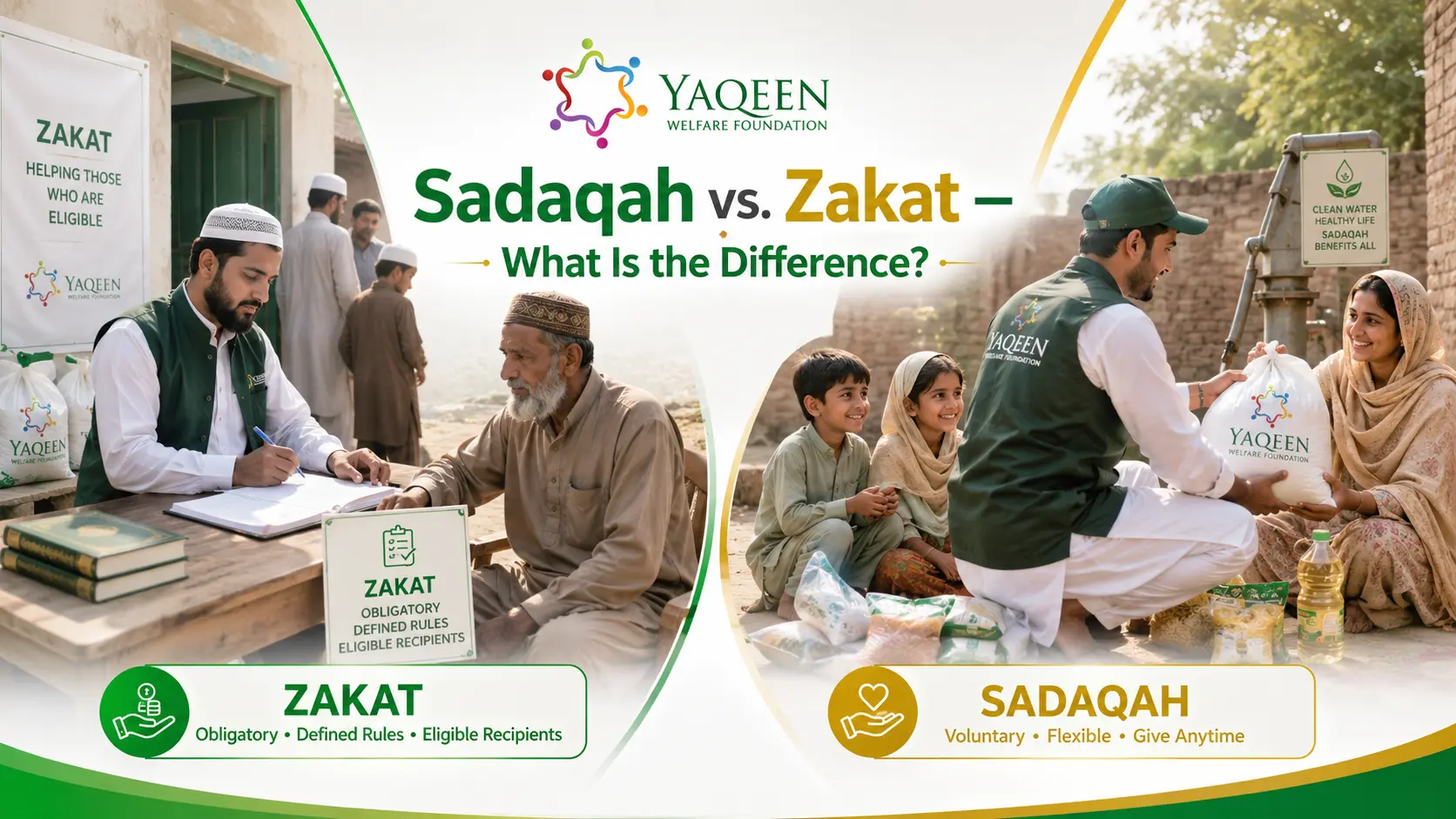
Zakat is an obligatory form of giving required of eligible Muslims who meet specific wealth and asset thresholds. It follows defined rules for calculation, timing, and eligible recipients. Yaqeen’s own Zakat Calculator can help donors work out their obligatory amount.
Sadaqah, on the other hand, is voluntary. There is no minimum threshold, no fixed percentage, and no requirement to wait for a particular time of year.
| Feature | Zakat | Sadaqah |
|---|---|---|
| Nature | Obligatory (for eligible Muslims) | Voluntary |
| Amount | Fixed percentage (commonly 2.5% of eligible wealth) | Any amount, chosen by the donor |
| Timing | Typically once a year, after meeting Nisab | Anytime, all year round |
| Recipients | Defined categories under Islamic guidance | Broad — any person or cause in genuine need |
| Flexibility | Rule-based calculation | Highly flexible in form and timing |
This distinction matters because it means a person does not have to wait for their annual Zakat calculation to respond to someone’s hardship. Voluntary Sadaqah allows donors to act the moment they see a need — whether that’s a medical emergency, a family without food, or a community without clean water.
Why Small Sadaqah Donations Can Create Large Changes
It’s easy to assume that only large donations create meaningful change. In practice, the opposite is often true. Collective giving is what powers most humanitarian programs.
One donor’s contribution might go toward medicine. Another’s toward a week of meals. Another’s toward school supplies. Another’s toward a community water project. Individually, none of these amounts may look large — but combined, they fund programs that can serve entire villages.
Consider the ripple effect of a single well-placed donation:
Medical Assistance → Better Health → Ability to Work → Greater Household Stability
Education Support → Continued Learning → Skills → Better Opportunities → Stronger Family
Clean Water → Better Hygiene and Health → Fewer Disruptions → More Time for Education and Work
The real value of Sadaqah is rarely measured only by the size of the original gift. It’s measured by what that gift makes possible next.
1. Sadaqah Can Help a Family Access Healthcare
Healthcare costs create enormous pressure on low-income households. Families frequently face impossible trade-offs between a doctor’s visit, medicine, diagnostic tests, transportation to a clinic, food, and their children’s school fees.
Charitable healthcare initiatives funded through Sadaqah can help remove some of these barriers by supporting:
- Medical consultations and basic healthcare services
- Medicines and diagnostic testing
- Maternal and child healthcare
- Preventive healthcare and screenings
- Chronic disease management
- Community health programs
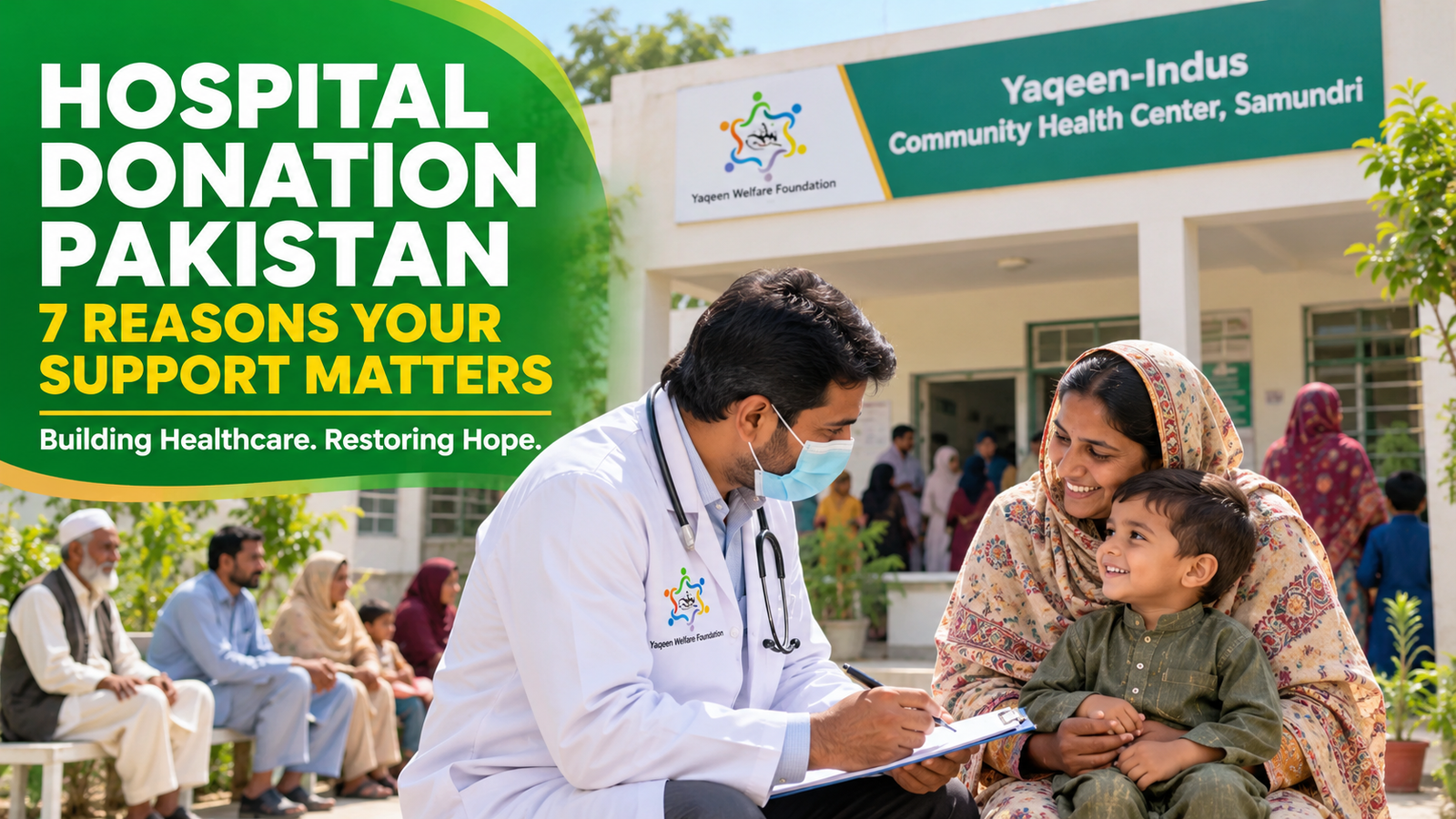
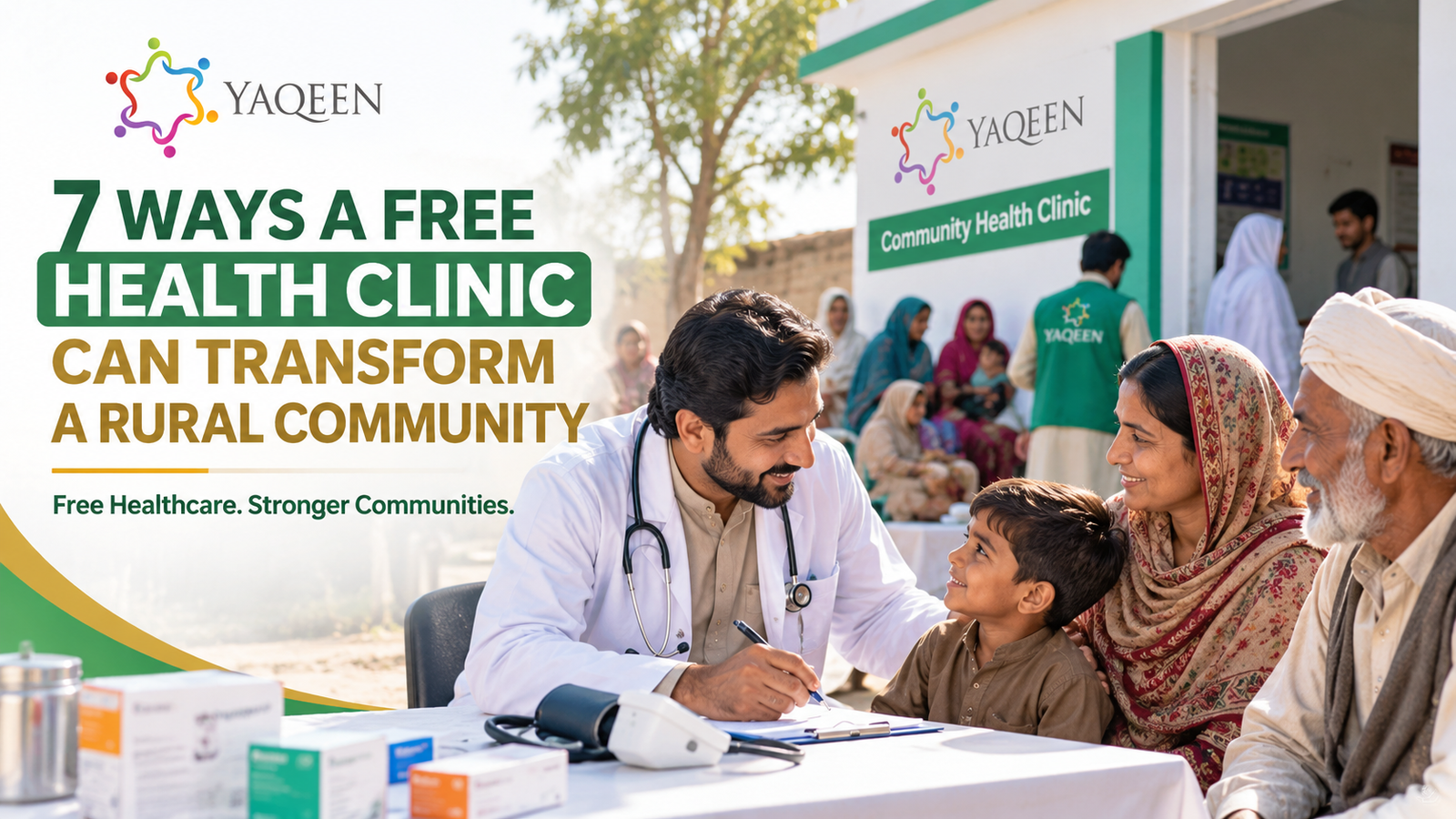
According to the World Health Organization, hundreds of millions of people worldwide face financial hardship because of healthcare costs, which is exactly the gap that charitable clinics attempt to close. Yaqeen’s own 10 Reasons Free Medical Clinics Save Lives Every Day explores this in more depth, and the Yaqeen Health Clinic is a direct example of Sadaqah turned into ongoing medical care.
When a parent regains their health, they’re often better able to return to work. When a child is treated, they’re often able to return to school. The chain looks simple, but its effects compound: Healthcare → Better Health → Work and Education → Greater Family Stability.
2. Sadaqah Can Put Nutritious Food on the Table
Food insecurity is about more than hunger. It shapes nutrition, physical development, children’s growth, energy levels, concentration in school, and a parent’s ability to hold down work.
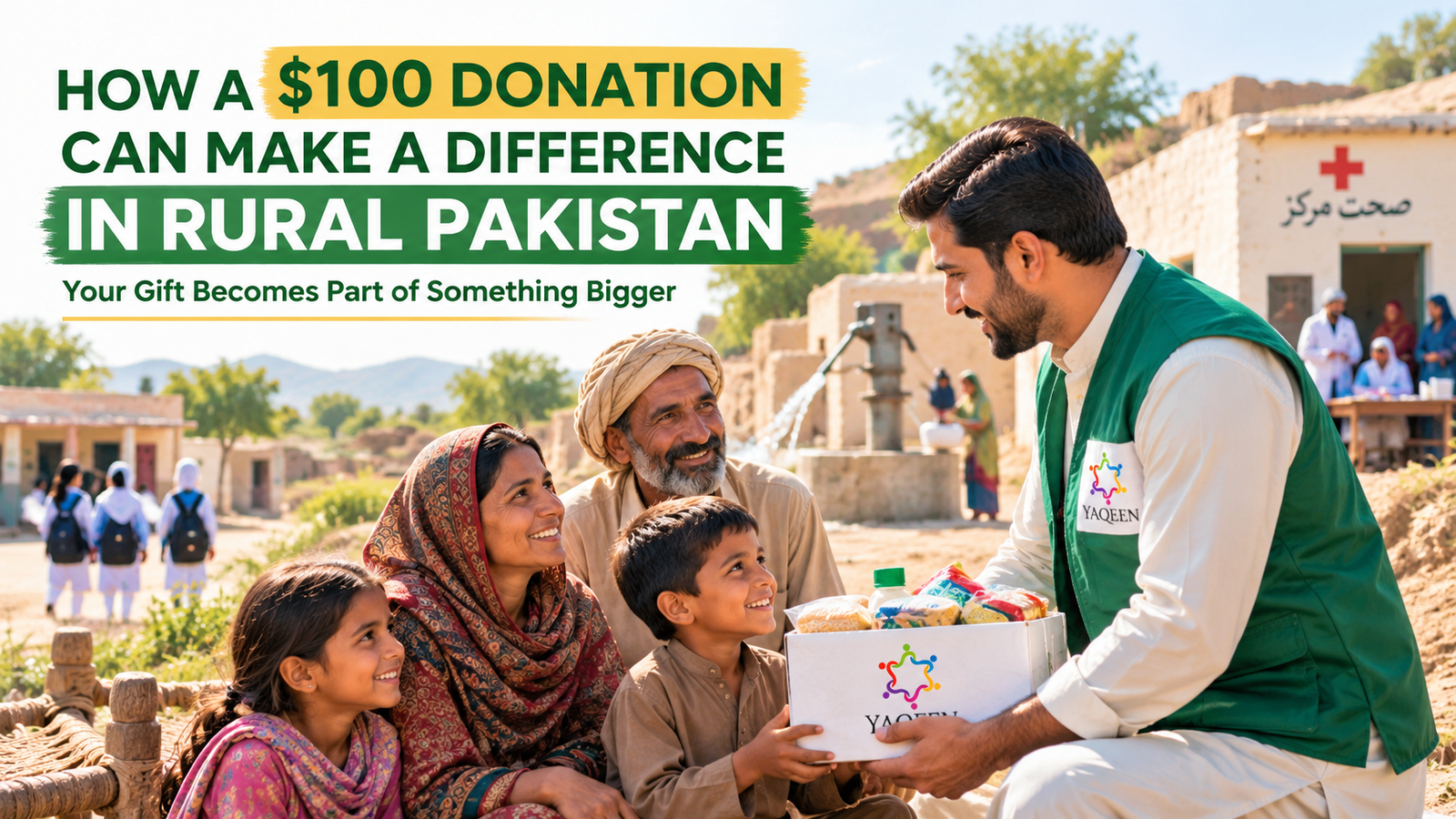
Sadaqah directed toward food-relief programs can support struggling households in a very direct way, and it can also free up whatever limited income a family has left for other essentials — healthcare, transportation, or school costs. The UN World Food Programme tracks global hunger trends and consistently shows how closely food insecurity is tied to broader poverty cycles, reinforcing why food assistance is often one of the first and most urgent forms of Sadaqah a family needs.
3. Sadaqah Can Bring Clean Water to Communities
Reliable access to safe drinking water is foundational to almost everything else in a community’s well-being — drinking, cooking, hygiene, sanitation, and children’s health all depend on it.
Unlike food or medical aid, a water project funded by Sadaqah — a well, a filtration system, or a pipeline — often benefits an entire community rather than a single household. The effect compounds:
Clean Water → Better Hygiene → Reduced Exposure to Water-Related Illness → More Time for School and Work → Stronger Communities
Because a well or water system can continue serving people for years or even decades after it’s built, this type of giving is often discussed as an example of Sadaqah Jariyah — ongoing charity — a concept explored in more detail later in this article and in Yaqeen’s dedicated post, Give Sadaqah Jariyah Today and Earn Rewards for 100 Years. UNICEF notes that unsafe water and poor sanitation remain among the leading contributors to preventable illness in children worldwide, which underscores why clean-water Sadaqah carries such long-term weight.
4. Sadaqah Can Keep a Child in Education
Poverty can interrupt even a capable, motivated child’s education. School expenses, books, supplies, uniforms, transportation, and sometimes tuition or fees can all become barriers a struggling family simply cannot clear — especially when those funds are needed for food or medicine instead.
Sadaqah given toward education can help remove that trade-off. The long-term chain is powerful:
Education → Knowledge → Skills → Employment Opportunities → Greater Financial Stability
Helping a single child stay in school doesn’t just change that child’s life — it can change the trajectory of their entire household, and sometimes their children’s household too. The World Bank has repeatedly linked years of schooling completed to long-term earning potential, which is part of why education-focused Sadaqah is considered one of the most sustainable investments a donor can make.
5. Sadaqah Can Help Provide Safer Shelter
Safe housing is about far more than having a roof overhead. Poor or overcrowded housing can affect physical safety, sanitation, privacy, a child’s ability to study, protection from severe weather, and basic personal dignity.
Housing-focused Sadaqah can help vulnerable families move into safer, more stable living conditions — and that stability tends to make everything else easier. A family that isn’t worrying about where they’ll sleep tonight has more room to focus on employment, healthcare, and their children’s education.
6. Sadaqah Can Support Mothers and Children
Mothers and young children in financially vulnerable households face specific and often overlooked challenges: limited access to prenatal care, poor maternal nutrition, lack of safe delivery support, and gaps in infant and child healthcare.
Sadaqah directed toward maternal and child health programs can help close these gaps by supporting prenatal checkups, safe maternal care, postnatal support, infant healthcare, and access to essential medicines. The WHO’s maternal health data shows that most maternal deaths are preventable with adequate care — a sobering reminder of how much difference this specific form of Sadaqah can make. Improving the health of a mother or child rarely helps just one person; it strengthens the entire household around them.
7. Sadaqah Can Help Families During Emergencies
Unexpected crises — a sudden illness, a lost job, a natural disaster, a family emergency — hit hardest when a household already has no financial cushion. There’s no savings account to fall back on and no room in the budget to absorb the shock.
Emergency Sadaqah acts as a safety net in exactly these moments. Depending on the situation, it may provide food, clean water, emergency medicine, temporary shelter, household essentials, or urgent medical care. Responsible organizations assess genuine need before distributing this kind of aid, ensuring that emergency Sadaqah reaches the people who need it most, when they need it most.
8. Sadaqah Can Help Break the Cycle of Childhood Poverty
Childhood poverty is rarely caused by a single factor — it’s usually a chain of interconnected disadvantages:
Poverty → Poor Nutrition → Health Problems → Missed School → Fewer Educational Opportunities → Reduced Economic Opportunity → Continued Poverty
Targeted Sadaqah can interrupt this cycle at multiple points at once. When food, healthcare, clean water, education, and safe housing are addressed together — rather than in isolation — children have a genuinely better chance to learn, grow, stay healthy, and build a different future than the one poverty alone would have handed them.
9. Sadaqah Can Restore Dignity
Meaningful charity should never reduce a person to a statistic or a helpless recipient. Every beneficiary is an individual with a story, not a case number.
Responsible Sadaqah programs are built around respect: privacy for the people receiving help, compassion in how aid is delivered, choice wherever possible, and careful, non-exploitative storytelling. Giving Sadaqah isn’t only about transferring resources from one person to another — it’s about doing so in a way that protects the dignity of the person on the receiving end.
10. Sadaqah Can Help Families Become More Self-Sufficient
There’s an important difference between emergency relief and long-term opportunity. Emergency aid is essential when someone is hungry, sick, displaced, or in crisis — but where circumstances allow, longer-term Sadaqah can address some of the underlying barriers that keep families in poverty in the first place.
That might mean funding education, skills development, sustainable livelihood tools, employment support, or community infrastructure. The goal shifts from simply helping a family survive today to helping create the conditions for greater independence tomorrow.
11. Sadaqah Can Strengthen an Entire Community
Zoom out far enough, and individual acts of Sadaqah start to look like the building blocks of an entire community’s wellbeing. A single healthcare initiative can serve hundreds of patients. A single water project can serve every household nearby. Education support can eventually produce future teachers, healthcare workers, and entrepreneurs from within the very community that was once struggling.
One Donation → One Project → Multiple Beneficiaries → Healthier Families → Better Opportunities → Stronger Communities
This is the broader mission Yaqeen Welfare Foundation works toward every day — not isolated acts of charity, but a connected system of healthcare, clean water, food, education, and family support that lifts entire communities together.
Immediate Relief vs. Long-Term Change
Effective humanitarian work usually needs both immediate relief and long-term development, and neither should replace the other.
Immediate assistance typically includes food for hungry families, medicine for patients, emergency shelter, clean water, and essential supplies.
Longer-term assistance typically includes education, water infrastructure, healthcare access, sustainable housing, and skills or livelihood development.
Put simply: relief helps a family survive today’s crisis, while long-term support helps build tomorrow’s opportunities. Vulnerable communities usually need a combination of both, depending on where they are on that journey.
What Is Sadaqah Jariyah?
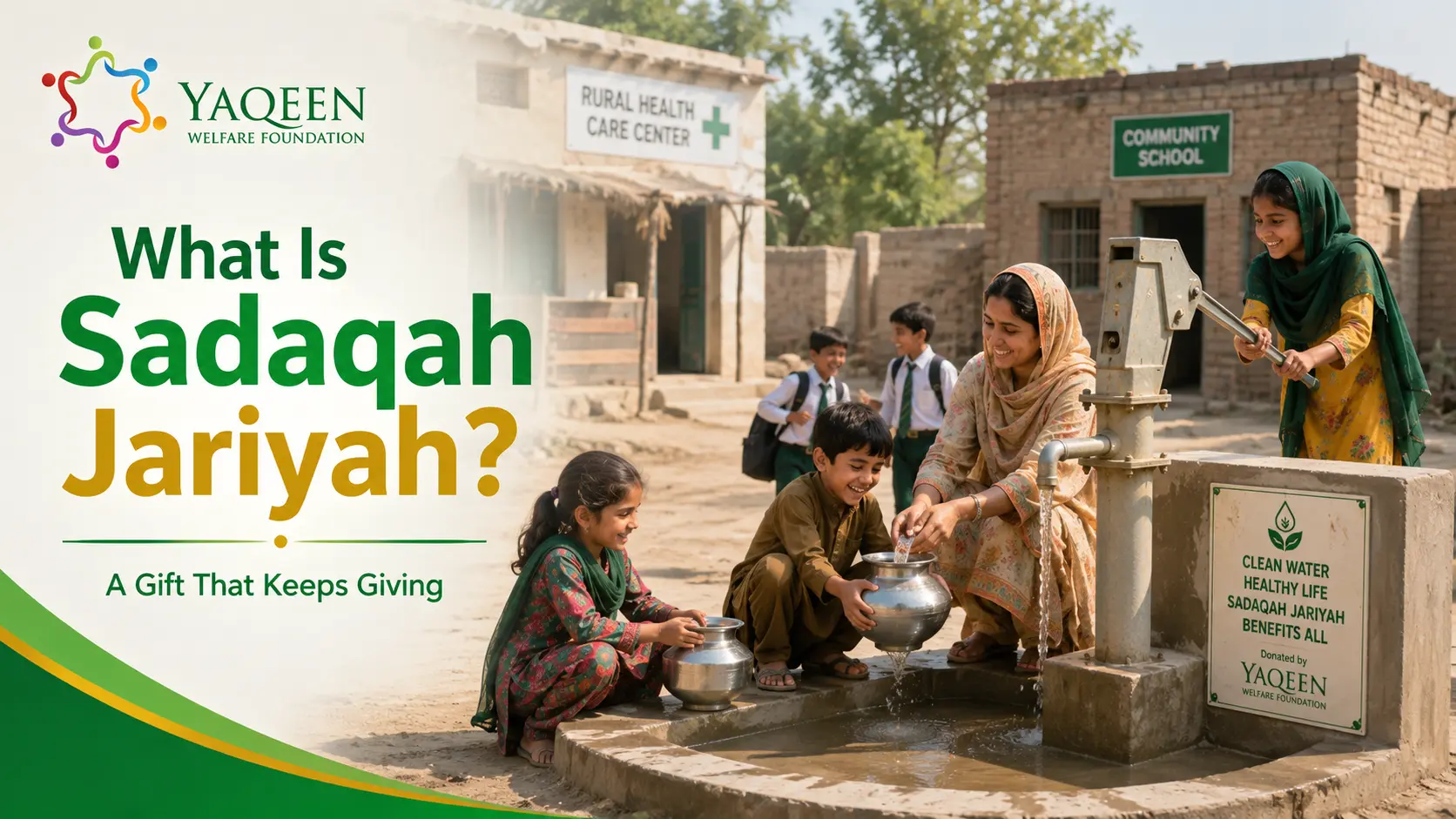
Sadaqah Jariyah refers to ongoing charity — giving whose benefit continues long after the original act, sometimes for years or generations. A well that keeps providing water, a school that keeps educating new students, or a clinic that keeps treating patients are all commonly cited examples.
This concept is rooted in a hadith in which the Prophet Muhammad ﷺ described three things whose reward continues after a person’s death, one of which is ongoing charity (recorded in Sahih Muslim). For donors interested in long-term humanitarian impact rather than a single-use donation, Sadaqah Jariyah projects are worth exploring in more depth — Yaqeen’s article Give Sadaqah Jariyah Today and Earn Rewards for 100 Years covers this concept and its projects in detail.
Can I Give Sadaqah on Behalf of Someone Else?
Many donors want to give Sadaqah in honor of their parents, on behalf of a family member, or in memory of someone who has passed away. This is a common and meaningful practice, though the specific rulings can vary, so it’s worth distinguishing general charitable information from specific Islamic guidance. For a ruling that applies to your particular situation, consulting a qualified scholar is recommended.
Why Give Sadaqah to Families in Pakistan?
Vulnerable communities across Pakistan, particularly in rural areas, continue to face real and layered challenges: limited access to nearby healthcare facilities, unreliable clean-water infrastructure, food insecurity, educational gaps, housing insecurity, and heightened maternal and child health risks.
According to UNICEF Pakistan, millions of children in the country still face barriers to basic services including healthcare, clean water, and education — figures that are regularly updated and worth reviewing directly for the most current data. This is why Sadaqah directed toward Pakistan’s underserved communities can carry such tangible, measurable impact.
How Yaqeen Welfare Foundation Turns Donations Into Impact
Healthcare
Through initiatives like the Yaqeen Health Clinic, donations help fund medical consultations, treatment, medicines, and maternal and child healthcare for people who would otherwise struggle to access care.
Clean Water
Water initiatives supported by Yaqeen aim to give communities more reliable access to safer drinking water, addressing both immediate needs and longer-term community health.
Education
Education-focused programs help deserving students continue their studies and pursue greater opportunities, in line with the long-term impact of Sadaqah discussed earlier in this article.
Food and Family Assistance
Food-support programs help relieve immediate pressure on households facing acute financial hardship.
Safe Homes and Family Stability
Where current programs allow, housing and family-stability initiatives help vulnerable households move toward safer, more secure living conditions.
You can review the organization’s full scope of work on the Mission & Vision page.
How to Choose Where Your Sadaqah Can Help Most
Urgent needs — Consider emergency-focused giving when people urgently require food, healthcare, water, shelter, or essential supplies.
Long-term impact — Consider education, water infrastructure, healthcare access, sustainable housing, or livelihood-support programs.
Regular giving — Recurring donations help organizations plan ahead and maintain consistent humanitarian services rather than reacting only when funds happen to be available.
If you’re deciding what cause matters most to you: healthcare helps people access essential care, clean water supports one of life’s fundamental necessities, education helps create future opportunity, food responds to immediate hunger, and safe housing helps families gain stability and dignity.
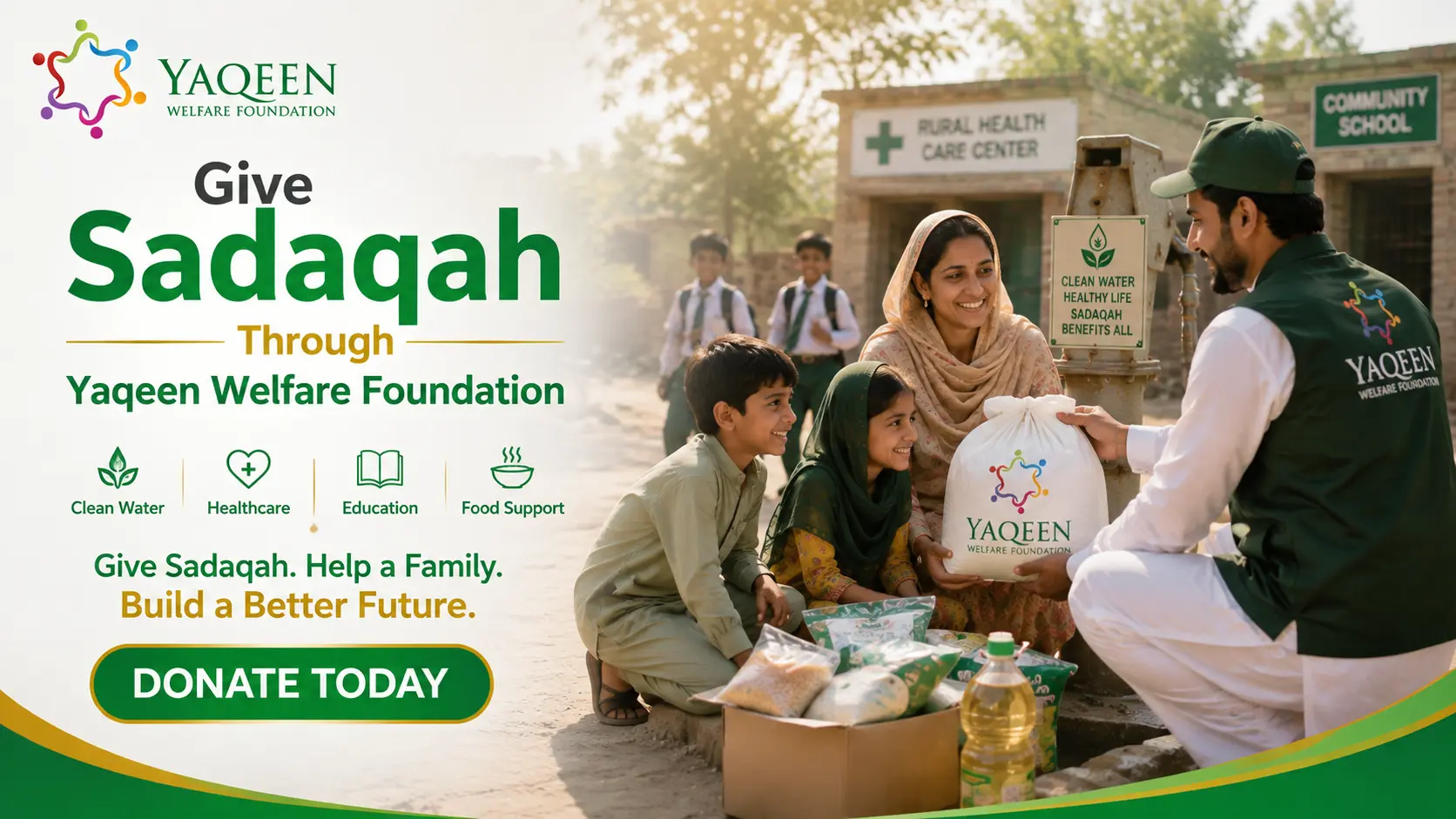
How to Give Sadaqah Through Yaqeen Welfare Foundation
- Visit the official Donate page.
- Select the cause or project you’d like to support.
- Choose your donation amount.
- Select one-time or recurring giving, where available.
- Complete your donation through a secure payment method (PayPal, credit/debit card, bank transfer, or Zelle).
If you have questions before giving, you can contact Yaqeen Welfare Foundation online — the team is glad to help you decide where your Sadaqah can do the most good.
Frequently Asked Questions About Sadaqah
What is Sadaqah? Sadaqah is voluntary charitable giving in Islam, given to help others and seek the pleasure of Allah. It can take the form of money, goods, time, or service.
Is Sadaqah different from Zakat? Yes. Zakat is obligatory for eligible Muslims and follows fixed rules, while Sadaqah is voluntary, with no minimum amount or fixed schedule.
When can I give Sadaqah? Sadaqah can generally be given at any point during the year — it isn’t limited to Ramadan or any single season.
Does Sadaqah have to be money? No. Sadaqah can include food, water access, medical support, educational help, or even a kind, helpful action. It isn’t limited to financial donations.
Can I give a small amount as Sadaqah? Yes. Small contributions add up through collective giving, and many large humanitarian projects are funded by combining many modest donations rather than a few large ones.
Can Sadaqah help provide healthcare? Yes. Sadaqah can fund medical consultations, medicines, diagnostic services, and ongoing healthcare programs for people who couldn’t otherwise afford care.
Can I give Sadaqah for clean water? Yes. Water-focused Sadaqah, such as funding a well or filtration system, can benefit an entire community and is often considered a form of Sadaqah Jariyah.
Can Sadaqah support education? Yes. Sadaqah can cover school costs, supplies, and scholarships that help children stay in school and pursue long-term opportunities.
Can Sadaqah help orphans and vulnerable children? Yes. Charitable programs can direct Sadaqah toward food, healthcare, education, and other essential needs for orphans and vulnerable children.
What is Sadaqah Jariyah? Sadaqah Jariyah is ongoing charity whose benefits continue over time, such as a well, school, or clinic. Read more in Give Sadaqah Jariyah Today and Earn Rewards for 100 Years.
Can I give Sadaqah on behalf of my parents? Many donors choose to give Sadaqah in honor of their parents or in memory of a loved one. For guidance specific to your situation, consult a qualified Islamic scholar.
Can I make recurring Sadaqah donations? Yes, where available. Recurring giving helps organizations like Yaqeen plan and sustain ongoing programs rather than relying only on one-time gifts.
How do I know where my donation goes? Yaqeen Welfare Foundation directs donations toward verified healthcare, water, education, and family-assistance programs, and can be contacted directly for more detail on current projects.
Which type of Sadaqah should I choose? Consider the urgency of the need, the kind of impact you want to create, and the specific projects currently available through an organization you trust.
Conclusion — One Act of Giving Can Start a Bigger Story
Sadaqah may begin with a single act of generosity, but its impact rarely stays that small. A medical consultation can help someone regain their health. Clean water can protect an entire household’s wellbeing. Food assistance can relieve the pressure on a struggling family long enough for them to catch their breath. Education can open doors for a child that poverty would otherwise have closed. Safe shelter can offer the kind of security that makes everything else possible.
Your Sadaqah can meet an urgent need today while helping lay the foundation for a stronger tomorrow — for one family, and eventually, for an entire community.
Give Sadaqah. Help a family. Build a better future.
👉 Donate to Yaqeen Welfare Foundation or get in touch with the team to learn more about where your Sadaqah is needed most.