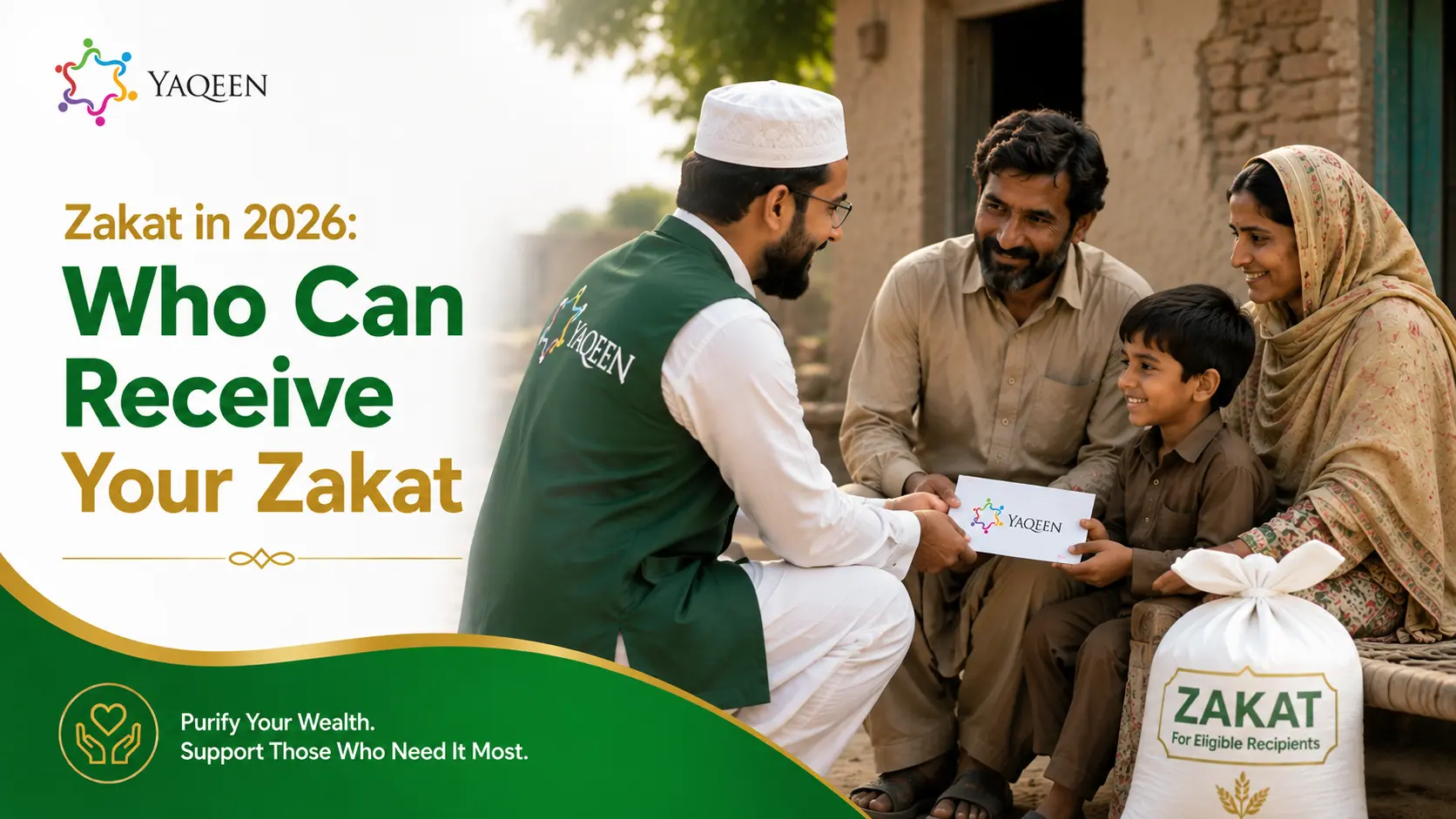
Zakat in 2026: A Complete Guide to Who Can Receive Your Zakat
Zakat is not just another charitable donation you tick off once a year — it is one of the Five Pillars of Islam and an obligatory act of worship for every Muslim who meets the qualifying conditions. Each year, as balances are calculated and the lunar Zakat date approaches, millions of Muslims around the world ask the same practical question: who can actually receive my Zakat?
It’s a question that matters. Good intentions alone are not enough — Zakat comes with defined rules, and Allah Himself has specified who is eligible to receive it. Give it to the wrong cause, however well-meaning, and the obligation may not be considered fulfilled.
In this guide, we’ll walk through:
- Who can receive Zakat, according to the Qur’an
- Who is eligible for Zakat in Islam — and who generally is not
- Whether Zakat can be given to relatives, orphans, students, or the sick
- Whether Zakat can fund medical treatment or clean water projects
- How much Zakat you owe, and how the nisab works in 2026
- How a responsible charity like Yaqeen Welfare Foundation distributes Zakat
The foundational reference for all of this is Surah At-Tawbah, verse 60 (Qur’an 9:60), where Allah identifies eight categories of Zakat recipients. We’ll explain each one in plain language — while being clear that detailed personal rulings, complex calculations, and differences between schools of jurisprudence should always be referred to a qualified scholar.
This article provides general educational information. It is not a substitute for individual religious guidance.
What Does Zakat Mean?
The Arabic word Zakat carries the meaning of purification and growth. It is not simply generosity — it is a mandatory financial obligation placed on Muslims who possess wealth above a specific threshold, held for a full lunar year.
Zakat has two dimensions working together:
- Spiritual — it purifies the wealth and the heart of the person who gives it, fulfilling a direct obligation to Allah.
- Social — it directs real resources toward people facing poverty, debt, displacement, and hardship.
Because Zakat is treated differently from ordinary charity, understanding who can receive Zakat is just as important as calculating how much Zakat you owe. If you’re new to the distinction between obligatory and voluntary giving, our article on Sadaqah vs. Zakat: 6 Key Differences Every Muslim Should Know is a useful place to start.
Why Understanding Zakat Eligibility Matters
Unlike general Sadaqah, Zakat cannot automatically be redirected to every good cause. Before distributing it, a donor should think through:
- Whether the intended recipient genuinely qualifies
- Which of the eight Zakat categories applies to them
- Whether a charity has a clear, scholar-approved Zakat policy
- Whether the specific project (a clinic, a school, a well) is Zakat-eligible or better suited to Sadaqah
- Whether there is scholarly disagreement on the specific case
Treating Zakat as an amanah — a trust — rather than an ordinary donation is what keeps its distribution both spiritually and practically sound.
Quick summary: Zakat is worship with rules attached
Paying Zakat fulfills your obligation. Distributing it correctly to eligible recipients is what completes that act of worship.
Who Must Pay Zakat?
Zakat al-Mal generally becomes obligatory on a Muslim whose qualifying wealth meets the applicable nisab threshold and has been held for a full lunar year. Depending on the type of wealth and the jurisprudential guidance a person follows, this can include:
| Type of Wealth | Commonly Considered Zakatable? | Notes |
|---|---|---|
| Cash and bank savings | Yes | Held above nisab for one lunar year |
| Gold and silver | Yes | Subject to weight and purity conditions |
| Business inventory | Yes | Valued at current market price |
| Investments and shares | Often, in part | Depends on the nature of the investment |
| Personal home and car | Generally no | Used for personal need, not held as wealth |
| Outstanding debts owed to you | Case-by-case | Depends on likelihood of repayment |
This table is a simplified overview, not a full ruling. Detailed treatment of pensions, agricultural produce, livestock, cryptocurrency, and business assets can vary between schools of thought, so readers with complex finances should consult a qualified scholar or a reliable Zakat calculator, such as the one on our own Zakat Calculator page.
What Is Nisab?
Nisab is the minimum threshold of qualifying wealth that triggers the Zakat obligation. It is traditionally based on a fixed weight of gold (roughly 87.48 grams) or silver (roughly 612.36 grams).
Because gold and silver prices move constantly, there is no single fixed nisab figure for 2026 in dollars, pounds, or Pakistani rupees. Any published currency figure needs to show:
- The calculation date
- Whether it’s based on the gold or silver standard
- The weight used
- The market price on that date
- The currency
Always check the current nisab value at the time you calculate your own Zakat, rather than relying on last year’s number.
How Much Zakat Do You Pay?
For most qualifying monetary wealth held for a full lunar year, 2.5% is the commonly applied rate. As a simple illustration only:
If, according to the applicable rules, a person determines they hold $10,000 of net Zakatable wealth: $10,000 × 2.5% = $250 in Zakat owed.
This is a simplified example, not a complete calculation for every financial situation — business owners, investors, and people with irregular income should seek more detailed guidance. Our article on 7 Mistakes People Make When Calculating Zakat covers the most common calculation errors donors make each year.
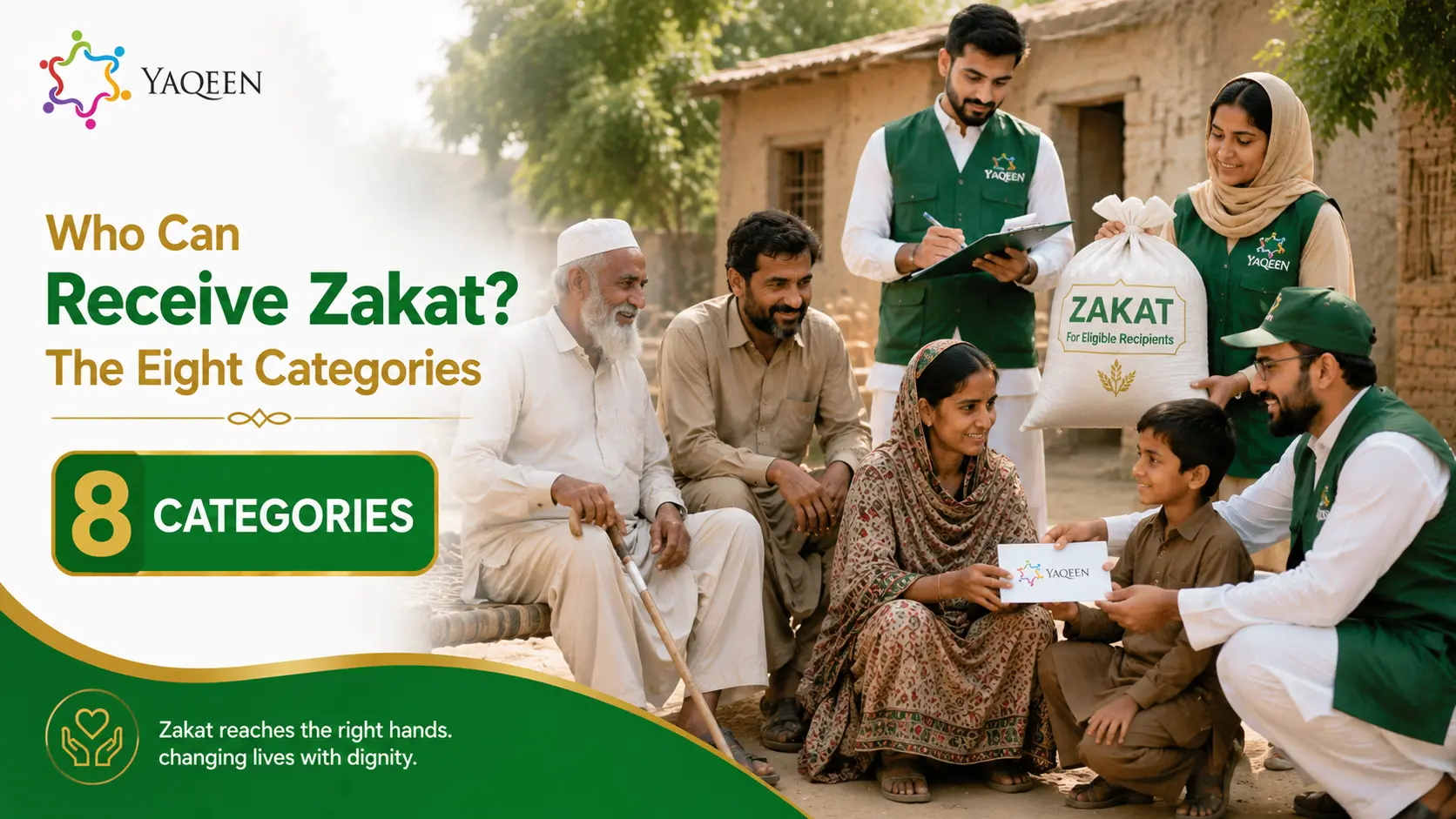
Who Can Receive Zakat? The Eight Categories
This is the central question of this guide, and the Qur’an answers it directly:
“Zakat expenditures are only for the poor and for the needy, and for those employed to collect it, and for bringing hearts together [for Islam], and for freeing captives, and for those in debt, and for the cause of Allah, and for the stranded traveler — an obligation imposed by Allah.” — Qur’an 9:60
Translations vary slightly in wording, so it helps to look at each category individually, using both the Arabic term and its general meaning.
The eight categories at a glance
- Al-Fuqara — the poor
- Al-Masakin — the needy
- Al-‘Amilina ‘Alayha — those appointed to administer Zakat
- Al-Mu’allafati Qulubuhum — those whose hearts are to be reconciled
- Fir-Riqab — for freeing those in bondage
- Al-Gharimin — those in qualifying debt
- Fi Sabilillah — in the cause of Allah
- Ibn al-Sabil — the stranded traveler
1. The Poor — Al-Fuqara
This category generally includes people who don’t have sufficient resources to meet essential needs — food, clothing, housing, healthcare, and basic household expenses. Poverty shouldn’t be judged only by whether someone has any income; a person can work and still fall well short of covering essential needs. A responsible charity assesses actual household circumstances rather than relying on appearances alone.
2. The Needy — Al-Masakin
Scholars discuss meaningful distinctions between faqir and miskin, and definitions differ somewhat between schools of jurisprudence. For the purposes of a general donor guide, both categories relate to genuine financial need — insufficient income, food insecurity, unaffordable healthcare, or dependents whose basic needs go unmet. Neither category should be reduced to a single rigid financial cutoff without proper scholarly backing.
3. Those Who Administer Zakat — Al-‘Amilina ‘Alayha
This category covers people formally appointed to collect, assess, and distribute Zakat — not general organizational overhead. Legitimate responsibilities can include assessing eligibility, collecting funds, maintaining records, and managing distribution. A charity should have transparent religious and financial governance before allocating funds under this heading, and donors should be able to understand that policy.
4. Those Whose Hearts Are to Be Reconciled — Al-Mu’allafati Qulubuhum
This is often oversimplified as “new Muslims,” but the scholarly discussion is more nuanced than that. Its modern application has been debated extensively in Islamic jurisprudence, so organizations and donors applying this category should rely on qualified scholarly guidance rather than a broad, informal interpretation.
5. For Freeing Those in Bondage — Fir-Riqab
Historically tied to freeing people from slavery or bondage, this category involves complex modern jurisprudential questions. Not every contemporary humanitarian cause automatically fits here — organizations wishing to apply Zakat under this heading should seek reliable contemporary scholarly guidance.
6. People in Qualifying Debt — Al-Gharimin
Being in debt doesn’t automatically make someone Zakat-eligible. The circumstances matter: the reason for the debt, available income and assets, ability to repay, and whether essential family needs are being met. Debt from luxury spending or irresponsible borrowing is treated differently from unavoidable financial hardship, and specific cases should be assessed according to Islamic guidance.
7. In the Cause of Allah — Fi Sabilillah
This is one of the categories with the widest range of scholarly discussion. Some scholars interpret it more narrowly; others discuss broader applications under specific circumstances. No single contemporary interpretation should be presented as the only accepted view. A charity using Zakat under this category should be able to explain its scholarly basis — and donors should feel free to ask.
8. The Stranded Traveler — Ibn al-Sabil
A traveler who becomes stranded, or lacks access to sufficient resources while away from home, may qualify here, subject to applicable conditions — even if they are financially comfortable at home but genuinely cannot access those resources during the journey. Assistance may relate to essential food, temporary accommodation, transportation, or the means to return home.
Can Zakat Be Given to Poor Families?
Yes, when a family’s circumstances genuinely fall within an eligible category. Eligibility should reflect real household situations — income, essential expenses, number of dependents, assets, debts, housing, and medical needs — not just a general impression of hardship. The goal of assessment is always to distribute Zakat responsibly while protecting the dignity of the family receiving it.
Can Zakat Be Given to Orphans?
Here’s an important misconception to clear up: being an orphan does not, by itself, make someone eligible for Zakat.
An orphan who is poor or needy — falling under Al-Fuqara or Al-Masakin — may be eligible. An orphan who has sufficient wealth of their own may not qualify simply because they lost a parent. This distinction matters because supporting orphans remains an excellent, deeply rewarded form of voluntary charity (Sadaqah), even in cases where formal Zakat eligibility isn’t established.
Can Zakat Pay for Medical Treatment?
Medical need alone isn’t treated as a separate, ninth Zakat category — it depends on the patient’s overall financial circumstances and which of the eight categories applies to them. A poor or needy person who cannot afford necessary healthcare — consultations, medicine, diagnostic tests, maternal or child healthcare — may potentially receive Zakat under an eligible category.
Because the method of payment (paying a provider directly versus transferring ownership of funds to the beneficiary) can involve jurisprudential considerations, medical Zakat programs should be structured under qualified scholarly guidance.
This is directly relevant to our own mission. Our 10 Reasons Free Medical Clinics Save Lives Every Day article explains how accessible healthcare changes outcomes for underserved families in Pakistan. Our piece on 9 Diseases Free Clinics in Pakistan Help Treat Every Day outlines the most common conditions patients present with.
Can Zakat Help Pay for Education?
It depends on what, exactly, is being funded. A financially eligible student — one who is poor or needy — may potentially receive Zakat to help meet legitimate educational necessities. But using Zakat to fund school buildings, general infrastructure, or unrestricted institutional expenses raises separate jurisprudential questions. There’s a real difference between:
- Giving Zakat directly to an eligible, struggling student, and
- Using Zakat to fund a general education project or institution
Donors and organizations should seek qualified guidance before treating the second as automatically Zakat-eligible.
Can Zakat Be Used for Food or Housing?
Eligible poor and needy recipients may receive Zakat that helps meet essential living needs, including food and housing costs. However, the method of distribution — direct cash, food purchased on the beneficiary’s behalf, or paying a landlord directly — can involve questions of ownership and agency in Islamic law. A responsible charity follows an established Zakat policy grounded in appropriate scholarly guidance, and does so without unnecessarily exposing or humiliating the person receiving help.
Can Zakat Be Used to Build a Water Well?
This question deserves special attention because water wells are so commonly associated with Islamic charity — and the honest answer is: it depends.
A water well can be an excellent form of Sadaqah Jariyah (ongoing charity) — but a project being beneficial doesn’t automatically make it Zakat-eligible. Whether Zakat can fund a particular water project depends on who owns or benefits from it, whether identifiable eligible Zakat recipients are directly involved, how the funds are structured, and which jurisprudential opinion is being followed.
Not every public water well qualifies as a Zakat-eligible project. If you’re exploring this kind of giving, our articles on 5 Reasons a Water Well Is the Best Sadaqah Jariyah and A Drop of Water Donation, a Sea of Reward in 5 Beautiful Ways explain how clean water projects are usually funded through Sadaqah rather than Zakat, and why that distinction matters.
Can Zakat Be Given to Family Members?
This depends heavily on the specific relationship and circumstances. Supporting an eligible relative can carry extra reward, since it combines charity with maintaining family ties — but a person generally cannot use Zakat to discharge financial obligations they are already required to fulfill toward certain dependents.
Common questions include:
- Can I give Zakat to my parents or grandparents?
- Can I give Zakat to my adult children or grandchildren?
- Can I give Zakat to my brother, sister, uncle, aunt, or cousin?
- Can a husband give Zakat to his wife — or a wife to her husband?
Direct ascendants (parents, grandparents) and direct descendants (children, grandchildren) are generally treated differently because of existing financial-maintenance obligations between them.
Siblings, aunts, uncles, and cousins may qualify if they are genuinely poor or needy and not someone the donor is already required to support.
The question of whether a wife can give Zakat to her husband — and vice versa — has specific scholarly discussion, and the two are not automatically treated the same way.
Because family situations are rarely simple, readers with a specific case should consult a qualified scholar rather than apply a blanket rule.
Can Zakat Be Given to Non-Muslims?
This involves specific jurisprudential considerations tied directly to the categories in Qur’an 9:60, and there is no single, universally agreed answer that applies to every situation. Muslims wanting to support humanitarian needs outside the Zakat eligibility framework generally have broader flexibility through voluntary Sadaqah. Anyone with a specific situation should seek guidance from qualified scholarship rather than assume one blanket rule applies.
Who Generally Cannot Receive Zakat?
Subject to the applicable Islamic rulings, particular caution is generally needed around:
- People who are financially self-sufficient and don’t fall into another qualifying category
- Certain close relatives the donor is already obligated to financially maintain
- General projects that don’t transfer Zakat ownership to an identifiable eligible beneficiary
- Charitable causes that are genuinely beneficial but don’t fall within an accepted Zakat category
A “good cause” and a “Zakat-eligible cause” are not automatically the same thing. A project can be excellent and still be better funded through Sadaqah than Zakat.
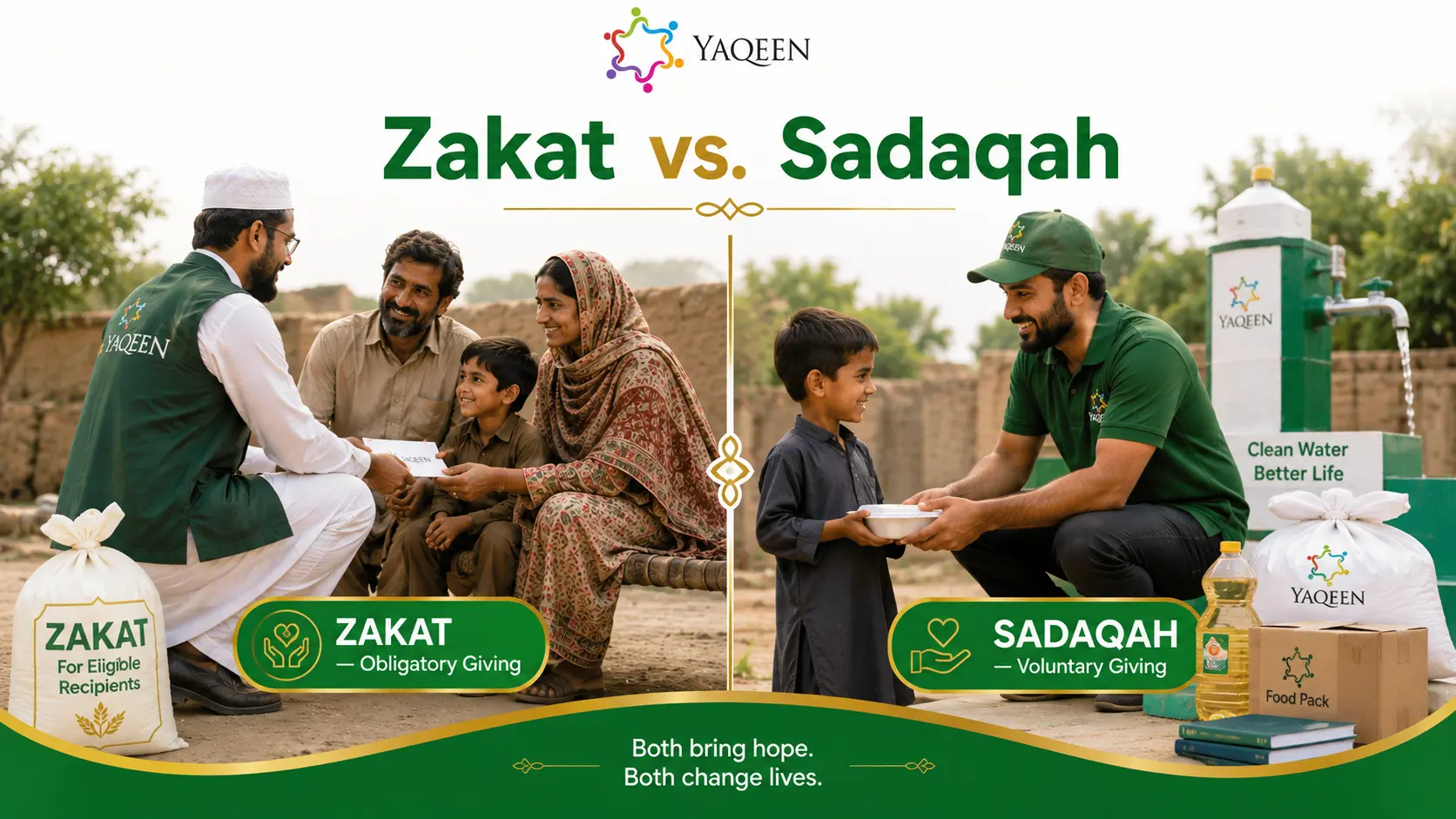
Zakat vs. Sadaqah
| Zakat | Sadaqah | |
|---|---|---|
| Nature | Obligatory for eligible Muslims | Voluntary |
| Timing | Due once qualifying wealth reaches nisab for one lunar year | Can be given anytime |
| Recipients | Limited to the 8 categories in Qur’an 9:60 | Broad flexibility |
| Calculation | Requires specific calculation (commonly 2.5%) | No fixed amount |
| Flexibility | Rules-based distribution | Can support almost any humanitarian project |
Both forms of giving matter, and both play essential roles in supporting vulnerable communities — they simply operate under different rules. For a deeper breakdown, see Sadaqah vs. Zakat: 6 Key Differences Every Muslim Should Know.
Zakat vs. Sadaqah Jariyah: these are different concepts entirely. Zakat is obligatory giving governed by specific rules; Sadaqah Jariyah refers to voluntary charity whose benefit continues over time — water wells, ongoing education, and lasting healthcare access are common examples. A Sadaqah Jariyah project shouldn’t automatically be assumed to be Zakat-eligible; the two labels answer different questions.
When Should Zakat Be Paid?
Zakat on qualifying wealth becomes due according to your own Zakat cycle — the date your wealth first reached nisab and a lunar year passed. Many Muslims choose Ramadan as a convenient time to calculate and give Zakat because of the month’s spiritual significance, but Zakat is not inherently tied to Ramadan. If your due date falls outside Ramadan, follow the applicable guidance rather than assuming payment must wait. Questions about paying Zakat early or intentionally delaying it should be directed to a qualified scholar, since the rulings can vary.
How Should You Calculate Zakat in 2026?
A practical framework — not a replacement for a scholar or calculator:
- Establish your personal Zakat due date.
- Identify all Zakatable assets (cash, gold, silver, business inventory, eligible investments).
- Subtract relevant deductible liabilities, according to the guidance you follow.
- Check the current nisab value.
- Confirm whether the applicable conditions are met.
- Calculate the Zakat due (commonly 2.5% of qualifying wealth).
- Identify eligible recipients from the eight categories.
- Distribute the amount responsibly, or through a trusted organization.
If you have a business, complex investments, a pension, cryptocurrency holdings, agricultural assets, or unusual debts, get specialized guidance rather than estimating.
How Charities Distribute Zakat Responsibly
A strong Zakat distribution framework generally includes:
- Receiving funds clearly designated as Zakat, separate from general donations
- Keeping accurate accounting records
- Identifying and assessing potential beneficiaries
- Determining which of the eight categories applies
- Protecting beneficiary privacy and dignity
- Distributing according to an approved Islamic framework
- Documenting and monitoring distribution
- Reporting appropriately to donors
Collecting Zakat is a significant responsibility. Organizations should treat every rupee or dollar as an amanah, with clear, consistent processes governing how it is used — not just where it ends up.
How Charities Determine Who Is Eligible
Responsible eligibility assessment typically considers income, household size, dependents, essential expenses, assets, debts, housing situation, medical needs, employment status, and existing assistance the family may already receive. This process should always be respectful and proportionate — beneficiaries should never be unnecessarily exposed or humiliated simply because they need help.
Why Zakat Transparency Matters
Before giving Zakat through any organization, it’s worth asking:
- Does the charity have a clear, published Zakat policy?
- How does it determine recipient eligibility?
- Does it separate Zakat funds from unrestricted donations?
- Who provides Islamic scholarly oversight?
- Which of the eight categories does it distribute to?
- Are any administrative deductions clearly explained?
- How are distributions documented and reported?
- How is beneficiary dignity protected throughout the process?
Transparency isn’t a bonus feature — it’s what allows a donor to trust that their Zakat has genuinely reached an eligible recipient.
How Zakat Can Help Families Facing Poverty
When distributed correctly, Zakat can relieve pressure on eligible households facing food insecurity, inadequate housing, unaffordable healthcare, unmanageable qualifying debt, and other essential, unmet needs. The chain of impact generally looks like this:
Zakat Assistance → Immediate Financial Relief → Essential Needs Supported → Reduced Household Pressure → Greater Opportunity for Stability
Every step depends on the funds actually reaching people who meet one of the eight eligible categories — which is exactly why eligibility assessment matters so much.
Zakat and Yaqeen Welfare Foundation’s Mission
Yaqeen Welfare Foundation exists to provide free medical treatment, clean water, and various forms of assistance to underserved communities across Pakistan.
Where a patient, student, or family qualifies as poor, needy, indebted, or otherwise falls under an eligible category, Zakat may be structured to support their needs according to our approved Zakat policy. But not every program, clinic expense, or infrastructure project is automatically Zakat-eligible.
Some of our work is better suited to general Sadaqah, and we aim to be clear about that distinction rather than blur it for the sake of convenience.
If you’d like to understand which programs currently accept Zakat and which rely on Sadaqah, our team is glad to walk you through it. You can reach out any time through our donation and contact page or by emailing info@yaqeen.org.
Common Zakat Mistakes to Avoid
- Giving without checking eligibility — financial hardship alone doesn’t confirm someone falls into an accepted category.
- Treating every charity project as Zakat-eligible — a good humanitarian project isn’t automatically a valid use of Zakat.
- Confusing Zakat with Sadaqah — the two have different rules and very different levels of flexibility.
- Using an outdated nisab figure — currency equivalents shift constantly as gold and silver prices move.
- Guessing a complex calculation — business owners and investors especially benefit from specialized guidance.
- Assuming every orphan automatically qualifies — financial eligibility still has to be established.
- Assuming every water well is Zakat-eligible — it may be excellent Sadaqah Jariyah, but Zakat funding needs separate consideration.
- Ignoring a charity’s distribution policy — always understand how an organization determines and manages eligibility before giving through them.
For a closer look at calculation errors specifically, see 7 Mistakes People Make When Calculating Zakat.
Frequently Asked Questions About Zakat
Who can receive Zakat? According to Qur’an 9:60, Zakat can go to eight categories: the poor, the needy, Zakat administrators, those whose hearts are being reconciled, those in bondage, people in qualifying debt, causes in the path of Allah, and stranded travelers. Individual eligibility within each category still needs to be assessed.
What are the eight categories of Zakat recipients? Al-Fuqara (the poor), Al-Masakin (the needy), Al-‘Amilina ‘Alayha (Zakat administrators), Al-Mu’allafati Qulubuhum (those whose hearts are reconciled), Fir-Riqab (freeing those in bondage), Al-Gharimin (those in debt), Fi Sabilillah (in the cause of Allah), and Ibn al-Sabil (the stranded traveler).
Who is eligible for Zakat in 2026? The underlying Islamic categories don’t change from year to year. What changes with “2026” is mainly practical: current nisab values, exchange rates, and cost-of-living conditions affecting who falls into poverty or need.
Can I give Zakat directly to a poor family? Yes, when the family is genuinely eligible and the distribution satisfies the applicable Islamic requirements around ownership and transfer.
Can I give Zakat to my relatives? Some relatives may qualify if they’re genuinely poor or needy and not someone you’re already obligated to support. Direct ascendants and descendants are generally treated differently. Seek specific guidance for your situation.
Can Zakat be given to an orphan? Yes, if the orphan falls under an eligible category like poverty or need — but orphan status alone doesn’t automatically establish eligibility.
Can Zakat be used for healthcare? Potentially, for an eligible recipient’s legitimate medical needs, when structured according to appropriate Islamic guidance.
Can Zakat pay for education? Potentially, for an eligible student under an appropriate structure — but not every educational project is automatically Zakat-eligible.
Can Zakat build a water well? It depends on the ownership structure, the beneficiaries involved, and the jurisprudential position being followed. There’s no automatic “yes.”
Can Zakat be given to someone in debt? Potentially, under the Al-Gharimin category, if the person meets the relevant conditions around genuine, unavoidable debt.
Can I pay Zakat before Ramadan, or delay it until Ramadan? Zakat is tied to your individual due date, not to Ramadan specifically. Questions about paying early or delaying an already-due obligation should be directed to a qualified scholar.
Is Zakat always 2.5%? 2.5% commonly applies to qualifying monetary wealth, but other Zakatable assets — such as agricultural produce or livestock — can follow different rules.
What is the nisab for Zakat in 2026? There’s no single fixed figure for the whole year, because nisab is based on gold or silver value, which fluctuates. Always check the current market-based nisab when you calculate.
Can I pay Zakat online? Yes — online payment can be a practical, secure method when you’re using a trustworthy organization with a clear, transparent Zakat distribution process.
How do I know a charity will use my Zakat correctly? Review its published Zakat policy, eligibility process, scholarly oversight, financial transparency, and how it documents and reports distributions.
Authoritative References
Religious claims in this guide are grounded in primary Islamic sources, including:
- The Qur’an, Surah At-Tawbah 9:60 — the foundational verse identifying the eight categories of Zakat recipients
- The Qur’an, Surah Al-Baqarah 2:43 — the general command to establish Zakat
- The Qur’an, Surah At-Tawbah 9:103 — Zakat and the purification of wealth
- Authentic Hadith concerning Zakat obligations and distribution
- Established classical fiqh references, and qualified contemporary scholars, for detailed modern rulings
Where recognized schools of jurisprudence differ on a specific point, that disagreement has been noted rather than presented as a single, universal ruling.
Conclusion: Give Your Zakat With Knowledge and Confidence
Zakat isn’t simply an annual donation — it’s an act of worship with real responsibilities attached to both calculation and distribution. Understanding who can receive Zakat is what allows a donor to fulfill that responsibility with genuine confidence, rather than guesswork.
The Qur’an lays out eight categories of eligible recipients, and that framework hasn’t changed. What has changed are the modern situations — healthcare costs, education, family debt, clean water access, and the charitable organizations distributing funds on donors’ behalf — that require careful, case-by-case application of that same timeless guidance.
The principle to hold onto is simple: calculate carefully, verify eligibility, choose responsible distribution, and treat Zakat as an amanah.
If you’re looking for an organization with a transparent Zakat policy that supports genuinely eligible families through free medical treatment, clean water access, and essential assistance across Pakistan, donate your Zakat online with Yaqeen Welfare Foundation or reach our team directly at info@yaqeen.org with any questions before you give.
Give your Zakat with care. Support eligible families. Protect their dignity. Create meaningful impact.