Sadaqah Jariyah is the one investment that does not stop paying out when you do. There will come a moment unlike any moment you have ever lived through — no lawyer standing beside you, no witness who owes you a favor, no chance to change what you said, fix what you chose, or revisit what you dismissed. The record will be sealed. Time will have run out. And the only things that will move — the only things that will rise and speak — are the deeds you sent forward while you still had the chance.
Among all of them, charity holds a station unlike any other. It does not simply sit quietly in your record, waiting to be checked. It moves. It stands between you and the fire. It shades you from a heat no ordinary sun could compare to. It speaks — not with a voice, but with something far more powerful: with weight, with impact, with the changed lives it touched long after your hands let it go.
This is an update for every Muslim — rich or struggling, healthy or unwell, young or aged — because the moment you have right now is the most valuable asset you possess.
A Reminder About Sadaqah Jariyah
We often talk about charity from the perspective of the recipient — the family lifted out of poverty, the child who now has clean water, the patient who received treatment they could never afford. All of that is real, and all of it matters. But there is a dimension to giving that we rarely pause long enough to fully absorb: one day, the giver will need what they gave — more urgently, more desperately, than anyone they ever helped.
On the Day of Judgment, every soul will be searching for something to speak on its behalf. Wealth will not stand up. Degrees will not stand up. Reputation will not stand up. But Sadaqah Jariyah — ongoing charity given sincerely for the sake of Allah — will rise and present itself before your Lord.
If you’re new to this concept, our companion piece on the Islamic blessings of helping the poor is a good starting point before diving deeper into what makes ongoing charity uniquely powerful.
The Day When Nothing Else Will Matter
Picture standing in a gathering unlike any gathering in history. Every human being who ever lived, assembled in one place. The sun brought near. The wait stretching beyond imagination. And in that moment, all the things that defined you in this world — your career, your assets, your social standing, your network — stripped away entirely.
Allah ﷻ describes this Day with a clarity that should shake every heart:
“The Day when neither wealth nor children will benefit anyone — except the one who comes to Allah with a sound heart.” (Surah Ash-Shu’ara, 26:88–89)
A sound heart is the currency of that Day. And one of the most effective ways to purify and protect the heart in this life is through giving — sincerely, consistently, and without expectation of any worldly return. The Prophet ﷺ described a man who gave charity so secretly that his left hand did not know what his right hand gave, and he will be among the seven whom Allah shades beneath His throne on the Day when there is no shade but His (Sahih al-Bukhari). Not the one who gave the most. Not the one who gave most publicly. The one who gave sincerely.
Sadaqah Jariyah in the Time of the Prophet ﷺ
The companions of the Prophet ﷺ did not treat generosity as something reserved for moments of surplus. They gave when they had little. They gave when giving meant sacrifice. They gave because they genuinely believed — not theoretically, but in the marrow of their bones — that what they sent forward was more real and more lasting than what they kept.
When the Muhajirun arrived in Madinah having left behind their homes, their businesses, and in many cases their families, the Ansar did not offer sympathy and send them on their way. They opened their homes. They divided their land. The Qur’an honored them for something extraordinary:
“They give preference to others over themselves, even when they are themselves in need.” (Surah Al-Hashr, 59:9)
This was not a one-time act of emergency generosity. It was a culture — a deeply rooted understanding that holding onto the world while a brother or sister suffered was simply not consistent with what it meant to believe. Aisha (RA) reported that the family of Muhammad ﷺ never ate their fill of wheat bread for three consecutive days until he passed from this world. He gave nearly everything away — not out of poverty forced upon him, but as a deliberate, continuous act of trust in Allah.
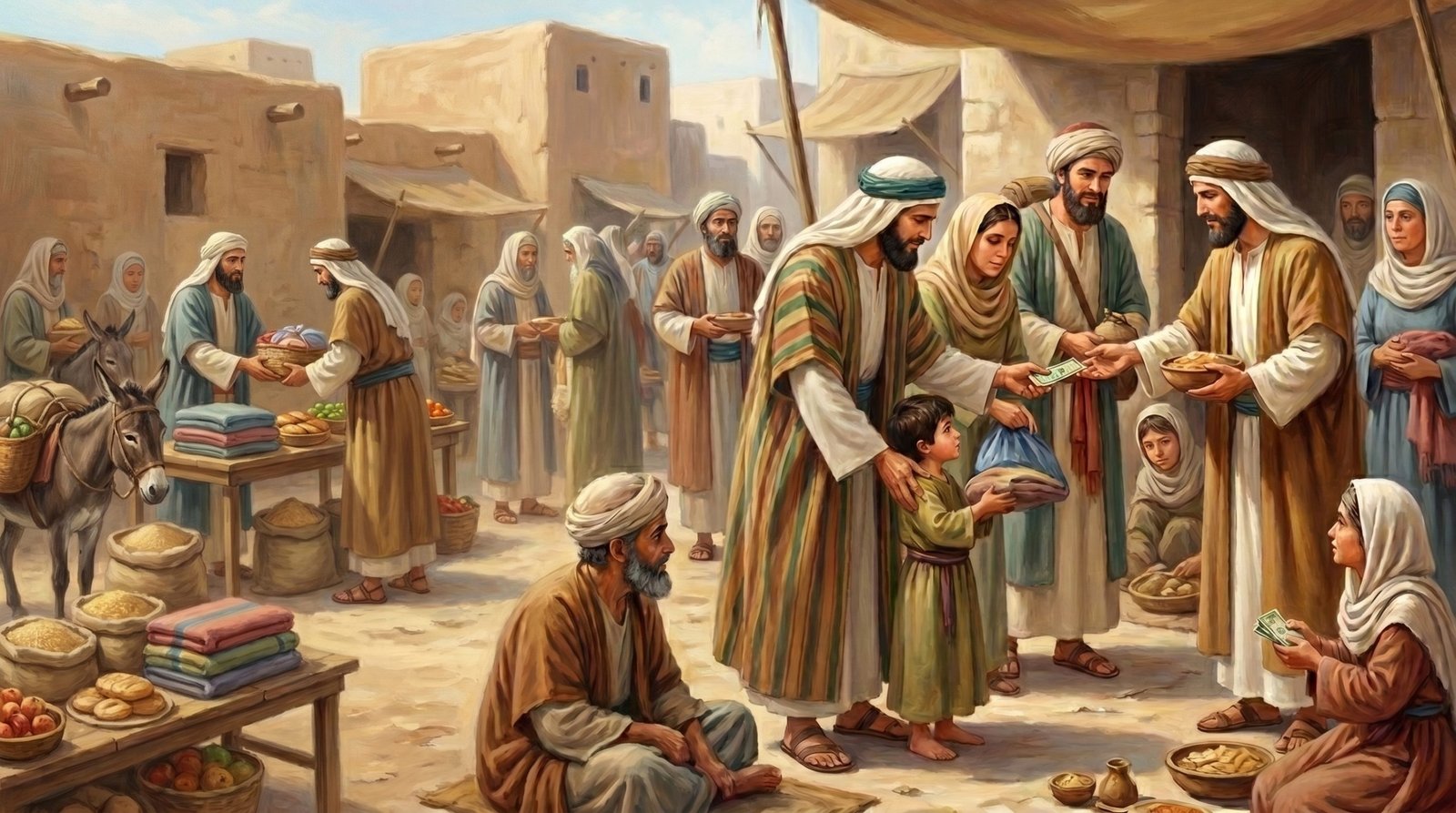
When Charity Became Waqf — The Endowment Model of Sadaqah Jariyah
Among the most brilliant institutions ever developed in human history is the Islamic concept of Waqf — a charitable endowment given once but continuing to benefit people for generations. This is Sadaqah Jariyah in its most structural form.
The companions understood this concept instinctively. They didn’t just want to help the people of their time — they wanted their giving to outlast them. When Umar ibn al-Khattab (RA) acquired land in Khaybar, one of the finest pieces of land in Arabia, he asked the Prophet ﷺ what he should do with it. The Prophet ﷺ advised him to make the land itself endowed — unchangeable, permanent — and to give its produce to those in need. That land continued to feed and support the poor for generations after Umar (RA) had passed (Sahih al-Bukhari).
Uthman ibn Affan (RA) purchased the Well of Rumah at his own expense, freeing it for public use when water access in Madinah was a pressing concern. He sought no repayment, attached no conditions, and gave it entirely for the sake of Allah — and the Prophet ﷺ promised him a spring in Paradise in return.
These men were not giving from their excess. They were giving from what mattered most. And in doing so, they created streams of reward that have never stopped flowing — the very definition of Sadaqah Jariyah. For a deeper historical dive into this system, see our related post on the history of Waqf and its role in shaping Muslim civilization.
When Sadaqah Jariyah Becomes Your Shade
The Prophet ﷺ said:
“Every person will be beneath the shade of their charity on the Day of Resurrection.” (Ahmad — authenticated)
On a Day of intense pressure — a gathering that will test every soul beyond any natural experience — the believer who gave for Allah’s sake will find something waiting for them. Not a palace. Not a certificate of honor. A shade.
Think about what shade means. It means relief. It means shelter. It means mercy extended over you at the moment you need it most. Every meal you funded for a family with nothing, every clean water source you helped establish, every medication that reached a sick child because of your contribution — all of it becomes shade. It does not matter if you forgot you gave it. It does not matter if you never saw the impact. Allah ﷻ saw. Allah ﷻ recorded. And on that Day, He will return it to you — amplified, multiplied, and turned into your shelter. This is the lasting power behind Sadaqah Jariyah: the charity does not vanish when you let it go. It travels ahead of you, preparing your place before you arrive.
The Words You Will Not Need to Say
How much energy do we spend in this life managing how we are seen? Crafting explanations. Defending choices. Hoping the people around us understand our intentions. On that Day, none of that will be necessary — and none of it will be possible.
But there is a mercy in this. Because on that Day, your charity will not need your help. It will not wait for you to frame it correctly or present it in the best light. It will simply stand. A small act of kindness given to a stranger in a forgotten moment. A donation made at midnight, seen by no one. A recurring gift that quietly kept a program running. These acts are not lost. They have been gathered, preserved, and will be presented before the One whose knowledge includes everything that was ever done in secret or in the open.
A Scene Most People Never Truly Imagine
Close your eyes for a moment and try to feel this — really feel it. You are standing on the Day of Judgment. Your heart is tight with uncertainty. You cannot remember everything you did or failed to do. And then, something appears in your record that you had nearly forgotten.
A donation you made years ago — maybe modest, maybe made in a rush, maybe without knowing exactly where it would go. But it reached a water project that has now served a village for a decade. Thousands of people have drunk from that source. Crops were watered. Children grew up healthy. Lives continued that might have ended without it.
All of that is yours. Not because you planned it that way. Not because you were particularly clever or particularly wealthy. But because you trusted, you gave, and you moved on — leaving it entirely in the hands of Allah. This is the essence of Sadaqah Jariyah: deeds sent forward, working quietly, long after you’ve stopped thinking about them.
What Your Sadaqah Jariyah Is Doing Right Now
At this very moment, somewhere in the world:
- A woman is drinking clean water from a well made possible by someone’s donation — a person she has never met and likely never will.
- A child is receiving medical care his family could not have paid for, surviving an illness that would otherwise have taken him.
- A family on the edge of collapse has found just enough support to hold together — to feed their children, to keep going, to rebuild.
In each of these situations, a name is being written — not in a public record, not in a newspaper — but in a divine account that will be opened on the Day when every deed must answer for itself. The person who gave is not there to see any of it. But their Sadaqah Jariyah is. It is already working. Already accumulating. Already preparing to speak.
Where Your Sadaqah Jariyah Can Go
Every contribution toward ongoing charity is best treated as an amanah — a trust — that carries weight far beyond this life. Some of the most enduring forms of Sadaqah Jariyah include:
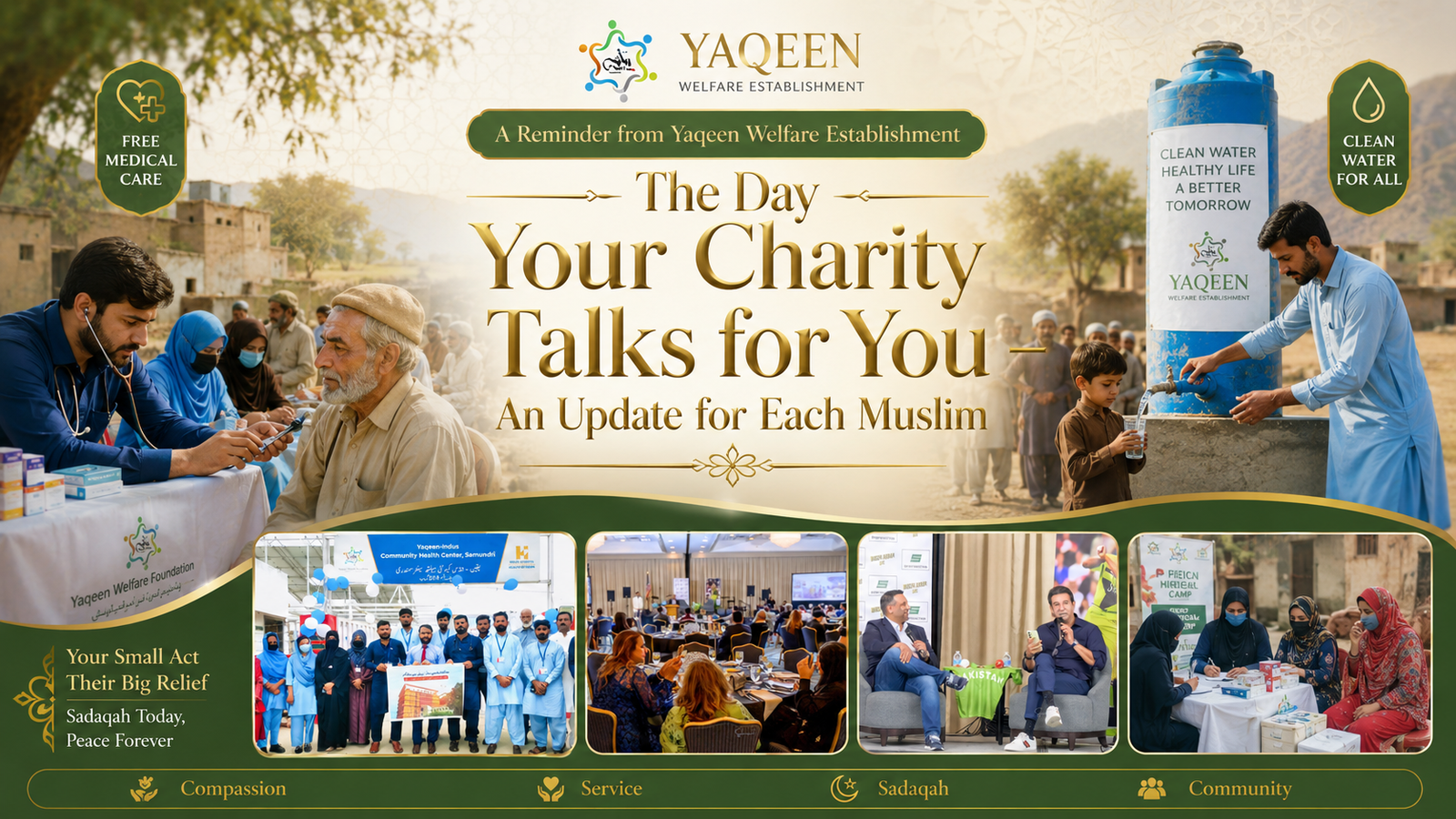
- 💧 Clean Water Projects — Inspired by the legacy of Uthman ibn Affan (RA), each clean water installation becomes a source of continuous reward. Every person who drinks, every family that cooks, every child spared from waterborne illness — all of it flows back to the one who gave.
- 🏥 Free Healthcare Initiatives — Illness does not wait for those with means. Healthcare programs that bring treatment to the overlooked turn every recovered patient into a testimony in the giver’s record.
- 📚 Education and Scholarships — Funding a child’s schooling creates a ripple that extends across that child’s entire future — and often into the lives of their own children.
- 🏠 Community and Family Resilience Programs — Poverty is not just the absence of money; it is the erosion of dignity and stability. Supporting a family’s recovery is a witness that will stand for the giver on the Day of Judgment.
If you’d like to compare how Sadaqah Jariyah differs from other categories of giving, our guide on the difference between Zakat and Sadaqah breaks down the obligations and flexibility of each.
Why Postponing Sadaqah Jariyah Is More Expensive Than It Feels
The human mind is remarkably good at convincing itself that there will be a better time — a better financial moment, a clearer sense of where to give, a larger amount worth giving, more certainty about the future. But the future is not guaranteed. And while we plan, the opportunity we are waiting for may quietly close.
The Prophet ﷺ was clear and direct on this point:
“Take advantage of five before five: your youth before your old age, your health before your illness, your wealth before your poverty, your free time before your distraction, and your life before your death.” (Verified by al-Albani)
Every day we delay, there are people who needed help today. Every week we wait, there are deeds we may have sent forward but didn’t. The scholar Ibn al-Qayyim wrote that delaying good deeds is one of the greatest tools the enemy of the soul uses against the believer — because it does not feel like failure. It feels like preparation. It is not preparation. It is loss.
Final Thought on Sadaqah Jariyah
One day, you will stand before your Lord with nothing in your hands. Not your reputation. Not your savings. Not your plans for what you were going to do next year. Just you — and everything you chose to do with the time and resources you were given.
But here is what is beautiful about Islam: you do not have to stand there empty-handed. You can send things ahead. You can fill that moment now, while you still have the ability to act. Every sincere act of Sadaqah Jariyah you give today is a deposit in an account that does not lose value, does not suffer from inflation, and cannot be taken from you. It will be there — more complete than when you gave it, multiplied beyond what you imagined, standing at exactly the moment you need it most.
So ask yourself, honestly and quietly: when that Day comes, what will speak for you? The answer to that question is built right now. In this moment. With what you choose to do next.
👉 Start Your Sadaqah Jariyah Today
May Allah accept our charity, purify our intentions, and allow every act of giving to become a light and a shield on the Day we face Him. Ameen.
“Protect yourselves from the Fire — even with half a date given in charity.” (Sahih al-Bukhari & Sahih Muslim)
FAQs About Sadaqah Jariyah
Q1. Does Sadaqah Jariyah given during our lifetime truly benefit us after we pass away?
Yes — with full certainty, based on authentic hadith. The Prophet ﷺ taught that when a person dies, all their deeds come to an end except three: ongoing charity (Sadaqah Jariyah), knowledge that benefits others, and a righteous child who prays for them (Sahih Muslim). Sustainable giving is one of the clearest ways to reward that continues past the grave.
Q2. What types of Sadaqah Jariyah carry the greatest long-term impact?
Charity that creates sustained benefit tends to be most effective — water infrastructure that serves communities for decades, healthcare programs that treat recurring need, and educational support that empowers future generations. The deeper and longer the impact, the longer the stream of reward flowing back to the giver.
Q3. Is there value in giving a small amount toward Sadaqah Jariyah?
Absolutely — and this is one of the most important points in Islamic teaching on charity. The Prophet ﷺ said: “Do not look down upon any good deed, even meeting your brother with a cheerful face” (Sahih Muslim). Sincerity is the multiplier, not size. A small gift given with a pure heart can carry immense weight before Allah.
Q4. Can Sadaqah Jariyah truly protect us on the Day of Judgment?
According to authentic narrations, yes. Charity forms a physical shade for the believer on that Day. It also extinguishes sins the way water extinguishes fire, as the Prophet ﷺ described. These are not metaphors — they are realities of the unseen that the scholars of Islam have consistently affirmed based on sound prophetic transmission.
Q5. What if I am not sure my Sadaqah Jariyah was accepted?
Trust in Allah’s generosity. The condition for acceptance is sincerity — giving for His sake alone, not for status or recognition. If your intention was to please Allah, leave the outcome with Him. As the Qur’an says: “Indeed, Allah does not allow the reward of the good-doers to be lost” (Surah At-Tawbah, 9:120).
Q6. How is Sadaqah Jariyah different from regular Sadaqah?
Regular Sadaqah is typically a one-time act of voluntary charity, while Sadaqah Jariyah is structured to keep generating benefit — and therefore reward — long after the original act of giving. A meal given once feeds one moment; a well dug once can feed a community for generations. For more on structuring your giving for maximum lasting impact, see our post on why Sadaqah Jariyah is the smartest long-term investment a Muslim can make.
Get in Touch
Have questions about setting up an ongoing Sadaqah Jariyah project, sponsoring a well, or funding a scholarship? Contact us online — our team is happy to help you find the right path forward.