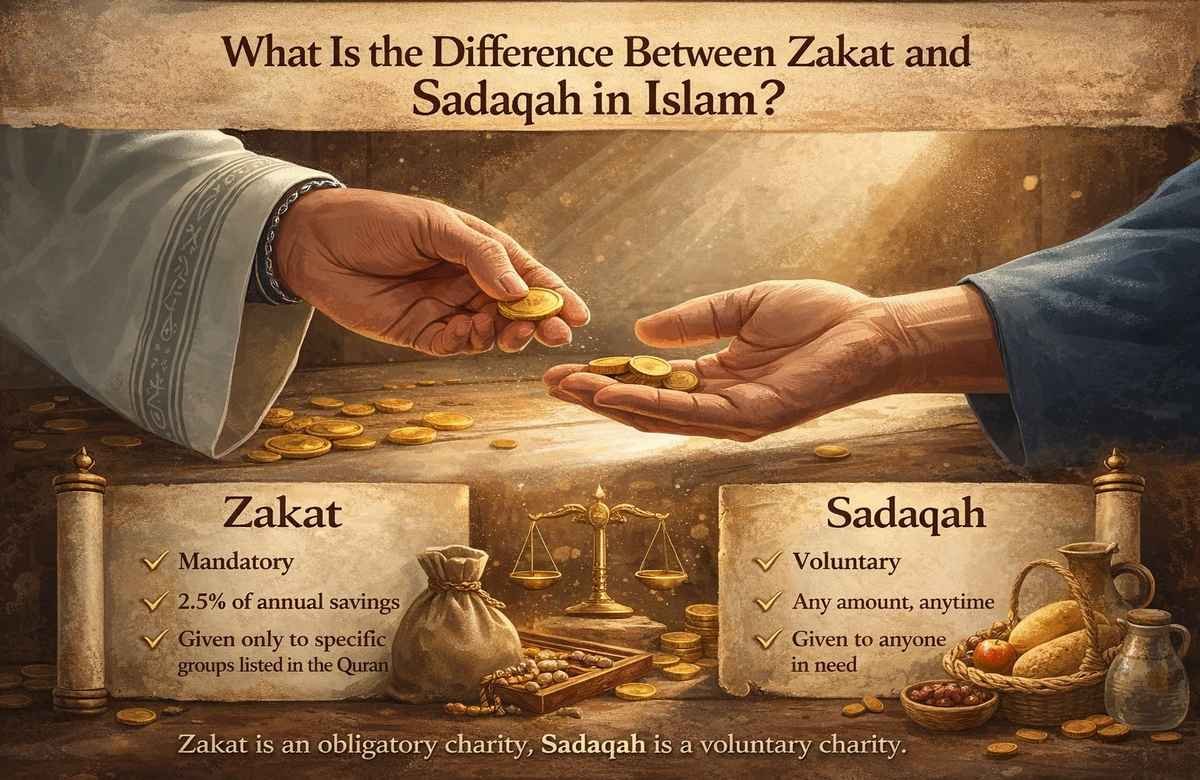
Every Muslim gives. But not every Muslim gives correctly — and that difference matters more than most people realise. At Yaqeen Welfare Foundation, Pakistan’s trusted name in free healthcare and clean water access, we see this confusion every single day. People mix up Zakat and Sadaqah. They use them interchangeably. Sometimes they give one thinking it counts as the other. It does not. Understanding the difference between Zakat and Sadaqah is not just a religious technicality — it is the foundation of giving that actually reaches the right people the right way. We built Yaqeen Indus Health Clinic and our clean water projects on exactly that principle. Your giving should count fully. So let us make sure it does together.
The Core Difference Between Zakat and Sadaqah
What Makes Them Fundamentally Different
Zakat is an obligation. Sadaqah is a choice.
That single line carries everything. Zakat is one of the Five Pillars of Islam — as foundational as Salah and Sawm. If you qualify, you must give it. There is no negotiating, no postponing without consequence, no replacing it with something else.
Sadaqah sits in a completely different category. It is voluntary. Open. Flexible. You give it when your heart moves you, in whatever form you choose, to whoever needs it.
Both are acts of worship. Both carry enormous rewards. But they are not the same act — and treating them as if they are leads to real gaps in both your obligation and your impact.
Understanding Zakat — The Obligatory Pillar
Who Must Give Zakat
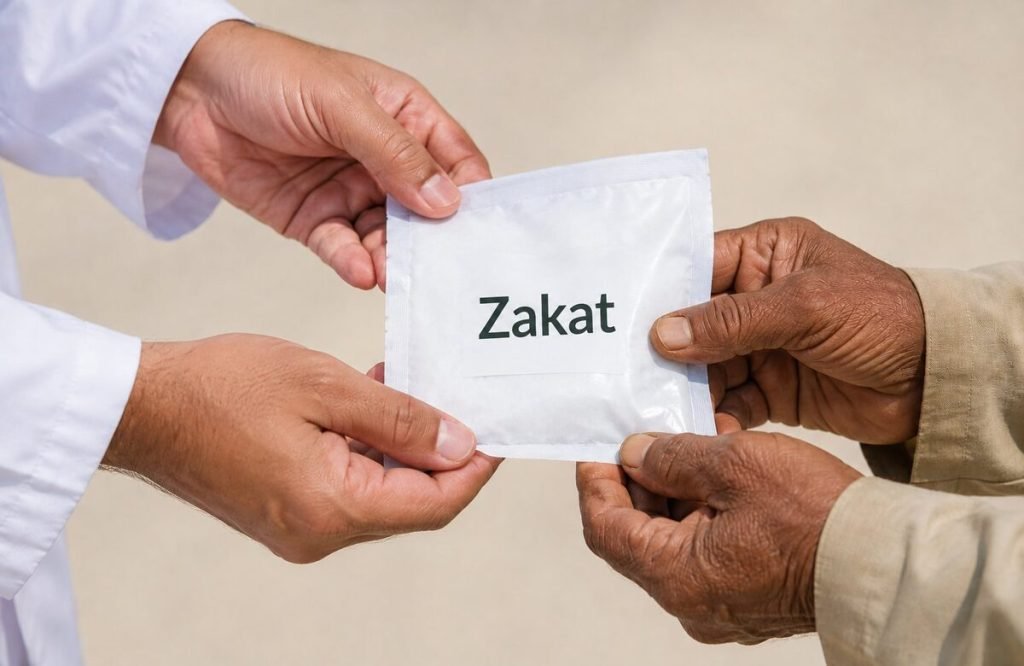
Zakat applies to every sane adult Muslim who has held wealth above the Nisab threshold for one complete lunar year. Nisab is currently calculated at the value of 87.48 grams of gold or 612.36 grams of silver — whichever is lower according to the scholarly position most beneficial to the poor.
The amount is fixed — 2.5% of total qualifying wealth. This includes savings, gold, silver, business inventory and certain investments. It does not include your home, your car or personal items you use daily.
What the Quran Says About Zakat
Allah does not leave room for ambiguity here:
“Take from their wealth a charity by which you purify them and cause them to increase.” (Surah At-Tawbah 9:103)
Zakat is described as purification — not generosity. The poor have a right to your wealth that was always theirs. Zakat is simply the mechanism by which that right is fulfilled.
Who Can Receive Zakat
The Quran specifies eight categories in Surah At-Tawbah 9:60 — the poor, the needy, those in debt, travellers in need and others. This is not a loose list. Giving Zakat outside these categories does not fulfil the obligation.
This specificity is why Yaqeen Welfare Foundation maintains strict Zakat distribution protocols — ensuring every rupee given as Zakat reaches a qualifying recipient through our healthcare and clean water programmes.
Understanding Sadaqah — The Open Door
Why Sadaqah Is Different From Zakat
Sadaqah is derived from the Arabic root, Sidq , which means truthfulness and sincerity. By giving Sadaqah, we prove that our faith is genuine. That our faith in Allah’s generosity encourages us to give from what we have.
The Prophet ﷺ said:
“Every act of goodness is Sadaqah.” (Sahih Muslim)
A smile. Removing something harmful from the road. Sharing knowledge. Giving a meal. All of it counts. Sadaqah has no minimum, no fixed amount, no single form.
Sadaqah Jariyah — The Sadaqah That Never Stops
Within Sadaqah there is a category that carries a special weight — Sadaqah Jariyah, or ongoing charity.
The Prophet ﷺ said:
“When a person dies, all their deeds come to an end except three — ongoing charity, knowledge that benefits others, or a righteous child who prays for them.” (Sahih Muslim)
A water well. A free clinic. A funded classroom. These are not acts that end when you give them. They keep giving. And every time they give — the reward flows back to you.
At Yaqeen Welfare Foundation, our clean water projects and Yaqeen Indus Health Clinic are built precisely as vehicles for Sadaqah Jariyah. Donors who gave towards our water pumps two years ago are still earning a reward today — because those pumps are still running and those families are still drinking clean water every single morning.

Can Sadaqah Replace Zakat
No. This is one of the most common and most costly misunderstandings in Islamic giving.
No matter how much Sadaqah you give — ten times the Zakat amount, every Ramadan, every Friday — it does not cancel your Zakat obligation. They are separate doors. You cannot enter one through the other.
If Zakat is due on you and unpaid, that obligation remains. Scholars consider unpaid Zakat a serious matter — a debt to Allah that does not disappear until it is fulfilled.
What About Giving Both
Yes — and this is where giving becomes truly powerful.
Give your Zakat as an obligation fulfilled correctly. Then give Sadaqah from a place of love and choice. One is the floor. The other is everything you build above it.
At Yaqeen Welfare Foundation we accept both — and we ensure each is used correctly and transparently according to its category.
The Difference Between Zakat and Sadaqah in Everyday Giving
Here is what this looks like practically.
Your colleague at work is struggling. You give him money. If he qualifies as a Zakat recipient — that can count as Zakat. If not — it counts as Sadaqah. Both carry reward. But only one fulfils the pillar.
You sponsor a child’s school fees. That is Sadaqah — educational support does not fall under Zakat categories. But if that child’s family qualifies under the poor or needy category and you give directly to them — that can be Zakat.
The intention and the recipient both matter. Clarity is not bureaucracy. It is respect for the obligation.
How Yaqeen Welfare Foundation Uses Your Giving
When you give to Yaqeen Welfare Foundation — whether Zakat or Sadaqah — here is exactly where it goes:
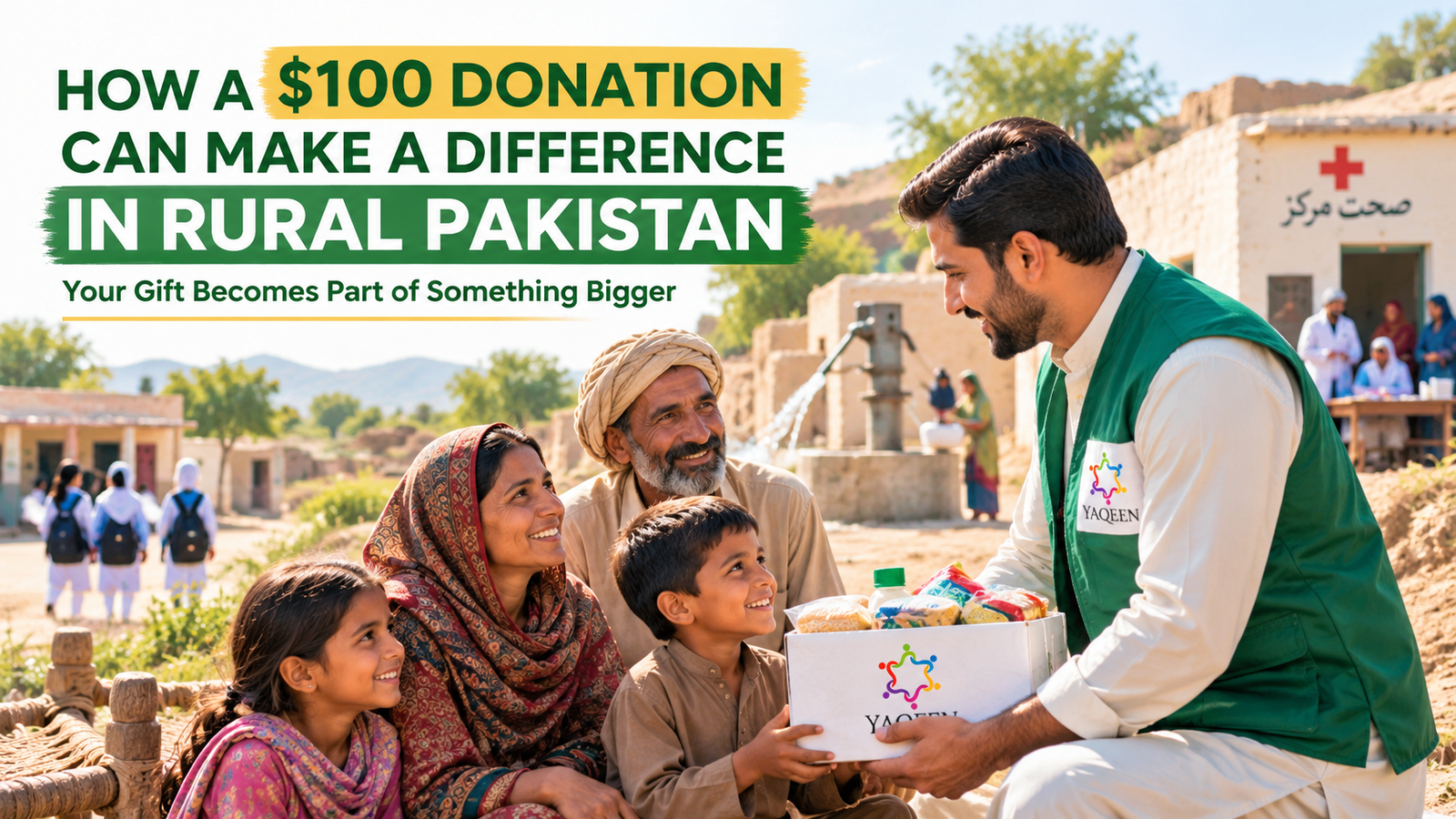
Clean Water Projects — pumps and water sources installed in villages where families walk miles for contaminated water. Every drop is Sadaqah Jariyah for the donor.
Yaqeen Indus Health Clinic — free medical consultations, medicine and treatment for communities that have never had access to a doctor. Patients who could not afford a single visit receive ongoing care at zero cost.
Every Zakat rupee is distributed only to qualifying recipients. Every Sadaqah rupee is channelled into ongoing projects that carry permanent reward. We treat your trust as seriously as the obligation itself.
DONATE NOW
Final Thought
Right now, there is a woman in a village outside Karachi who has been drinking contaminated water for thirty years. And there is a man outside Yaqeen Indus Health Clinic who walked two hours because it is the only place he can get real treatment without paying anything at all. Your Zakat reaches him directly — as a right he already had sitting inside your wealth. Your Sadaqah builds the water pump that changes her mornings permanently and completely. The difference between Zakat and Sadaqah is not just Islamic knowledge. It is the difference between giving that fulfils an obligation and giving that never stops. At Yaqeen Welfare Foundation we make sure both happen — correctly, transparently, every single day.
The word Sadaqah is derived from the Arabic word Sidq, meaning truth — making it an act of sincerity — while Zakat is one of the five fundamental foundations of Islam, making it compulsory. Abandoning Zakat payments is considered a form of serious transgression, while not giving Sadaqah is never sinful.
Source: National Zakat Foundation UK
FAQs — Difference Between Zakat and Sadaqah
Q. Can I give Zakat to a non-Muslim?
Most scholars agree Zakat can’t be paid to non-Muslims because it’s limited to the eight categories in the Quran , which are generally understood to be Muslims.You can give Sadaqah to anyone in need regardless of faith. If you have a non-Muslim neighbour who needs help, you can give Sadaqah and it is meritorious.
Q. Does giving Sadaqah count as Zakat if the amount is the same?
No. The difference between Zakat and Sadaqah isn’t amount , it’s obligation and intention. If the Sadaqah was given with the intention of fulfilling Zakat, it doesn’t count. The exception is Zakat given to a qualifying Zakat recipient with a certain Zakat intention. If you aren’t sure for a given case, please ask a scholar.
Q. Can I give Zakat to my own family members?
You can’t pay Zakat to anyone you are financially accountable for , your spouse, children, or parents. You can however, pay Zakat to other relatives such as siblings, cousins, aunts and uncles if they meet the requirements. In fact, Zakat given to a qualifying relative is more meritorious because it’s a combination of Zakat and helping your family.
Q. Is Sadaqah Jariyah better than regular Sadaqah?
Both carry real reward. But Sadaqah Jariyah — ongoing charity — has a unique quality. The reward does not stop when you stop. A water pump you funded keeps giving a reward every time someone drinks from it. A clinic you supported keeps earning for you every time a patient is treated. For those thinking about legacy and long-term reward — Sadaqah Jariyah is among the most powerful investments a Muslim can make.