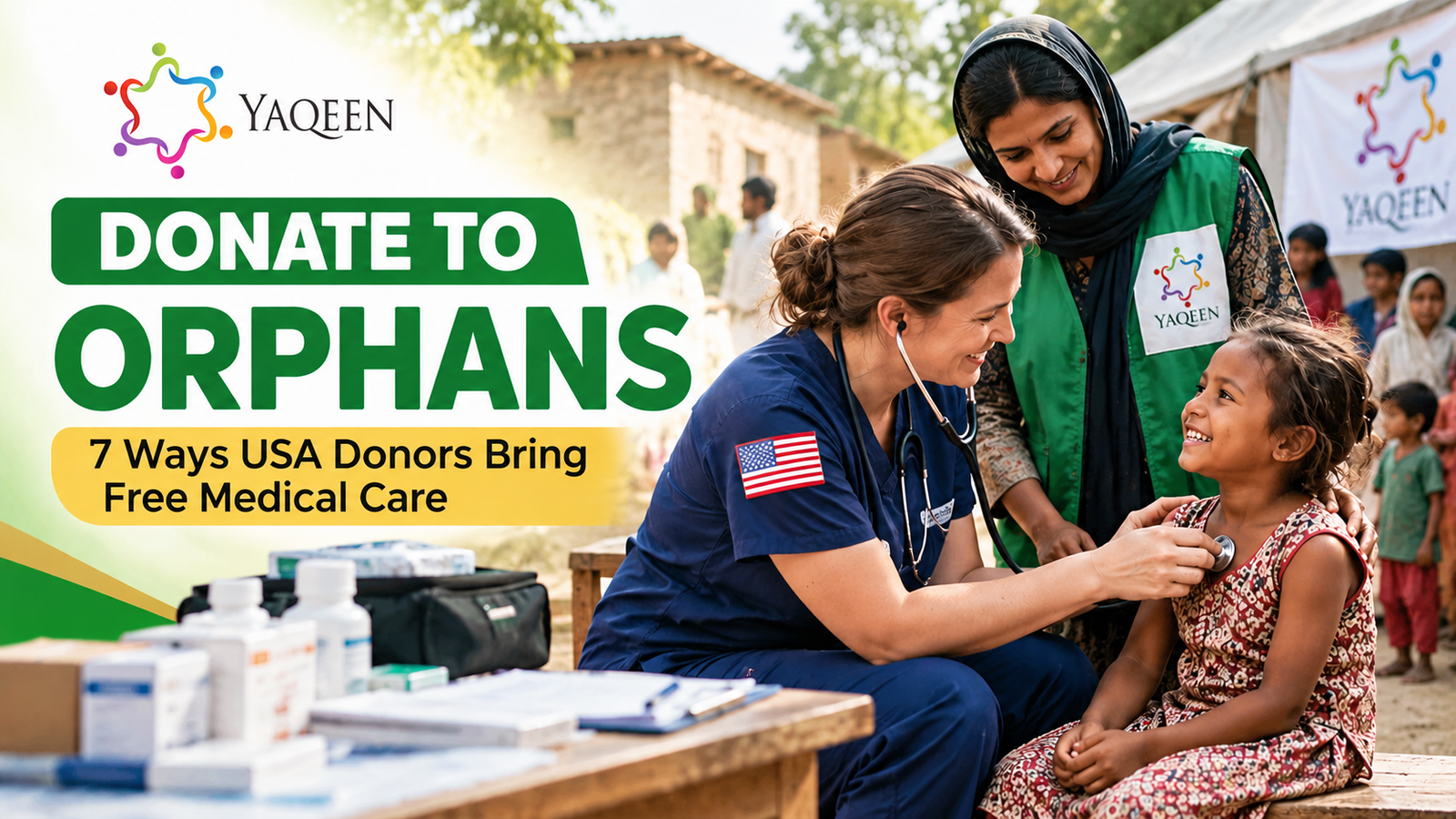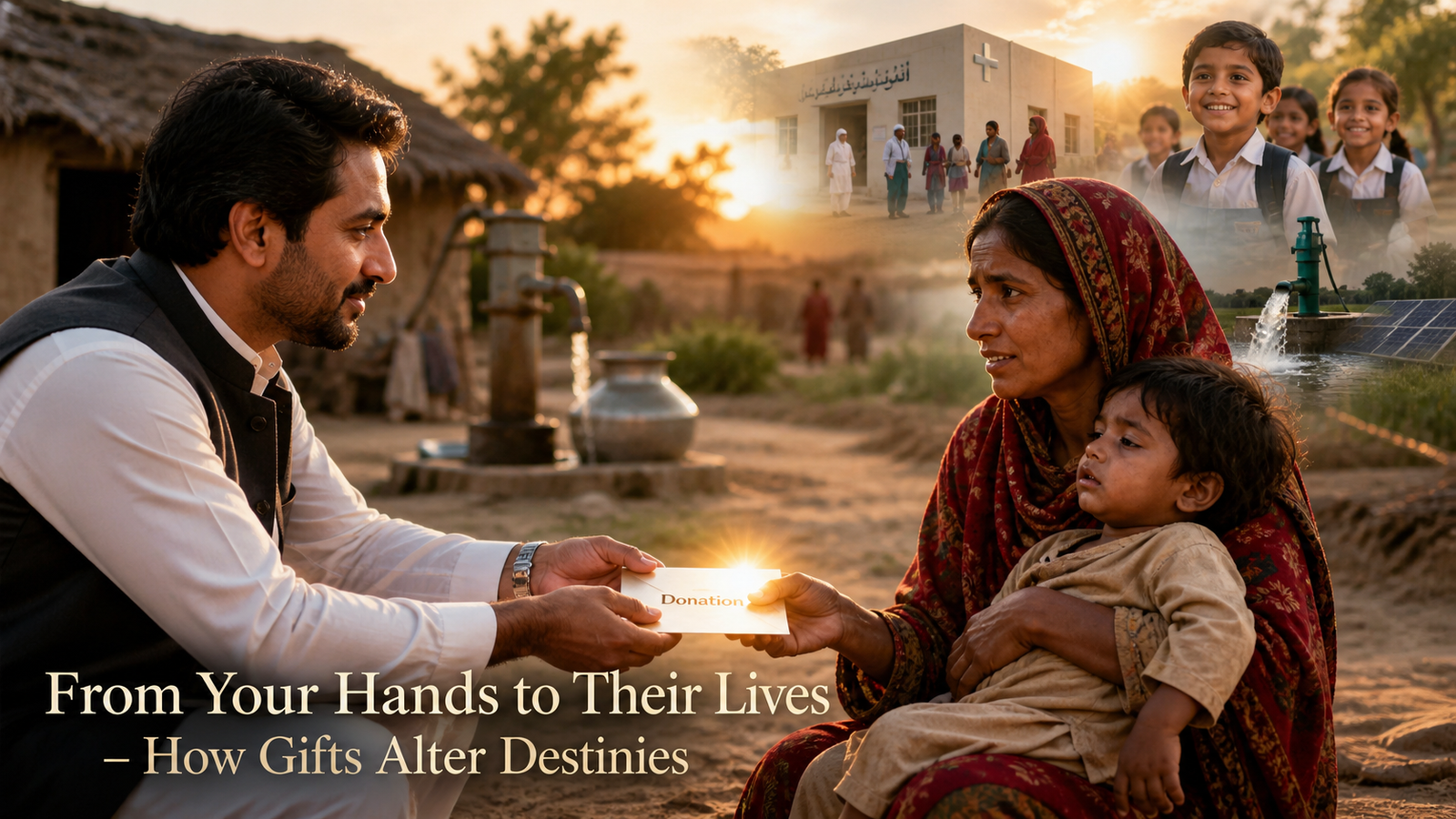
Islamic giving is rarely measured the way the rest of the world measures generosity. Most people think little of the weight carried by a single act of charity. A moment of generosity — however small it feels on your end — carries a force that travels across distances, breaks through walls of despair, and lands in someone’s life like the first rain after a long dry season. At Yaqeen Welfare Foundation, we witness this quiet phenomenon constantly. What leaves your hand as a modest contribution arrives somewhere else as medicine, clean water, a meal, or the first real hope a family has felt in months. The transformation isn’t a metaphor. It’s real, measurable, and lasting.
The Legacy of Islamic Giving: A History of Transformation
Long before the language of “social impact” entered the world’s vocabulary, Islam had already built an entire civilization on the principle of voluntary generosity. The concept of giving was never passive — it was architecture. Islamic giving built hospitals, sustained libraries, supported the poor, and held entire societies together through a discipline of trust and collective care.
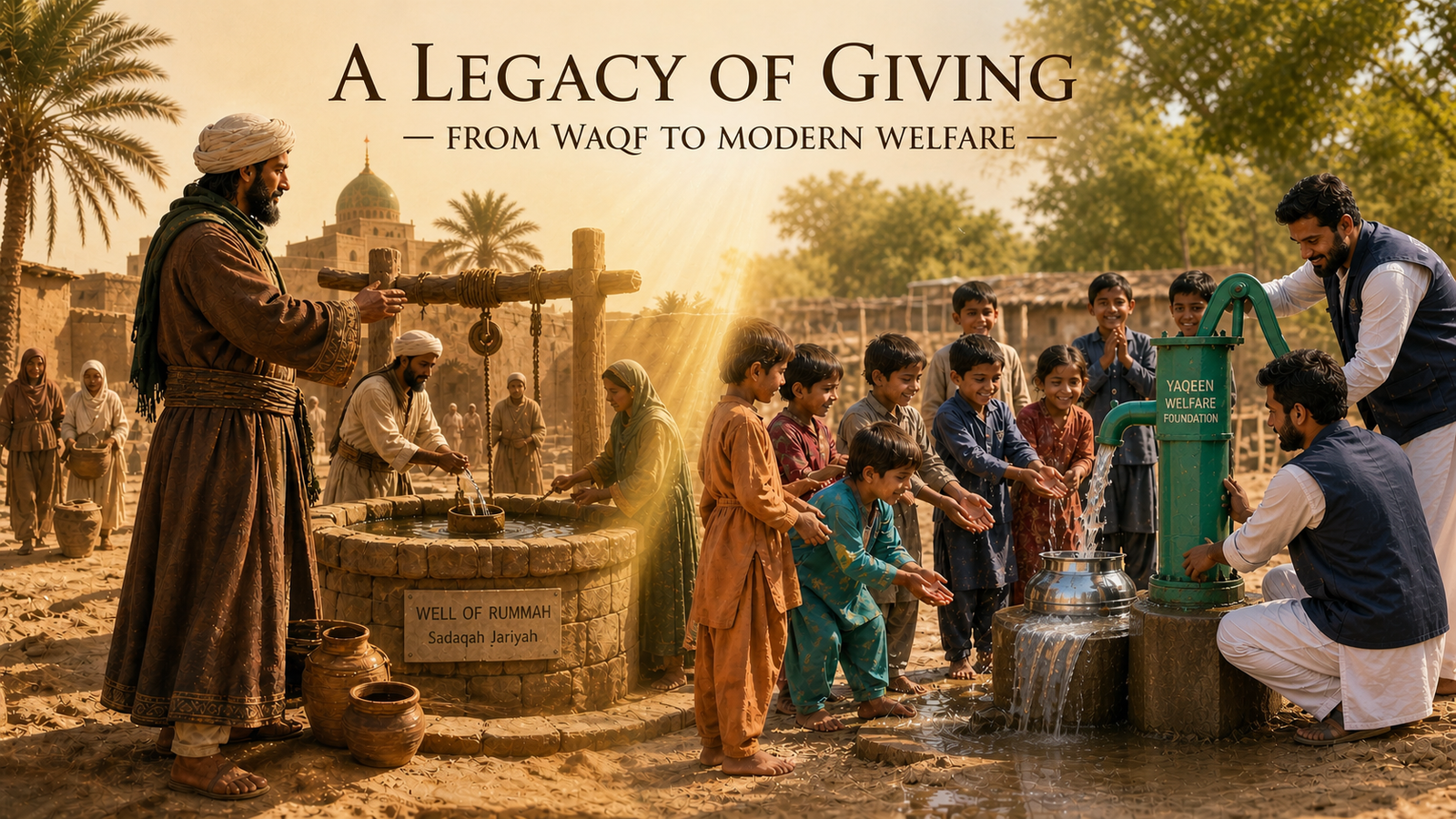
The Well of Uthman (RA)
When the people of Madinah were struggling to access clean water, Uthman ibn Affan didn’t simply make a donation — he purchased the Well of Rummah from a private owner and declared it a gift for every Muslim, traveler, and soul in need. That single decision, made over 1,400 years ago, continues to ripple forward to this day. The Saudi government later developed the surrounding land, and the proceeds from that very waqf continue to be distributed in Uthman’s name even now. One act. Fourteen centuries of reward.
The Bimaristans of the Golden Age
The hospitals of the Abbasid era were not charitable afterthoughts — they were architectural marvels, staffed by the era’s finest physicians, and funded entirely through waqf endowments given by merchants, rulers, and ordinary believers alike. Patients were treated regardless of their faith, their wealth, or their background. Musicians were even employed to ease the distress of those who were mentally unwell. Compassion was institutionalized, and it was made possible entirely through the sustained giving of a community that understood a simple truth: wealth is purified when it flows toward others.
Fatima al-Fihri and the Power of Education
In 859 CE, a Muslim woman named Fatima al-Fihri founded the University of al-Qarawiyyin in Fez — the oldest continuously operating university in the world — using her entire inheritance as an endowment. She fasted every day during its construction and only broke her fast the day its doors opened to students. Her endowment didn’t just feed the hungry; it fed the minds of generations that followed.
These three stories alone capture what makes Islamic giving so distinct from charity as the modern world understands it. It was never about a single transaction. It was about building something that would keep giving long after the giver was gone — a principle Islam calls Sadaqah Jariyah. If you’d like to understand that concept in more depth, our article on The Power of Sadaqah Jariyah – A Lifetime of Reward explores exactly how a single act of charity can continue generating reward indefinitely.
Where Your Gifts Go at Yaqeen Welfare Foundation
Your giving becomes real, tangible change:
- 💧 Clean Water Projects — Turning unsafe water into a daily source of life.
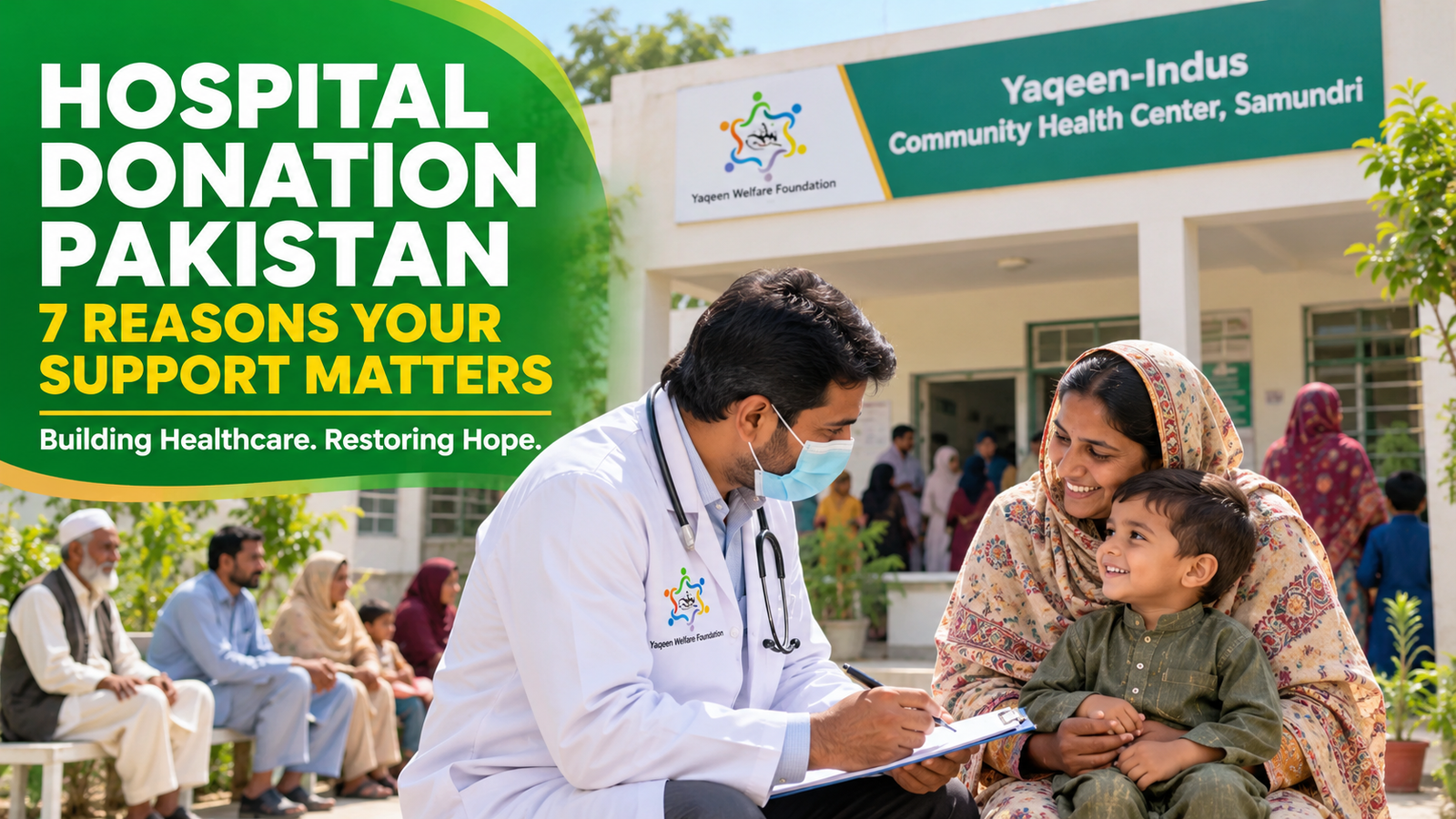
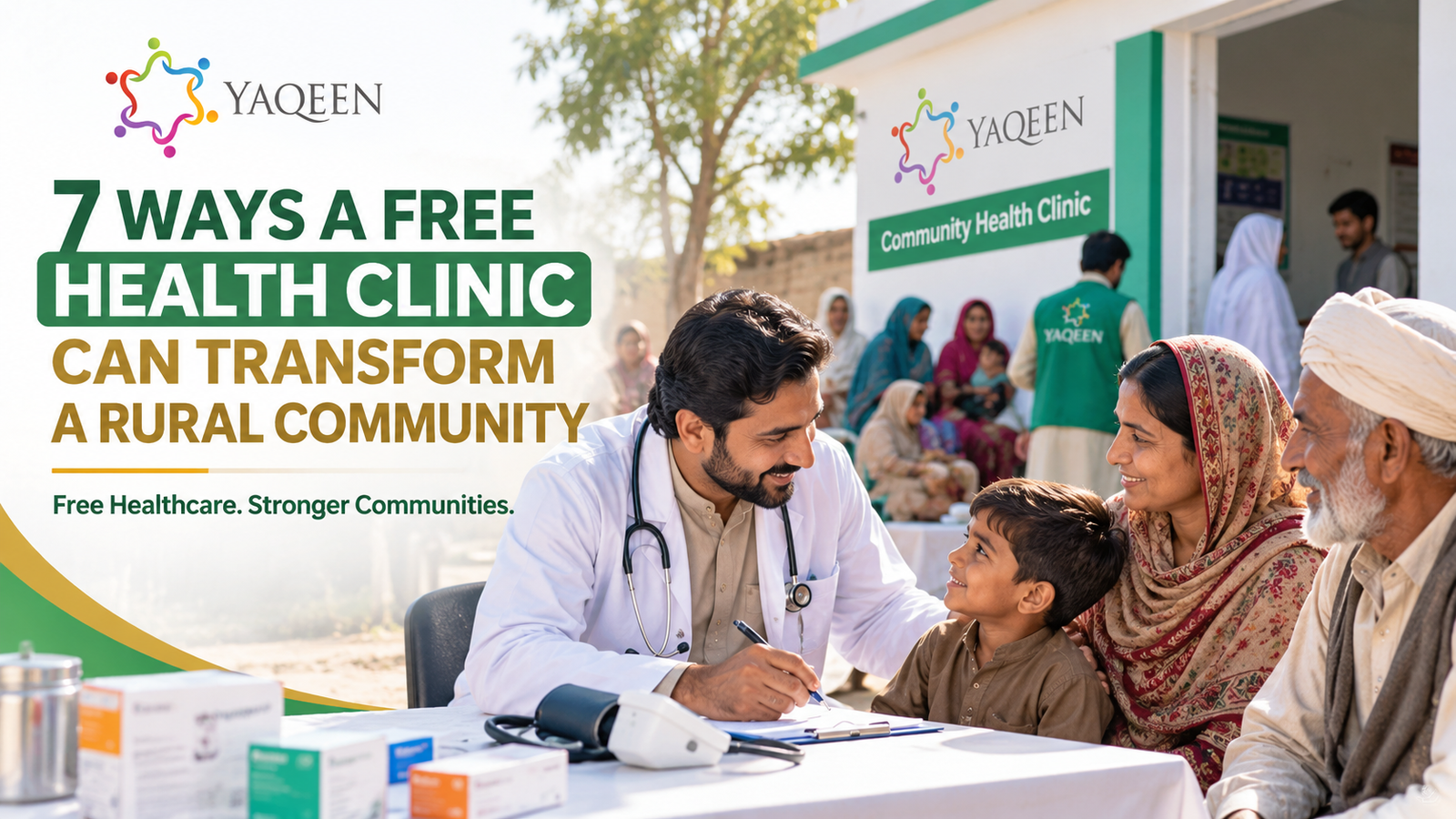
- 🏥 Free Healthcare — Providing treatment, medicine, and care for those who cannot afford it.
- 🍲 Food & Emergency Support — Helping families survive when they have nothing left.
- 📚 Health Awareness — Teaching communities how to manage their health and prevent future crises.
The Prophet ﷺ reminded us:
“The best of people are those who bring the most benefit to others.”
When you donate through Yaqeen Welfare Foundation, you are not performing a modern transaction. You are joining a legacy of believers whose hands have always reached toward the struggling, the sick, and the overlooked — and whose rewards continue to accumulate long after they have returned to their Lord.
The Intersection of Education and Health Care in Pakistan
Pakistan stands at a critical crossroads. It is a country of remarkable resilience and talent, yet millions of its people remain trapped in cycles of preventable illness — not because medicine doesn’t exist, but because knowledge hasn’t reached them. Waterborne diseases claim thousands of young lives every year. Maternal mortality rates in rural areas remain heartbreakingly high. Children go malnourished not always because of poverty alone, but often because families lack the information needed to make the most of what they have.
This is where health education becomes as life-saving as any surgical procedure. For a closer look at how Yaqeen approaches this gap on the ground, our post on Building a Future for Free Healthcare: Why Modern Infrastructure Is the Key to Healing Pakistan goes deeper into the infrastructure side of this challenge.
The Hidden Crisis of Preventable Illness
A child doesn’t fall sick simply because bacteria exist in the world. The illness takes hold because a family doesn’t know how to properly store water, or doesn’t recognize the early signs of dehydration, or believes a fever will pass without treatment. When communities receive organized guidance on basic hygiene, nutrition, and preventive care, hospital admission rates in those regions drop measurably. The illness was never inevitable — it was a gap in knowledge.
Mothers as the First Healthcare System
In rural Pakistan, a mother is often the only healthcare resource a child has access to. She decides what the child eats, how wounds are cleaned, when to seek help, and how to manage illness at home in the hours before a doctor becomes available. When Yaqeen Welfare Foundation reaches a mother with health education — not just pamphlets, but real, practical, culturally sensitive training — that woman becomes a shield for her entire family. Her knowledge compounds over time, passes to her daughters, and spreads through her community.
Community Knowledge as Lasting Infrastructure
A course of antibiotics heals one patient. A season of clean water access protects one village. But a community that understands how to protect its own health becomes permanently more resilient. Education of this kind is not a luxury — it is infrastructure, as permanent and load-bearing as any bridge or water pump. At Yaqeen Welfare Foundation, every health outreach initiative is designed with this principle in mind: the goal is not to be needed forever, but to leave something behind that lasts.
A Simple Act That Travels Further Than You Know
There is a particular kind of distance that a donation travels — not just in kilometers, but across layers of improbability. Between you and the person your gift reaches, there may be hundreds of miles of unpaved road, a language barrier, a bureaucratic wall, and a family that has stopped believing anyone is coming. Your contribution collapses all of that.
May Allah accept every gift, make it a means of changing lives, and return it to you in ways you never imagined. Ameen.
The Journey of a Single Donation
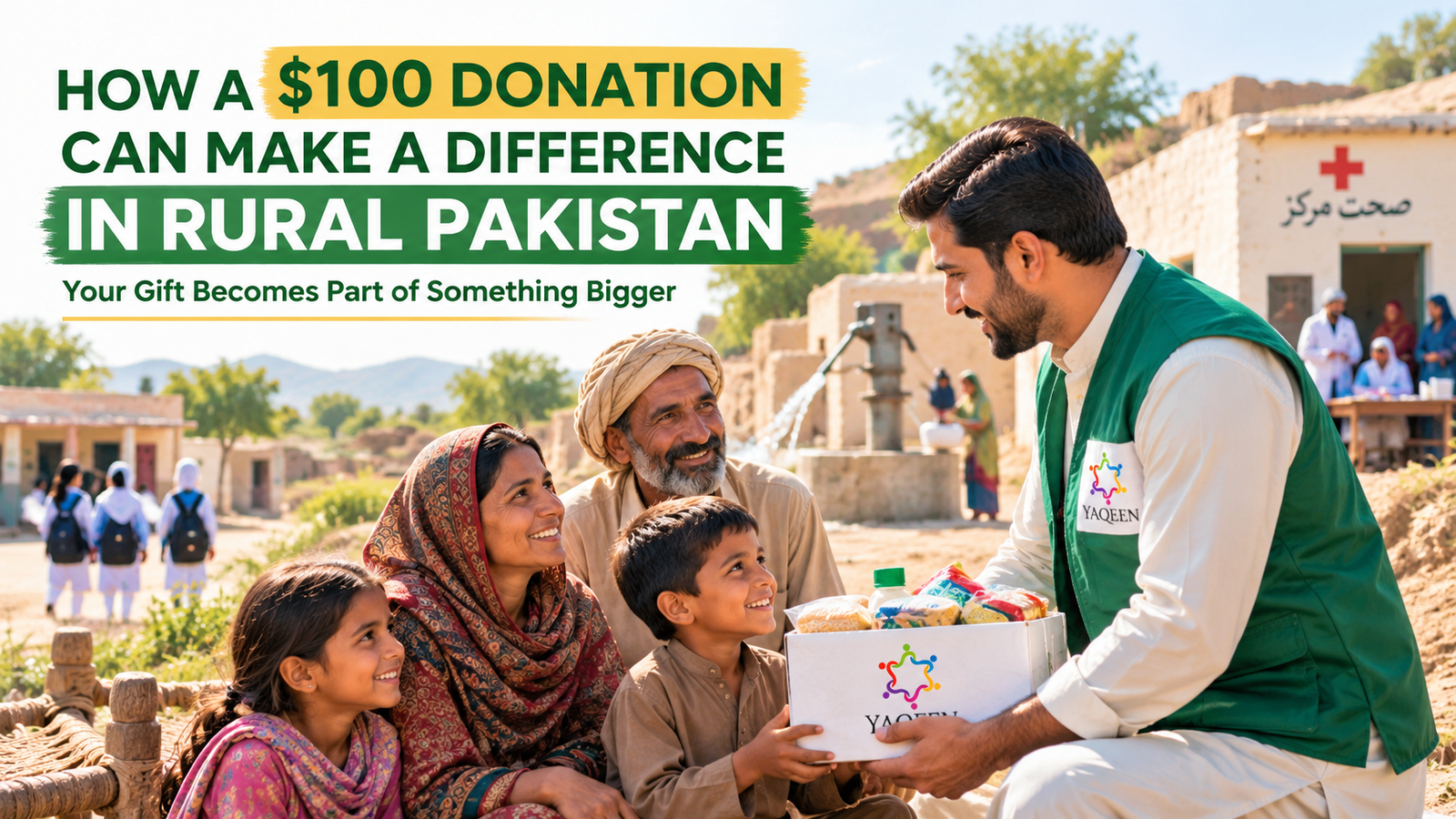
By the time your gift arrives at Yaqeen Welfare Foundation, it has already been transformed. It is no longer a number on a screen — it becomes a decision made by our team about where the need is most pressing. It travels to a field hospital, or a water-drilling site, or a community kitchen. There, it becomes physical: a pump handle that lifts clean water, a prescription filled, a meal placed in front of a child who hasn’t eaten since the day before.
You will likely never meet that child. You will never know their name or see the look on their face. But between your decision and their survival, there is a thread — invisible, unbreakable, and recorded with precision by the One who misses nothing.
Why Anonymous Giving Carries Its Own Power
In Islamic tradition, charity given so quietly that the left hand doesn’t know what the right hand has given is among the highest forms of generosity. There is something profound about giving without expectation of recognition, without a photo or a thank-you letter — giving simply because someone is in need, and you are able. This is the spirit that drives Yaqeen Welfare Foundation’s model: your name may not be on a building, but your reward is recorded somewhere far more permanent. For more on how this kind of charity is recognized and accepted, our piece on When Allah Acknowledges Your Charity – Signs You Should Never Ignore is worth reading alongside this one.
Where Your Donations Go at Yaqeen Welfare Foundation
Every rupee entrusted to Yaqeen Welfare Foundation is directed with accountability and intent. Here is where your generosity becomes tangible:
💧 Clean Water Infrastructure
Access to safe drinking water is not a luxury — it is the foundation on which health, dignity, and productivity are built. Your donations fund the drilling of water wells, the installation of hand pumps, and the filtration systems that turn contaminated sources into daily relief for entire villages.
🏥 Free Medical Care
Our mobile health units and established clinics provide consultations, diagnostic testing, and essential prescriptions to communities where the nearest hospital may be a day’s travel away. No patient is turned away. No family is asked to choose between treatment and food.
🍲 Nutritional Support and Emergency Relief
When floods, droughts, or economic collapse strip families of everything, Yaqeen Welfare Foundation responds with food packages, emergency rations, and supplemental nutrition programs focused on children under five and pregnant mothers — the two groups for whom malnutrition causes the most irreversible harm.
📚 Health Literacy and Community Education
Our educators work directly within communities, training local volunteers, running mothers’ health circles, and delivering workshops on sanitation, child nutrition, and disease prevention. The knowledge doesn’t leave when our team does — it stays, grows, and multiplies.
This full cycle — water, healthcare, food, and knowledge — is what makes Islamic giving through Yaqeen so different from a single transaction. Each pillar reinforces the others, and each donation becomes part of a structure designed to outlast the moment it was given. To understand more about how this connects to obligatory giving like Zakat, see our guide on Understanding Zakat: Importance, Calculation, and Impact, and for guidance on timing your voluntary charity well, our post on Best Times and Methods for Giving Sadaqah in Islam offers practical direction.
Final Thought
Right now, somewhere in Pakistan, a person is sitting in the quiet before the worst. They have exhausted every option. They have borrowed what they can borrow, asked for what they could ask for. They are waiting — not knowing that something is already on its way to them. Something set in motion by a decision you haven’t made yet.
That decision costs you a moment. It costs them everything not to receive it.
Give today. Not because it’s easy, and not because you’ll see the outcome. Give because Allah sees what hands reach out in the dark toward strangers they will never meet — and He does not let a single act of sincerity go unrewarded.
Donate Now — Change a Life Today »
May every contribution you make become a seed of Sadaqah Jariyah — growing long after you have returned to your Lord, and waiting for you in ways you never imagined. Ameen.
Frequently Asked Questions About Islamic Giving
Q1. Can a small gift really make meaningful change?
Absolutely — and Islamic tradition has always confirmed this. The Prophet ﷺ encouraged giving even half a date to protect oneself from the Fire. But beyond theology, the economics of collective small giving are powerful. When thousands of people each contribute what they can, the result is a fully functioning water pump, a stocked clinic, or a month of food security for a family. No genuine act of Islamic giving is ever too small to matter.
Q2. Why does Yaqeen Welfare Foundation invest in health education alongside direct aid?
Because treatment alone cannot end the cycle. A child treated for waterborne illness today will face the same risk again tomorrow if the water source remains contaminated and the family has no guidance on safe handling. Health education breaks that cycle permanently. It is the difference between relief and transformation — and transformation is what we are committed to.
Q3. How does giving affect the giver, according to Islamic belief?
The Quran describes charity as something that purifies wealth and protects the giver from harm. The Prophet ﷺ said that charity extinguishes sin as water extinguishes fire. Beyond spiritual protection, there is a documented psychological truth: generosity increases wellbeing, strengthens a sense of purpose, and deepens one’s connection to community. To give is not just to help another — it is to become more fully human.
Q4. How does Yaqeen Welfare Foundation ensure donations are used responsibly?
Accountability is central to our mission. We maintain transparent records of how funds are allocated, prioritize high-need areas based on field assessments, and follow up on every project to measure real-world impact. Your trust is the foundation we build on, and we take that seriously.
Q5. What’s the difference between Zakat and other forms of Islamic giving?
Zakat is an obligatory annual payment owed by Muslims who meet a wealth threshold, calculated according to specific rules and directed toward defined categories of recipients. Other forms of Islamic giving — such as Sadaqah, waqf, and Sadaqah Jariyah — are voluntary and can be given at any time, in any amount, toward any cause that serves people in need. Both obligatory and voluntary giving work together as part of a complete framework of Islamic giving. Our guide on Understanding Zakat: Importance, Calculation, and Impact explains the obligatory side in detail, including how to calculate it accurately using our Zakat Calculator.
Q6. Can I dedicate my donation to a specific project, like a well or a clinic?
Yes. Many donors choose to direct their contribution toward a specific cause — clean water, healthcare, food relief, or community education — or dedicate it in memory of a loved one. Reach out to our team directly to discuss how your gift can be directed toward the project closest to your heart.