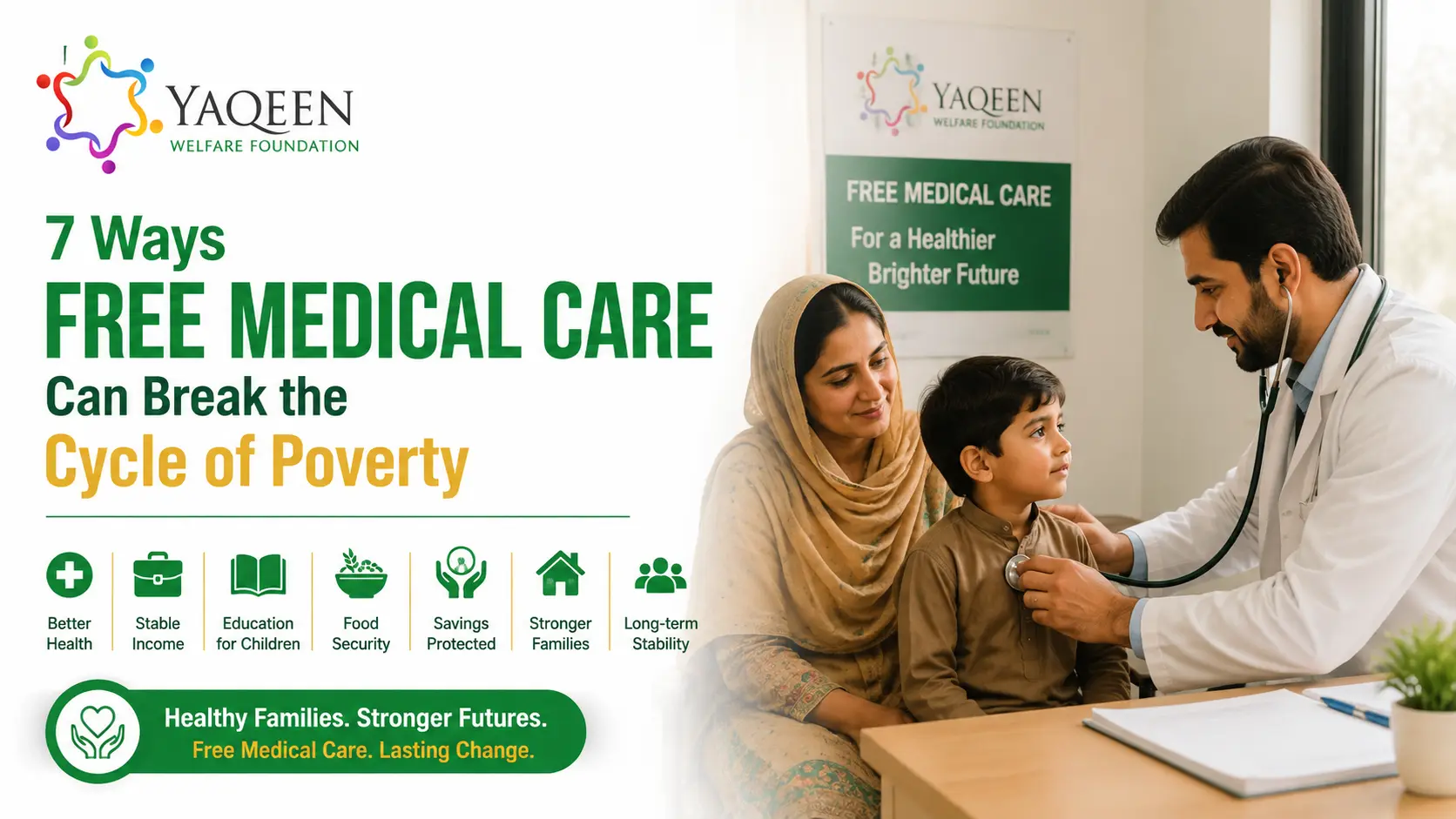
Free medical care is one of the most direct ways to interrupt the relationship between illness and poverty. For a low-income family, sickness is rarely just a medical event. When a parent falls ill, they may be unable to work. When income falls, the household may struggle to cover food, rent, transportation, and children’s school fees. At the same time, doctor visits, diagnostic tests, and medicines create new expenses the family did not plan for.
This can quietly trap a household in a difficult pattern:
Illness → Medical Expenses → Lost Income → Financial Pressure → Delayed Care → Worsening Hardship
For families already living with limited resources, even a manageable health problem can spiral into a lasting financial setback when affordable healthcare is out of reach. This is where free medical care can make a measurable difference — not only by treating illness, but by helping protect a family’s income, education, food security, and long-term stability.
This article looks at seven ways accessible healthcare can help interrupt the cycle of poverty, and how organizations like Yaqeen Welfare Foundation are working to bring that care closer to underserved communities in Pakistan.
Why Health and Poverty Are Closely Connected
Health and financial stability tend to influence each other in both directions. Poverty can make healthcare harder to access because families have fewer resources for doctor consultations, medicines, diagnostic tests, transportation, and preventive or maternal healthcare. At the same time, illness can deepen financial hardship. A person who becomes sick may miss work, lose wages, spend savings on treatment, borrow money, or delay other essential expenses.
According to the World Health Organization, billions of people worldwide faced financial hardship in recent years, with a large share pushed into poverty or deeper into it because of out-of-pocket health expenses. That is a global illustration of a very local reality: free medical care removes one of the biggest financial shocks a low-income household can face.
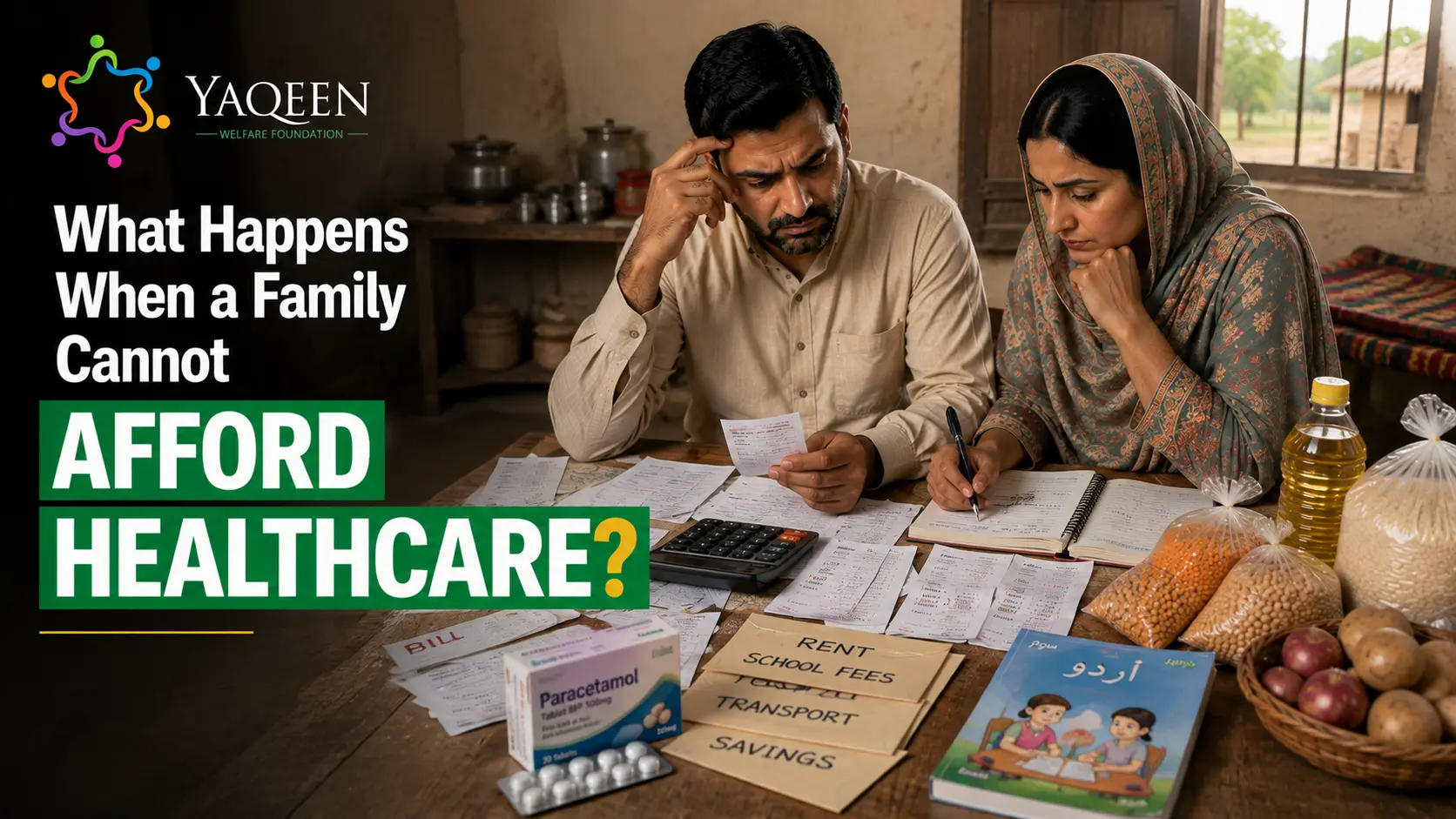
What Happens When a Family Cannot Afford Healthcare?
A family with limited income may have to choose between:
| Difficult Trade-Off | What the Family May Sacrifice |
|---|---|
| Medicine or Food | Nutrition and daily meals |
| Doctor Visit or School Fees | A child’s education |
| Diagnostic Test or Rent | Housing stability |
| Transportation to a Clinic | Other household necessities |
| Follow-Up Care or Savings | A future financial safety net |
Some families delay seeking medical attention because they fear the cost. Others receive an initial consultation but struggle to afford tests, medicines, or follow-up visits. Delaying care does not automatically mean every condition becomes severe, but timely evaluation is often important for identifying a problem early and choosing the right treatment path.
The Hidden Financial Cost of Illness
Medical bills are only one part of the picture. A household facing illness may deal with direct costs — consultation fees, medicines, diagnostic tests, hospital expenses, transportation — alongside indirect costs such as lost wages, missed work, caregiving responsibilities, and missed school days. For low-income households, these indirect consequences can be just as damaging as the medical bill itself, because there is often little financial cushion to absorb them.
1. Free Medical Care Can Reduce the Financial Burden of Illness
The most direct benefit of free medical care is straightforward: when medical services are available without unaffordable costs, families can preserve more of their limited income for other essential needs.
Depending on the program, charitable healthcare may include:
- Medical consultations and basic examinations
- Diagnostic services and medicines
- Preventive, maternal, and child healthcare
- Chronic disease management
- Referrals for additional treatment
Reducing these expenses allows families to redirect money toward food, housing, education, transportation, and utilities. Free healthcare Pakistan initiatives that reach underserved districts are, in effect, a form of financial protection for households that would otherwise have almost nothing left after a medical emergency.
Financial Protection Matters
The purpose of free healthcare is not simply to provide a service at no cost — it functions as a safeguard for vulnerable families:
Affordable Care → Lower Medical Financial Pressure → More Resources for Essential Needs → Greater Household Stability
2. Free Medical Care Can Help Adults Stay Healthy Enough to Work
For many low-income households, income depends heavily on one or two adults being able to work consistently. When illness prevents someone from working, the effects ripple through the entire family: lost daily wages, reduced hours, difficulty maintaining employment, and increased dependence on relatives.
Accessible healthcare helps people get evaluated and treated sooner, which can support a quicker return to daily activities and employment. This is not a guarantee — health outcomes vary by condition — but timely care removes one major obstacle standing between a sick worker and a stable paycheck.
The Employment Connection
Healthcare Access → Appropriate Treatment → Better Ability to Function → Potential Return to Work → Improved Household Stability
Helping one patient can therefore affect every family member who depends on that person’s income.
3. Free Medical Care Can Help Children Stay in School
Illness disrupts a child’s education in more than one way. A child with an untreated health problem may miss school, struggle to concentrate, or fall behind academically. Family illness affects education indirectly too — if a parent becomes seriously ill, children may face financial instability, added household responsibilities, or pressure to help earn income.
When children receive appropriate medical assistance Pakistan programs can offer, they have a better chance of maintaining regular school attendance. When parents receive the care they need, the resulting household stability also helps protect a child’s education.
Healthy Child → Better School Participation → Continued Education → Greater Future Opportunity
Healthier Parent → Greater Family Stability → Better Protection for Children’s Education
4. Free Medical Care Can Protect a Family’s Savings
A low-income family may spend years building a small financial reserve, only to see it disappear after one unexpected illness. Medicines, consultations, tests, transportation, and hospital treatment can consume savings quickly. Once that cushion is gone, the family becomes more vulnerable to the next emergency — a job loss, a spike in food prices, or another illness.
Savings are not simply extra money. For financially vulnerable households, they represent a small but critical safety net. Helping families avoid unaffordable healthcare costs is one of the most practical ways to protect that safety net.
5. Free Medical Care Can Help Protect Food Security
When medical expenses rise while income falls because of illness, food budgets come under pressure. Families may respond by buying less food, choosing cheaper and less nutritious options, or prioritizing children’s meals over their own. This shows how a health problem can quietly become a nutrition problem.
High Medical Costs → Less Money for Food → Greater Household Pressure
Accessible Healthcare → Reduced Medical Financial Burden → More Household Resources Remain for Food and Essentials
Free healthcare alone does not eliminate food insecurity — that depends on income, food prices, employment, and household size — but reducing the financial competition between medicine and meals matters a great deal for healthcare for poor families.
6. Free Medical Care Can Prevent Some Health Problems From Becoming Bigger Financial Crises
Some people delay seeing a doctor because they believe they cannot afford it. In many cases, earlier evaluation can identify a problem before it becomes harder — and more expensive — to manage. This includes routine consultations, blood pressure checks, diabetes screening, maternal healthcare, and medication management.
Earlier Access → Evaluation → Appropriate Management → Potential Reduction in Preventable Complications
Prevention does not guarantee a particular outcome for every patient, but consistent access to a free clinic Pakistan families can rely on tends to reduce the number of health problems that turn into financial emergencies.
7. Free Medical Care Can Help Restore Family Stability
A family facing illness may simultaneously deal with reduced income, medical expenses, food insecurity, educational disruption, and emotional stress. Healthcare cannot solve every dimension of poverty on its own, but it addresses one of the central pressures contributing to that instability. When medical needs are met and healthcare costs are reduced, families have more capacity to focus on employment, education, nutrition, and long-term planning.
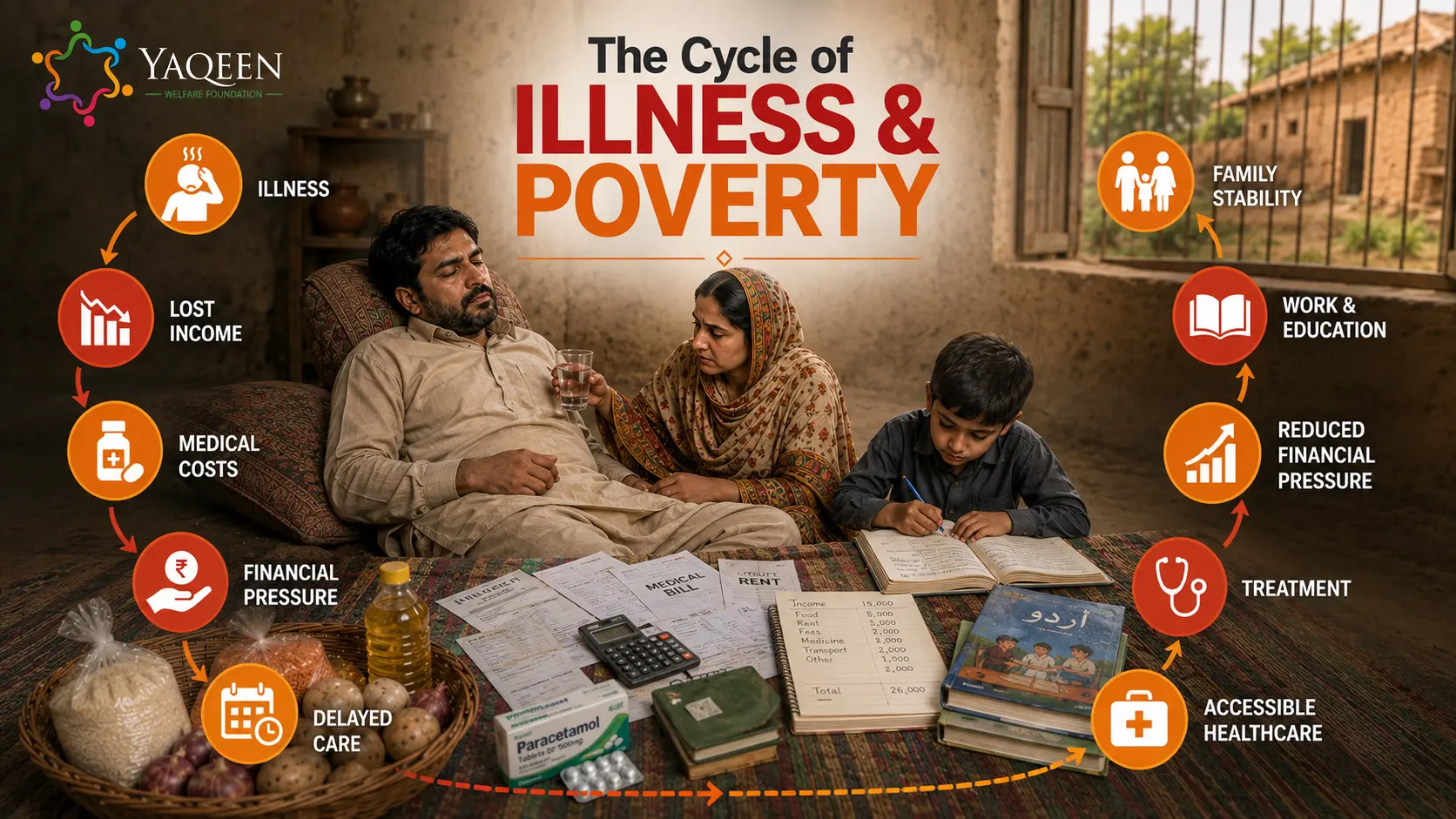
The Cycle of Illness and Poverty
Illness → Unable to Work Regularly → Loss of Income → Medical Expenses → Savings Depleted → Less Money for Food and Education → Greater Financial Hardship → Healthcare Delayed Again
Families can become trapped in this pattern for years. The alternative pathway looks very different:
Accessible Healthcare → Earlier Evaluation and Appropriate Treatment → Reduced Financial Pressure → Better Ability to Work and Study → More Household Resources Protected → Greater Family Stability
This is a possible pathway, not a guaranteed outcome for every patient — but it is the pathway that consistent, dignified free medical care makes possible.
Why Rural Families Can Face Additional Healthcare Barriers
Families in some areas face challenges that go beyond cost: distance from healthcare facilities, limited physicians and specialists, medicine shortages, lost wages while traveling for care, and limited health information. Healthcare accessibility means more than a clinic technically existing somewhere — a service also has to be reachable and usable by the people who need it. That is part of why rural healthcare Pakistan programs focus so heavily on bringing care physically closer to the communities that need it most.
Why Transportation Can Become a Healthcare Problem
Even when treatment itself is free, patients may still face transportation fares, long travel times, lost working hours, and the need for a family member to accompany them. For a low-income household, these indirect costs often determine whether care is sought at all — which is why reducing the distance between a family and a clinic matters just as much as reducing the cost of the visit itself.
How Free Healthcare Can Support Mothers and Children
Financial barriers can make it especially difficult for vulnerable mothers to access prenatal care, appropriate delivery support, and postnatal healthcare. Supporting a mother’s health has wider implications for the wellbeing of her children and household. Similarly, accessible healthcare for children — routine evaluation, treatment, nutrition guidance, and preventive services — helps them avoid the kind of health-related interruptions that derail schooling and everyday life.
Chronic Illness and Long-Term Poverty
Some health conditions require ongoing consultations, medicines, monitoring, and follow-up care. These recurring costs create persistent financial pressure on a household. Accessible chronic-disease care helps patients manage their conditions more consistently while reducing some of the financial barriers that would otherwise cause them to skip treatment altogether.
Why Healthcare Charity Can Have a Multiplier Effect
A donor may help fund healthcare for one person, but that person is often also a parent, a wage earner, a caregiver, or a student. Supporting one patient’s health can therefore benefit an entire household.
One Patient Receives Care → Health Needs Are Addressed → Daily Activities May Become Easier → Family Responsibilities Can Resume → Household Stability May Improve
Why Free Medical Care Is More Than Charity
Medical assistance can help protect health, income, education, nutrition, savings, and family stability. A healthcare donation is not simply paying for one doctor’s visit — it can help remove a barrier that is preventing a vulnerable family from moving forward.
People receiving charitable medical care deserve the same respect and dignity as any other patient. Quality humanitarian healthcare should prioritize respectful treatment, patient privacy, compassion, clear communication, and responsible, dignity-focused messaging — never portraying patients as powerless simply to generate donations.
How Yaqeen Welfare Foundation Supports Healthcare
Yaqeen Welfare Foundation works to provide free medical treatment, clean water, and other forms of assistance to underserved communities in Pakistan. Through the Yaqeen Health Clinic, the organization supports medical consultations, diagnostic services, and community health programs designed to reduce the barriers that keep families from getting timely care.
If you’d like to understand more about how consistent access to care changes outcomes for families, our related post on 10 Reasons Free Medical Clinics Save Lives Every Day looks at this from the clinic’s side of the counter. And if you’re exploring ongoing ways to give, Give Sadaqah Jariyah Today and Earn Rewards for 100 Years explains how a single donation toward healthcare can continue benefiting a community long after it’s given.
How Healthcare Connects With Yaqeen’s Other Programs
Poverty is rarely a single-issue problem, which is why healthcare works alongside Yaqeen’s other efforts:
- Free Healthcare → Helps protect health
- Clean Water → Supports hygiene and community wellbeing
- Food Assistance → Helps address hunger
- Education Support → Builds future opportunities
- Safe Homes → Supports stability and security
Addressing these interconnected needs together builds a stronger foundation for the families Yaqeen serves.
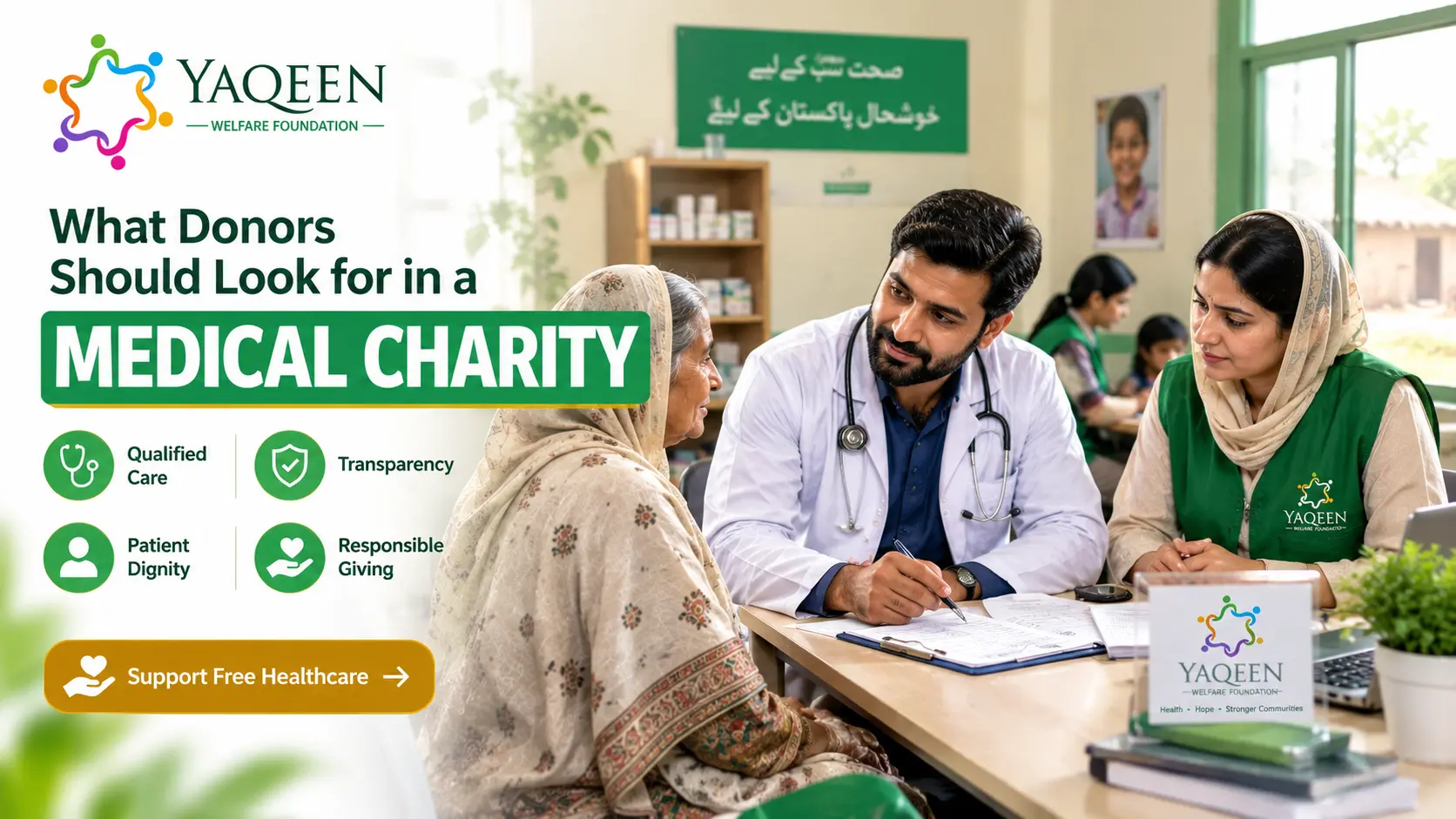
What Donors Should Look for in a Medical Charity
Before donating to any medical charity Pakistan program, it’s worth asking a few questions: Who receives the healthcare services? Are qualified medical professionals involved? How are patients identified, and is their privacy protected? Is the organization transparent about how donations are used and how outcomes are reported? Responsible healthcare charity should prioritize both compassion and appropriate clinical standards.
How to Donate to Free Healthcare Through Yaqeen Welfare Foundation
Supporting this work is simple:
- Visit Yaqeen Welfare Foundation’s official donation page.
- Select the healthcare or medical program you’d like to support.
- Choose the amount you wish to contribute.
- Select one-time or recurring giving, where available.
- Complete your donation through the official secure payment method.
- Follow Yaqeen’s project updates to see the impact of your support.
You can also use the Zakat Calculator if you’d like to direct your Zakat toward medical care for underserved families.
Frequently Asked Questions About Free Medical Care
What is free medical care? Free medical care generally refers to healthcare services provided to eligible patients without requiring them to bear the full cost of those services, often funded through donations and charitable programs.
How can free healthcare help reduce poverty? Reducing healthcare expenses and improving access to treatment can help protect a family’s income, savings, employment, and education — all of which contribute to breaking the cycle of poverty.
How does illness push families into poverty? Through medical expenses, lost wages, reduced productivity, debt, and depleted savings, which together can force a household into a more precarious financial position.
Can free healthcare help people stay employed? Appropriate healthcare can help some patients manage health problems and return to normal activities sooner, though individual outcomes vary by condition and circumstance.
How can healthcare affect a child’s education? Illness can lead to missed school days directly, while parental illness and the resulting financial hardship can also disrupt a child’s education indirectly.
Does free medical care include medicines? This depends on the specific program. Yaqeen’s healthcare initiatives are designed to address medical needs as comprehensively as resources allow — you can learn more on the Yaqeen Health Clinic page.
Can I donate specifically for medical care? Yes. Donors can choose to direct their contribution toward Yaqeen’s healthcare programs through the official donation page.
Can healthcare donations help mothers and children? Yes, maternal and child healthcare are core components of accessible community health programs, supporting prenatal care, delivery support, and pediatric services.
Why is preventive healthcare important? Routine evaluation, screening, and health education can help identify certain health concerns earlier, before they become more serious or costly to treat.
What types of illnesses can a free clinic treat? This varies by clinic and available resources. Not every condition can be fully managed at a community clinic, but many receive initial evaluation, treatment, or an appropriate referral for further care.
How do free clinics help rural communities? By reducing both the financial and geographic barriers to care — bringing consultations, medicines, and diagnostic services closer to communities that would otherwise travel long distances for basic treatment.
Is healthcare an appropriate form of Sadaqah? Supporting the health of those in need is widely regarded as a meaningful form of charity in Islamic tradition. For specific religious rulings, it’s best to consult a qualified scholar or reliable Islamic reference.
Can I give Sadaqah for someone’s medical treatment? Yes, many donors choose to give Sadaqah specifically toward another person’s medical treatment. For guidance on the religious specifics, consult a trusted local scholar.
Can I make a healthcare donation in memory of someone? Yes, many charitable organizations, including Yaqeen, allow donations to be made in memory of a loved one. For questions on the Islamic guidance around this, a qualified scholar can offer specific direction.
How do I know my medical donation is being used responsibly? Reputable organizations provide transparency around how funds are used, document their programs, and report on outcomes. You can contact Yaqeen Welfare Foundation directly with any questions about how healthcare donations are allocated.
Can small healthcare donations really make a difference? Yes. Collective giving means that many modest donations combine to support larger healthcare programs, even when an individual contribution feels small on its own.
Healthcare Can Protect More Than Health
When a low-income parent becomes ill, the consequences reach far beyond their physical health. Work may stop. Income may fall. Savings may disappear. Food budgets may shrink. Children’s education may be disrupted. Family stability may become harder to maintain.
Accessible medical care helps interrupt parts of this cycle. A consultation identifies the problem. Appropriate treatment supports recovery. Reduced healthcare costs protect limited household resources. Better health allows adults to return to work and children to return to school. The impact of one visit to a doctor extends far beyond the clinic walls.
Free Medical Care → Better Access to Treatment → Reduced Financial Pressure → Greater Ability to Work and Learn → More Stable Families → Stronger Communities
Support free medical care. Protect health. Strengthen families. Help break the cycle of poverty — donate to Yaqeen Welfare Foundation today, or contact the team to learn more about current healthcare programs.