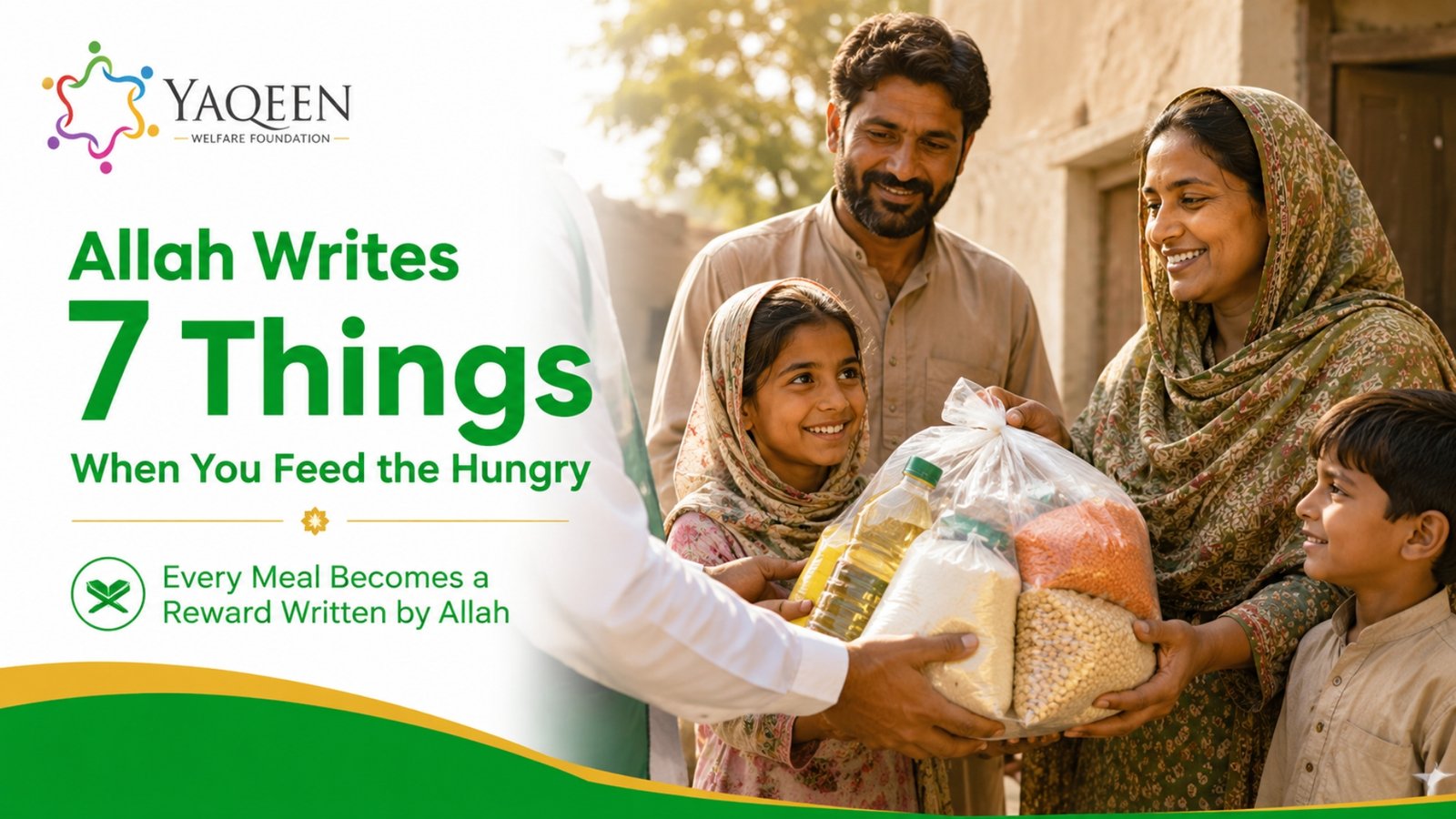
Allah Writes 7 Things in a believer’s record when they feed the hungry — and this is not a minor footnote in Islamic teaching. It is a promise woven into the Quran, repeated through the Sunnah, and confirmed across centuries of Islamic scholarship.
There are acts of worship you perform in private: in the stillness of the night, on the prayer mat, in the quiet of your own heart. And then there are acts of worship that happen at a table. In a kitchen. In a moment of hunger met by generosity.
The bowl of food passed to a neighbour in need. The meal prepared for a family who could not prepare their own. The contribution made so that someone, somewhere — a stranger, a child, a mother — would not go to sleep with an empty stomach tonight.
You may not think of these moments as acts of profound worship. Allah Writes 7 Things to say otherwise.
This article walks through each of those seven recordings — grounded in Hadith and Quranic guidance — and connects them to the very real, very present hunger that persists in Pakistan and across the world. If you have ever wondered whether your small contribution truly reaches the scale of divine reward, what follows is your answer.
What the Prophet صلى الله عليه وسلم Said About Feeding Others
Allah Writes 7 Things — Beginning With What the Prophet Elevated Above Other Deeds
The Prophet صلى الله عليه وسلم did not speak about feeding the hungry as a minor act of social kindness. He spoke about it as a pillar of a life well-lived before Allah.
“The best of people are those who are most beneficial to people.” (Al-Tabarani)
“Feed the hungry, visit the sick, and free the captive.” (Bukhari)
And in one of the most striking narrations — when the Companions asked the Prophet صلى الله عليه وسلم which act of Islam was best — one of his answers was:
“That you feed others and greet with peace those you know and those you do not know.” (Bukhari, Muslim)
Read that carefully. Not lengthy voluntary prayer. Not an extended fast beyond the obligation. Not a specific ritual act. That you feed others.
This is what the Prophet صلى الله عليه وسلم placed at the peak of the question that every sincere believer wants answered. And it is precisely why understanding what Allah Writes 7 Things means — in practice, for each person who gives — matters so deeply.
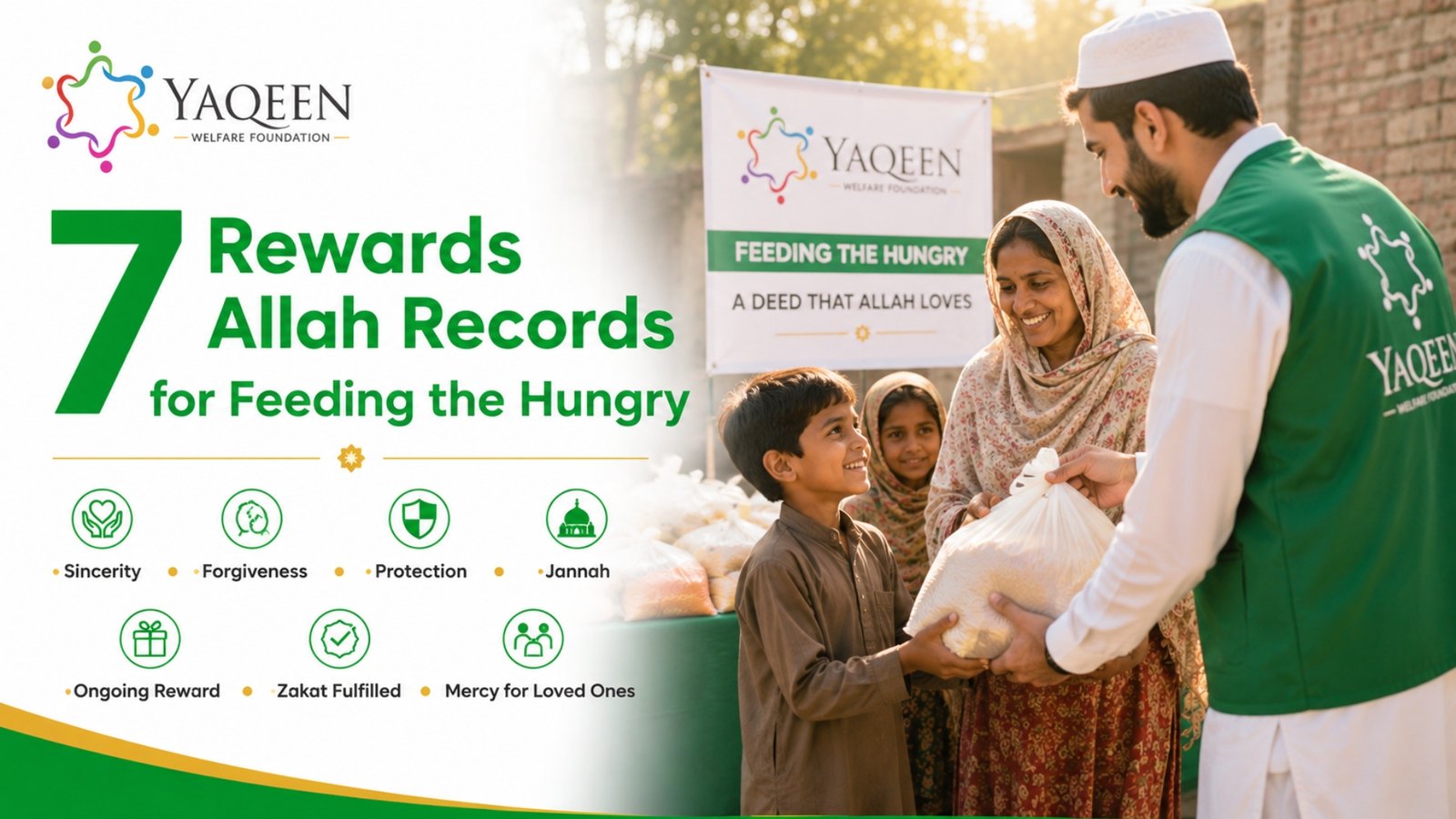
Allah Writes 7 Things: What Is Recorded When You Feed Someone
We tend to think of worship as something that happens in a masjid, on a prayer mat, in a state of ritual purity. Islam does not confine ‘ibadah to those formal settings. It extends the definition of worship far into the texture of daily life — and nowhere more powerfully than in how we treat the hungry.
When Allah Writes 7 Things in the record of a person who feeds the hungry, each entry is distinct. Each has its own Quranic or Hadith basis. And each is worth understanding on its own terms.
1. Allah Writes Your Sincerity as an Act of Worship
The Intention Transforms the Meal Into ‘Ibadah
The first of the things Allah Writes 7 Things refers to is the intention itself. When the meal is given not for gratitude or public recognition, not for the praise of people, but because the heart moved toward another human being in their moment of need — that intention is recorded.
The Quran points to this directly in Surah Al-Insan:
“And they feed, for the love of Allah, the poor, the orphan, and the captive.” (76:8)
Not for any return. Not for any visible reward. For the love of Allah. That quality of giving — that direction of the heart — is itself the first entry in the record. Before the food is eaten, before the family is full, the intention has already been written.
2. Allah Writes the Erasure of a Sin
Charity Extinguishes Sin the Way Water Extinguishes Fire
The second thing Allah Writes 7 Things encompasses is purification. The Prophet صلى الله عليه وسلم taught:
“Charity extinguishes sin as water extinguishes fire.” (Tirmidhi)
This is not a metaphor for gradual moral improvement. It is a statement about divine mechanism — a structure Allah has built into how generosity is received and responded to. When you feed a genuinely hungry person, Allah writes against that act a purification that He alone measures and grants.
For anyone carrying the weight of guilt — anyone who wonders whether their account with Allah is burdened by what they have done or neglected — this is a door that remains open. Not because the sin is overlooked, but because Allah, in His boundless mercy, has attached to the act of giving a means of erasure.
A meal given in sincerity becomes a mercy returned. The food nourishes the recipient. The purification nourishes the giver.
3. Allah Writes Protection Over Your Body
The Hand That Gives Is Protected in Return
The third entry when Allah Writes 7 Things is physical: a protection that returns to the giver’s own body. The Prophet صلى الله عليه وسلم taught:
“Treat your sick with charity.” (Abu Dawud, authenticated by scholars)
What flows outward from the open hand — the food given, the donation made, the contribution that feeds a family — carries a divine response back to the giver. Not in the form of a guaranteed medical outcome, but as a promise woven into how Allah responds to the generous.
The connection between physical wellbeing and spiritual generosity is documented in the Sunnah. When Allah Writes 7 Things in the believer’s record, this protection is among them — a covering the miser does not have access to, a return the generous person may not always be able to trace but is written nonetheless.
4. Allah Writes a Mark at the Gates of Jannah
The Generous Have Doors of Their Own in Paradise
When Allah Writes 7 Things, the fourth is among the most extraordinary: a marking toward the doors of Paradise. The Prophet صلى الله عليه وسلم described a gate of Paradise called Al-Rayyan, entered only by those who fasted. But he described other doors as well — doors of mercy, doors of generosity, doors reserved for those who gave.
And he said:
“Whoever feeds a fasting person will have a reward like that of the fasting person, without any reduction in his reward.” (Tirmidhi)
This is the mathematics of divine generosity: a reward that does not divide when it is shared, but mirrors the act it enabled. The person who feeds someone carries a record equivalent to the worship of the one they fed — and the one who was fed loses nothing of their own reward.
Allah Writes 7 Things in the record of the one who fed, and the fourth entry is this: a path toward Jannah, marked and held.
5. Allah Writes Ongoing Reward When the Impact Continues
One Meal Can Become a Decade of Sadaqah Jariyah
The fifth thing Allah Writes 7 Things refers to is continuity. The Prophet صلى الله عليه وسلم said:
“When a person dies, all their deeds end except three: a continuous charity, beneficial knowledge, or a righteous child who prays for them.” (Muslim)
Not every act of feeding the hungry is a one-time reward. When a donation funds a livelihood programme, a community kitchen, or sustainable food security infrastructure, the ongoing benefit it produces carries the quality of continuous charity. As long as families continue to eat because of the systems that gift helped build, the reward continues — even long after the giver has forgotten the moment of giving.
A seed planted in the ground of generosity can produce fruit for years. And Allah Writes 7 Things in proportion to the impact — not only the initial effort.
For more on this principle, see our blog: Sadaqah Jariyah: 5 Forms of Forgotten Charity Allah Never Forgets
6. Allah Writes Fulfilment of Your Zakat Obligation When It Reaches the Eligible
Feeding the Hungry Can Complete a Pillar of Islam
The sixth entry when Allah Writes 7 Things is perhaps the most practically significant for many believers: the discharge of a formal religious obligation. Zakat — one of the five pillars of Islam — is obligatory on every Muslim who meets the nisab threshold. Among those eligible to receive it are the poor and the destitute: precisely the people who go to sleep hungry.
When a donation intended as Zakat reaches a genuinely hungry person in a qualifying category, Allah Writes 7 Things includes the completion of that pillar. Two forms of worship converge in one act: the hungry person is fed, and the religious obligation is fulfilled.
Use our Zakat Calculator to determine what you owe — and consider directing it toward food aid for those in genuine need.
7. Allah Writes Your Gift as a Message That Reaches the Deceased
Food Given in a Loved One’s Name Travels Beyond This World
The seventh and final thing Allah Writes 7 Things encompasses is perhaps the most tender: a gift that travels. The Prophet صلى الله عليه وسلم confirmed that charity given on behalf of someone who has passed reaches them:
“A man said to the Prophet: ‘My mother has died. Will it benefit her if I give sadaqah on her behalf?’ He said: ‘Yes.'” (Bukhari, Muslim)
Feeding the hungry in the name of a parent, a spouse, a sibling — Allah Writes 7 Things for the living giver and simultaneously delivers a message of mercy to the one who has passed. There is perhaps no act more beautiful than feeding a stranger in the name of someone you loved.
For more on giving on behalf of the deceased, read: Sadaqah Jariyah for Deceased — Their Rewards Can Still Grow
Summary Table: The 7 Things Allah Writes When You Feed the Hungry
| # | What Allah Writes | Islamic Source |
|---|---|---|
| 1 | Your sincerity recorded as an act of ‘ibadah | Surah Al-Insan 76:8 |
| 2 | The erasure of a sin | Tirmidhi |
| 3 | Protection over your body | Abu Dawud |
| 4 | A mark toward the gates of Jannah | Tirmidhi |
| 5 | Ongoing Sadaqah Jariyah when impact continues | Muslim |
| 6 | Fulfilment of your Zakat obligation | Quran 9:60 |
| 7 | A gift that reaches your deceased loved one | Bukhari, Muslim |
When Allah Writes 7 Things, the record is comprehensive. The intention. The purification. The protection. The path to Paradise. The continuity. The obligation. The message beyond this world. All seven are available — in exchange for the simple act of feeding someone who is hungry.
The Hunger You Cannot See From Here
It is possible to live an entire lifetime in relative comfort and never truly encounter the kind of hunger that greets a child each morning and accompanies them to sleep. But that hunger exists. It is real. And it is vast.
In Pakistan — a country of more than 230 million people — millions of families face food insecurity that is structural, seasonal, and in some regions, relentless. Families where there is simply not enough. Children whose growth is stunted not because of any failure of their own, but because the circumstances of their birth placed them in a geography of scarcity. Mothers who eat last, or do not eat at all, so their children might have slightly more.
This is not a story from another century. This is happening now, in real communities, at this moment.
According to the World Food Programme, an estimated 36.9% of Pakistan’s population experiences moderate to severe food insecurity. These are not abstract numbers. They are real households, real children, real hunger — the exact kind that Islam calls us to address.
The Quran does not treat indifference to this reality as a neutral position:
“Have you seen the one who denies the Din? That is the one who drives away the orphan and does not encourage feeding the poor.” (Surah Al-Ma’un, 107:1-3)
The denier of the Din is not described only as someone who abandoned formal prayer. It is someone who saw hunger and turned away. Someone who had and did not give.
The inverse is equally true. The person who sees, and gives, is doing something of profound religious weight. And Allah Writes 7 Things in their record to testify to it.
A Real Impact: The Meal That Kept Giving
Let us make this tangible.
A donor gave toward a food support programme — not a grand gesture, but a modest contribution made on an evening when someone asked and the heart said yes.
That contribution became part of a food package delivered to a family in a region where drought had devastated local harvests. Inside the package: flour, lentils, rice, cooking oil. Enough for several weeks.
What happened next was not captured by any camera.
Children who had been crying from hunger slept peacefully that night. A mother who had been rationing her own meals ate properly for the first time in days. A father who had been carrying the shame of not being able to provide felt, for a moment, the pressure ease.
The donor did not witness any of this. The reward was written regardless.
That is the nature of sincere giving. It does not require your presence. It does not require your awareness of the outcome. The act was completed. Allah Writes 7 Things against what was given — and against every ripple that the donor will never trace.
The Spiritual Logic Behind Allah Writes 7 Things
Why So Much Reward for Something So Simple?
There is a wisdom in why Islam places feeding the hungry so high — and why Allah Writes 7 Things in return for what seems, in the moment, like a simple act.
Hunger is among the most immediate and universal forms of human suffering. Its effects extend far beyond the physical: into dignity, into hope, into the ability to raise children, to build a future, to participate fully in community and worship. A person who is chronically hungry cannot engage properly in education, in family life, or even in the salah their weakened body struggles to sustain. Hunger is not merely discomfort. It is a compound deprivation.
When a believer addresses hunger — even in a small way — they intervene in that entire chain. They restore not only calories but the conditions for a life to be lived with dignity. And Allah, who knows the full weight of what that intervention produces, Allah Writes 7 Things in proportion to the total impact — not only the visible effort.
The IslamQA resource on the reward for feeding others provides further grounding on the Hadith related to feeding those who fast — and the same principles of reward extend to feeding the hungry at any time, in any season.
Where Your Giving Goes: Yaqeen Welfare Foundation’s Food Programmes
Every programme at Yaqeen Welfare Foundation is built around impact that reaches real people in genuine need. When you give toward food and nutrition, you are not making an abstract contribution. You are placing a meal in front of a person who would not otherwise have it. And that is precisely the act for which Allah Writes 7 Things.
Food Aid and Emergency Nutrition
When disaster strikes — floods, drought, displacement — the first thing that collapses is access to food. Our emergency food programmes deliver packages directly to affected families with speed and care. Every package is a family fed. Every family fed is a reward written.
Livelihood and Food Security Programmes
Short-term relief feeds a person for a week. Long-term investment changes what a family can feed itself for years. Our livelihood programmes support communities in building sustainable access to nutrition — through agricultural support, income generation, and community food systems. A gift made today can become a decade of meals — and a decade of ongoing entries in the record where Allah Writes 7 Things.
Nutritional Support at Yaqeen Indus Health Hospital
Illness and malnutrition are deeply linked. Our hospital serves patients who arrive depleted — weakened simultaneously by illness and inadequate nutrition. Through your support, patients receive not only medical care but the nutritional support that makes recovery possible. Your donation walks through the hospital doors every day, in every meal served.
For more on how your giving impacts healthcare for Pakistan’s most vulnerable, read: Free Healthcare: 10 Reasons for Donation in Pakistan
Clean Water and the Hunger It Compounds
There is another deprivation that intensifies hunger and makes its effects far worse: the absence of clean water. A family without safe water cannot properly cook food, cannot maintain hygiene that prevents illness, and cannot protect the nutritional value of what little food they have.
At Yaqeen Welfare Foundation, clean water provision is inseparable from our food security mission. A donation toward clean water is, in many settings, also a nutritional intervention — protecting children from waterborne illness that strips away the benefit of whatever food they manage to eat.
To understand the compound reward of giving water alongside food, and why each drop carries its own record in the place where Allah Writes 7 Things, read: 1 Drop Clean Water Donation — A Sea of Reward
The Best Moments to Invite Allah Writes 7 Things Into Your Record
While the reward for feeding the hungry applies at any moment in any season, there are times in the Islamic calendar when it is multiplied — and when need intensifies simultaneously:
Ramadan — when the poor feel the gap most acutely, and when the reward of feeding a fasting person is equivalent to that person’s entire fast.
The First Ten Days of Dhul Hijjah — among the most beloved days in the sight of Allah, with righteous deeds carrying exceptional weight.
Mondays and Thursdays — days on which deeds are presented to Allah, and on which giving carries its own heightened quality.
The Last Third of the Night — a time of particular closeness to Allah, when supplication and charity both carry a receptivity beyond the ordinary hours.
But the deeper teaching is that need is not seasonal. The child who is hungry in Sha’ban is as hungry as the child who is hungry in Ramadan. Allah Writes 7 Things for the gift made in any sincere moment — not only the celebrated ones.
For more on the best practices and timing of giving, read: Best Times and Methods for Giving Sadaqah in Islam
The Final Thought
There will come a day when someone eats because of something you gave.
You will not know their name. You will not see their face. You may have long since forgotten the moment you clicked a button, completed a transfer, or placed a note in a donation box.
But somewhere — a child is full. A mother has slept without hunger. A family has one less thing to fear today.
And in a ledger you cannot open, in a record that does not lose a single line, that meal is written against your name. All seven entries. Every one.
Not for the amount. Not for the scale of the gesture. For the intention. For the compassion. For the moment when you could have kept and instead you gave.
“Whoever feeds a fasting person will have a reward like that of the fasting person, without any reduction in his reward.” (Tirmidhi)
The reward does not diminish when it is shared. It multiplies.
The question is not only: Should I give?
The deeper question is: Who is waiting for what only you can offer today — and what is Allah ready to Write in return?
When Allah Writes 7 Things, your answer to that question is already in the record. It begins with a single meal.
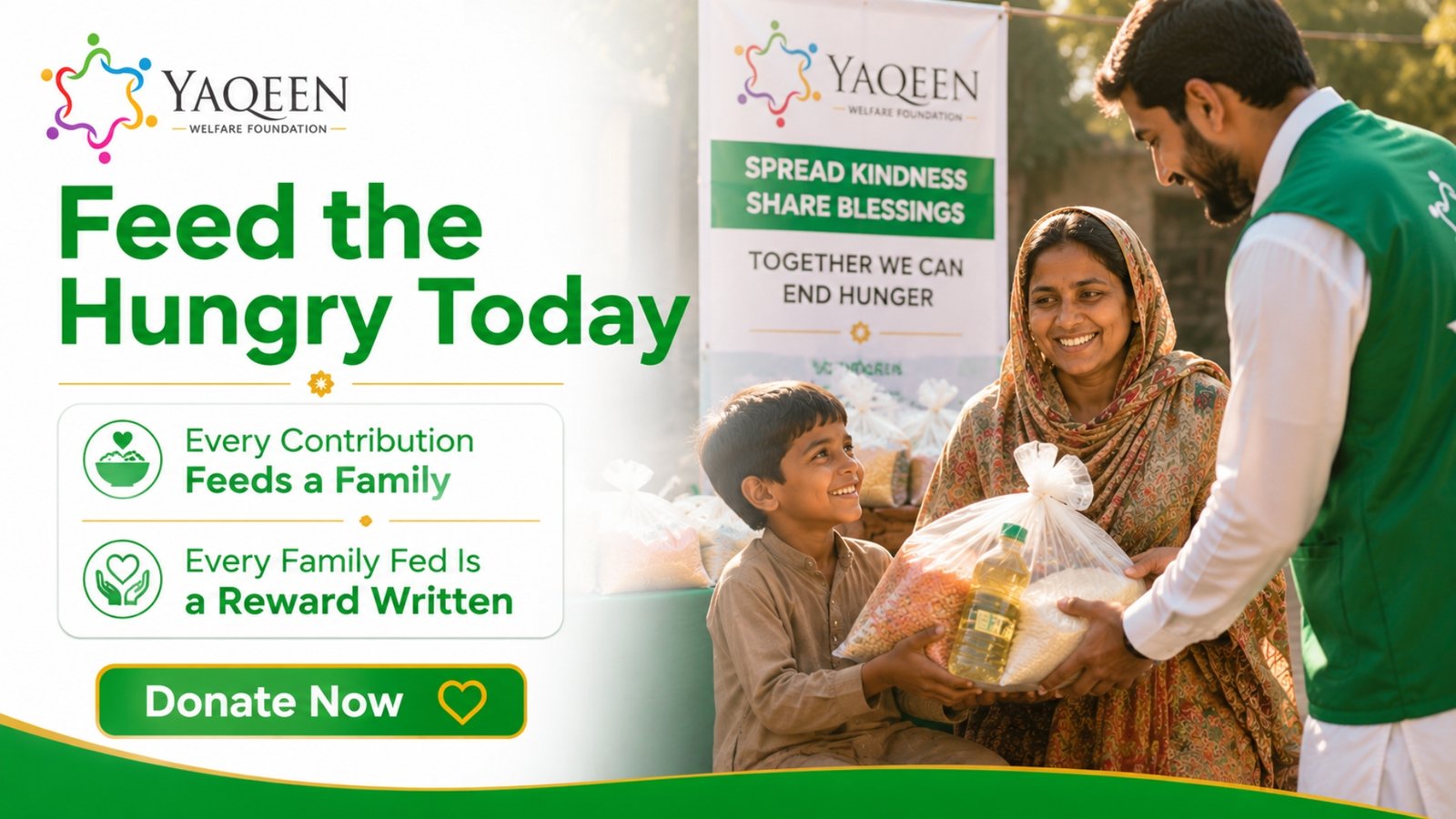
DONATE NOW — Feed the Hungry Today
Give toward food aid and nutrition programmes at Yaqeen Welfare Foundation
Every contribution feeds a real family. Every family fed is a reward written. When Allah Writes 7 Things, your name is already there — before the plate is even empty.
Frequently Asked Questions About Allah Writes 7 Things When You Feed the Hungry
We know that giving is a deeply personal decision. Here are answers to the most common questions people ask before taking that step.
Q: Is feeding the hungry considered Sadaqah Jariyah?
Food itself is consumed and does not endure the way a water well or a masjid does. However, when your donation funds a livelihood programme, a community kitchen, or sustainable food security infrastructure, the ongoing benefit it produces carries the quality of continuous charity. In that case, Allah Writes 7 Things continues to accumulate — the reward flows as long as the benefit flows.
Q: Can I give food charity on behalf of a deceased loved one?
Yes — and this is among the most beloved acts you can perform for someone who has passed. The Prophet صلى الله عليه وسلم confirmed that charity given on behalf of the deceased reaches them. Feeding the hungry in the name of a parent, a spouse, or a sibling means every meal becomes a gift that travels beyond this world. It is one of the seven things Allah Writes 7 Things encompasses.
Q: Does the amount I give matter?
There is no minimum. The Prophet صلى الله عليه وسلم encouraged giving even half a date. What matters most is the sincerity of intention and the genuineness of the need it meets. A modest gift, placed in the right hands, can feed a child for a week. What Allah Writes 7 Things in return for that is not modest at all.
Q: How do I know my donation is reaching people who are truly hungry?
At Yaqeen Welfare Foundation, transparency is central to how we operate. We work directly with communities in genuine need, through vetted on-the-ground partners. Our food programmes are designed to reach the most vulnerable first — those with no safety net, no alternative, and no one else to turn to. Your donation is directed where the need is verified and real.
Q: Can I give Zakat toward food programmes?
Yes. Food aid that reaches those in eligible Zakat categories — the poor, the destitute, those in debt — qualifies as a valid discharge of Zakat. If you intend your donation as Zakat, please indicate this when giving so we can ensure it is allocated to the correct programme. Use our Zakat Calculator to determine what you owe.
Q: What is the reward for feeding someone during Ramadan specifically?
The Prophet صلى الله عليه وسلم said: “Whoever feeds a fasting person will have a reward like that of the fasting person, without any reduction in his reward.” (Tirmidhi). In Ramadan, a single meal given can carry the weight of an entire day’s fast. This is one of the most vivid demonstrations of why Allah Writes 7 Things — the reward truly multiplies in proportion to what the act produces.
Q: Is there a difference between feeding a Muslim and feeding a non-Muslim?
The Quran describes the believers who feed others as giving to “the poor, the orphan, and the captive” — with no restriction of faith specified. The generosity of Islam is universal in its scope. Allah Writes 7 Things for feeding any human being who is genuinely in need, regardless of their religion.