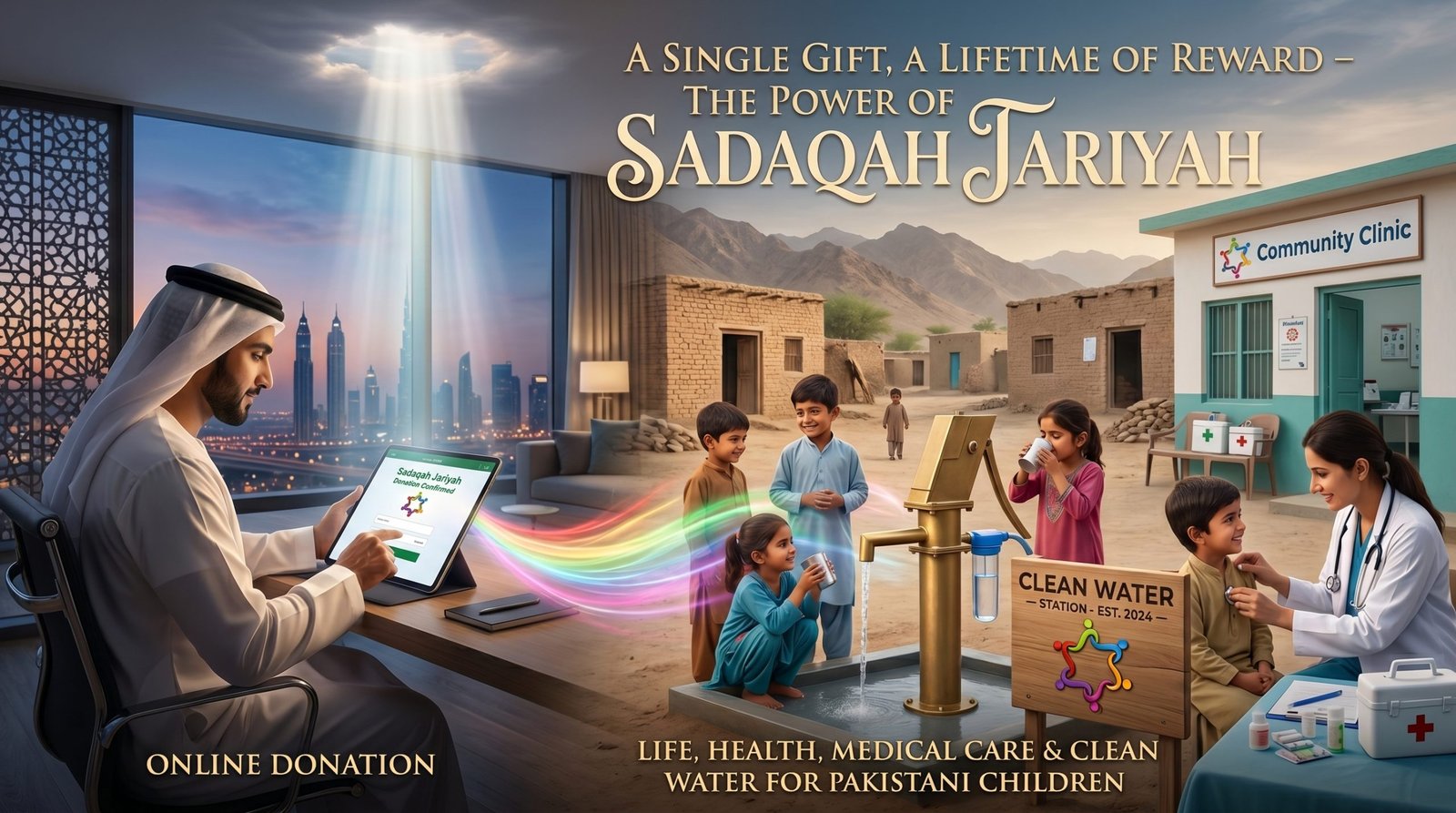
There are two kinds of charity in this world.
One feeds a person for a day. The other feeds a community for generations. One ends the moment your hand opens and closes again. The other keeps moving long after your eyes have closed for the final time.
Sadaqah Jariyah is the name Islam gives to that second kind of giving — charity that doesn’t stop when you stop. At Yaqeen Welfare Foundation, we see this form of generosity reshape destinies every single day, quietly and relentlessly, long after the person who gave it has moved on with their life — or left this world entirely.
Because some acts of charity don’t just help people in the moment. They echo through time, touching lives that haven’t even begun yet.
What Is Sadaqah Jariyah?
The word jariyah comes from an Arabic root meaning “to flow” — like a river that never runs dry. Sadaqah Jariyah, then, is flowing charity: a single act of giving that doesn’t end when the transaction ends, but keeps generating benefit for others again and again, indefinitely.
Unlike one-time acts of charity — which are valuable and necessary in their own right — Sadaqah Jariyah carries a quality nothing else can claim: it outlives the person who gave it.
The Prophet ﷺ said:
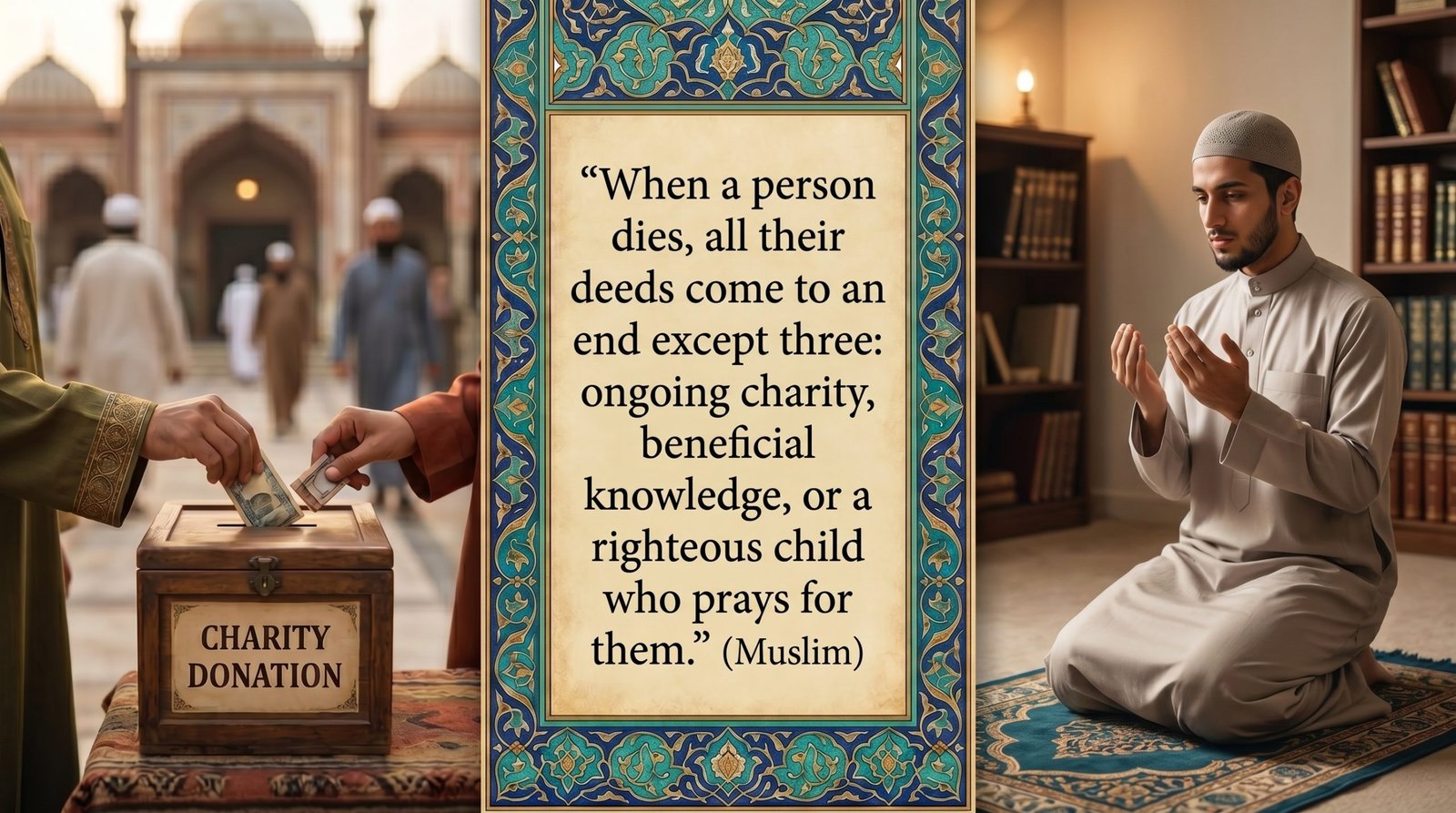
“When a person dies, all their deeds come to an end except three: ongoing charity, beneficial knowledge, or a righteous child who prays for them.” (Muslim)
Sit with that for a moment. All deeds come to an end — except these three. Everything else is sealed the instant the soul departs. But ongoing charity? It stays open. Active. Accumulating.
This isn’t a metaphor or a hopeful saying. It’s a divine promise — that what you give for the wellbeing of others doesn’t disappear with you. It travels ahead of you, recording your account before you even arrive.
If you’re new to the broader concept of charitable giving in Islam, our guide on Best Times and Methods for Giving Sadaqah in Islam is a useful starting point before diving deeper into Sadaqah Jariyah specifically.
Why One Act of Charity Can Last a Lifetime
There is something quietly extraordinary about a gift that multiplies without ever being spent again. When you establish Sadaqah Jariyah, you’re not giving once — you’re creating a source of benefit that renews itself naturally, on its own, without end.
Picture what that looks like in real life:
- A child drinks clean water before school — and your reward is recorded.
- A mother fills her cooking pot without walking three miles under the sun — and your reward is recorded again.
- A patient in a rural clinic receives medicine they couldn’t otherwise afford — and your name is written into an account you will never see.
- A family breaks free from a cycle of poverty because they had access to consistent support — and something shifts, not just for them, but for their children, and their children’s children.
Every single time that benefit reaches someone, a reward is logged. Not proportional to the size of your gift. Not limited by how many years have passed. Not dependent on whether you’re even alive to witness it.
That is the essential difference between charity that helps and Sadaqah Jariyah — charity that never stops helping.
The Charity That Follows You Beyond This World
We spend our lives accumulating things. We build wealth, build careers, build reputations, and leave behind physical traces of our time here. But most of what we build stays here. Property transfers to heirs. Careers end at retirement. Reputation fades within a generation or two.
Sadaqah Jariyah is different. It is, in the truest sense, portable.
It doesn’t stay behind in this world — it travels with you. It enters your Hisaab — your account with Allah — and speaks on your behalf at a time when nothing else you’ve done or said can intervene for you.
Islamic scholars have described it beautifully: a person resting in their grave, unaware of the world moving on above them, yet still receiving a steady stream of reward — from a water source that flows, from knowledge that has spread, from a structure that still shelters people. The charity you released into the world has become an advocate for your soul.
Long after your name has faded from human memory, your charity continues its quiet work. Long after the world has moved past your story, your story is still being written — in the lives of people you may never meet.
A Real Impact: The Story of One Well
Let’s make this tangible.
There was a village — unremarkable by most standards — where clean water simply wasn’t within reach. The nearest source was far. Children who should have been in school spent hours of their day fetching water that wasn’t even safe to drink. Waterborne illness was common. Mothers rationed every drop that came into the home.
Then someone, somewhere, made a choice. A single donation funded the installation of a water pump in that village.
What happened next wasn’t dramatic. There was no ceremony, no crowd gathered to watch. Just water — clean, reliable, close.
- Families no longer rationed or risked illness with every sip.
- Girls who once carried water containers for miles started attending school instead.
- Rates of preventable disease steadily declined.
- Mothers gained back hours of every day that had been consumed by the struggle to survive.
The person who funded that pump may live on the other side of the world. They may have given on a quiet evening, clicked a button, and gone back to their day without a second thought. They may no longer be alive at all.
But the water still flows. And with every container filled, every wound washed, every meal cooked using that water, a reward is recorded for the person who made it possible — without them lifting a finger again.
One decision. One gift. A story that never stops being written.
For a closer look at how this principle connects to other major acts of worship and giving, see our piece on Understanding Zakat: Importance, Calculation, and Impact, which explains how obligatory and voluntary giving work together in a Muslim’s life.
Where Your Sadaqah Jariyah Goes at Yaqeen Welfare Foundation
Every project we run at Yaqeen Welfare Foundation is built around one principle: impact that lasts. We are not interested in interventions that need constant renewal to mean anything. We build things that endure, serve communities that need long-term change, and direct your generosity toward the most sustainable forms of giving available — true Sadaqah Jariyah.
💧 Clean Water Projects
Access to safe water isn’t a luxury — it’s the foundation everything else is built on. Without it, health suffers, education suffers, dignity suffers. Our clean water initiatives install pumps and filtration systems in villages where contaminated or inaccessible water has been a source of suffering for years.
Every pump we install becomes a lasting source of Sadaqah Jariyah for the person who funded it — flowing for as long as the water itself flows.
🏥 Free Healthcare Support – Yaqeen Indus Health Hospital
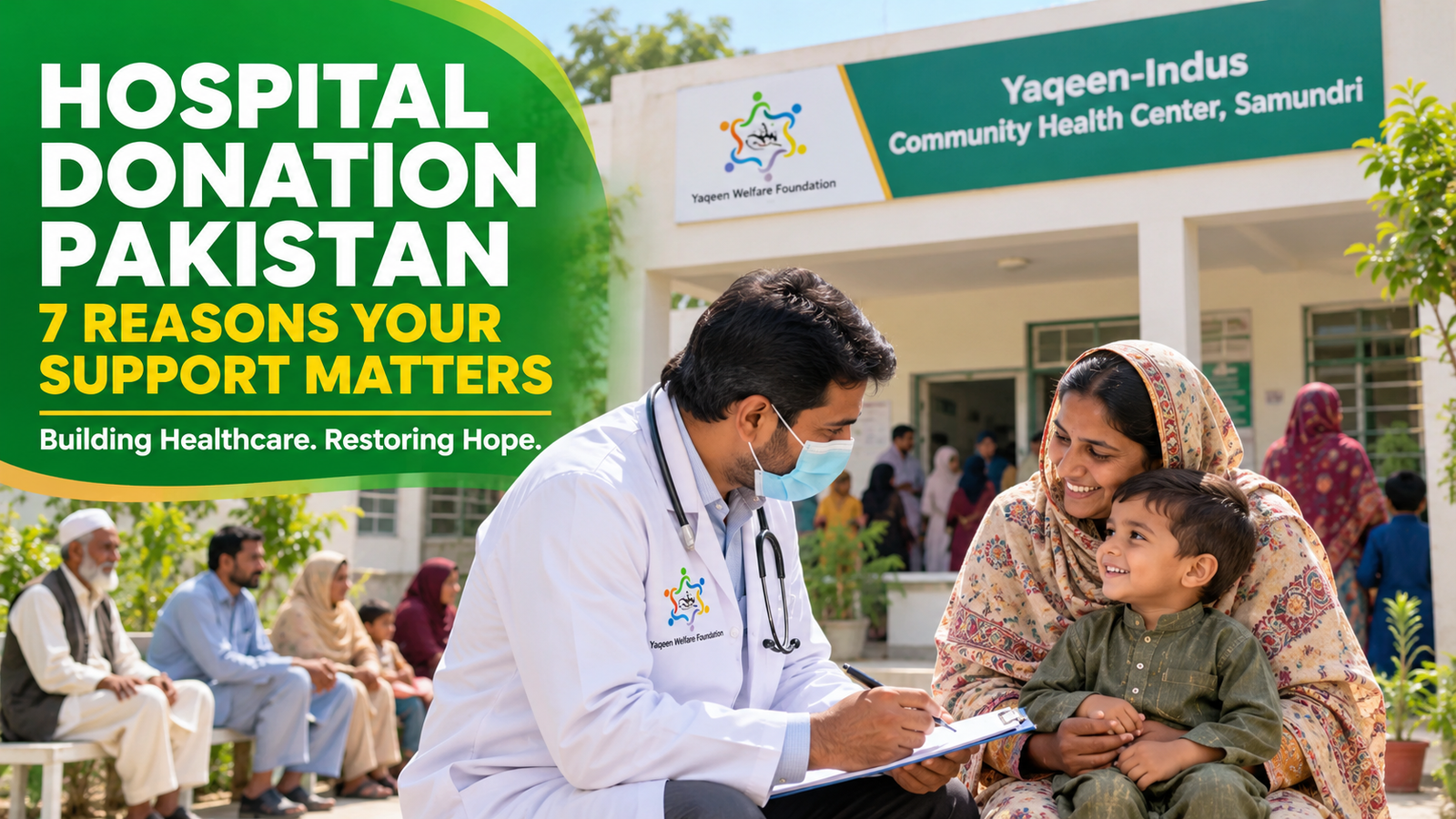
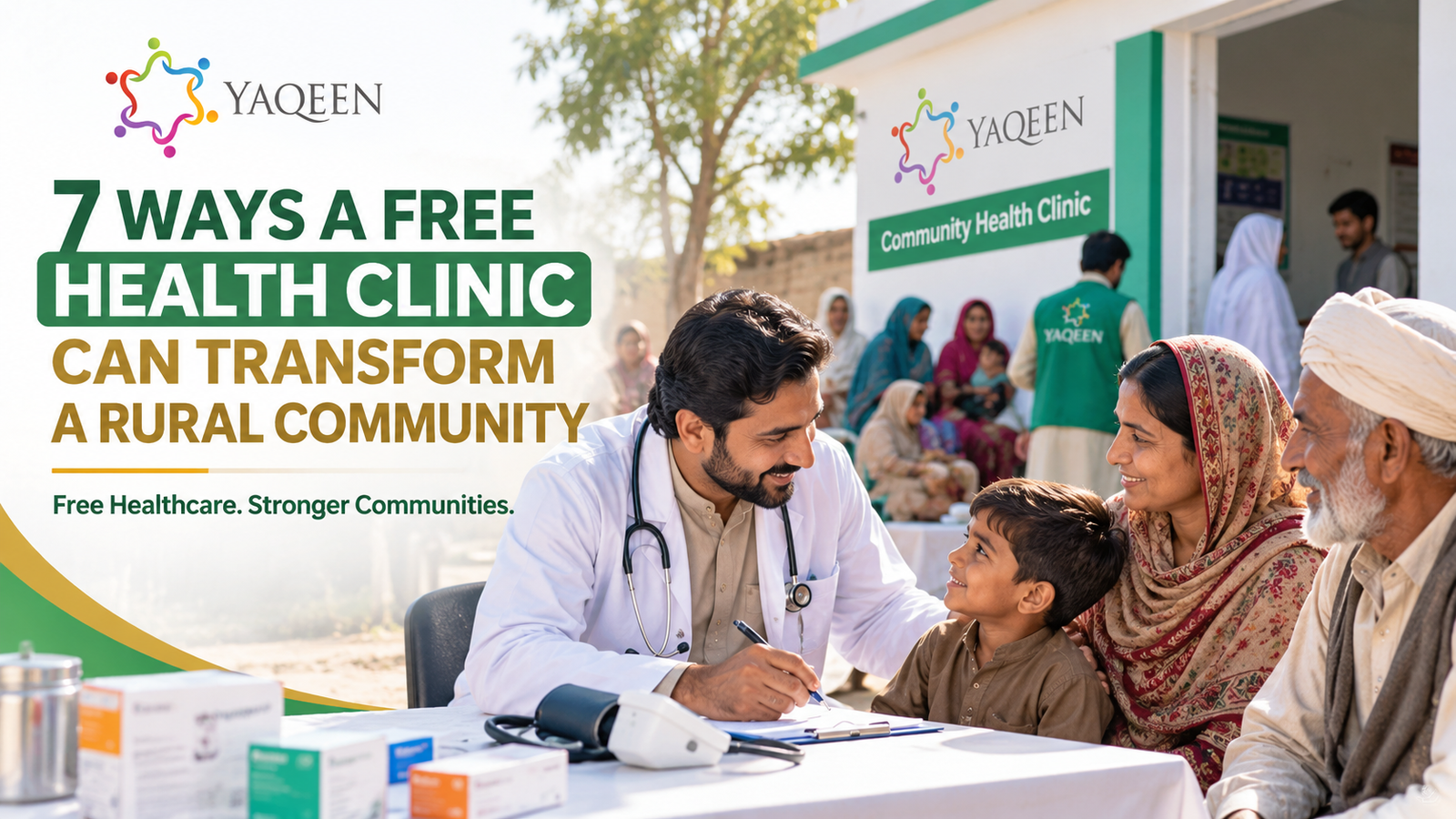
Illness doesn’t check someone’s income before it arrives. Neither does our hospital. Through the Yaqeen Indus Health Hospital, patients from underserved communities receive medical consultations, treatment, and medication at no cost — because healthcare should be a right, not a privilege reserved for those who can afford it.
You can read more about the work being done on the ground in our post on Building a Future for Free Healthcare: Why Modern Infrastructure Is the Key to Healing Pakistan, which lays out just how far this kind of investment reaches.
Your contribution to this work means that every patient treated, every diagnosis made, every family saved from a medical crisis they couldn’t have managed alone — all of it becomes part of your ongoing charity.
🏠 Community Stability Programs
Survival isn’t the goal. Thriving is. Our community support programs work to address the root conditions that keep families trapped in cycles of hardship — providing resources, stability, and pathways that allow people not just to get through the month, but to build a genuinely better future.
When a family stabilizes, their children’s prospects change. When children’s prospects change, communities shift. One act of generosity, directed wisely, can ripple outward in ways that are impossible to fully measure.
This is, in many ways, the quiet engine behind Sadaqah Jariyah. It rarely announces itself with a single dramatic moment. More often, it works the way roots work underground — unseen, slow, and far more powerful than anything visible on the surface. A community program that helps one household find stability this year often becomes the reason several more households find their footing the year after, simply because hope and example tend to spread in ways hardship usually isn’t allowed to.
We’ve seen this pattern repeat itself across the regions we serve. A family that no longer has to choose between medicine and food finds a little room to plan for tomorrow. A mother who isn’t spending her entire day securing water or income finds time to teach her children to read. None of these moments make headlines. But each one is a continuation of someone’s Sadaqah Jariyah — a ripple from a decision made, perhaps, years earlier and thousands of miles away, by a person who will never see the result with their own eyes, yet will be rewarded for it all the same.
If you’d like to understand how Yaqeen channels these donations transparently, our explainer on the Donation Center for Online Sadaqah & Free Healthcare walks through exactly how the process works from the moment you give.
Sadaqah Jariyah and the Signs That Your Charity Has Been Accepted
Many people wonder, quietly, whether their giving has actually meant something — whether it has been seen, accepted, recorded. It’s a natural question, and one rooted in sincerity rather than doubt. Our article on When Allah Acknowledges Your Charity – Signs You Should Never Ignore explores this in more depth, and pairs well with everything discussed here about Sadaqah Jariyah’s lasting nature.
The Last Thought
There will come a day when your hands can give no more.
Your voice will be still. Your signature will no longer appear on any transaction. Your ability to act in this world will be over.
But your Sadaqah Jariyah — if you established it — will still be working. It will still be drawing water from the ground. Still treating the sick. Still steadying the lives of families who never knew your name. And still writing reward, quietly and continuously, into an account that never closes.
The question isn’t simply: “Should I give?”
The deeper question is:
“What will still be giving on my behalf, when I am no longer able to give anything at all?”
Your answer to that question is one of the most important decisions of your life. And it starts with a single act.
Donate Now — Start Your Sadaqah Jariyah Today »
Frequently Asked Questions About Sadaqah Jariyah
Q: What is the best example of Sadaqah Jariyah?
Any contribution that produces a repeating benefit qualifies as Sadaqah Jariyah. Funding a water source, building or contributing to a mosque, supporting schools or libraries, financing healthcare infrastructure, or sustaining ongoing educational programs — all of these generate continuous reward because they keep serving people long after the original act of giving. The defining quality is continuity of benefit, not the size of the gift.
Q: Can I give Sadaqah Jariyah on behalf of someone who has passed away?
Yes — and this is one of the most cherished acts a person can do for a deceased parent, spouse, sibling, or friend. The Prophet ﷺ confirmed that charity given on behalf of the deceased reaches them. It is a way of continuing to love someone and serve their spiritual connection even after they are gone. Many donors give specifically in memory of a loved one, turning each act of ongoing charity into a tribute that keeps paying forward.
Q: Does the reward really continue after my own death?
Yes. This is the explicit meaning of the hadith on Sadaqah Jariyah. As long as people continue to benefit from what you established — whether it’s a well, a clinic, or a program — the rewards continue to accumulate in your account. The act of giving is completed once; the reward from that act is never completed.
Q: How do I know my donation is being used for something lasting?
At Yaqeen Welfare Foundation, transparency is central to how we operate. Our projects are designed specifically to create durable, community-level impact rather than short-term relief. We direct donations toward infrastructure and services — not one-off distributions — so that your charity genuinely carries the quality of Sadaqah Jariyah, not just the intention of it.
Q: Is there a minimum amount required to give Sadaqah Jariyah?
There is no minimum. Even a modest contribution toward a water pump, a share of a hospital’s running costs, or a portion of a community program becomes Sadaqah Jariyah when it produces ongoing benefit. What matters is not the size of the gift — it is the nature of what it builds.
Q: What’s the difference between Sadaqah Jariyah and Zakat?
Zakat is an obligatory annual payment calculated on qualifying wealth, owed to specific categories of recipients. Sadaqah Jariyah is voluntary and open-ended — it can be given at any time, in any amount, toward any project that creates lasting benefit. Many donors give both: fulfilling their Zakat obligation while also establishing Sadaqah Jariyah as a separate, ongoing legacy. Our guide to Understanding Zakat: Importance, Calculation, and Impact breaks down the obligatory side in detail.