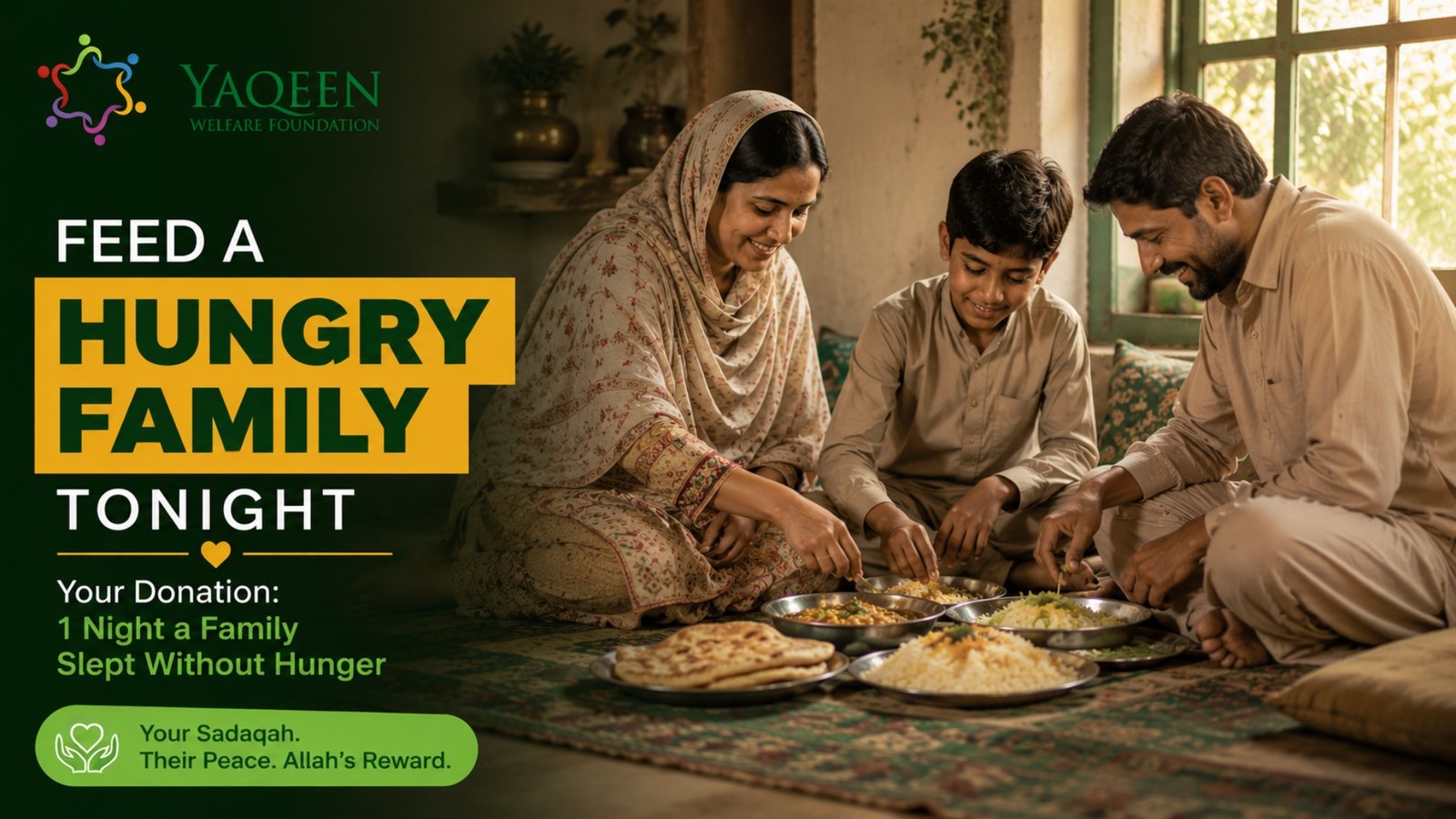
Your Donation: To feed a hungry family is not a single act that begins and ends with a meal. It is a decision that reaches into a home you will never see, on a night you will never witness, and changes everything for the people inside it.
There are moments that do not announce themselves. A pot filled. A table set. A mother who has not slept in three days because the worry would not let her — finally closing her eyes. Children who fell asleep last night asking whether there would be food tomorrow, tonight sleeping without that question on their lips.
These moments do not make the news. They leave no record in the world. And yet in the ledger that Allah keeps — the one that catches what the eye misses and the tongue cannot express — they are written in full.
You may never know that you were the reason a family slept peacefully tonight. But Allah knows. And that is precisely the point of choosing to feed a hungry family when you have the means to do so.
Why Choosing to Feed a Hungry Family Matters So Much in Islam
The Prophet ﷺ did not speak of feeding the poor as one option among many. He spoke of it as a mark of faith itself — its presence or absence a measure of who a person truly is.
“The best of people are those who are most beneficial to people.” (Al-Mu’jam al-Awsat)
“Whoever relieves a Muslim of a burden from the burdens of the world, Allah will relieve him of a burden from the burdens on the Day of Judgement.” (Muslim)
Consider what is being promised. Not simply a reward recorded in a book. But a direct exchange — your relief of another’s suffering, met with Allah’s relief of yours on the day when relief will matter most.
The family that sleeps without hunger tonight because you chose to feed a hungry family is not a side effect of your charity. They are the very reason the reward exists.
If you want to understand more broadly when and how this kind of giving is most rewarded, our earlier post on the Best Times and Methods for Giving Sadaqah in Islam walks through the seasons and methods that multiply the reward of every act of charity.
What Hunger Actually Looks Like
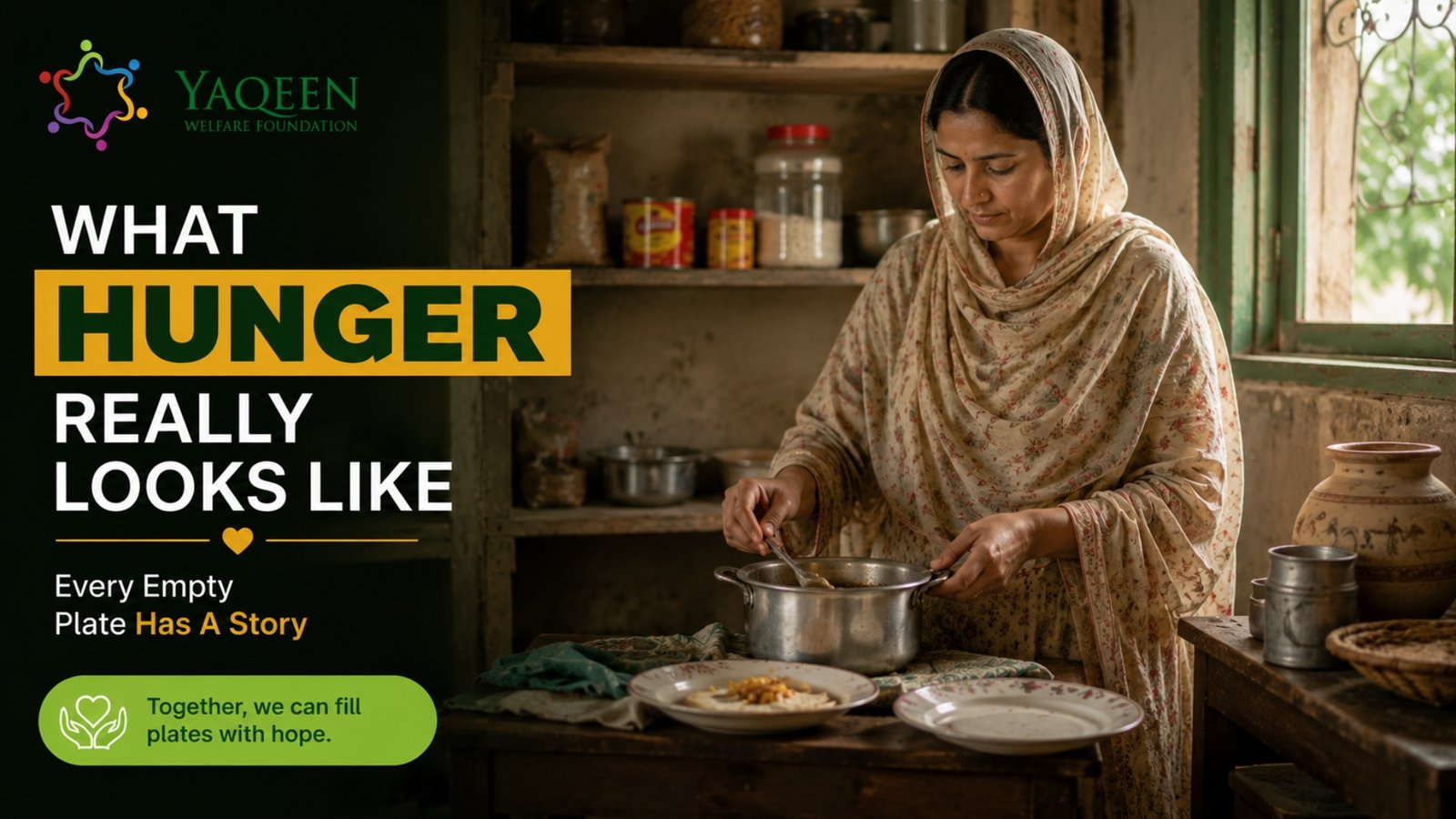
It is easy to hold hunger as an abstraction. A statistic. A category on a donation page. But hunger is not abstract to the mother who measures out the last of the rice and knows it will not stretch to morning. It is not abstract to the child who learns to go quiet when their stomach hurts, because they have learned that asking changes nothing.
Hunger is the weight of a father who leaves the house before dawn so his children do not see him weep. It is the oldest daughter who pretends she has already eaten so her younger siblings can have more. It is a family that has learned to sleep early, because sleep is the only thing that costs nothing.
This is not a rare story in Pakistan. According to the World Food Programme’s Pakistan country page, record-high food and fuel prices, worsened by climate shocks, have pushed many of the country’s most vulnerable households deeper into food insecurity, with WFP working alongside local partners to reach families who would otherwise go without. This is the reality that your decision to feed a hungry family reaches. Not a category. A family. Real people, in a real home, waiting for someone to remember them.
The Quran does not allow us the comfort of distance. Surah Al-Insan describes the believers as those who feed others — despite their own need. You can read the full chapter on Quran.com, Surah Al-Insan, where the believers are described as giving food to the poor, the orphan, and the captive, purely for the love of Allah. Not because it is easy. Not because they have surplus. But because they understand that what they give for Allah is never truly lost.
What Is Written When You Feed a Hungry Family
The deed of feeding someone is not a simple transaction that begins and ends at the moment of giving. It opens a door that does not close easily.
A duʿa is made that travels without a map
When a mother who has been carrying the weight of an empty home finally lays her children down to sleep with full stomachs, her gratitude to Allah is a duʿa. She may not say your name. She may not know it. But the one who made her relief possible receives a share of every word lifted to Allah from that moment of peace.
A burden is lifted — and Allah promises to lift yours in return
The Prophet ﷺ tied the relief of worldly burdens directly to divine relief on the Day of Judgement. That is not a metaphor. It is a promise given by the most truthful of all creation.
Children who are fed grow up to give
A child who knows what it is to receive care learns what it means to give it. The family you help today does not simply survive. They carry forward. The son who remembered a season of hunger grows into a man who cannot pass suffering without responding to it. The thread of your decision to feed a hungry family runs through what he becomes — and through everyone he reaches.
Your heart is softened toward Allah
The Prophet ﷺ connected the act of feeding the poor directly to the remedy for a hardened heart. Giving does not only benefit the one who receives. It transforms the one who gives. Something shifts when generosity becomes habitual — when the instinct to open a hand becomes the instinct of a soul oriented toward Allah.
A Real Night: The Family That Did Not Expect Anyone to Come
Let us make this real.
A family of five in a rural community had been surviving on one meal a day for eleven days. The father had been ill. The mother had sold the last of what could be sold. The children had stopped asking for second helpings not because they were no longer hungry but because they had learned that asking was its own kind of pain.
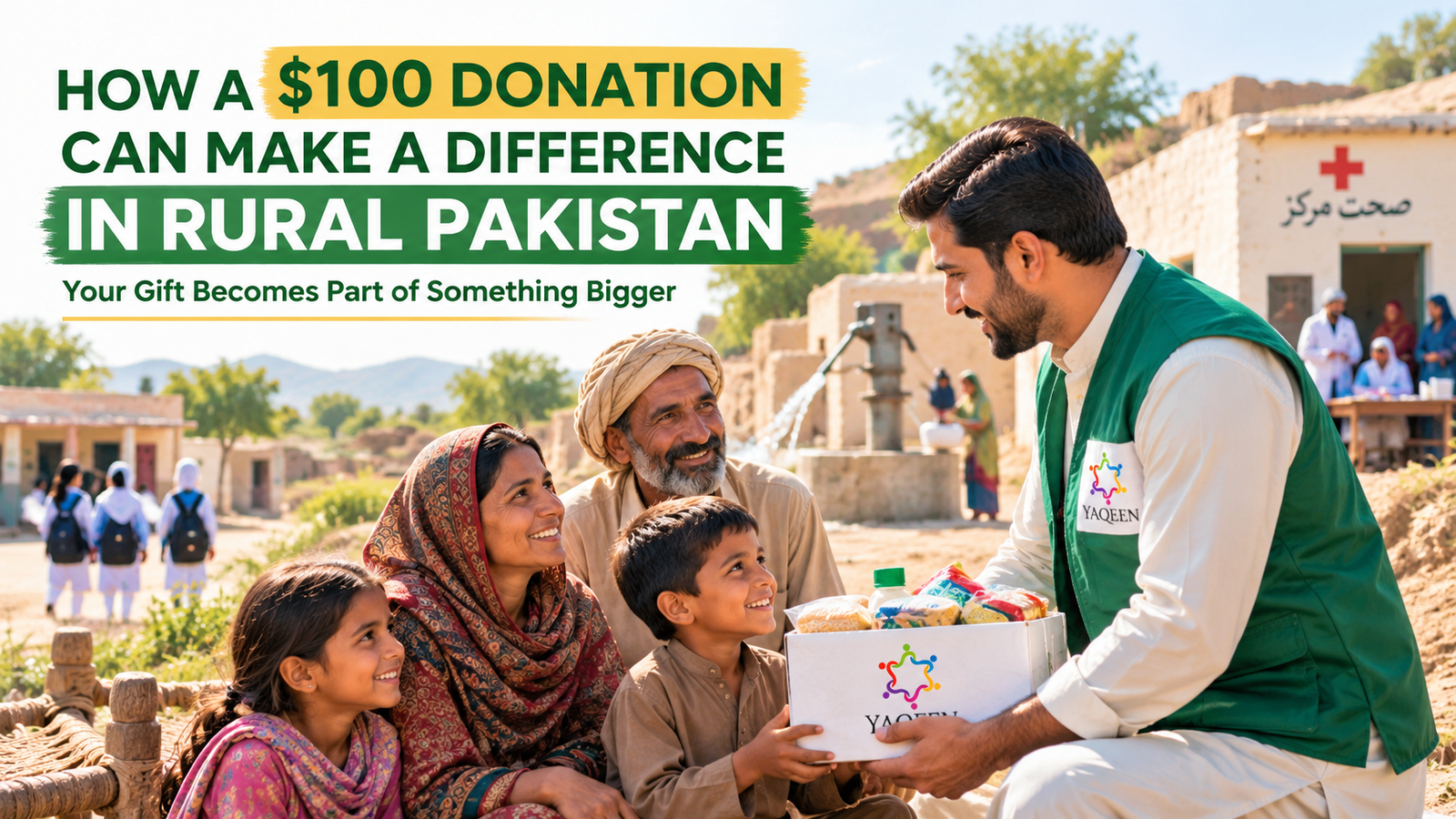
A food parcel reached them through a welfare distribution. Rice. Lentils. Oil. Dates. Enough to last two weeks. Not a fortune. Not a transformation of circumstances. But enough for that night to be different from the eleven that had come before.
The mother cooked after Maghrib. The children ate until they were full — some of them for the first time in nearly two weeks. The youngest, who was four years old, fell asleep still holding a piece of bread.
The donor who contributed to that food parcel will never know this story. The reward was written regardless.
The duʿa the mother made before she slept that night. The gratitude of the father. The peace of five children sleeping without the question of tomorrow pressing on them — all of it was heard. All of it was received. And the one who chose to feed a hungry family that day carries a share of every moment of it.
Where Your Donation Goes When You Feed a Hungry Family at Yaqeen Welfare Foundation
Every programme at Yaqeen Welfare Foundation is built around real impact that reaches real people. When you give toward food relief, you are not making an abstract contribution. You are choosing to be the reason a family’s night is different.
| Programme | Who It Reaches | What It Provides |
|---|---|---|
| Emergency Food Parcels | Families facing sudden income loss, illness, or crisis | A two-week food parcel delivered directly, with dignity |
| Ramadan Food Distribution | Fasting families who cannot afford iftar | Large-scale distributions during the most rewarded month |
| Ongoing Family Food Support | Households in chronic, long-term poverty | Monthly food support that continues beyond the crisis |
| Widow and Vulnerable Household Support | Widow-headed, elderly, or earner-less households | Targeted, sustained support for the most forgotten |
🍚 Emergency Food Parcels
We provide food parcels to families in acute need — those facing sudden loss of income, illness, displacement, or crisis. Each parcel is enough to sustain a family for two weeks and is distributed with dignity, directly to the hands that need it most. One parcel. One family’s hunger addressed.
🌙 Ramadan Food Distribution
In Ramadan, the reward for feeding someone who is fasting is among the greatest acts of worship available to us. We coordinate large-scale food distributions so that families who cannot afford iftar are not excluded from the mercy and barakah of the blessed month. Choosing to feed a hungry family in Ramadan multiplies in ways that no other time of year allows.
🏘️ Ongoing Family Food Support
For families in chronic poverty — where the crisis is not a single event but a sustained condition — we provide ongoing monthly food support. This is the giving that does not simply address a crisis and move on. It walks alongside a family through the season of difficulty and does not leave when the attention does.
♥️ Widow and Vulnerable Household Support
Among the most vulnerable are households headed by widows, the elderly, and those with no able-bodied earner. The Prophet ﷺ described the one who strives for the widow and the poor as equal to one who strives in the path of Allah. We direct specific support to these households so that those most forgotten are not forgotten by us.
This food work sits alongside our wider mission. If you would like to see how the same model of direct, dignified giving applies to other essential needs, take a look at how we donate water through our foundation across Pakistan, and how your support has helped fund free healthcare in Pakistan.
How Far a Donation Goes When You Feed a Hungry Family
People often ask what a specific amount actually does. While costs vary by region and season, here is a general picture of how a contribution translates into relief for a household that needs to feed a hungry family tonight:
| Type of Support | What It Typically Covers |
|---|---|
| A single emergency food parcel | Roughly two weeks of staple food for a family of five |
| A monthly food support sponsorship | Ongoing meals for one household through a season of hardship |
| A Ramadan iftar contribution | Daily iftar meals for a fasting family across the month |
| A widow household sponsorship | Sustained monthly food and basic support for a vulnerable home |
No contribution is too small to matter. The Prophet ﷺ taught that the most beloved deeds to Allah are those done consistently, even if modest in size — which means a small, regular gift to feed a hungry family can carry more weight than a single large one given once and forgotten.
The Final Thought: Your Donation 1 Night a Family Slept Without Hunger
Somewhere tonight, a family is going to sleep hungry.
Not because the world lacks the means to feed them. Not because no one could have reached them. But because the moment of giving that could have changed their night did not happen.
You cannot reach every family. But you can choose to feed a hungry family tonight — one mother who sleeps without the weight of an empty house pressing on her chest, one child who does not fall asleep wondering, one father who does not carry alone the shame of not being able to provide.
And in the record that Allah keeps — the one that catches every tear of relief, every whispered “alhamdulillah” from a heart that was given reason to mean it — every one of those moments is written against your name.
“Whoever relieves a Muslim of a burden from the burdens of the world, Allah will relieve him of a burden from the burdens on the Day of Judgement.” (Muslim)
One family. One night. One decision to feed a hungry family that is heard, received, and written.
The question is not only: “Should I give?” The deeper question is: tonight, somewhere, a family will either sleep with empty stomachs or full ones — and what is Allah ready to write for the person who makes the difference?
Your answer to that question begins with a single act of care.
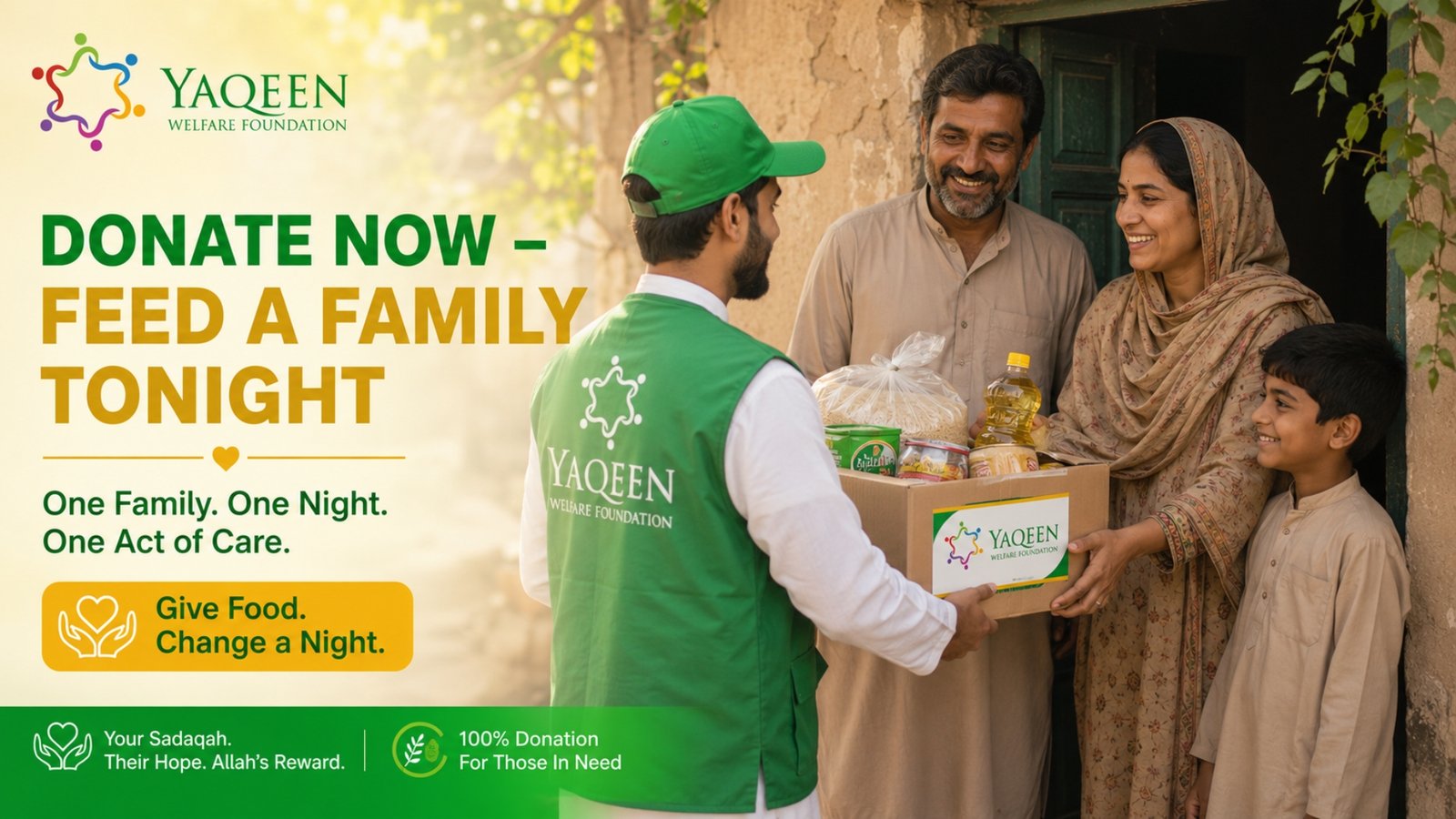
Donate Now — Feed a Family Tonight
You can also learn more about how every donation is acknowledged and recorded in our piece on how Allah acknowledges charity — you should never ignore, or explore how to give through our online Sadaqah donation centre.
Frequently Asked Questions About Feeding the Poor in Islam
Q: Does feeding a hungry family count as Sadaqah Jariyah? Food given to a hungry family is an immediate act of charity. Where it becomes ongoing is in the lives it changes. A family stabilised through food support can recover, work, and build. A child who does not grow up hungry carries that stability forward into everything they become. The chain of good that flows from one decision to feed a hungry family may be far longer than we can see.
Q: Can I give food charity on behalf of a deceased loved one? Yes — and this is among the most beautiful gifts you can give to someone who has passed. Sadaqah given on behalf of the deceased reaches them, as confirmed in authentic narrations. Choosing to feed a hungry family in a parent’s name means that every duʿa made in that household, every moment of relief that night, carries a portion back to the one in whose memory the gift was given.
Q: Does the amount I give matter? There is no minimum in Allah’s ledger. The Prophet ﷺ taught that the most beloved deeds to Allah are those done consistently, even if they are small. A modest monthly contribution that continues reliably over time may do more for a family — and carry more weight with Allah — than a large, one-time gift. Consistency is its own form of honour.
Q: How do I know the food reaches people who truly need it? At Yaqeen Welfare Foundation, we work with verified on-the-ground partners who identify families in genuine acute need — those with no alternative source of food, no safety net, and no one else to turn to. When you give, you can be confident that your contribution reaches a family that would otherwise go without.
Q: Can food charity count as Zakat? Yes. Families in acute poverty and food insecurity fall within the eligible categories for Zakat. If you intend your donation as Zakat, please indicate this when giving so that we can ensure it is allocated to Zakat-eligible programmes. Choosing to feed a hungry family is among the most valid and meaningful ways to fulfil this obligation. You can confirm your eligible amount using our Zakat Calculator