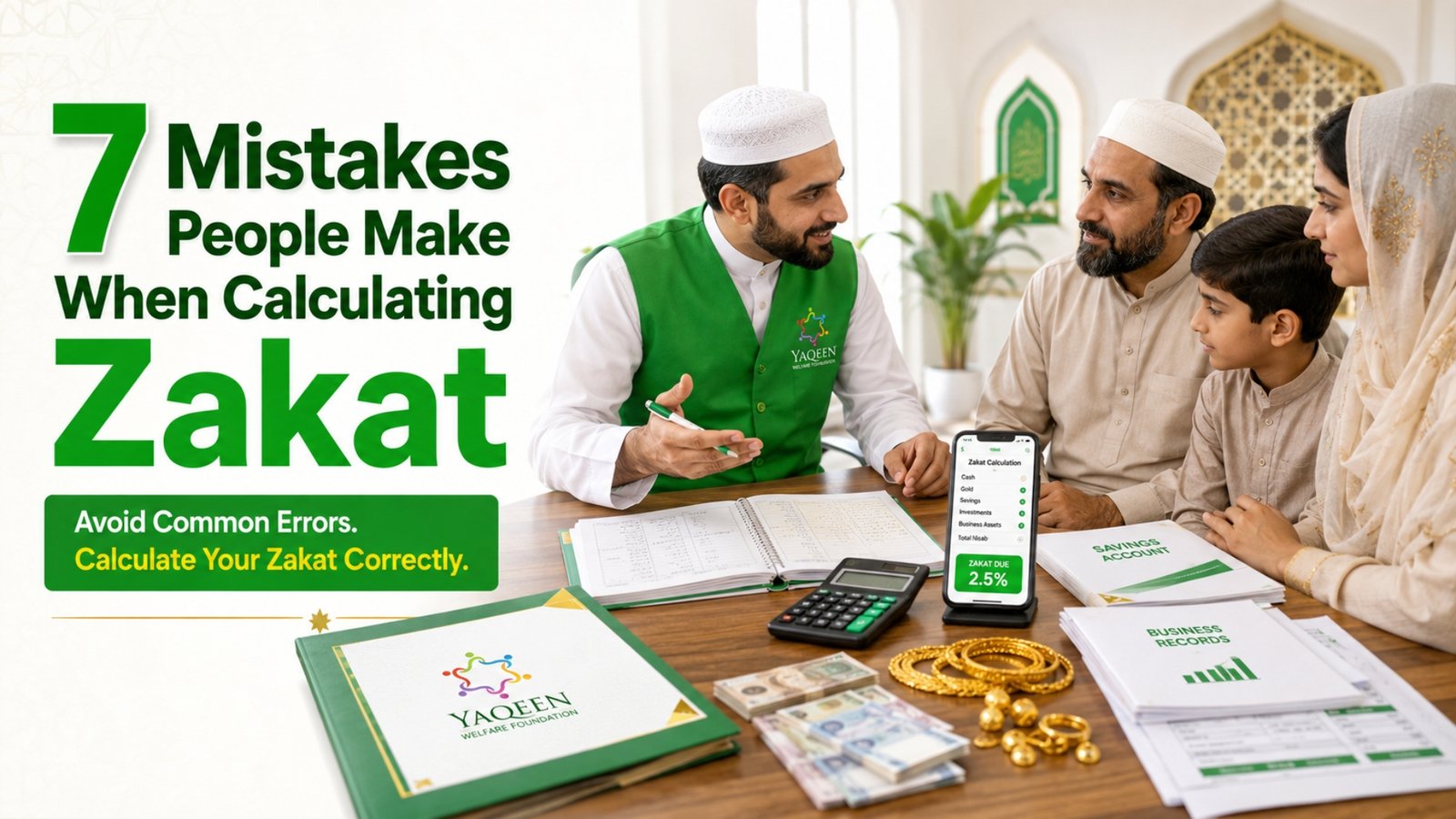
Calculating Zakat correctly is one of the most important financial and spiritual responsibilities a Muslim carries every year, yet it is also one of the most commonly miscalculated. Zakat is not a rough estimate or a symbolic gesture — it is a precise obligation, the third pillar of Islam, and a right that the poor have over the wealth of the rich. Small errors in calculating Zakat can mean underpaying what is owed to the needy, overpaying unnecessarily, or missing the obligation entirely for an entire lunar year.
At Yaqeen Welfare Foundation, we work directly with underserved communities in Pakistan, and every Zakat contribution we receive is used to fund free medical treatment, clean water projects, and emergency relief for families who have nowhere else to turn. Because so much depends on accuracy, this guide walks through the seven most common mistakes people make when calculating Zakat, why each one matters, and exactly how to correct it — whether you are calculating for the first time or reviewing your approach after several years of giving.
Why Calculating Zakat Correctly Matters
Zakat is not simply “giving some charity when you feel generous.” It is a fixed, structured obligation: 2.5% of qualifying wealth that has been in your possession for a full lunar year (known as the hawl), once your net assets exceed a minimum threshold called the nisab. Getting this number wrong has real consequences.
If you underpay, you fall short of a religious duty and the poor receive less than what is rightfully theirs. If you overpay, you may be giving away money you actually need, or double-counting assets that were never zakatable in the first place. If you miscalculate the timing, you might delay your Zakat past its due date or pay it before it is actually owed. This is precisely why calculating Zakat with care — rather than guessing — protects both your finances and your standing before Allah.
Organizations such as Islamic Relief Worldwide note that Zakat is based on the total value of zakatable assets a person owns, including cash, gold, silver, savings, and business assets, minus deductible short-term liabilities. Getting each of those categories right is where most people go wrong.
Quick Recap: What Is Zakat and Who Must Pay It
Before looking at the mistakes, it helps to recap the basics:
- Zakat is obligatory on every sane, adult Muslim whose wealth reaches the nisab threshold.
- The nisab is based on the value of either 87.48 grams of gold or 612.36 grams of silver, according to figures widely cited by Islamic charities and referenced on Wikipedia’s overview of Zakat.
- Wealth must remain above the nisab for one full lunar (Hijri) year before Zakat becomes due.
- The Zakat rate is a fixed 2.5% of qualifying net wealth.
With that foundation in place, let’s look at where people commonly go wrong when calculating Zakat.

7 Common Mistakes People Make When Calculating Zakat
Mistake 1: Not Knowing the Nisab Threshold
The single biggest mistake in calculating Zakat is skipping the nisab check altogether. Many people assume they owe Zakat simply because they have savings, without first confirming whether their total wealth actually exceeds the minimum threshold. Others use an outdated nisab figure from a previous year, forgetting that gold and silver prices shift daily.
The fix: Check the current gold and silver rates before you begin. Most scholars recommend using the silver nisab (612.36 grams) rather than the gold nisab (87.48 grams), since the silver value is almost always lower — meaning more people qualify to give, and more support reaches those in need. You can use the Yaqeen Zakat Calculator to check this automatically against live rates rather than relying on memory.
Mistake 2: Confusing Zakat with Sadaqah or Fitrana
Zakat, Sadaqah, and Fitrana are all forms of charity in Islam, but they are not interchangeable, and treating them as the same thing is a frequent error when calculating Zakat. Sadaqah is voluntary charity with no fixed amount or timing. Fitrana (Zakat al-Fitr) is a separate, smaller obligation paid before Eid prayer to ensure every Muslim — rich or poor — can celebrate Eid with dignity. Zakat, by contrast, is calculated annually on wealth and paid at 2.5%.
Some people mistakenly count their Fitrana payment toward their Zakat obligation, or assume that any charitable giving throughout the year automatically “covers” their Zakat. It does not. If you want to understand the distinction more fully and calculate Fitrana separately, the Yaqeen Fitrana Calculator is a useful companion tool alongside the Zakat calculator.
Mistake 3: Ignoring Debts and Liabilities
Another common error is calculating Zakat on gross assets without subtracting short-term debts and liabilities. Zakat is due on net zakatable wealth, not your total account balance. If you owe money that is due imminently — a credit card bill, an overdue loan installment, unpaid rent — that amount can typically be deducted before you calculate your 2.5%.
However, this doesn’t mean every debt is deductible. Long-term liabilities like the full remaining balance of a mortgage or student loan are generally not subtracted in full; only the portion that is currently due is deducted. People often make the opposite mistake here too — deducting an entire multi-year loan balance and dramatically underpaying their Zakat as a result.
The fix: List your zakatable assets first (cash, savings, gold, silver, investments, business inventory), then subtract only debts and bills that are due imminently, not your entire long-term debt load.
Mistake 4: Using the Wrong Zakat Rate
It sounds basic, but miscalculating the percentage itself is surprisingly common. Zakat on standard wealth — cash, savings, gold, silver, business assets — is 2.5%. Some people confuse this with the rate applied to agricultural produce (which can be 5% or 10% depending on irrigation method) or with the rate for livestock, which follows an entirely different structure based on the number and type of animals owned.
If you are only calculating Zakat on cash, gold, silver, and investments, the rate is a flat 2.5% of the total net value. Applying any other percentage — or rounding it to “roughly 2%” or “about 3%” for convenience — results in an inaccurate obligation.
Mistake 5: Forgetting Gold, Silver, and Investments
Many people calculate Zakat only on their bank balance and forget entirely about gold jewelry, silver items, stocks, mutual funds, retirement accounts, or business inventory. Jewelry that is worn regularly is still zakatable in most scholarly opinions — the fact that it is “in use” does not exempt it. Similarly, shares and investment funds are zakatable based on their current market value, not their original purchase price.
The fix: Before calculating Zakat, make a full list of every asset category: cash on hand, bank balances, gold, silver, shares, business stock, rental income saved, and money owed to you by others that you expect to be repaid. Leaving out even one category — especially gold jewelry — is one of the most frequent reasons Zakat calculations come in too low.
Mistake 6: Miscalculating the Zakat Year (Hawl)
The hawl, or Zakat year, is the full lunar year your wealth must remain above the nisab before Zakat is due. A common mistake is using the Gregorian calendar instead of the Hijri (lunar) calendar, which is roughly 10-11 days shorter each year. Over time, this shifts your Zakat due date and can cause confusion about whether a full year has actually passed.
Another related error is resetting the “seed date” every time wealth temporarily dips below the nisab, even briefly. According to guidance published by Islamic charities, as long as your wealth is above the nisab on your original seed date, Zakat remains due even if it dipped below that threshold for part of the year — the seed date only truly resets if you become completely without zakatable assets.
The fix: Mark your Zakat anniversary using the Hijri calendar, and don’t restart your count just because your balance fluctuated during the year. Many people find it easiest to fix their Zakat date to occur during Ramadan each year, so the timing becomes a consistent annual habit.
Mistake 7: Not Verifying the Charity Before Donating
The final mistake isn’t in the arithmetic at all — it’s in where the Zakat goes after it has been correctly calculated. Zakat can only be given to specific categories of recipients defined in Islamic law, primarily the poor and needy. Donating to an organization that does not properly verify recipient eligibility, or that spends a large share of donations on overhead rather than reaching beneficiaries directly, means your carefully calculated Zakat may not fulfill its intended purpose as effectively as it should.
The fix: Choose an organization with a transparent track record of reaching those most in need. At Yaqeen Welfare Foundation, Zakat contributions go directly toward free medical care at the Yaqeen Health Clinic, clean water access, and emergency assistance for families across Pakistan — you can read real accounts of this impact in stories like Your Charity Saved Lives: 8 Heartwarming Stories and One Meal, One Prayer: 5 Incredible Reasons One Life Changed Forever.
Nisab Threshold at a Glance
Since gold and silver prices change daily, it helps to understand the two standards used when calculating Zakat, and why the numbers differ so much.
| Nisab Standard | Weight | Who Typically Uses It | Effect on Your Zakat |
|---|---|---|---|
| Silver Nisab | 612.36 grams | Recommended by most scholars | Lower threshold — more people qualify to give |
| Gold Nisab | 87.48 grams | Some schools of thought and those holding mostly gold assets | Higher threshold — fewer people meet the minimum |
| Mixed Assets | Combined value | Anyone holding both gold, silver, cash, and investments | Combine all zakatable wealth, then compare against silver nisab |
As explained by Islamic Relief Worldwide’s guidance on nisab, most scholars advise using the silver value because it is almost always the lower of the two thresholds, which means a greater amount of wealth becomes eligible for Zakat — and more support reaches people who genuinely need it.
How to Avoid These Mistakes When Calculating Zakat
Getting this right doesn’t require an accounting degree. A simple, repeatable process each year prevents nearly all of the errors above:
- Pick a fixed Zakat anniversary date, ideally aligned with the Hijri calendar.
- List every zakatable asset: cash, bank savings, gold, silver, shares, business inventory, and money owed to you.
- Subtract only imminent debts and bills, not long-term loan balances in full.
- Compare your net total against the current silver nisab.
- Apply the flat 2.5% rate to the net amount if it exceeds the nisab.
- Verify the charity you plan to give to before transferring funds.
- Use a trusted calculator rather than doing the math from memory.
To make this process even easier, the Yaqeen Zakat Calculator walks you through each asset category automatically and applies the current nisab value, removing most of the guesswork involved in calculating Zakat by hand.
The Deeper Purpose Behind Getting It Right
Beyond the numbers, Zakat exists to purify wealth and redistribute it toward those who are struggling. Every mistake in calculating Zakat — whether it results in underpaying or overpaying — ultimately affects real families waiting on the other end. When Zakat is calculated accurately and given to a trustworthy organization, it becomes clean water for a village, a free consultation at a rural clinic, or a meal for a family that had none. You can read more about how everyday giving transforms lives in posts like 9 Ways Charity Softens the Heart and Changes the Soul and Allah Writes 7 Things When You Feed the Hungry.
Calculating Zakat is a Responsibility Worth Taking Seriously
At the end of the day,carefully is an act of worship in itself. Rushing through it, guessing at figures, or copying last year’s number without rechecking the nisab undermines the very purpose of the obligation. Taking twenty minutes to sit down, list your assets, and calculate accurately is a small investment that protects a major pillar of your faith.

Frequently Asked Questions About Calculating Zakat
What is the easiest way to start calculating Zakat?
Start by listing every zakatable asset you own — cash, gold, silver, savings, and investments — then subtract any debts due immediately. Compare the total to the current nisab threshold using a tool like the Yaqeen Zakat Calculator before applying the 2.5% rate.
Do I need to pay Zakat on jewelry I wear every day?
In most scholarly opinions, yes. Gold and silver jewelry remains zakatable regardless of whether it is worn regularly or kept in storage. This is one of the most commonly missed items when people are calculating Zakat.
Can I deduct all my debts before calculating Zakat?
No. Only debts and bills that are due imminently can typically be deducted. Long-term liabilities, such as the remaining balance on a mortgage or student loan, are not subtracted in full — only the portion currently due.
Is Zakat the same as Fitrana?
No. Zakat is an annual 2.5% obligation on qualifying wealth, while Fitrana (Zakat al-Fitr) is a separate, smaller payment made before Eid prayer. Use the Yaqeen Fitrana Calculator to calculate that obligation separately.
Which nisab value should I use — gold or silver?
Most scholars recommend using the silver nisab (612.36 grams) because it is generally the lower threshold, which allows more people to qualify and directs more support to those in need. If your assets are entirely in gold, some scholars advise using the gold nisab instead.
How do I know my Zakat is reaching the right people?
Choose a transparent, verified organization. Yaqeen Welfare Foundation directs Zakat contributions toward free medical treatment, clean water, and direct relief for underserved communities in Pakistan, with outcomes shared openly through our blog and mission page.
Still Have Questions About Calculating Zakat?
If you are unsure about any part of your calculation, don’t guess — ask. Our team is happy to walk you through the process or help you understand where your Zakat can make the greatest impact.
📩 Contact Yaqeen Welfare Foundation online with your questions, or visit our Donate page to give your Zakat directly toward free healthcare, clean water, and emergency relief for families across Pakistan.