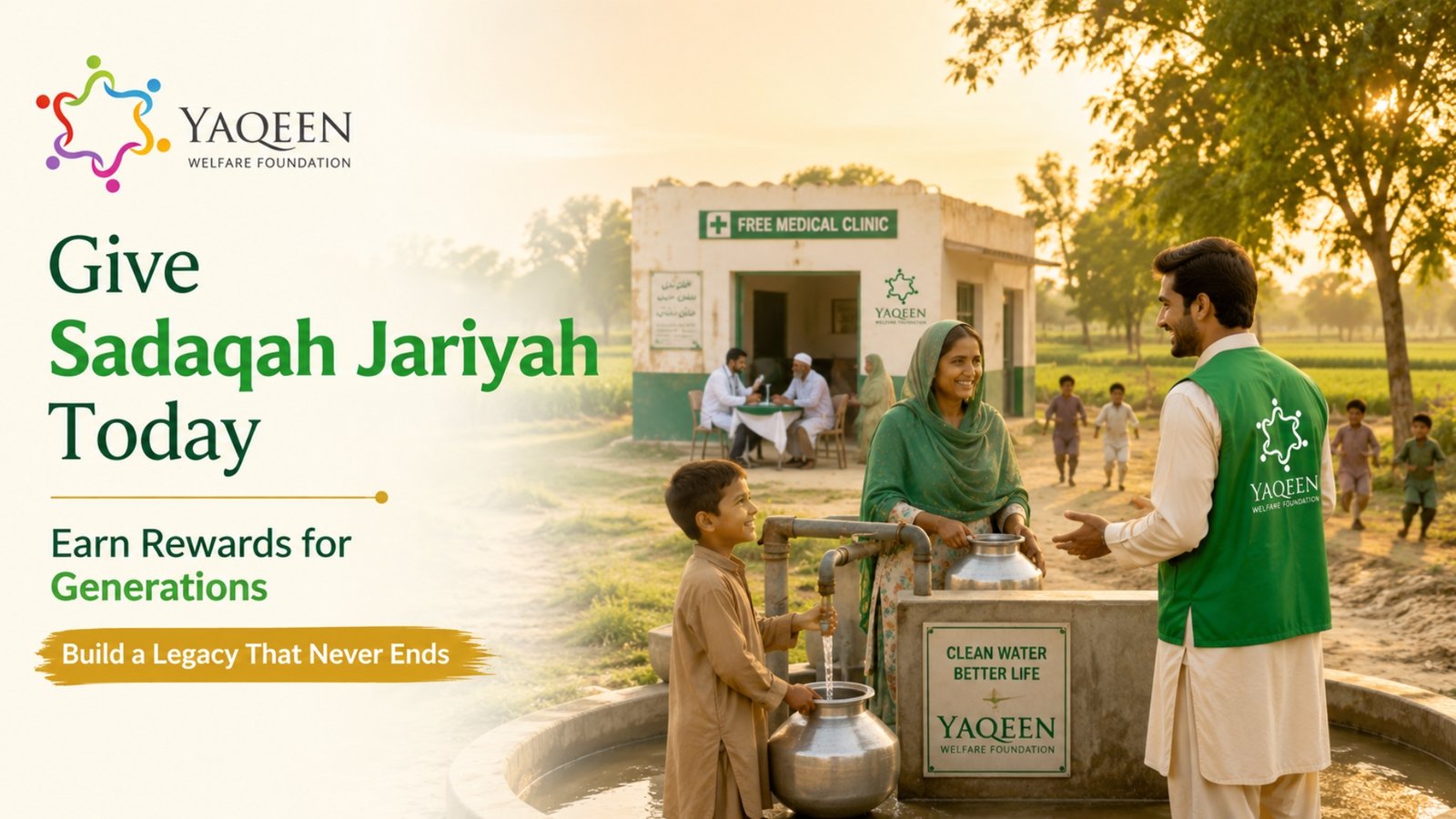
Sadaqah Jariyah is the only kind of charity that keeps working long after you’ve forgotten you gave it. A single act — a well dug, a clinic funded, a tree planted, a Quran donated — can go on benefiting people for decades, and every single time it does, the reward is written into your book of good deeds. Give it today, and it is entirely possible that a well you funded is still giving a village clean water, or a Quran you donated is still being recited, a hundred years from now. That is the promise behind this form of giving, and it is why so many Muslims consider it one of the wisest investments they will ever make — an investment that pays dividends long after this life is over.
This article explains exactly what Sadaqah Jariyah means, the hadith evidence behind the “100 years of reward” idea, seven practical ways you can give it today, and how Yaqeen Welfare Foundation turns these donations into real projects for underserved communities across Pakistan. By the end, you’ll know exactly how to start your own ongoing charity — and why waiting even one more day means one more day of reward you could have already been earning.
What Does Sadaqah Jariyah Mean?
Sadaqah Jariyah translates roughly to “continuous” or “flowing” charity. It stands apart from a one-time donation — like handing someone cash or buying a family a meal — because its benefit doesn’t stop at the moment of giving. Instead, it keeps reaching people again and again, for as long as the project or asset remains useful.
The foundation for this concept comes from a hadith narrated by Abu Hurairah, in which the Prophet Muhammad ﷺ said that when a person dies, their deeds come to an end except for three things: ongoing charity, beneficial knowledge left behind, and a righteous child who prays for them. This hadith is recorded in Sahih Muslim, Hadith 1631, one of the most authentic hadith collections in Islam, and repeated in other collections such as Riyad as-Salihin, Hadith 1383.
Of these three deeds, this one is the one almost anyone can begin today — you don’t need to raise a righteous child or spend a lifetime teaching to start earning this reward. You simply need to fund something that continues to help others after you’ve given it.
Why People Say Sadaqah Jariyah Can Earn Rewards for 100 Years
The “100 years” framing isn’t a literal hadith figure — scholars don’t put a fixed number of years on the reward of ongoing charity. What it captures is the real, well-documented fact that many forms of ongoing charity genuinely can, and do, last a century or longer. A well-built mosque, a properly maintained water well, or an endowed piece of land (waqf) can easily outlive the donor by 50, 80, or well over 100 years, with each day of benefit generating fresh reward.
One of the clearest historical examples is the well of Ruma in Madinah, purchased by the Companion Uthman ibn Affan (may Allah be pleased with him) and made free for public use. Scholars still reference this act today, more than 1,400 years later, as the archetype of ongoing charity — proof that a single act of giving can genuinely echo across centuries. When you give toward a lasting project like this, you are placing your name, quite literally, into that same tradition.
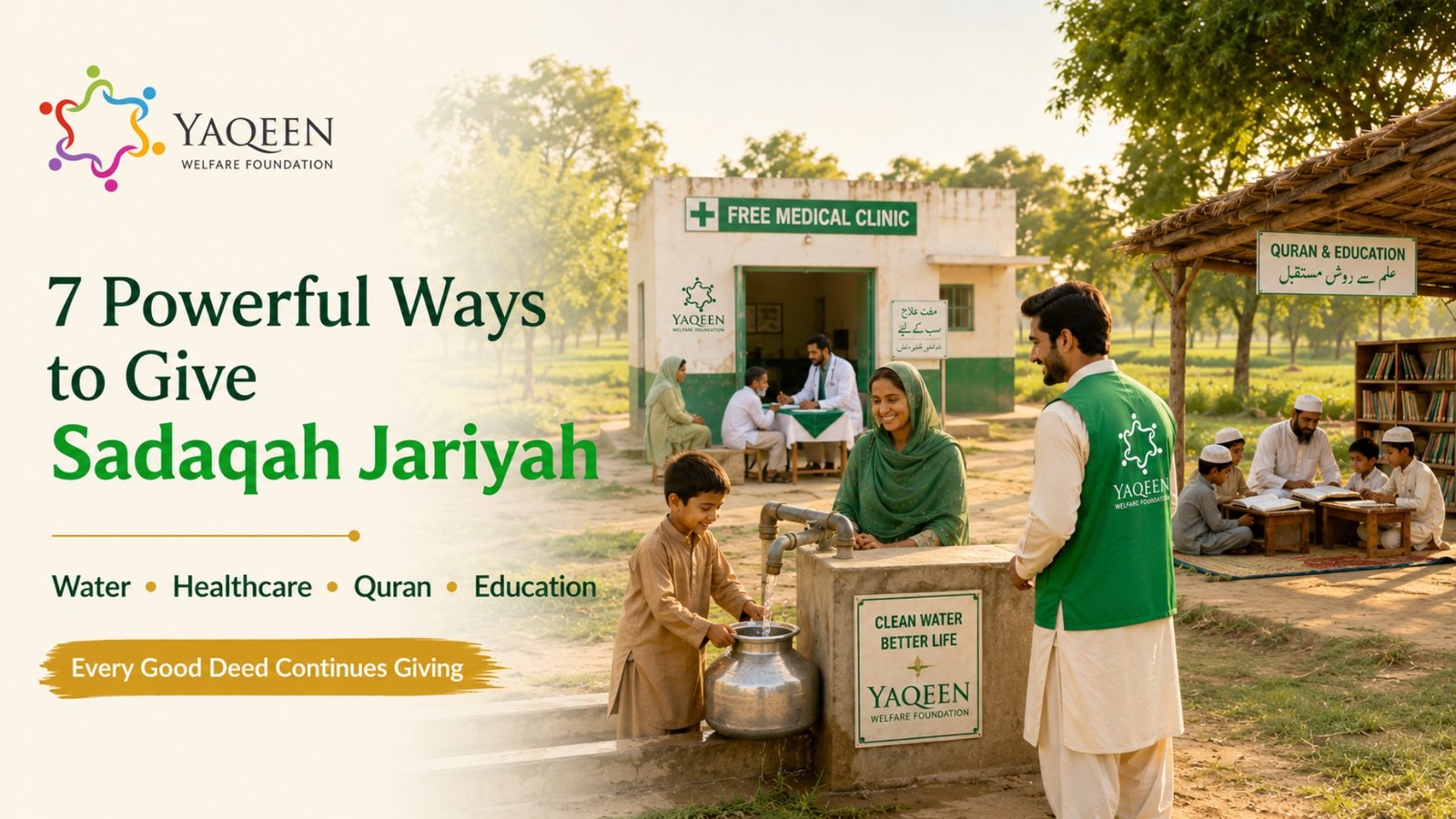
7 Powerful Ways to Give Sadaqah Jariyah Today
Not every act of ongoing charity looks the same. Some require significant funding, while others can be started with a modest, recurring contribution. Here are seven of the most impactful and widely recommended ways to give.
1. Fund a Water Well
A water well is often described as the single best form of Sadaqah Jariyah because it directly mirrors the Prophet’s ﷺ own description of giving water to drink as the best charity. A well can serve a village for 20 to 30 years or more, and every time someone drinks, cooks, or performs wudu with that water, the reward reaches the donor. Yaqeen Welfare Foundation covers this in detail in 5 Reasons a Water Well Is the Best Sadaqah Jariyah, which walks through the hadith evidence and real impact of well-building projects in rural Pakistan.
2. Support a Free Medical Clinic
Funding medical treatment for people who cannot otherwise afford it is a living, breathing form of ongoing charity — every diagnosis made, every prescription filled, and every life saved because a clinic existed adds to the donor’s ongoing reward. Yaqeen Welfare Foundation’s clinics treat a wide range of conditions every single day, something explored further in 9 Diseases Free Clinics in Pakistan Help Treat Every Day.
3. Donate a Quran or Islamic Literature
A Quran placed in a mosque or madrasa can be read by dozens, even hundreds, of people over its lifetime. Every recitation from that copy is credited, in part, to the person who funded it. This is one of the simplest and most affordable entry points into this type of giving, and many donors choose to fund multiple copies in memory of a loved one.
4. Sponsor an Orphan’s Education
Education is a form of ongoing charity that compounds. A child who learns to read because of your sponsorship may go on to teach others, support their own family, and contribute to their community for decades — a ripple effect that keeps expanding the original act of charity.
5. Build or Support a Mosque
Few projects carry the scale of reward that a mosque does. Every prayer performed inside it, for as long as it stands, becomes part of the donor’s ongoing account of good deeds. Because mosques often last well over a century, this is one of the clearest real-world examples of ongoing charity earning reward for 100 years or more.
6. Plant Trees or Fund Agricultural Projects
The Prophet ﷺ taught that when a Muslim plants a tree and anything eats from it — whether a person, animal, or bird — it counts as charity for the one who planted it. Trees can bear fruit and provide shade for generations, quietly generating reward the entire time.
7. Contribute to a Recurring Charity Fund
For donors who can’t fund an entire well or clinic on their own, giving smaller, recurring amounts toward an ongoing charity fund — like those pooled by Yaqeen Welfare Foundation — allows several people to jointly “own” the reward of a shared, ongoing project. It’s an accessible way to be part of something lasting without needing significant upfront wealth.
Comparing the Most Common Sadaqah Jariyah Options
Choosing where to direct your giving often comes down to lifespan of benefit, how many people it reaches, and cost. Here’s a quick comparison to help guide the decision:
| Sadaqah Jariyah Type | Typical Lifespan of Benefit | People Reached | Relative Cost |
|---|---|---|---|
| Water Well | 20–30+ years | 100–250+ per well | Low–Moderate |
| Free Medical Clinic Support | Ongoing, daily impact | Hundreds per month | Moderate–High |
| Quran / Literature Donation | 10–20 years per copy | Dozens of readers | Very Low |
| Orphan Education Sponsorship | Full schooling period | 1 child, wider family ripple | Moderate |
| Mosque Construction/Support | Decades to 100+ years | Hundreds to thousands | High |
| Tree Plantation | 15–40+ years | Local community/environment | Very Low |
| Recurring Charity Fund | Depends on pooled project | Shared across many | Flexible/Low entry |
As the table shows, there is no single “correct” way to give — the right choice depends on your budget and what kind of long-term impact you want your name attached to. Many donors choose to combine two or three of these approaches over time, building a portfolio of ongoing charity rather than relying on just one project.
How Yaqeen Welfare Foundation Turns Sadaqah Jariyah Into Real Impact
Yaqeen Welfare Foundation exists to provide free medical treatment, clean water, and essential humanitarian assistance to underserved communities across Pakistan. Every project — whether a well, a clinic visit, or a food distribution — is treated as an amanah (a trust) that must reach the people who need it most, and this kind of ongoing charity sits at the heart of how that mission is funded.
When you give Sadaqah Jariyah through Yaqeen, field teams identify communities with the greatest need, whether that’s a village with no safe water source or a district with no accessible medical care. The project is then built or delivered, and outcomes are documented so donors can see exactly where their charity went. This same spirit of transparency and lasting impact runs through many of the foundation’s stories, including Your Charity Saved Lives: 8 Heartwarming Stories and One Meal, One Prayer: 5 Incredible Reasons One Life Changed Forever, both of which show how a single act of giving continues to ripple outward long after the initial donation.
The foundation’s broader philosophy on charity — that even small, consistent acts carry lasting spiritual weight — is explored further in posts like The Charity You Forgot About: 7 Rewards Allah Never Forgets and 9 Ways Charity Softens the Heart and Changes the Soul, both worth reading if you want a deeper understanding of why Sadaqah Jariyah is so highly recommended in Islamic tradition.
Sadaqah Jariyah vs. Zakat: Don’t Confuse the Two
A common question donors ask is whether this kind of ongoing giving can replace Zakat. It cannot. Zakat is an obligatory annual payment calculated on a Muslim’s eligible wealth once it exceeds the nisab threshold, while Sadaqah Jariyah is a voluntary act that can be given at any time, in any amount, toward any lasting project. The two operate on completely different rulings, and understanding the distinction matters for anyone trying to fulfill their religious obligations correctly. For a full breakdown, see Sadaqah vs. Zakat: 6 Key Differences Every Muslim Should Know, and if you’re unsure whether you owe Zakat this year, Yaqeen’s Zakat Calculator can help you work it out before deciding how much additional Sadaqah Jariyah you’d like to give.
It’s also worth checking your figures carefully, since miscalculating Zakat is more common than most people realize — a topic covered in 7 Mistakes People Make When Calculating Zakat.
The Real-World Case for Giving Water, Health, and Aid Today
According to the World Health Organization’s fact sheet on drinking water, unsafe water and inadequate sanitation remain a leading cause of preventable illness and death among children under five worldwide. In many rural districts of Pakistan, this isn’t an abstract statistic — it’s daily life. Women and children often walk hours to fetch water from unsafe sources, and preventable diseases spread easily where clean water and basic medical care are out of reach.
This is precisely why ongoing charity given toward wells, clinics, and community aid produces such visible, measurable impact. It isn’t only a spiritual investment for the Hereafter — it’s a direct intervention that reduces suffering in this life, today, for real families. According to UNICEF’s overview of its water, sanitation and hygiene (WASH) programmes, children under five remain especially vulnerable to death from diseases linked to unsafe water, and closing that gap through improved WASH access has ripple effects across health, education, and household stability — underscoring how a single well can quietly transform a community’s future for generations.
Who Can Give Sadaqah Jariyah — and How Much Is Needed?
One of the most common misconceptions about this kind of giving is that it requires significant wealth. It doesn’t. Islamic teaching emphasizes intention and consistency over size — even a small, steady contribution toward a shared well or clinic fund carries real reward. Most donors choose one of the following paths:
- Fund an entire project individually — ideal for those who want a complete, dedicated well, clinic sponsorship, or Quran distribution, often given in memory of a parent or loved one.
- Split a project with family or friends — several relatives pool funds together, frequently as a joint reward project during Ramadan or on behalf of someone who has passed away.
- Give a smaller, recurring amount — some donors prefer to contribute monthly toward a larger Sadaqah Jariyah fund, allowing the reward to build gradually over time.
Whichever path you choose, the underlying principle stays the same: Sadaqah Jariyah is measured by lasting benefit, not by the size of the initial gift.
How to Start Your Sadaqah Jariyah Today
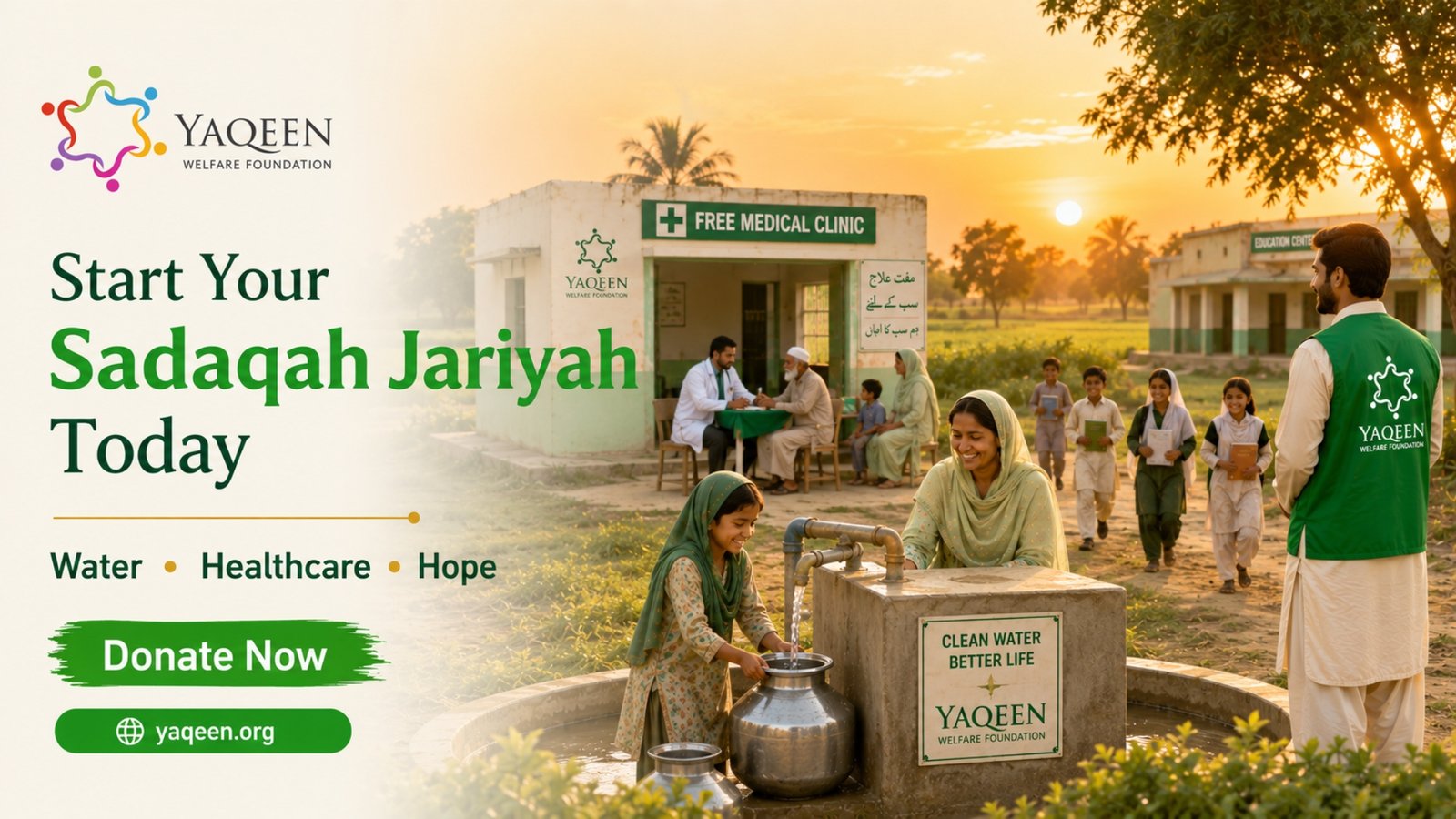
Starting is simpler than most people expect. You can donate directly through Yaqeen Welfare Foundation toward a water well, a clinic sponsorship, or a general Sadaqah Jariyah fund, and choose whether to give it in your own name or in memory of a loved one. If you’d like to ask questions first — about current project costs, timelines, or which community your donation would support — you can contact Yaqeen Welfare Foundation online before giving.
Frequently Asked Questions About Sadaqah Jariyah
What is the difference between Sadaqah and Sadaqah Jariyah?
Sadaqah is any act of voluntary charity, including a one-time gift like cash or a meal. Sadaqah Jariyah is a specific category of Sadaqah whose benefit continues over time — such as a well, a mosque, or a scholarship — and whose reward keeps reaching the donor for as long as the project keeps helping people.
Does Sadaqah Jariyah really earn reward for 100 years?
There’s no fixed hadith figure of exactly 100 years, but many real projects — wells, mosques, endowed land — genuinely last a century or longer, and Islamic teaching holds that reward continues for as long as the benefit continues. The “100 years” framing reflects how long-lasting these projects can realistically be, not a literal scriptural limit.
Can I give Sadaqah Jariyah on behalf of a deceased parent or relative?
Yes. Giving Sadaqah Jariyah on behalf of someone who has passed away is a well-established and encouraged practice. Many families choose to fund a well, a clinic sponsorship, or a Quran donation specifically in a loved one’s name as a lasting legacy of good deeds.
How much does it cost to start a Sadaqah Jariyah project with Yaqeen Welfare Foundation?
Costs vary depending on the type of project — a hand pump well costs less than a deeper bore well, and clinic sponsorships vary by scope. You can view current project details on the donation page or reach out directly for the latest figures.
Is Sadaqah Jariyah the same as Waqf?
They are closely related. Waqf refers specifically to an endowment — an asset permanently dedicated for public benefit, such as land or a building. Sadaqah Jariyah is the broader Islamic concept of ongoing charity, and Waqf is considered one of its most formal and enduring expressions.
Where can I read more stories about the impact of Sadaqah Jariyah?
You can browse more real accounts of how ongoing charity has changed lives in posts such as 7 Signs A Simple Donation, Village Needs Your Help and 7 Blessings of Helping a Stranger for the Sake of Allah on the Yaqeen Welfare Foundation blog.