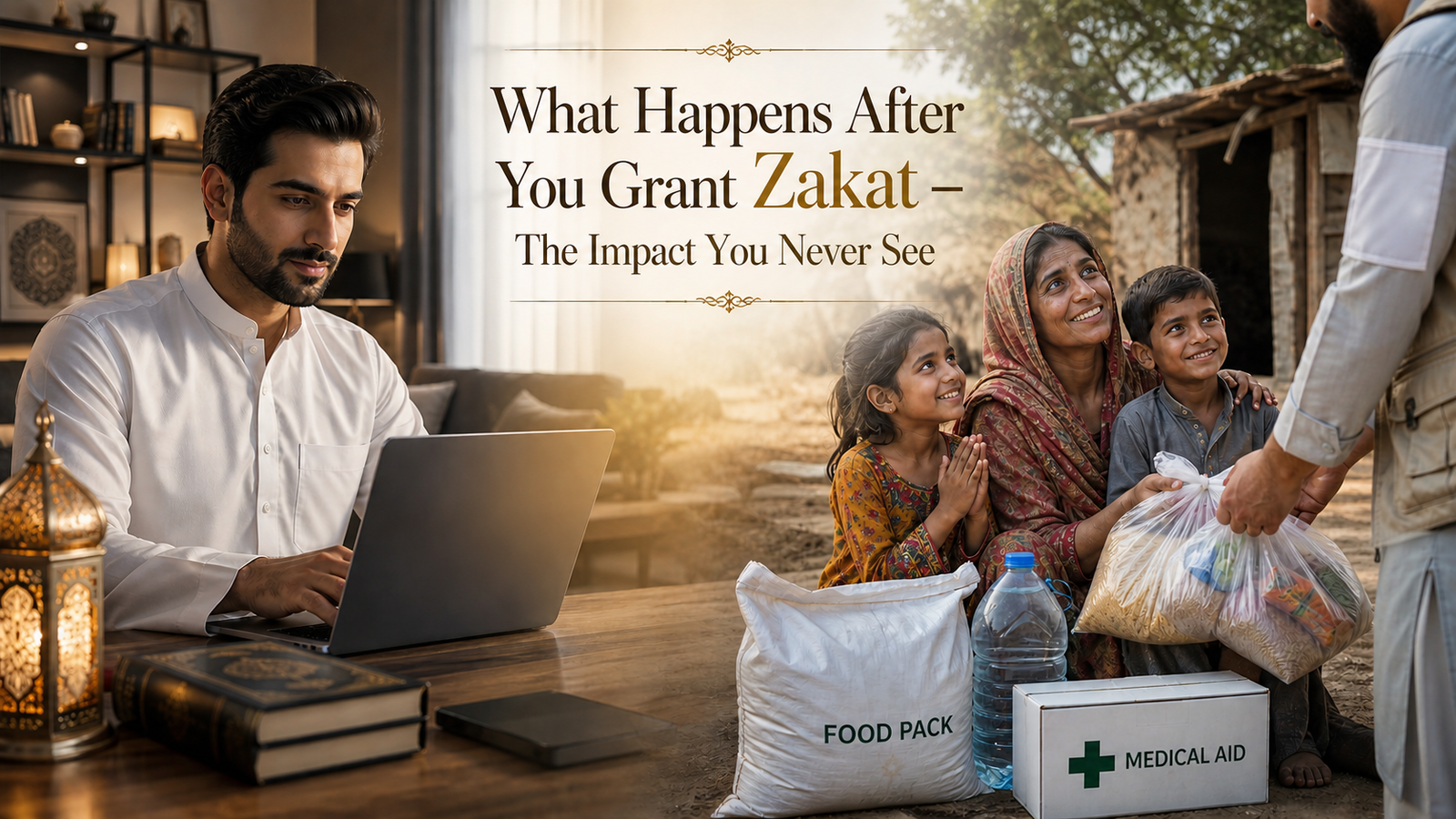
Understanding Zakat is one of the most important responsibilities a Muslim can undertake — not merely as a religious formality, but as a living, breathing act of justice that connects the prosperous to the vulnerable in ways that ripple across generations. Zakat is not charity in the conventional sense. It is a divinely mandated redistribution of wealth, a recognition encoded in Islamic law that the poor carry an inherent right over the surplus of the rich. Before you calculate a number and transfer a sum, it helps to understand what Zakat truly is, why it exists, and what it sets in motion when it leaves your hands.
At Yaqeen Welfare Foundation, we have had the privilege of witnessing something most donors never see — the transformation that unfolds on the other side of a commitment. We see it in families who can finally afford medication, in children eating a proper meal for the first time in days, and in the quiet dignity restored to those the world had forgotten. This guide is your complete resource for understanding Zakat: its sacred foundation, the rules of calculation, the people it reaches, and the unseen effects it produces long after the moment of giving has passed.
The Sacred Foundation: What Zakat Means in Islam
The word Zakat comes from the Arabic root z-k-w, which carries meanings of growth, increase, and purification. This is not accidental. Zakat is not described in the Quran as a tax, a donation, or even a gift — it is described as purification. The act of releasing a portion of your wealth does not diminish you. It cleanses you.
Allah (SWT) commands in the Quran:
“Take from their wealth a portion as charity, purifying them and cleansing them thereby, and pray for them.” — Surah At-Tawbah, 9:103
As one of the Five Pillars of Islam, Zakat stands alongside the Shahada, Salah, Sawm, and Hajj as a non-negotiable pillar of the faith. It is obligatory for every sane, adult Muslim whose accumulated wealth meets or exceeds the Nisab threshold and has remained at or above that threshold for a full lunar year. Once those conditions are satisfied, 2.5% of eligible wealth becomes due — not as a favor to the needy, but as their lawful share.
Historically, Zakat operated as a robust economic safety net across Muslim societies. During the caliphate of Umar ibn Abd al-Aziz, collectors reportedly returned from certain regions unable to find eligible recipients — a testament to what systematic, faith-driven wealth redistribution can achieve when implemented with integrity and care. This was not coincidence. It was the result of a principle applied with commitment.
Understanding Zakat in this historical context reveals something profound: this institution has the power to eliminate poverty entirely, not just reduce it. The question is not whether Zakat works. The question is whether we give it fully, calculate it honestly, and direct it wisely.
Who Is Required to Pay Zakat?
Zakat becomes obligatory when three conditions are met:
1. Minimum Wealth Threshold (Nisab) Your total zakatable wealth must equal or exceed the Nisab — currently calculated based on the market value of either 87.48 grams of gold or 612.36 grams of silver. Most scholars recommend using the silver Nisab, as it is the lower threshold and therefore more inclusive.
2. Full Lunar Year (Hawl) Your wealth must have remained at or above the Nisab for a complete lunar year. Wealth that comes and goes below the threshold within the year is not subject to Zakat.
3. Full Ownership The wealth must be in your complete ownership — not borrowed, not pledged, not legally encumbered. You must have both physical possession and free disposal of the assets.
If all three conditions are met, Zakat is not optional. Withholding it is not simply a lapse in generosity; it is a failure to fulfill a divine obligation.
How to Calculate Zakat: A Step-by-Step Guide
Understanding Zakat calculation removes the uncertainty that prevents many Muslims from giving the correct amount. The process is straightforward when broken down clearly.
Step 1 — Determine Your Zakatable Assets
Not all assets qualify. The following categories are subject to Zakat:
| Asset Category | What to Include | Rate |
|---|---|---|
| Cash & Savings | Current accounts, savings accounts, cash on hand | 2.5% |
| Gold & Silver | Jewellery, bullion, coins held as wealth | 2.5% |
| Investment Holdings | Stocks, rental income, business dividends | 2.5% |
| Business Inventory | Goods held for commercial sale | 2.5% |
| Outstanding Loans | Money lent to others expected to be returned | 2.5% |
| Exempt Assets | Primary home, personal vehicle, clothing, household items | Exempt |
Step 2 — Check Against the Nisab
Add up all your zakatable assets. If the total equals or exceeds the Nisab value, you proceed to calculation. If it falls below, no Zakat is due for that year.
Step 3 — Apply the 2.5% Rate
Zakat is calculated at a fixed rate of 2.5% — one-fortieth of your qualifying wealth. If your total zakatable assets amount to, for example, $20,000, your Zakat due would be $500.
You can use the Yaqeen Welfare Foundation Zakat Calculator for a quick and accurate calculation tailored to current Nisab values.
One important note: scholars differ on whether gold jewellery worn regularly for personal use is zakatable. If you are uncertain about any specific asset, consult a trusted Islamic scholar for guidance specific to your situation.
The Eight Categories of Zakat Recipients
The Quran specifies in Surah At-Tawbah (9:60) exactly who is entitled to receive Zakat. These are not general guidelines — they are divine designations:
Al-Fuqara (The Deeply Impoverished) — Those who possess less than the Nisab and struggle to meet even the most basic necessities of life. These are people living in severe, ongoing deprivation.
Al-Masakeen (The Poor) — Those who have some income or assets but still cannot adequately cover their needs. They may be working but remain in hardship.
Al-Amileen (Zakat Administrators) — Those who collect, manage, and distribute Zakat. Their compensation from Zakat funds ensures the system operates with integrity.
Al-Muallafatu Qulubuhum (Those Whose Hearts Are to Be Reconciled) — New Muslims or those whose faith or goodwill toward the community may be strengthened through support.
Fi Al-Riqab (Freeing the Enslaved) — In the modern context, this extends to those trapped in forms of bondage, trafficking, or forced labour.
Al-Gharimeen (Those in Debt) — Individuals burdened by debt they have no means to repay, provided the debt was not incurred for sinful purposes.
Fi Sabilillah (In the Cause of Allah) — Resources directed toward the promotion of Islam and the welfare of the Muslim community, including education and community development.
Ibn Al-Sabil (The Stranded Traveller) — Those who are far from home and without access to their resources, including, in the modern context, refugees and displaced families.
At Yaqeen Welfare Foundation, our programs are specifically structured to serve these eight categories — ensuring that every rupee of Zakat reaches those who are divinely entitled to receive it.
The Journey Your Zakat Takes: From Your Hands to Real Lives
When you give Zakat through a trustworthy organisation, it does not sit idle. At Yaqeen Welfare Foundation, we channel every contribution directly into programs that address the most acute forms of suffering in underserved communities across Pakistan.
Free Healthcare Through the Yaqeen Indus Health Clinic
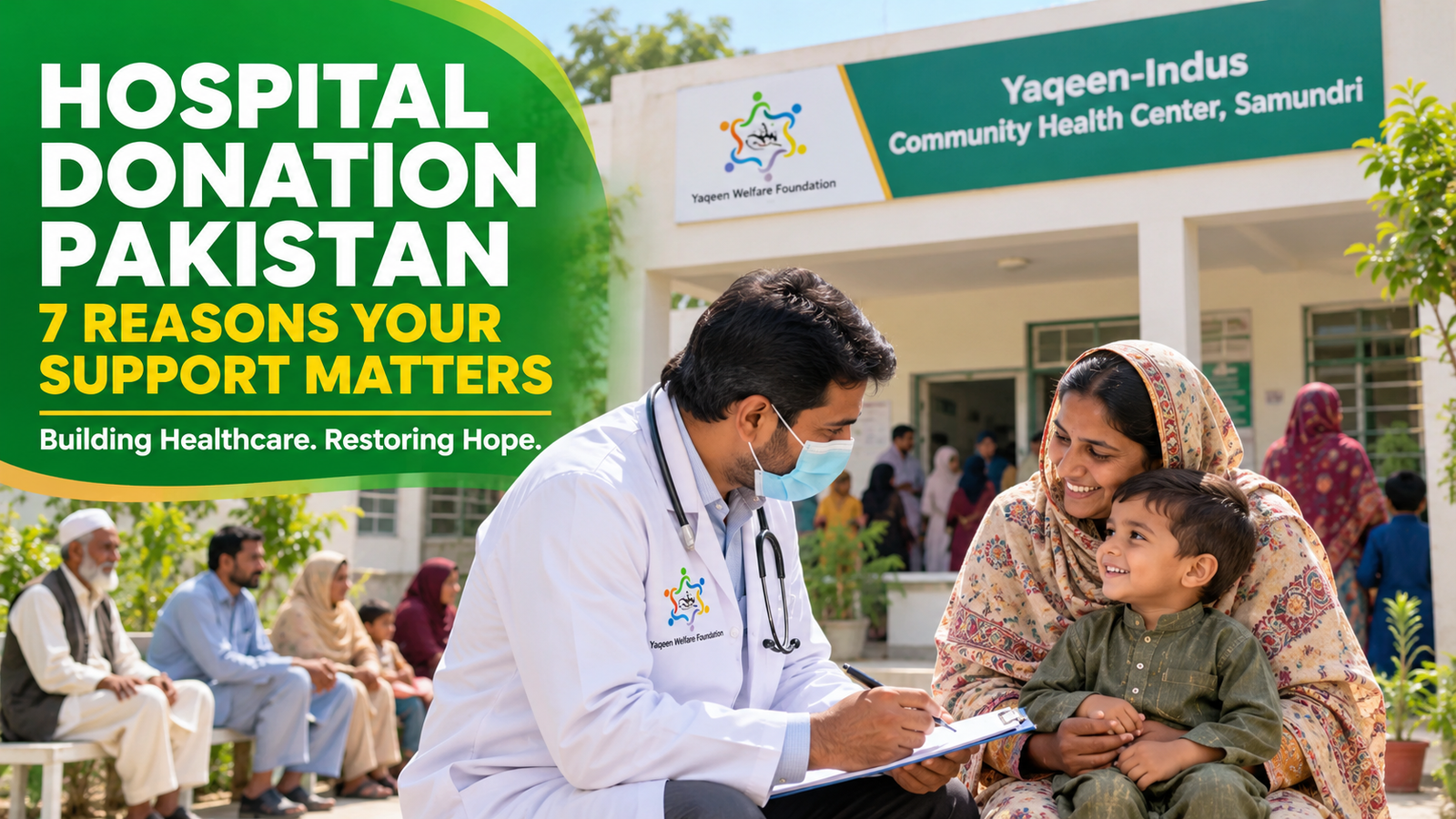
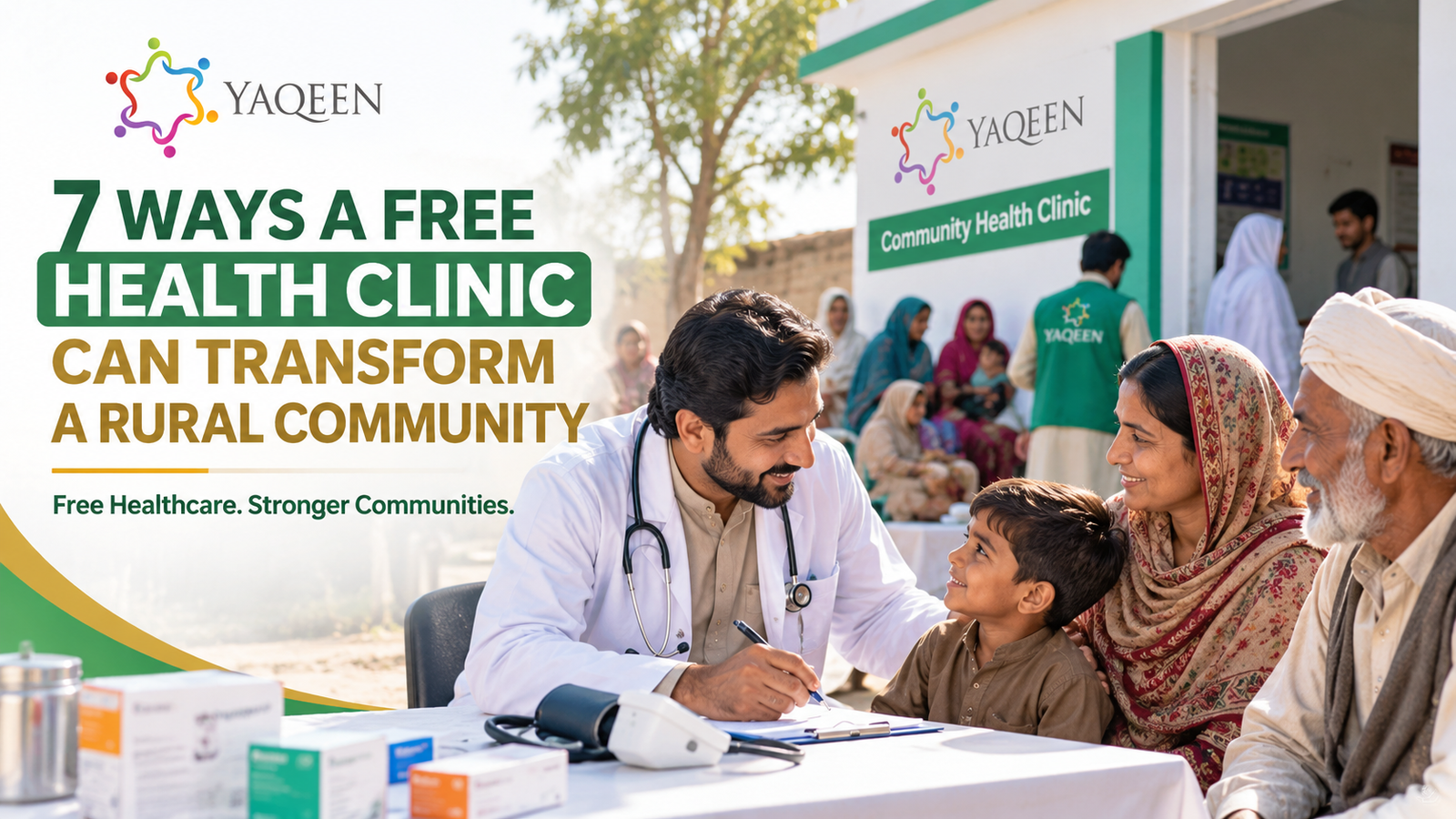
Illness should not be a death sentence for those without financial means. Through the Yaqeen Indus Health Clinic, your Zakat funds free consultations, prescription medication, and diagnostic care for patients who would otherwise go untreated. For many of these individuals, this clinic is the only healthcare they have ever accessed in their lives. When you give Zakat, you are directly funding the moment a mother learns her child’s illness has a treatment — and that she can afford it.
For more on the state of healthcare access and why infrastructure matters, read: Building a Future for Free Healthcare: Why Modern Infrastructure is the Key to Healing Pakistan
Nutritional Support for Struggling Families
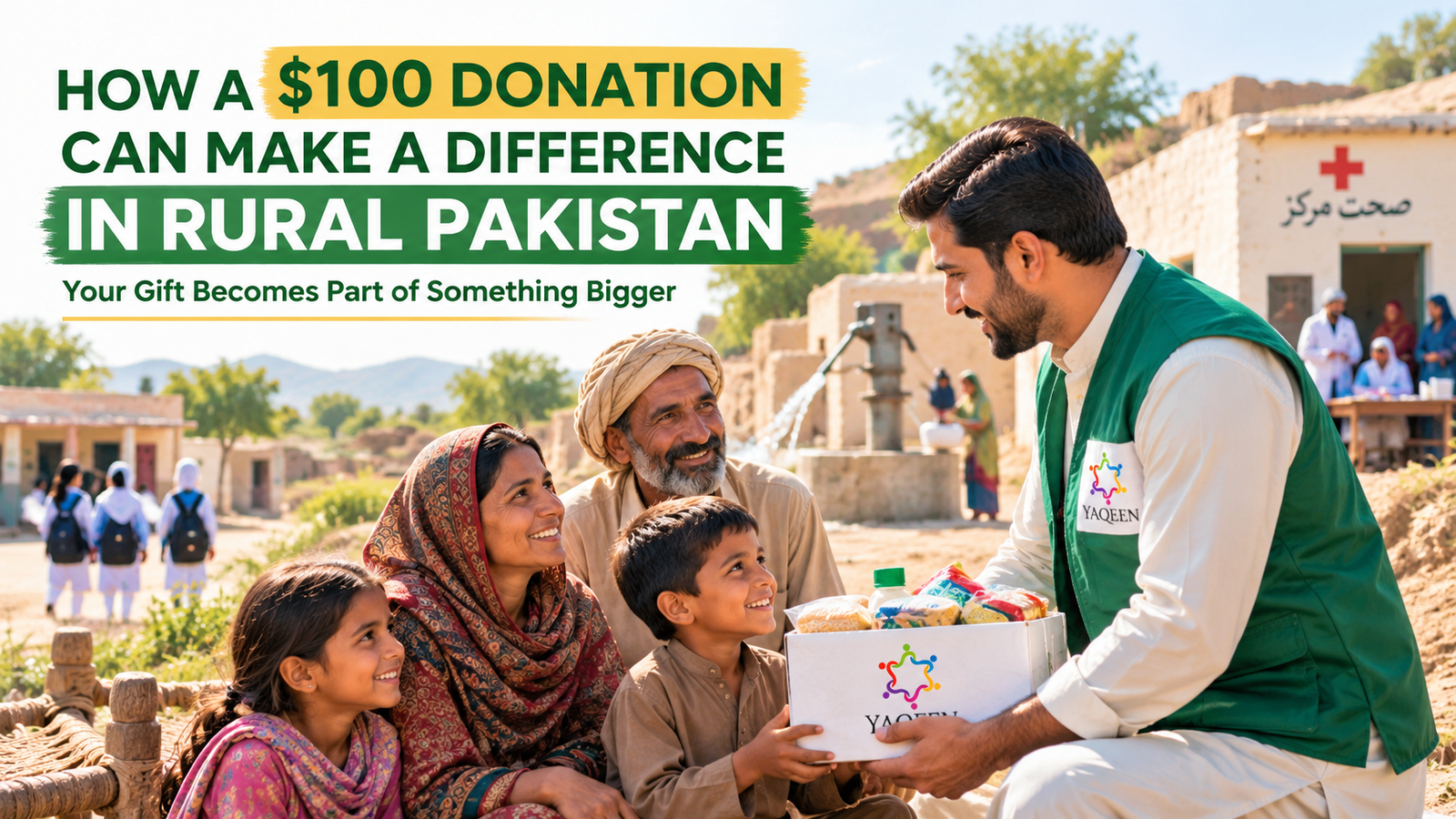
Hunger rarely makes headlines, yet it is a quiet daily crisis in countless homes. Monthly food packages are assembled and delivered to families navigating debt crises, sudden job loss, or the aftermath of natural disasters. These packages do not merely fill stomachs — they remove one crushing anxiety from an already overwhelmed household, creating space for stability and recovery.
Clean Water Infrastructure in Rural Communities
Access to clean drinking water should not be a privilege. In remote villages where contaminated water sources cause recurring illness — particularly among children — Zakat funds the construction of lasting water solutions: hand pumps, filtration systems, and community wells that serve entire neighbourhoods for years to come. To understand more about this critical need, explore: Water Well Donation in Pakistan: Give Clean Water & Save Lives
Emergency Support for Displaced Families
War, persecution, and climate disasters have left millions without homes, livelihoods, or stability. Refugee families receiving support through Yaqeen Welfare Foundation have often lost everything. Your Zakat helps restore the basics — shelter, food, and documentation assistance — so that families can begin rebuilding their lives from the ground up.
Understanding Zakat vs. Sadaqah: What Is the Difference?
While Zakat is obligatory, Islam also strongly encourages voluntary giving in the form of Sadaqah. The two are complementary but distinct:
Zakat is mandatory, calculated precisely, due annually, and restricted to the eight categories defined in the Quran. It purifies the specific portion of wealth that has accumulated over the year.
Sadaqah is voluntary, given in any amount at any time, and can be extended to anyone in need regardless of faith. Even a smile is described as Sadaqah in the hadith.
The importance of giving regularly and thoughtfully — in all its forms — is explored in depth in: Best Times and Methods for Giving Sadaqah in Islam
And if you have ever wondered whether your giving is accepted, the signs may be more visible than you think: When Allah Acknowledges Your Charity – Signs You Should Never Ignore
Understanding Zakat al-Fitr: A Separate Obligation
Zakat al-Fitr is a distinct end-of-Ramadan charity, traditionally given in the form of staple food or its monetary equivalent, with the purpose of purifying one’s fast and ensuring that the poor can celebrate Eid with dignity. It is obligatory for every Muslim who has food beyond their immediate needs on the night of Eid al-Fitr, and it must be given before the Eid prayer.
It is not the same as annual Zakat and is not calculated based on wealth thresholds. Use the Fitrana Calculator on our website to determine your Zakat al-Fitr obligation quickly and accurately.
The Ripple You Will Never Fully See
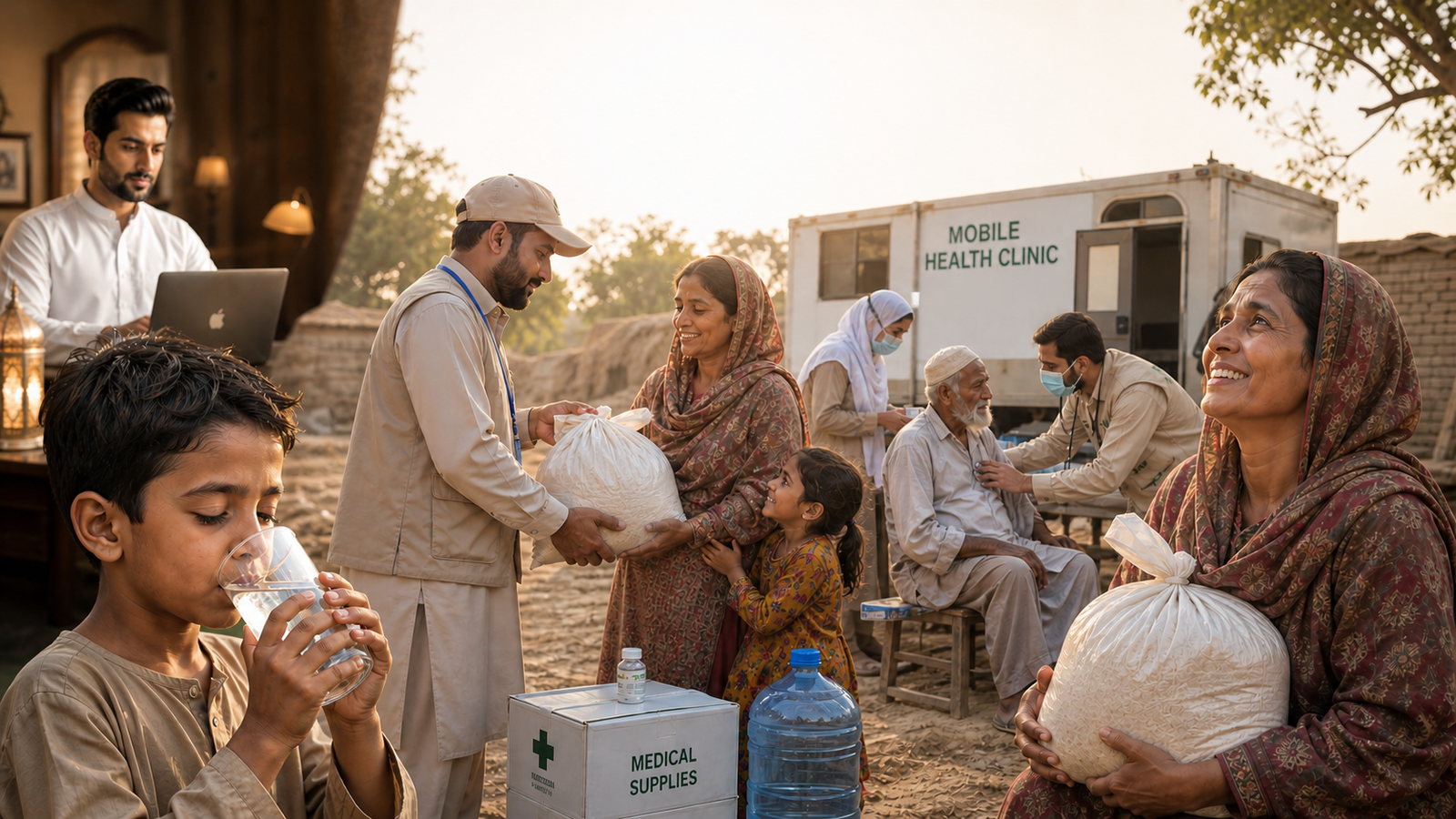
There is a quiet paradox at the heart of Zakat: the person who gives rarely witnesses the full depth of what their giving sets in motion. You will likely never sit across from the mother whose child recovered from illness because your contribution covered her clinic visit. You will not hear the relief in the voice of the man who ate properly for the first time in a week because of a food package assembled with your funds.
But the Prophet ﷺ gave us this assurance:
“Charity does not diminish wealth.”
What leaves your hand in the way of Allah returns multiplied — not always in the ways the world measures, but in Barakah, in protection, in the subtle blessings that quietly steady a life.
The 2.5% you release feels small in the moment. But downstream, it compounds. It moves through families, communities, and generations. A child who grows up healthy because her water source was clean will one day raise her own children in health. A young man who received emergency support during a crisis will stabilise, contribute, and perhaps one day extend a hand to someone else in need. Your single act of Zakat does not stop moving.
This is why the act of giving — in every form — carries such weight in Islam. As explored in The Day Your Charity Talks for You – A Reminder for Every Muslim, there will come a moment when every act of giving speaks on your behalf. And in The Blessings of Helping Poor – More Than You Imagine, you will discover that the return on this investment is unlike anything the world can offer.
Why Choose Yaqeen Welfare Foundation for Your Zakat?
When you entrust your Zakat to an organisation, you are not simply donating — you are delegating a divine obligation. The choice of where that Zakat goes matters enormously, both in terms of earthly impact and spiritual validity.
Yaqeen Welfare Foundation was founded by physicians and professionals who carry a personal connection to the communities they serve. Our team on the ground in Pakistan operates with full accountability, directing resources to verified recipients across the eight Quranic categories. We do not create dependency — we build capacity. We do not offer charity as a transaction — we offer it as a trust.
Whether your Zakat funds a child’s first proper meal, a grandmother’s first clinic visit, or a family’s first clean glass of water, it is placed with care, given with intention, and delivered with accountability.
You can also read more about how giving reaches people through our Donation Center for Online Sadaqah & Free Healthcare — and why the smallest act can alter a destiny, as explored in From Your Hands to Their Lives – How Gifts Alter Destinies.
Give Your Zakat Today
May Allah accept your worship, purify your wealth, and return to you — and those you love — more than you could calculate. Ameen.
Frequently Asked Questions About Zakat
What exactly is Nisab?
Nisab is the minimum threshold of wealth that makes Zakat obligatory. It is currently calculated based on the market value of either 87.48 grams of gold or 612.36 grams of silver. Most scholars recommend using the silver Nisab, as it is lower and therefore more inclusive. If your total zakatable wealth equals or exceeds this value and has done so for a full lunar year, you are obligated to give. Use our Zakat Calculator to check your exact obligation.
Who qualifies to receive Zakat?
The Quran identifies eight categories of recipients in Surah At-Tawbah (9:60): the deeply destitute (Fuqara), those who struggle to meet basic needs (Masakeen), individuals drowning in debt with no means to repay, stranded travellers, those working in Zakat administration, and those in the cause of Allah. In the modern context, refugees and displaced persons often fall within several of these categories simultaneously.
Is Zakat al-Fitr the same as annual Zakat?
No — they are distinct obligations. Zakat al-Fitr is a specific end-of-Ramadan charity given in the form of staple food or its monetary equivalent, intended to purify one’s fast and ensure that the poor can celebrate Eid. It must be given before the Eid prayer and is obligatory for every Muslim who has food beyond their immediate needs. Annual Zakat, by contrast, is calculated on accumulated wealth and is due once a year based on the Nisab threshold. Use our Fitrana Calculator for Zakat al-Fitr.
Can Zakat be given to non-Muslims?
The majority scholarly opinion holds that obligatory Zakat should be directed toward Muslim recipients, particularly those in the categories mentioned in the Quran. However, voluntary charity (Sadaqah) carries no such restriction and can be extended to anyone in need, regardless of faith.
How do I know my Zakat is being used correctly?
At Yaqeen Welfare Foundation, full accountability governs how every contribution is managed and distributed. Our programs are aligned with the eight Quranic categories of Zakat recipients, and we operate with complete transparency. If you have specific questions about how your Zakat is used, we welcome the conversation.
Can I give Zakat in instalments throughout the year?
Yes. While Zakat technically becomes due at the completion of the lunar year, many scholars permit spreading payments across the year provided the full amount is given before the annual due date. This approach often makes giving more manageable without reducing the total obligation.
What if I missed paying Zakat in previous years?
If you missed Zakat in prior years, you are responsible for calculating and paying the outstanding amount for each year you fell short. There is no expiry on this obligation. Calculate the amount owed for each missed year based on your wealth at that time and give it as soon as possible.
Is gold jewellery subject to Zakat?
Scholars differ on this question. The majority position holds that gold jewellery worn regularly for personal use is not zakatable, while a minority view — including that of Imam Abu Hanifa — holds that it is. If you are uncertain, consult a trusted Islamic scholar familiar with your madhab.