Your donation free healthcare in Pakistan is not a slogan — it is a working pipeline that converts generosity into finished clinic walls, working diagnostic machines, and thousands of patients receiving care they could not otherwise afford. If you have ever wondered whether your contribution actually reaches the people who need it most, this article answers that question in full. We walk through the medical access crisis driving the need, the step-by-step journey of a donation from your account to a patient’s treatment, the specific services your money funds, and the Islamic giving framework that makes this one of the most spiritually meaningful ways to fulfill your religious obligations.
Why Donation-Funded Free Healthcare in Pakistan Is No Longer Optional
Pakistan faces a healthcare access emergency that public budgets alone cannot resolve. According to the World Health Organization, the country maintains approximately 1.09 doctors per 1,000 people — a ratio well below international standards and concentrated almost entirely in urban centers like Karachi, Lahore, and Islamabad. Rural Sindh, southern Punjab, and the more remote districts of Khyber Pakhtunkhwa receive a fraction of the medical workforce available in those cities.
Nearly half of Pakistan’s entire population lacks dependable access to basic primary healthcare. According to data from the World Bank’s health financing indicators (https://data.worldbank.org/indicator/SH.XPD.OOPC.CH.ZS), out-of-pocket spending dominates how Pakistani families pay for medical care — meaning that when someone gets sick, they either pay out of savings they often do not have, or they go without treatment entirely. Government clinics in underserved areas are frequently underfunded, understaffed, or simply absent.
This is the gap that your donation free healthcare in Pakistan steps into. Donor-funded clinics do not replace the government’s responsibility — they respond to a medical emergency that cannot wait for policy reform. The families currently going without care cannot pause their illnesses while systemic change catches up. They need a clinic now. That is what donations build.
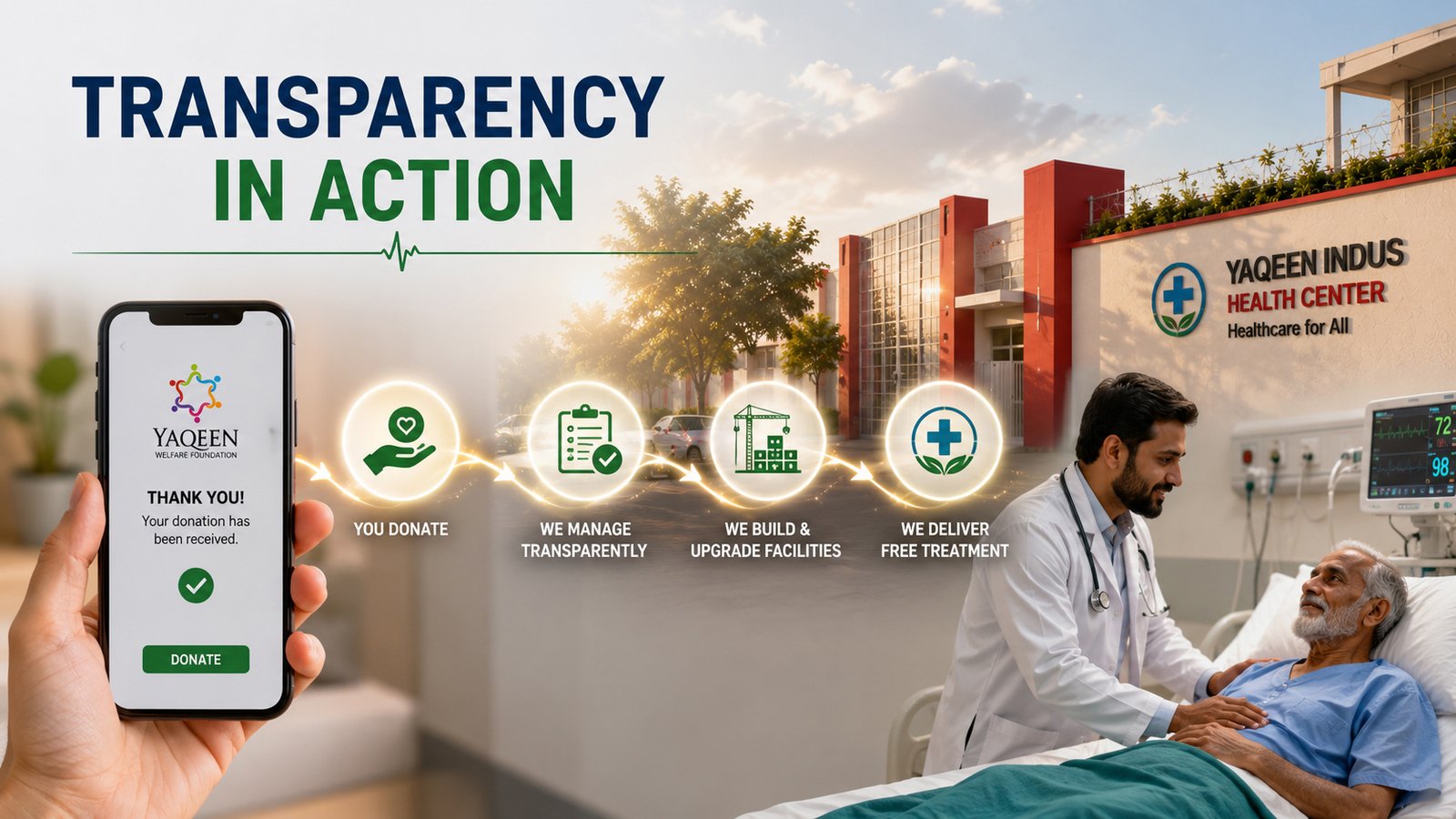 The Journey of Your Donation Free Healthcare in Pakistan: From Gift to Patient
Many donors assume their contribution disappears into a general fund once it leaves their account. In a well-run charitable model, the exact opposite is true. Every gift moves through a specific, traceable sequence from online transaction to finished medical outcome.
Step One: You Give Online
The process begins the moment you make a contribution through a secure digital platform. Donations can be one-time gifts, recurring monthly contributions, or structured giving tied to Islamic obligations like Zakat. The flexibility of the giving model is central to what makes donation-based free healthcare in Pakistan sustainable over the long term — it does not rely on a single annual fundraising drive, but on a continuous and diversified stream of contributions arriving at every scale.
Step Two: Construction and Equipment Procurement
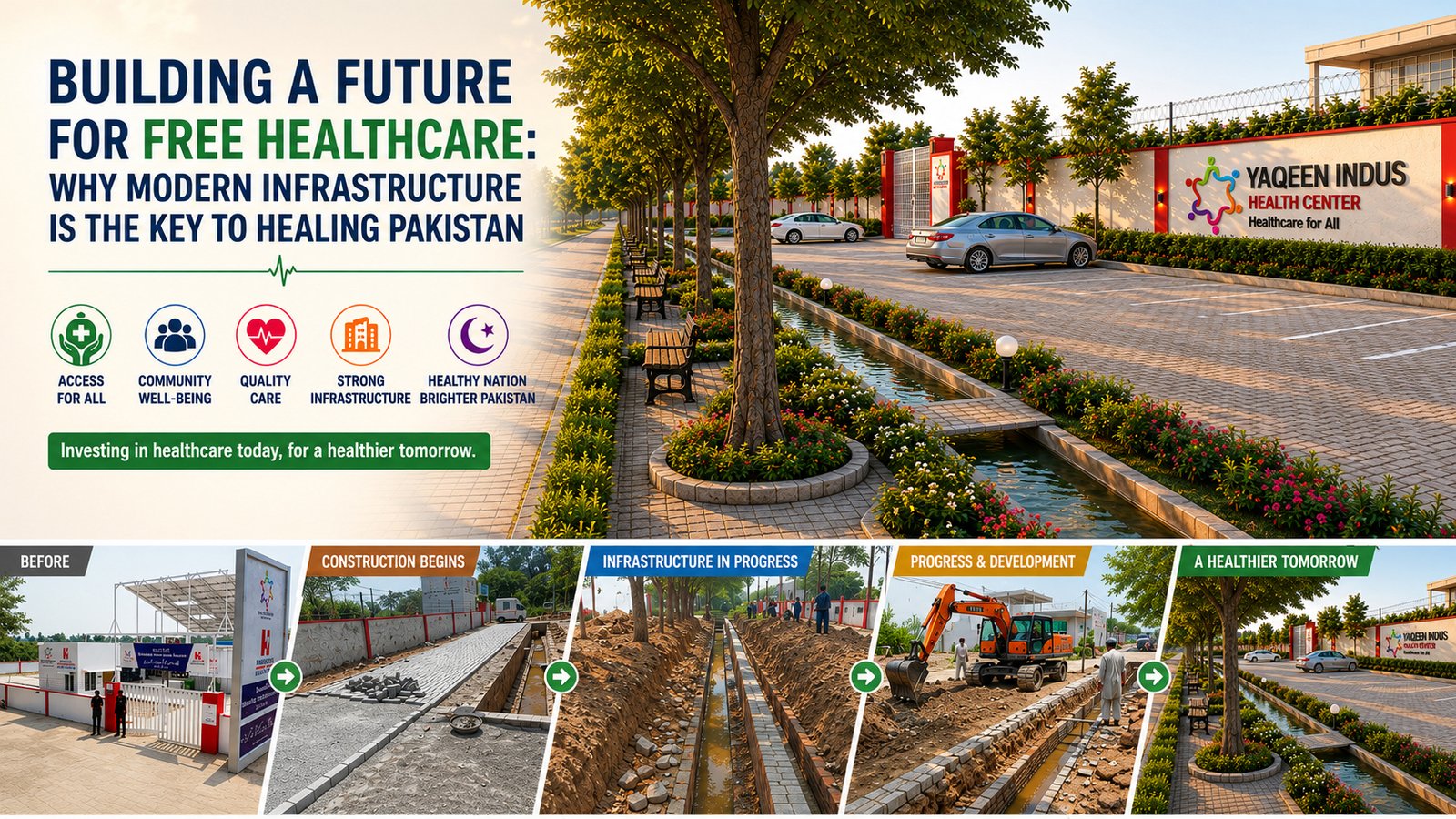
Once received, funds are directed toward verified facility construction, medical equipment procurement, and supply chain logistics. This is the stage where your donation physically becomes a building — foundations poured, walls raised, electrical and plumbing systems installed, diagnostic equipment delivered and calibrated. Strategic partnerships with established clinical networks like the Indus Hospital & Health Network compress overhead at this stage significantly. Shared procurement channels and existing logistics infrastructure mean a larger share of every donated rupee reaches the construction site rather than administrative costs.
Step Three: Patients Receive Free Care
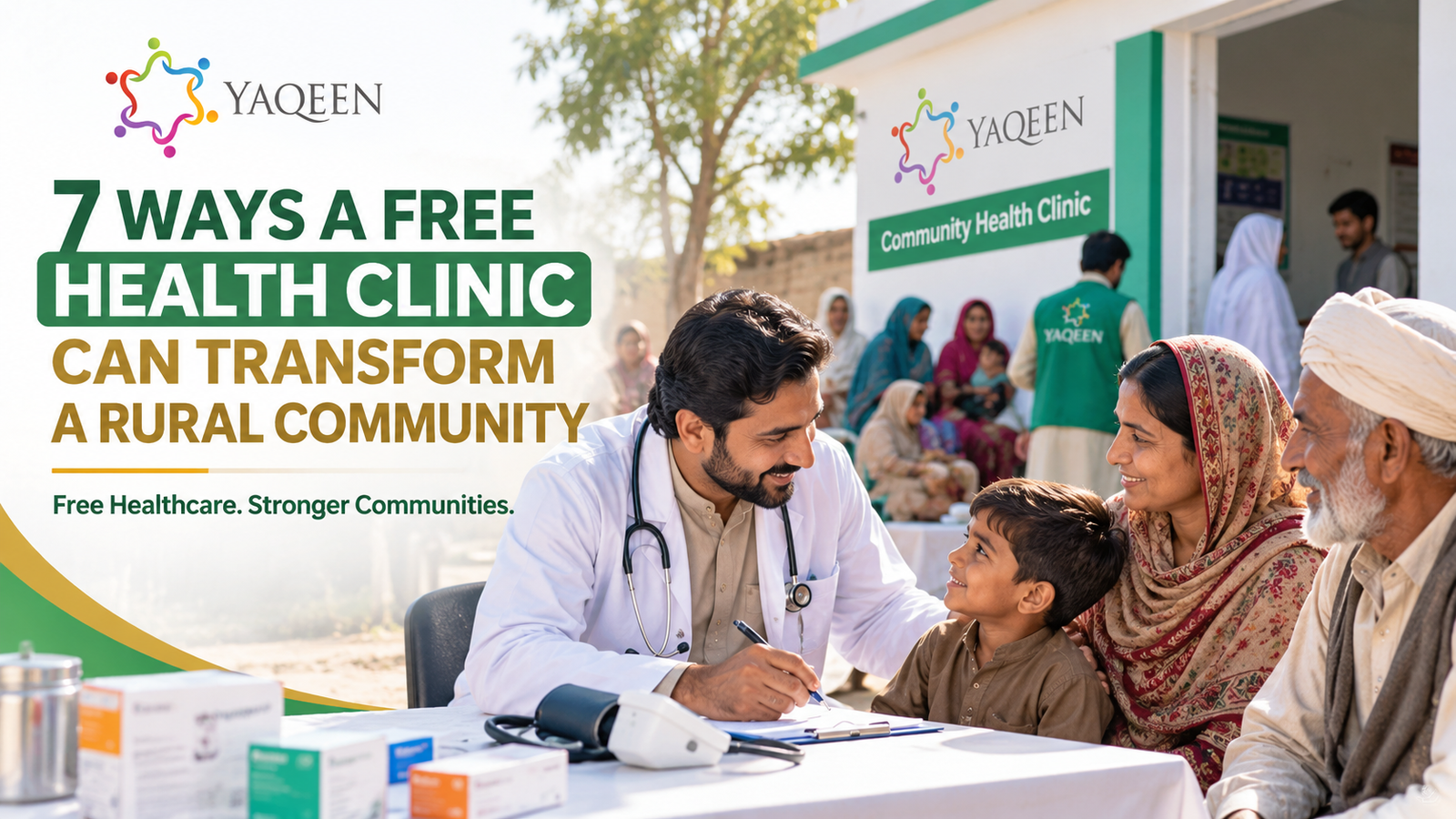
The final step is where your donation free healthcare in Pakistan becomes tangible for the families it was always intended to serve. A patient walks through the clinic’s door and receives a consultation, medication, immunization, or specialist referral — entirely free, with no co-pay, no registration fee, and no hidden charge. This is the moment the entire donation chain was built to produce, and it is repeated for thousands of patients every month once a facility is fully operational.
If you want to understand the specific digital tracking mechanisms that keep each transaction auditable from donor to patient, read our detailed guide: Donation Center for Online Sadaqah and Free Healthcare — How the Platform Works.
A Real Project Built on Donation Free Healthcare in Pakistan: Samundri, Faisalabad
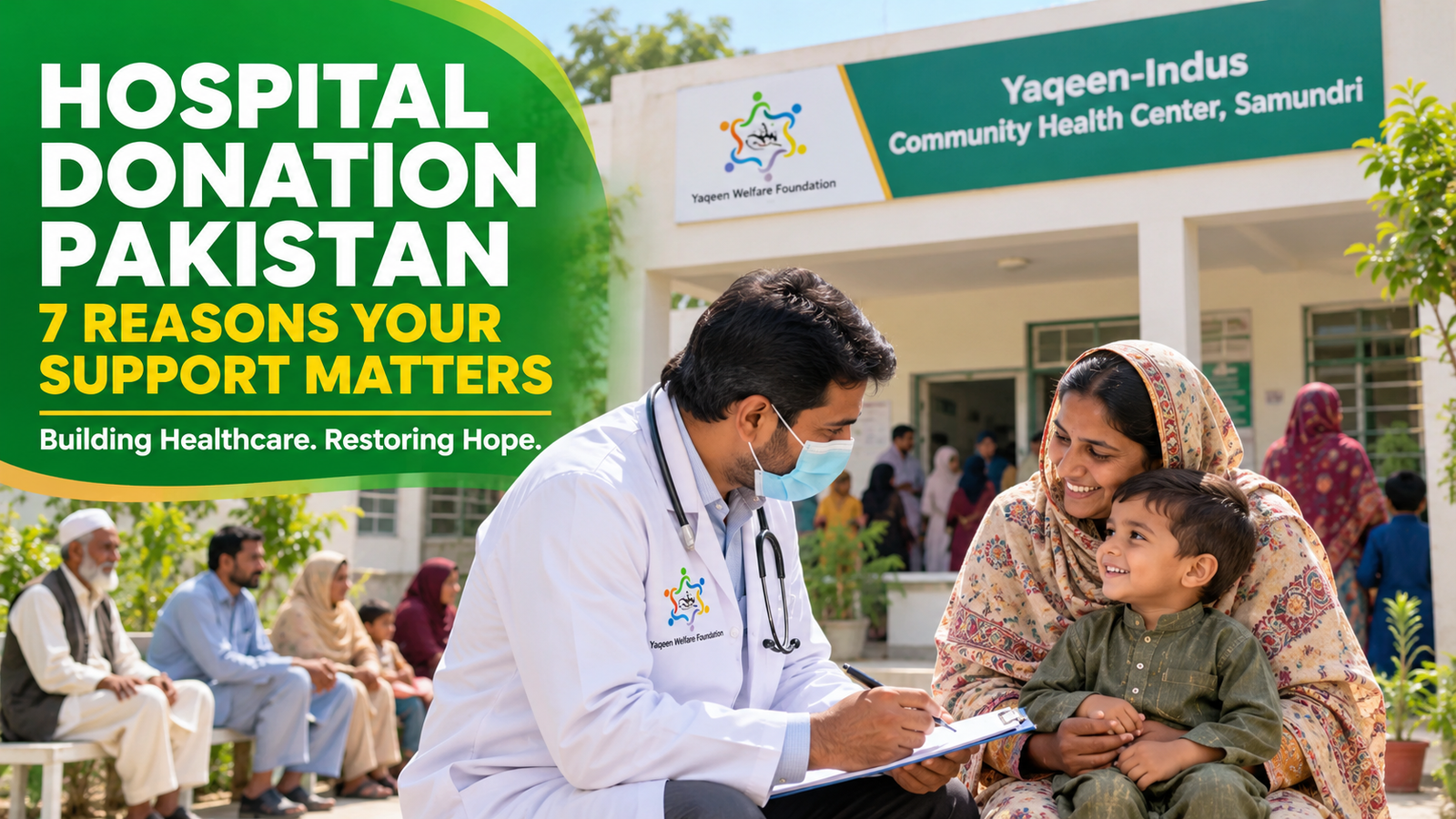
Abstract models become easier to trust when there is a physical project to examine. In Samundri, Faisalabad, that project is already underway. A small, under-resourced local clinic is being rebuilt from the ground up into a modern, multi-service healthcare facility — a direct and visible example of donation free healthcare in Pakistan moving from blueprint to building in real time.
The expanded Samundri facility is designed to serve more than 50,000 patients annually once construction and staffing are complete. The scale of that ambition is only achievable because of the operational partnership with the Indus Hospital & Health Network, which brings established clinical governance, evidence-based protocols, and accountability structures that ensure donor funds are spent according to medical standards already tested and proven elsewhere in Pakistan.
When finished, the Samundri clinic will offer:
Maternal and newborn care for routine deliveries and high-risk pregnancies
Mental health services addressing a need that remains almost entirely unmet across rural Pakistan
Childhood immunizations protecting the next generation from diseases that are entirely preventable
General family medicine for ongoing primary care across all age groups
None of this would exist without sustained donor contributions arriving consistently throughout the construction timeline. This is the clearest possible example of how your donation free healthcare in Pakistan moves from digital transaction to concrete medical reality — not through a single large grant, but through thousands of individual gifts accumulating into something that will serve patients for decades.
What Your Donation Free Healthcare in Pakistan Specifically Funds
It is worth being concrete about where money actually goes rather than leaving it as an abstraction. A typical contribution to a free healthcare project in Pakistan funds some or all of the following:
Facility construction — walls, roofing, electrical systems, plumbing, and the physical infrastructure required to operate a clinic safely and consistently
Medical equipment — diagnostic tools, maternal care equipment, vaccine refrigeration units, and basic surgical supplies that make a range of services possible
Staffing and training — salaries for doctors, nurses, and support staff, along with ongoing clinical training to maintain care quality over time
Medication and immunizations — the actual supplies handed directly to patients at zero cost at the point of service
Operational continuity — utilities, maintenance, and the administrative infrastructure that keeps a facility functioning year after year, not just through the opening months
Every one of these categories converts into something tangible for a real patient. A line item for medical equipment becomes the ultrasound machine that catches a high-risk pregnancy before it becomes a maternal death. A line item for staffing becomes the nurse who is present for a child’s third immunization visit, not just the first. This is what donation free healthcare in Pakistan looks like when you trace it all the way to the patient receiving care.
The Islamic Framework Behind Donation Free Healthcare in Pakistan
For the majority of donors supporting these projects, contributing to free healthcare in Pakistan is not simply an act of generosity — it is a religious obligation, a spiritual practice, or both. Islamic tradition treats charity as inseparable from justice. It is not optional kindness layered on top of daily life; it is an essential part of what it means to live as a Muslim.
Zakat: Obligatory Giving That Funds Real Change
Zakat, the obligatory annual charity required of every eligible Muslim, anchors much of the giving that funds clinics like the Samundri project. It is calculated as a fixed percentage of qualifying wealth and is specifically intended to redistribute resources toward those in genuine need — a category that squarely includes the families served by donation-funded free healthcare facilities across Pakistan.
If you are unsure how to calculate your Zakat obligation accurately, read our full guide: Understanding Zakat — Importance, Calculation, and Impact, or use the Zakat Calculator at yaqeen.org/zakat-calculator to determine the exact amount you owe before directing it toward a Zakat-compliant healthcare project.
Sadaqah: Voluntary Giving That Sustains Long-Term Projects
Sadaqah, the voluntary counterpart to Zakat, has no fixed schedule or amount — which makes it especially well suited to ongoing healthcare funding. A recurring monthly gift, however modest, contributes directly to the same construction and patient-care pipeline described throughout this article. To understand the most spiritually meaningful moments to give, read our post on Best Times and Methods for Giving Sadaqah in Islam.
Sadaqah Jariyah: Charity Whose Reward Continues
There is also a concept in Islamic teaching known as Sadaqah Jariyah — ongoing charity whose benefit, and whose reward, continues long after the initial gift is given. A clinic built today keeps treating patients for years, sometimes decades, afterward. This means donation free healthcare in Pakistan functions as one of the clearest and most powerful modern expressions of Sadaqah Jariyah available to a Muslim donor. For a related perspective on how Islamic charitable practice extends beyond a single transaction, read What Your Qurbani Truly Implies — Past the Sacrifice.
Why Transparency Determines Whether Donation Free Healthcare in Pakistan Actually Works
The single biggest factor separating effective charitable giving from wasted goodwill is transparency. Donors who cannot see where their money goes tend to give less, give less often, and eventually stop giving altogether. This is precisely why a credible model for donation free healthcare in Pakistan depends on visible, auditable fund tracking at every stage of the pipeline.
A digital donation platform that shows donors exactly how funds are allocated — what percentage goes toward construction, what goes toward medical supplies, and what covers operational costs — closes the trust gap that has historically undermined international charitable giving. When a donor can follow a clinic’s progress from a half-finished structure to a fully staffed facility treating thousands of real patients, the abstraction of “donating to a charity” becomes something concrete, verifiable, and worth repeating year after year.
This is also why institutional partnerships matter enormously. The Indus Hospital & Health Network brings established clinical governance to every project it supports, which means donor funds are not just being spent — they are being spent according to evidence-based medical protocols with a proven track record across Pakistan. You can explore the Indus Hospital network’s scale and standards at their official site: https://www.indushospital.org.pk.
The Long-Term Case for Donation-Funded Free Healthcare in Pakistan
A reasonable critique of charitable giving is that donations are an inherently unstable way to fund essential services — that the real solution is government investment, not private generosity. There is some truth to that argument at a macro policy level. But it misses a critical practical reality: government health spending in Pakistan, while growing, has not closed the access gap, and waiting for systemic reform leaves real families without care in the meantime.
Your donation free healthcare in Pakistan is not proposed as a permanent replacement for public health investment. It is a parallel track that moves faster, reaches further into underserved areas, and operates with a level of donor accountability that is often harder to achieve within large bureaucratic systems.
The Samundri project is moving from a modest clinic to a 50,000-patient-per-year facility on a construction timeline measured in months. A child who needs an immunization this year cannot wait for a multi-year government infrastructure plan. Donation-funded free healthcare reaches that child now. That is the long-term case in its simplest form.
How to Get Involved With Donation Free Healthcare in Pakistan
There are several practical paths to contributing to this work:
Give a one-time donation — even a modest contribution adds directly to the construction and patient-care pipeline that is already underway.
Set up recurring monthly giving — predictable contributions provide the steady funding stream that large infrastructure projects like Samundri depend on for procurement and staffing planning.
Calculate and direct your Zakat — use the Yaqeen Zakat Calculator to determine your obligatory giving amount and direct it toward a verified, Zakat-compliant healthcare facility.
Learn more before you give — review the Yaqeen Health Clinic project page and the foundation’s Mission and Vision to understand exactly where your contribution is headed before you commit.
Reach out with questions first — a transparent organization should always welcome questions about fund allocation, project timelines, and specific areas of need before you give. Contact the team directly through the link below.
Frequently Asked Questions About Donation Free Healthcare in Pakistan
1. What does “donation free healthcare in Pakistan” actually mean?
It refers to a model where charitable contributions — rather than government funding or patient fees — pay for the construction, staffing, and operation of clinics that deliver entirely free medical care to underserved communities across Pakistan.
2. How is my donation tracked once I give it?
A digital donation platform records each contribution and shows donors how funds are allocated across construction, medical supplies, staffing, and operational costs, creating an auditable and transparent path from your gift to a patient receiving care.
3. Why rely on donations instead of waiting for government investment?
Public health infrastructure in Pakistan has not kept pace with population need, particularly in rural areas. Donation-funded clinics can be constructed and staffed on a faster timeline, reaching underserved families sooner than large-scale public programs typically allow.
4. What specifically does my donation pay for?
Contributions fund facility construction, medical equipment, staff salaries and training, medication and immunization supplies, and the ongoing operational costs required to keep a clinic running year after year.
5. Is Zakat an appropriate way to fund free healthcare projects?
Yes. Healthcare projects serving low-income and marginalized communities generally qualify under Zakat-eligible categories. Use the Yaqeen Zakat Calculator to determine your exact obligation.
6. Does the Indus Hospital partnership make donations more effective?
Yes. The partnership reduces administrative overhead through shared procurement and existing logistics, meaning a larger share of each donation reaches direct patient care rather than operational administration.
7. How many patients will the Samundri clinic serve?
The expanded Samundri facility is designed to serve more than 50,000 patients annually, covering family medicine, maternal care, mental health services, and childhood immunizations.
8. Is giving to a clinic considered Sadaqah Jariyah?
Yes. Many Islamic scholars consider donations toward durable infrastructure — a clinic that continues treating patients for years — to be among the strongest forms of Sadaqah Jariyah, or ongoing charity whose reward continues well beyond the moment the gift was made.
9. Can I give a small recurring amount and still make a meaningful difference?
Absolutely. Predictable, recurring contributions — even small ones — are often more valuable than larger one-time gifts because they allow long-term projects to plan staffing and procurement with greater confidence.
10. What if I want more detail before donating?
Contact the team directly at info@yaqeen.org or through the online contact form below.
Contact Us About Donation Free Healthcare in Pakistan
If you have questions about how your contribution will be used, which project it will support, or how to fulfill your Zakat through a verified healthcare initiative, the Yaqeen Welfare Foundation team is available to help before you give — not only after.
Contact us online here — yaqeen.org/contact
You can also reach out by email at info@yaqeen.org. A transparent organization should always welcome that conversation.
Final Thought
Your donation free healthcare in Pakistan works because it converts something abstract — generosity, religious duty, a genuine desire to help — into something permanent: a finished wall, a calibrated ultrasound machine, a nurse present for her shift, a mother receiving safe maternal care for the first time in her life. The Samundri expansion is that conversion in progress. Every contribution that arrives while construction is still underway has a direct, traceable line to the 50,000 patients the facility is being built to serve — proof that when donations are transparent, well-partnered, and consistently given, they build something that lasts far longer than the moment the gift was made.
Donate now at yaqeen.org and put your contribution directly into Pakistan’s next free healthcare facility.