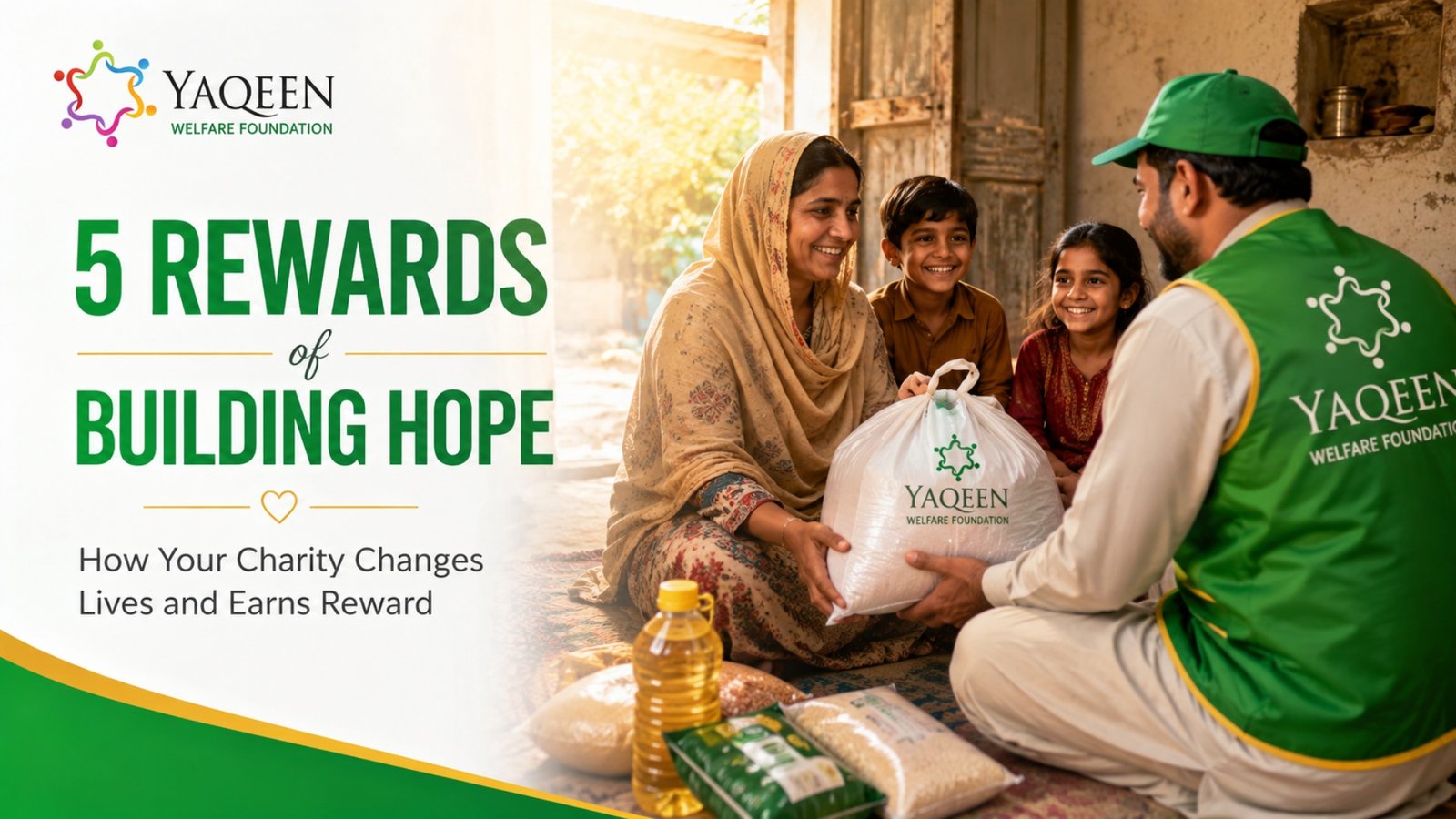
The 5 rewards of building hope in someone’s darkest moment are not theoretical. They are written in the Qurʾān, confirmed in the Sunnah, and felt — quietly, invisibly — in the homes of families whose darkness has turned to light because someone, somewhere, chose to give.
This is not a list of benefits designed to persuade you. It is a description of what is already happening when you give to a person in genuine need: a spiritual transaction between you, Allah, and a stranger whose name you may never know.
If you have ever wondered whether your charity truly matters — whether a donation made quietly, across a distance, to someone you have never met, carries any weight — this is what Islam teaches about the reward of hope-giving, and what Yaqeen Welfare Foundation witnesses every time a food parcel reaches a family in crisis.
What It Means to Give in Someone’s Darkest Moment
Before we explore the 5 rewards, it is worth being precise about what we mean by “darkest moment.” In the context of poverty in Pakistan — which is the ground on which Yaqeen Welfare Foundation works — this darkness is not abstract.
It is a mother who has made the same small portion of rice last three days and is now wondering how to explain to her children why there is nothing left tonight.
It is a widower managing a household that was never designed to rest on one pair of hands, and who has, this week, exhausted the last of what kept things together.
It is a family in rural Punjab or interior Sindh that has no food security, no clean water, and no access to medical care — and for whom a single act of charity is not a convenience but a lifeline.
When the Qurʾān speaks of giving to those in need, it does not speak in generalities. It speaks of specific people in specific conditions. And it promises specific rewards to those who respond.
Here are the 5 rewards Islam teaches us come from building hope in those moments.
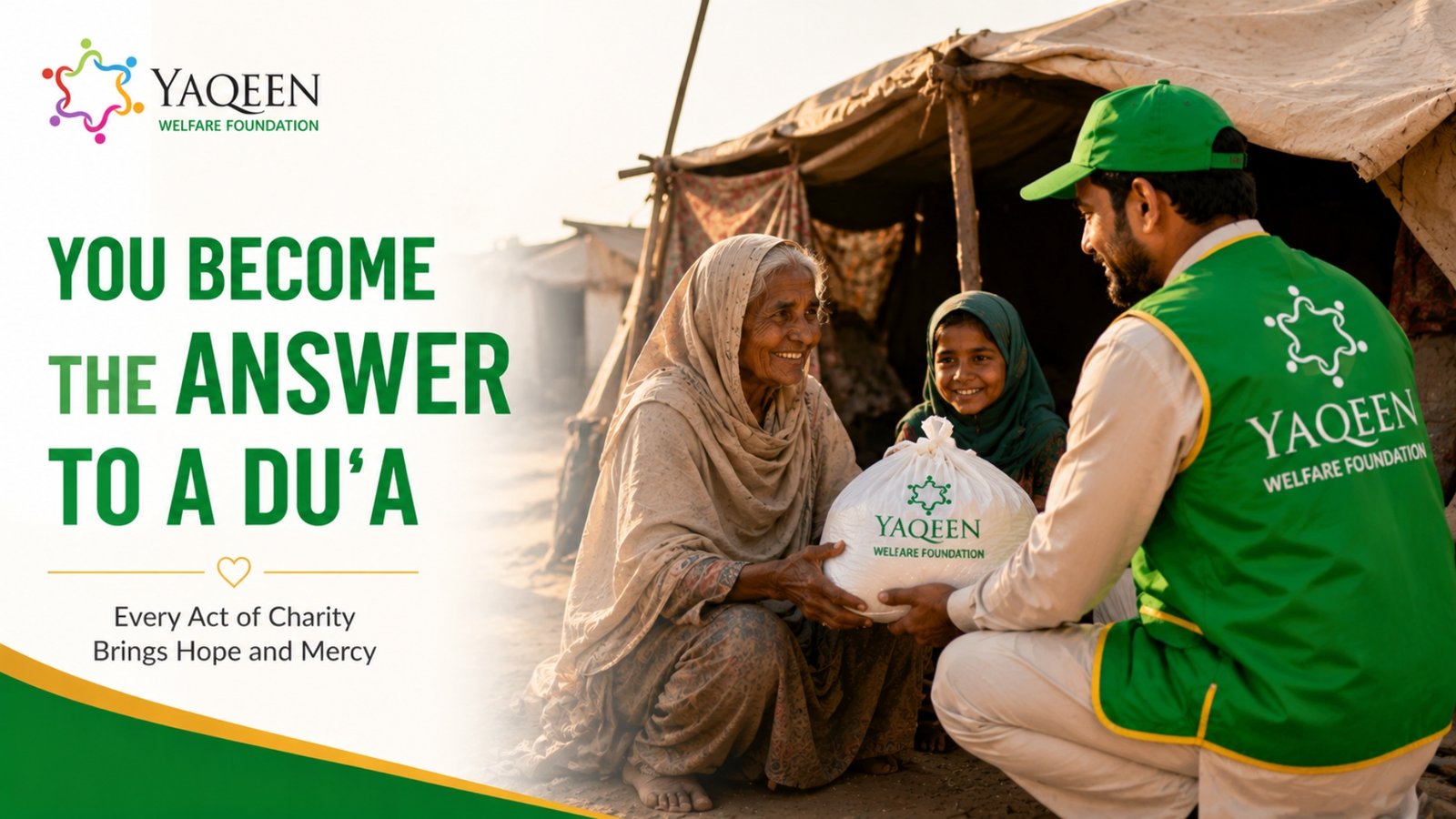
Reward 1 — You Become the Answer to a Duʿā You Never Heard
The 5 Rewards Begin With This: You Were Chosen
There is a moment that most people in genuine crisis reach, though the world rarely sees it. A moment when the weight of life — debt unpaid, hunger unmet, illness untreated, grief unaccompanied — presses so heavily that a person turns entirely to Allah.
They raise their hands. They do not ask for comfort. They ask for something real: food for their children, relief from the unbearable, a way forward they cannot yet see.
And somewhere, without knowing any of this, you gave.
The scholars of Islam described the duʿā of the one pressed by need — the prayer that rises from a person who has exhausted every worldly option — as carrying a particular weight and urgency. Such a prayer does not wait. It ascends with a speed that Allah answers swiftly.
When you gave to that family, that widow, that child, you became the vehicle of that answer. Not because you were grand. Because you were willing.
This is the first of the 5 rewards, and it is not small: you were placed by Allah in the position of being the answer to a desperate prayer. Of all the people in the world, in the moment that a person raised their hands, your giving was the response.
The Prophet صلى الله عليه وسلم said:
“The most beloved of people to Allah are those who are most beneficial to people.” (Al-Muʿjam al-Awsaṭ, al-Ṭabarānī)
Reward 2 — Your Sins Are Extinguished by the Fire of Their Need
The 5 Rewards Include Mercy Being Extended to You
The Prophet صلى الله عليه وسلم described charity as something with a living quality — not an inert transaction, but a force that moves between people and between worlds.
“Charity extinguishes sin as water extinguishes fire.” (Tirmidhī)
This is remarkable: the giving you do in someone else’s darkness works on your own. The act of building hope for a stranger is, simultaneously, an act of mercy being extended to you. The sin that rests on your account is not removed because you performed a ritual. It is removed because you acted on behalf of another.
He also said:
“Protect yourself from the Fire, even with half a date.” (Bukhārī and Muslim)
Half a date. The smallest imaginable portion of food — not a feast, not an extraordinary sacrifice. What this teaches is that the scale of your giving and the scale of its reward do not follow the same arithmetic. What is small in the world is not small in what follows.
When you give to a family in desperate need, you are not offering a sum of money. You are offering, in that darkest moment, the evidence that they have not been forgotten. The reward of that is not proportional to the cost. It is proportional to the need it met.
This is the second of the 5 rewards: your giving becomes protection. Not because giving is a transaction with Allah, but because Allah has told us, through His Prophet صلى الله عليه وسلم, that the act of mercy toward His creation invites mercy upon you.
Reward 3 — You Are Counted Among the Seven in Allah’s Shade
The 5 Rewards Include a Position That Cannot Be Earned Any Other Way
The Prophet صلى الله عليه وسلم described seven types of people who will rest in the shade of Allah on the Day of Judgement — the Day when there is no other shade. Among them:
“A man who gives in charity so secretly that his left hand does not know what his right hand has given.” (Bukhārī)
This is not a person who gave the most. Not a person who gave most visibly. It is a person who gave so quietly that even their own awareness of the act was minimal.
Giving to a stranger you will never meet approaches this quality most closely. It cannot be performed. It cannot be announced. The only witness is Allah.
When you donate to a family in Pakistan through Yaqeen Welfare Foundation — a family in another city, another language, another life — there is no face to thank you, no public record of your generosity, no moment of witnessed gratitude. There is you, and Allah, and a family that will never know your name.
This is one of the 5 rewards that cannot be manufactured by giving where you can be seen. It is available only in the giving that strips everything away except intention — the most sincere form of the act.
To learn more about the different forms of ongoing charity that earn reward beyond a single act, read: Sadaqah Jariyah: 5 Forms of Forgotten Charity Allah Never Forgets
Reward 4 — You Receive a Duʿā Offered With the Full Weight of a Relieved Heart
The 5 Rewards Return to You Through the Stranger’s Hands
Here is what happens in the home after the food parcel arrives.
The children eat. The mother, who has been holding herself together for days with the particular tension of someone who cannot afford to break, feels something release in her. In that relief — in the specific sensation of a need having been met — gratitude rises from a place that was recently empty.
She does not know your name. She cannot thank you by face or word or letter. But she raises her hands and she asks Allah to bless the one who sent this. She does not know who you are, but she asks Allah to guard you, to expand your provision, to be merciful to you in the way that mercy was sent to her.
The scholars noted that the duʿā of a person who has been given relief from genuine hardship carries a particular speed and weight — not because of who is making the prayer, but because of what they have just experienced: the specific gratitude of a person who was desperate and who now is not.
You gave a meal. You received a duʿā offered with the full weight of a heart that has been given reason to hope again.
These are not equivalent. What you received is greater.
This fourth reward is one of the 5 rewards that is entirely invisible to you — you will never hear it, you will never see it — and that is precisely what makes it so complete. It is between the stranger and Allah, offered on your behalf.
Reward 5 — You Become an Instrument of Al-Fattāḥ
The 5 Rewards Include Being the Means by Which a Closed Door Opens
The Qurʾān describes Allah as Al-Fattāḥ: the One who opens. The One who breaks through what has closed. When a family is trapped in the darkness of poverty — unable to eat, unable to access medical care, unable to see a way forward — what they are experiencing is a closed door.
Your giving is the key.
This is not metaphor. When your donation enables a food parcel to be delivered, a well to be dug, or a medical appointment to be attended, you are — in the language of Islamic understanding — the instrument of an opening. The means by which a door that had closed became passable.
“If anyone relieves a Muslim believer from one of the hardships of this worldly life, Allah will relieve him of one of the hardships of the Day of Resurrection.” (Muslim)
You will never fully know what you opened. You will not see the conversation that happened in that home after the meal was eaten, or what became possible for that family in the weeks that followed because one crisis was resolved. But Allah, who opened it through you, knows completely.
This final reward of the 5 rewards is the longest-lasting one. The door you opened may lead to outcomes that multiply through years — a child who ate that night who goes on to study, a mother who survived a week of hunger who goes on to rebuild. You will not see these. But they are part of what your giving set in motion.
What the 5 Rewards Look Like in Practice: A Summary Table
| Reward | What It Is | Where It Comes From |
|---|---|---|
| 1. Becoming the Answer to a Duʿā | Being placed by Allah as the response to a desperate prayer | Al-Muʿjam al-Awsaṭ, al-Ṭabarānī |
| 2. Sins Extinguished | Charity removes sin as water removes fire | Tirmidhī; Bukhārī and Muslim |
| 3. Shade on the Day of Judgement | Given to those who give in secret | Bukhārī |
| 4. A Stranger’s Duʿā for You | The relieved heart prays for the one who helped | Islamic scholarly tradition |
| 5. Instrument of Al-Fattāḥ | Opening a closed door in someone’s life | Muslim |
The Architecture of Hope: What Your Giving Actually Builds
Hope is not an emotion that arrives on its own. It requires something to rest on — a reason, a signal, a moment when the world, which had been contracting, opens slightly.
For a family in the depths of food poverty, hope looks like a parcel that arrives when they had stopped expecting one. It looks like their children eating a full meal. It looks like a night that passes without the specific anxiety of not knowing how tomorrow’s hunger will be met.
You built that. Not with grand architecture — no monument, no ceremony, no inscription of your name. But with something more lasting: a moment in which a person in genuine need experienced the world as one that responds to their suffering.
This is what Yaqeen Welfare Foundation has been built to enable. Every programme exists to place your giving at the exact point of darkest need — so that the 5 rewards described above are not theoretical but real, and immediate.
For more on how giving affects those who receive it, read: Your Donation: 1 Night a Family Slept Without Hunger
How Yaqeen Welfare Foundation Carries Your Giving to the Darkest Moments
Yaqeen Welfare Foundation is a Pakistan-based welfare organization founded with one aim: to provide free medical treatment, clean water, and urgent assistance to the most vulnerable people in Pakistan. Every programme is designed to reach people at the point of genuine crisis — not after it has passed, but inside it.
Emergency Food Parcels
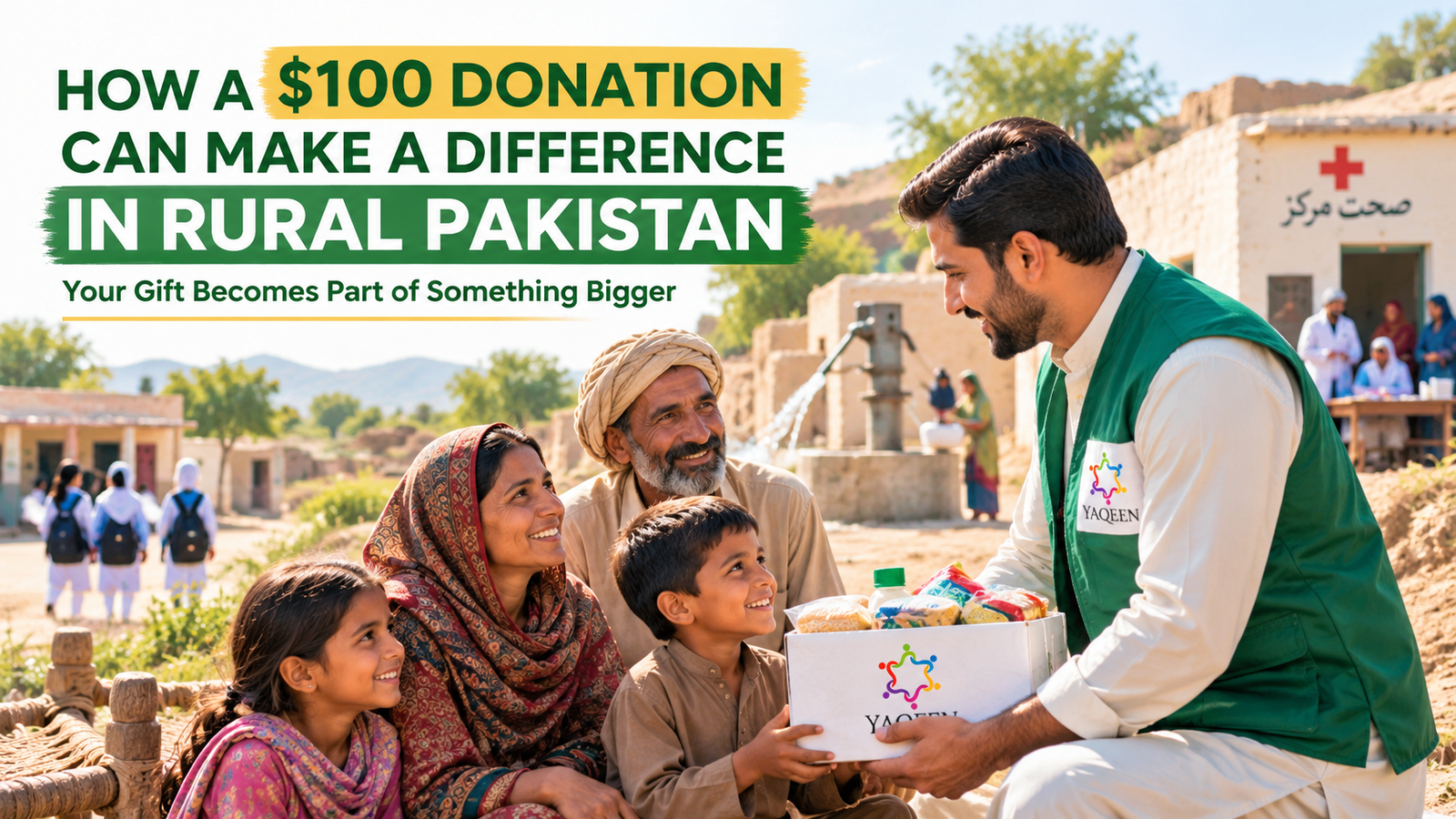
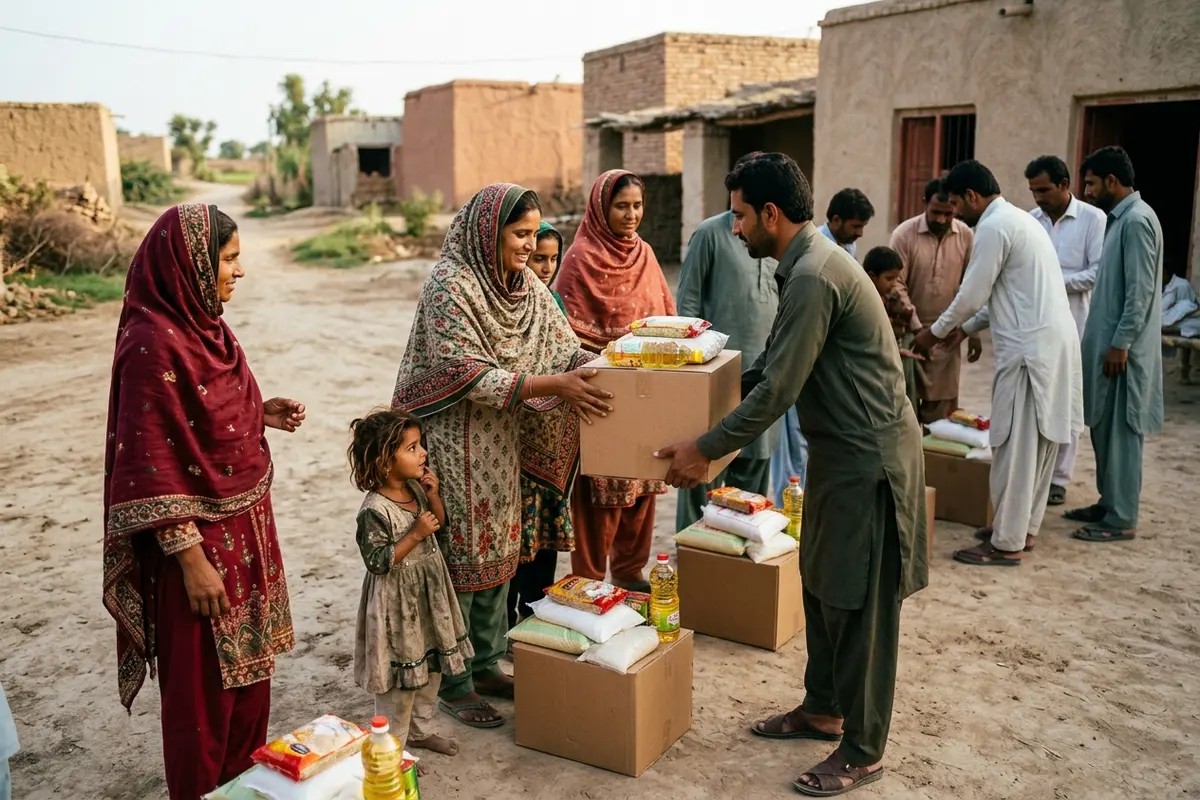
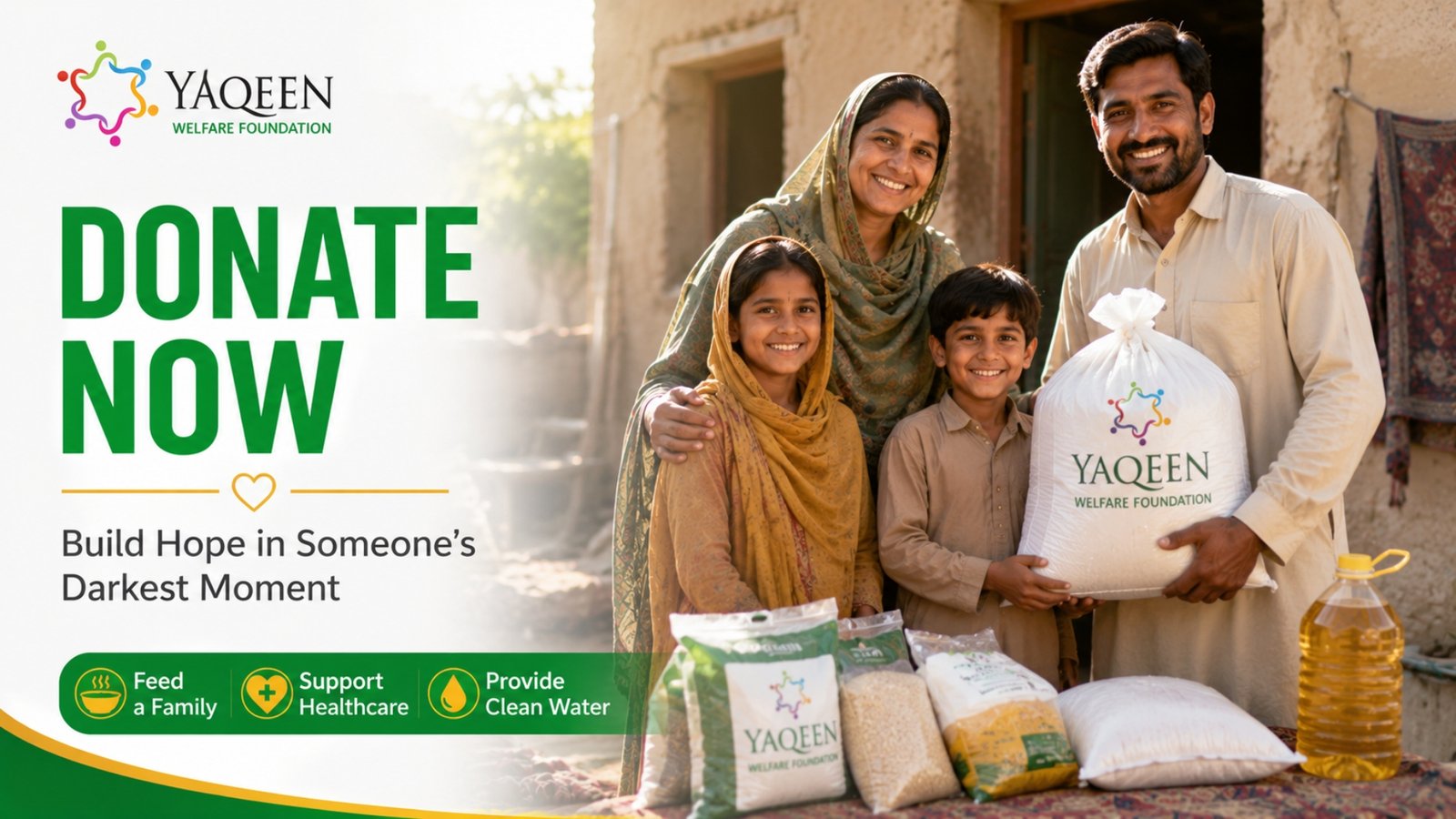
A family in acute crisis receives two weeks of food essentials — delivered rapidly through verified on-the-ground partners. Your giving becomes the answer to a duʿā that may have been made this morning.
Ramadan Food Distribution
A fasting stranger receives iftar through your hand. The gratitude of a fasting person breaking their fast with a full meal carries a quality that Islamic scholars noted as especially swift in its ascent.
Ongoing Family Food Support
For families where poverty is not a single crisis but a permanent condition, monthly support walks alongside them — not once but month after month. You rebuild hope not as a single event but as something reliable. Something that does not disappear.
Widow and Vulnerable Household Support
The households most often passed by — the widow managing alone, the elderly parent with no one to turn to — receive, through your giving, the specific message that they have not been forgotten. That someone moved for them. That their duʿā was heard.
Free Medical Care
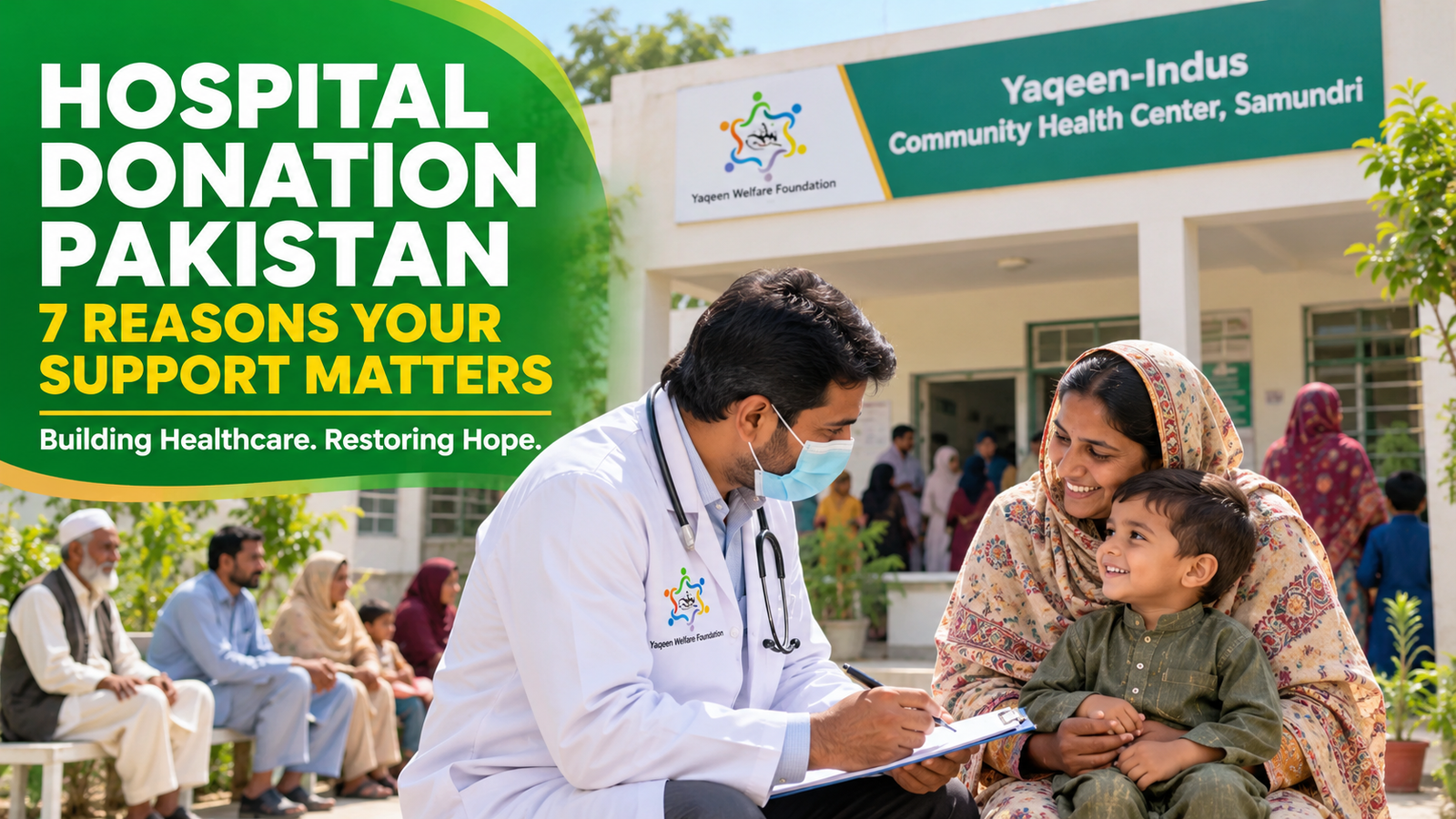
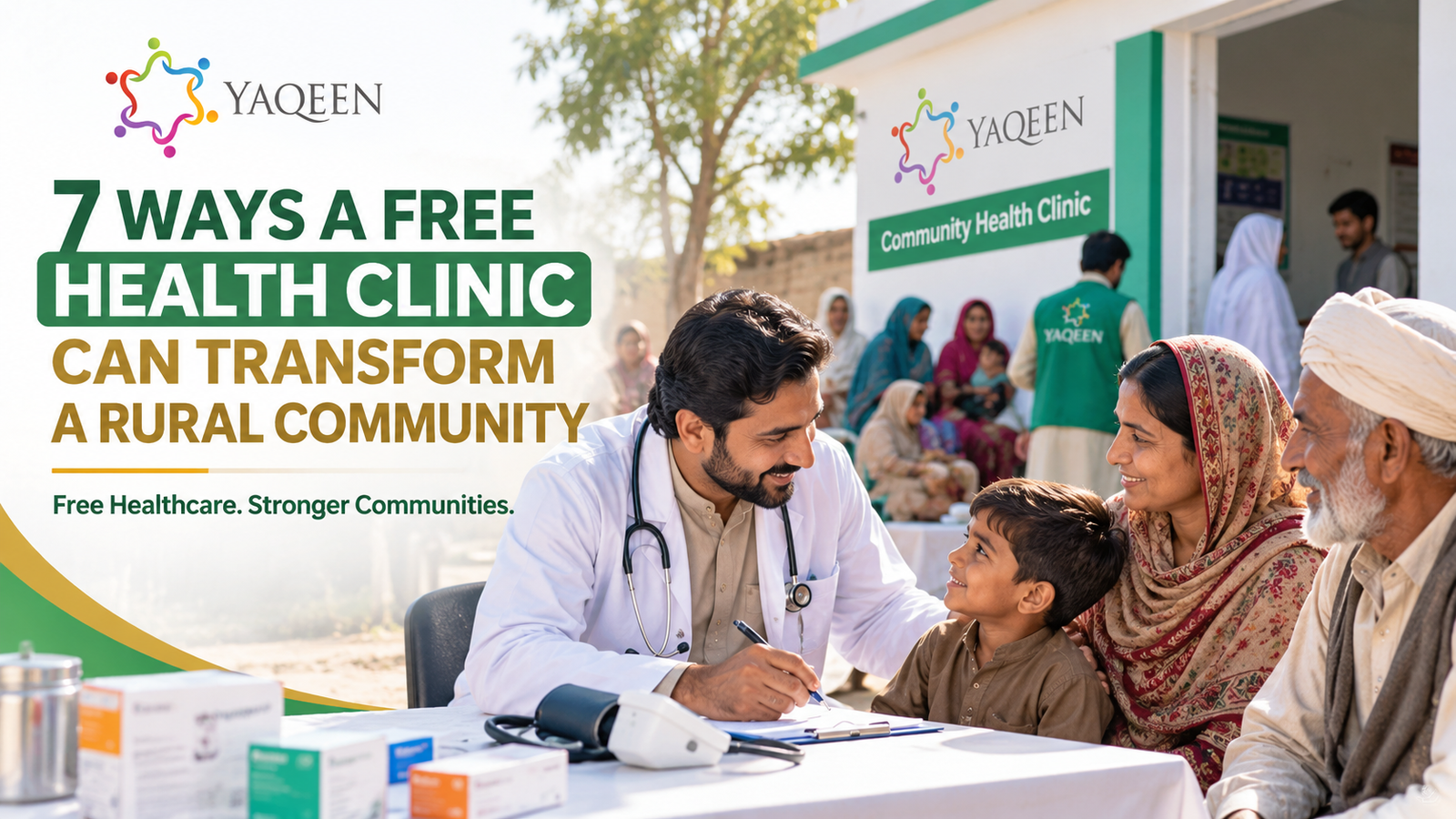
Through the Yaqeen Health Clinic and outreach programmes, people who cannot afford medical treatment receive care at no cost. For many families in Pakistan, illness without access to treatment leads to poverty spirals that take years to exit. Your giving interrupts that spiral. Learn more at: Yaqeen Health Clinic
Clean Water Access
Across Pakistan, communities without access to clean water face preventable illness, death, and devastation. A water well is a form of Sadaqah Jariyah — continuing charity — that earns reward every time someone drinks from it. Read: 1 Drop Clean Water Donation — A Sea of Reward
Why the 5 Rewards Are Not Proportional to the Amount You Give
One of the most important things to understand about Islamic charity is that the reward is not calculated the way we might expect.
The Prophet صلى الله عليه وسلم said:
“Protect yourself from the Fire, even with half a date.” (Bukhārī and Muslim)
This is a teaching about proportion — or rather, its irrelevance. Half a date is not a significant amount of food. It cannot change the trajectory of a life on its own. And yet the Prophet صلى الله عليه وسلم offered it as a shield against the Fire.
The reason is not that the amount is unimportant. It is that the act of reaching outside yourself — of taking from your own provision and extending it to another — is the thing that carries spiritual weight. The amount is secondary.
What is primary is:
- The sincerity of the intention (that you give for Allah, not for recognition)
- The reality of the need it meets (a genuine crisis, not a comfortable preference)
- The consistency of the act (a small, regular gift may do more than a large, occasional one)
This is why you do not need to wait until you have a large amount to give. You need only to give what you have, sincerely, toward a real need — and the 5 rewards described in this article begin to accumulate.
For a deeper exploration of the best ways to structure your charity in Islam, read: Best Times and Methods for Giving Sadaqah in Islam
The Darkest Moment Is Not the End of the Story
A person in darkness does not know that the giving is coming. They do not know that someone, right now, is reading these words, and that a decision is in front of them — whether the parcel arrives, whether the meal is cooked, whether the night passes with or without hunger.
But you know.
You are standing at the place in the story where the decision is made. And the 5 rewards described above do not come after the decision — they begin with it. The moment you give, you are already the answer to a duʿā. You are already under the mercy that charity carries. You are already in motion toward the shade of the Day when there is no other shade.
You do not need to know them. You do not need to witness what follows. You do not need their name, their face, or their gratitude to find you.
You need only to give — for the sake of Allah. And He, who hears every duʿā, will ensure that what you built in their darkness is written in your light.
“Charity extinguishes sin as water extinguishes fire.” (Tirmidhī)
One act. One family. One moment of darkness made passable.
DONATE NOW — Build Hope in Someone’s Darkest Moment: https://yaqeen.org/donate/
Further Reading on Giving in Islam
Explore these related resources on the Yaqeen Welfare Foundation blog:
- What Are the Best Charities to Give To in Islam?
- Sadaqah Jariyah for Deceased | Their Rewards Can Still Grow
- Free Healthcare: 10 Reasons for Donation in Pakistan
- Benefits of Free Healthcare and Why It Matters
- Donation Center for Online Sadaqah & Free Healthcare
External Resources on the Islamic Virtue of Charity
For further reading on the Qurʾānic and prophetic basis of charity and its rewards, the following external resources are recommended:
- Charity in Islam — IslamicRelief.org — An overview of the types of Islamic charity and their spiritual basis.
- Zakat Foundation of America — The Spiritual Benefits of Zakat and Sadaqah — Research-based resources on the theology and practice of Islamic giving.
- UNHCR Pakistan — Humanitarian Needs Overview — Current data on humanitarian conditions in Pakistan, confirming the context in which Yaqeen Welfare Foundation operates.
Frequently Asked Questions
Q: How quickly does my donation reach a family in need?
Emergency food parcels are dispatched within days of your donation through verified on-the-ground partners. For families in acute crisis, speed matters — and Yaqeen Welfare Foundation prioritises rapid deployment above all else. The 5 rewards of your giving begin from the moment you act, not from the moment the parcel is received.
Q: Can I give in memory of someone who has passed?
Yes — and this is among the most beautiful gifts you can offer a loved one who is gone. Sadaqah given on their behalf reaches them. Every duʿā made by the stranger whose meal was provided in their name carries a portion of that mercy to them. To understand more, read: Sadaqah Jariyah for Deceased | Their Rewards Can Still Grow
Q: Does the size of my donation matter?
The Prophet صلى الله عليه وسلم taught that even half a date, given sincerely, can protect a person from the Fire. There is no minimum in Allah’s accounting. A small, consistent gift may carry more weight — and do more for a family — than a single larger one given once. All 5 rewards described in this article are available to every level of giving.
Q: Can food charity count as Zakāt?
Yes. Families in acute food poverty and insecurity fall within the eligible categories for Zakāt. Please indicate your intention when giving so that Yaqeen Welfare Foundation can allocate your donation to Zakāt-eligible programmes. You can calculate your Zakāt obligation using the Yaqeen Zakat Calculator.
Q: How do I know the family is genuinely in need?
Yaqeen Welfare Foundation works exclusively with verified on-the-ground partners who identify families facing genuine acute need — those with no alternative source of food, no safety net, and no one else to turn to. When you give, it reaches a real family that would otherwise go without.
Q: What other programmes does Yaqeen Welfare Foundation run beyond food?
Beyond emergency food support, Yaqeen Welfare Foundation provides free medical care through its health clinic network and supports clean water access across Pakistan. You can explore all active programmes at yaqeen.org.
Q: How do I contact Yaqeen Welfare Foundation?
You can contact the team directly by email at info@yaqeen.org or support@yaqeen.org. To get in touch or make a donation online, visit: https://yaqeen.org/donate/