
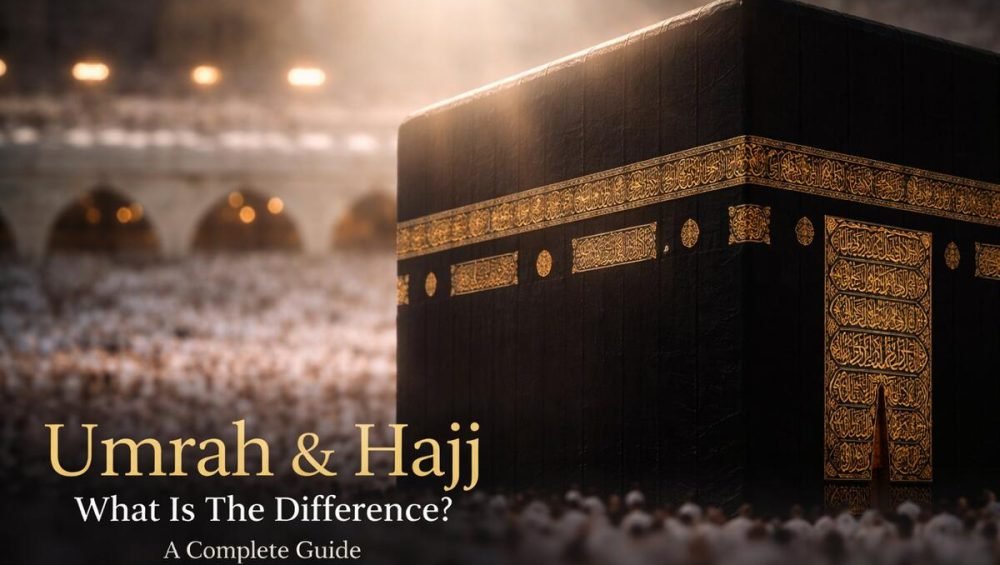
What’s the Difference Between Umrah and Hajj? A Complete Guide
If you have grown up Muslim, you have heard both these words your entire life. At weddings, at funerals, in dua after salah. Someone always just got back from Umrah. Someone’s uncle finally did his Hajj after years of waiting. But ask most people to explain the actual difference between umrah and hajj and they will pause. They will give you something. But it will be fuzzy around the edges. Actually Mostly they also don’t know the difference between umrah and hajj. That is completely okay. At Yaqeen Welfare Foundation, we want to walk through this with you — not throw facts at you, but actually help it land. Because once you understand the difference between umrah and hajj, something shifts. You start to see it’s a little differently. So let us start from the beginning. What Is Hajj Before understanding a difference between umrah and hajj, You have to know about Hajj first. Think of Islam as a house. Five pillars hold it up. Shahada. Salah. Zakat. Sawm. And the fifth — Hajj.When something is a pillar, it is not a suggestion. It is structural. Take it away and the whole thing is incomplete. That is how Hajj sits in your faith. Allah put it in the Quran without ambiguity — ” And Hajj to the House is a duty that mankind owes to Allah, for those who are able to undertake the journey. “ (Surah Aal-Imran 3:97) A duty. Not a bonus act of worship for the extra devoted. A duty — for every Muslim who has the health and the financial means to make it happen, at least once before they die. Now here is what that journey actually looks like. Hajj comes once a year, locked into the month of Dhul Hijjah. You cannot do it in Ramadan or move it to a convenient time. It has a ixed window and within that window, specific rituals unfold across several days. Tawaf around the Kaaba. Sa’i between Safa and Marwa. The standing at the plain of Arafat. A night in Muzdalifah under the open sky. The stoning of the Jamarat in Mina. And the sacrifice of Qurbani. Each of these carries its own history, its own ache, its own connection back to Ibrahim and Hajar and a story that is thousands of years old but somehow still feels personal. But of all of it — Arafat is the heart. The Prophet ﷺ said “Hajj is Arafat.” (Tirmidhi). Miss that one day on that one plain and there is no Hajj. Everything else wraps around it. What Is Umrah — And Why People Keep Going Back For understanding a difference between umrah and hajj, understand umrah too.. If Hajj is the obligation, Umrah is the open invitation. There is no fixed time for it. No narrow window. Ramadan, winter, spring, a random month when your heart is heavy and you just need to go — Umrah accepts you any time of year. That openness is part of what makes it so beloved. The rituals are fewer and simpler than Hajj. You enter the state of Ihram. You perform seven rounds of Tawaf around the Kaaba. You walk Sa’i between Safa and Marwa seven times, retracing the steps of Hajar as she searched for water for her child. Then you cut or shave your hair and step out of the Ihram. That is Umrah. No Arafat. No Muzdalifah. No stoning. Those belong to Hajj. But do not let the simplicity fool you into thinking it is small. The Prophet ﷺ said “Umrah to Umrah is an expiation for what is between them.” (Bukhari and Muslim). Every Umrah you complete wipes away the sins you carried since the last one. Sit with that for a moment. That is not a minor reward. That is a mercy so wide it is almost difficult to fully accept. Which is why people keep going back. Again and again. Once is never really enough. That’s a difference between umrah and hajj, How They Actually Differ — Understood Not Just Memorised Here is where it helps to slow down and see these two journeys side by side — not as a list to memorise but as a way to truly feel the difference. Hajj is compulsory. Umrah is Sunnah. That gap matters more than it sounds. If you have the means and you never perform Hajj, that is an obligation left unmet — a debt still owed. Umrah carries no such weight. Missing it is not a sin. But performing it is a gift you give yourself. Hajj lives in one specific stretch of days in Dhul Hijjah. It cannot be moved or rescheduled. Umrah is fluid — available to you on almost any day of the year. Hajj takes days. Multiple rituals spread across Makkah, Mina, Arafat, Muzdalifah — a journey that unfolds slowly and demands your full presence. Umrah, if you are already in Makkah, can be completed within a few hours. Most people stay longer because leaving feels impossible. But the rituals themselves are swift. And in terms of spiritual promise — both carry enormous weight. But Hajj holds something singular. The Prophet ﷺ said ” Whoever performs Hajj and does not commit any obscenity or wrongdoing will return as pure as the day his mother gave birth to him. “ Bukhari. A Hajj that Allah accepts does not just reduce your sins. It erases them entirely. You come back new. The Question Everyone Asks — Can Umrah Stand In For Hajj People ask this more than you might think. And it makes sense — if Umrah is so rewarding, if you have done it multiple times, surely it counts for something toward Hajj? It does not. That needs to be said gently but clearly. No number of Umrahs fulfills your Hajj obligation. They are not two versions of the same thing. They are two entirely separate acts of worship with different rulings, different rituals, and different standing in your faith.