Yaqeen Welfare Foundation

different-between-zakat-and-sadaqah CategoriesUncategorized

What Is the Difference Between Zakat and Sadaqah in Islam?

Every Muslim gives. But not every Muslim gives correctly — and that difference matters more than most people realise. At Yaqeen Welfare Foundation, Pakistan’s trusted name in free healthcare and clean water access, we see this confusion every single day. People mix up Zakat and Sadaqah. They use them interchangeably. Sometimes they give one thinking it counts as the other. It does not. Understanding the difference between Zakat and Sadaqah is not just a religious technicality — it is the foundation of giving that actually reaches the right people the right way. We built Yaqeen Indus Health Clinic and our clean water projects on exactly that principle. Your giving should count fully. So let us make sure it does together. The Core Difference Between Zakat and Sadaqah What Makes Them Fundamentally Different Zakat is an obligation. Sadaqah is a choice. That single line carries everything. Zakat is one of the Five Pillars of Islam — as foundational as Salah and Sawm. If you qualify, you must give it. There is no negotiating, no postponing without consequence, no replacing it with something else. Sadaqah sits in a completely different category. It is voluntary. Open. Flexible. You give it when your heart moves you, in whatever form you choose, to whoever needs it. Both are acts of worship. Both carry enormous rewards. But they are not the same act — and treating them as if they are leads to real gaps in both your obligation and your impact. Understanding Zakat — The Obligatory Pillar Who Must Give Zakat Zakat applies to every sane adult Muslim who has held wealth above the Nisab threshold for one complete lunar year. Nisab is currently calculated at the value of 87.48 grams of gold or 612.36 grams of silver — whichever is lower according to the scholarly position most beneficial to the poor. The amount is fixed — 2.5% of total qualifying wealth. This includes savings, gold, silver, business inventory and certain investments. It does not include your home, your car or personal items you use daily. What the Quran Says About Zakat Allah does not leave room for ambiguity here: “Take from their wealth a charity by which you purify them and cause them to increase.” (Surah At-Tawbah 9:103) Zakat is described as purification — not generosity. The poor have a right to your wealth that was always theirs. Zakat is simply the mechanism by which that right is fulfilled. Who Can Receive Zakat The Quran specifies eight categories in Surah At-Tawbah 9:60 — the poor, the needy, those in debt, travellers in need and others. This is not a loose list. Giving Zakat outside these categories does not fulfil the obligation. This specificity is why Yaqeen Welfare Foundation maintains strict Zakat distribution protocols — ensuring every rupee given as Zakat reaches a qualifying recipient through our healthcare and clean water programmes. Understanding Sadaqah — The Open Door Why Sadaqah Is Different From Zakat Sadaqah is derived from the Arabic root, Sidq , which means truthfulness and sincerity. By giving Sadaqah, we prove that our faith is genuine. That our faith in Allah’s generosity encourages us to give from what we have. The Prophet ﷺ said: “Every act of goodness is Sadaqah.” (Sahih Muslim) A smile. Removing something harmful from the road. Sharing knowledge. Giving a meal. All of it counts. Sadaqah has no minimum, no fixed amount, no single form. Sadaqah Jariyah — The Sadaqah That Never Stops Within Sadaqah there is a category that carries a special weight — Sadaqah Jariyah, or ongoing charity. The Prophet ﷺ said: “When a person dies, all their deeds come to an end except three — ongoing charity, knowledge that benefits others, or a righteous child who prays for them.” (Sahih Muslim) A water well. A free clinic. A funded classroom. These are not acts that end when you give them. They keep giving. And every time they give — the reward flows back to you. At Yaqeen Welfare Foundation, our clean water projects and Yaqeen Indus Health Clinic are built precisely as vehicles for Sadaqah Jariyah. Donors who gave towards our water pumps two years ago are still earning a reward today — because those pumps are still running and those families are still drinking clean water every single morning. Can Sadaqah Replace Zakat No. This is one of the most common and most costly misunderstandings in Islamic giving. No matter how much Sadaqah you give — ten times the Zakat amount, every Ramadan, every Friday — it does not cancel your Zakat obligation. They are separate doors. You cannot enter one through the other. If Zakat is due on you and unpaid, that obligation remains. Scholars consider unpaid Zakat a serious matter — a debt to Allah that does not disappear until it is fulfilled. What About Giving Both Yes — and this is where giving becomes truly powerful. Give your Zakat as an obligation fulfilled correctly. Then give Sadaqah from a place of love and choice. One is the floor. The other is everything you build above it. At Yaqeen Welfare Foundation we accept both — and we ensure each is used correctly and transparently according to its category. The Difference Between Zakat and Sadaqah in Everyday Giving Here is what this looks like practically. Your colleague at work is struggling. You give him money. If he qualifies as a Zakat recipient — that can count as Zakat. If not — it counts as Sadaqah. Both carry reward. But only one fulfils the pillar. You sponsor a child’s school fees. That is Sadaqah — educational support does not fall under Zakat categories. But if that child’s family qualifies under the poor or needy category and you give directly to them — that can be Zakat. The intention and the recipient both matter. Clarity is not bureaucracy. It is respect for the obligation. How Yaqeen Welfare Foundation Uses Your Giving When you give to Yaqeen Welfare Foundation — whether Zakat or Sadaqah — here

sadaqah-jariyah-donate-online-in-pakistan CategoriesBlog Uncategorized

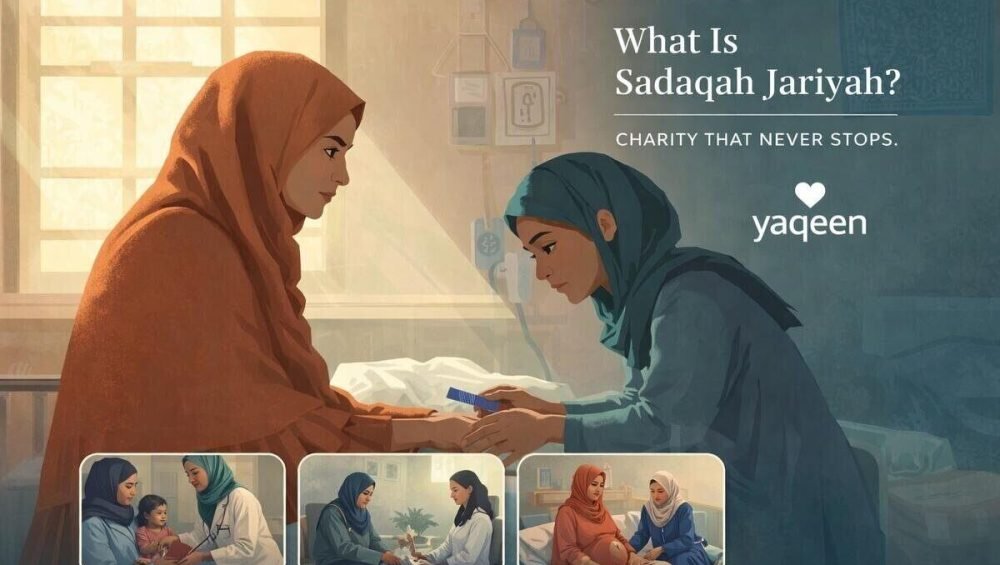
What Is Sadaqah Jariyah and Why Should You Donate Online in Pakistan?

Most of us give when we can. A little here, a little there. But there is one kind of giving in Islam that is different. It does not stop. It keeps going even after you are gone. That is sadaqah jariyah. And if you are looking to donate online in Pakistan in a way that actually means something, you need to read this. At Yaqeen, we are the best place in Pakistan to turn your charity into something that lasts a lifetime and beyond. What Is Sadaqah Jariyah? Sadaqah jariyah is basically charity that never switches off. The Prophet ﷺ told us that when we die, everything stops but not everything. Three things keep going and sadaqah jariyah is one of them. So just imagine — you are gone, but somewhere out there, someone is still being helped because of something you did while you were alive.. And every single time that happens, you are still earning from it. Day after day, without stopping. Not a hard concept to understand. Just a really, really heavy one when it actually sinks in. Why a Free Clinic Is One of the Best Examples Picture this. A woman walks into a clinic for a checkup. She has been unwell for many days, but she had no money for a doctor appointment. She gets checked. She gets medicine. She goes home better. Now ask yourself — who made that possible? The donor who gave months ago. Maybe someone who never even met her. That is sadaqah jariyah working exactly the way it should. At Yaqeen, our health clinic does this every single day. We have helped over 27,574 people through family medicine alone. More than 11,000 people have received mental health support. Nearly 1,800 mothers and children have been cared for maternal health services. Every one of those moments was funded by someone’s charity. Someone’s sadaqah jariyah. Why Give Online? Here Is the Honest Answer Because it is easier, faster, and nothing gets lost on the way. When you donate online in Pakistan through a trusted platform like Yaqeen, your money goes directly where it needs to go. You do not have to wonder. You do not have to follow up. The work is already happening — and your donation joins it instantly. You can also give monthly. That means your sadaqah jariyah does not depend on you remembering. It just runs. Quietly. Consistently. Earning for you while you go about your life. That is a beautiful thing when you think about it. What Yaqeen Has Built — And Is Still Building The Yaqeen Indus Health Clinic is real. It is open. People are walking through its doors right now. It started with a vision, responsibility and a lot of faith. Donors gave. Construction began. And eventually, a clinic stood where there was nothing before. Right now it looks after more than 50,000 people a year — family medicine, immunisation, mental health, maternal care, all of it. And those 50,000 are not just numbers. Every single one of them is somebody’s mother, somebody’s kid, somebody’s neighbour, somebody’s closest friend. And each one of them was helped — at least in part — by people who chose to give online and trust the process. Your donation can set all of that in motion. That is sadaqah jariyah — not as a concept, but as something you can actually see and point to.If you want your charity still working years from now, long after the moment has passed — Donate online at Yaqeen and start building something that genuinely outlasts you. Pakistan needs that right now. According to Human Rights Watch, more than half of Pakistanis cannot access basic primary healthcare — and 42% have no health coverage at all. People are waiting for care they cannot afford. Source; Human Right Watch Final Thought We do not always get to see the good we do. You give, life moves on, and somewhere out there, a person you will never meet gets the care they needed. That is okay. That is actually the point. Sadaqah jariyah is not about recognition. It is about leaving something behind that matters. Pakistan needs that right now. People are waiting for care they cannot afford. And you have the ability — right now, from your phone or laptop — to be part of the answer. Give through Yaqeen. Give simply. Give in a way that never really ends. FAQs 1. Can giving to a hospital or clinic count as sadaqah jariyah? Absolutely. Think about it — a clinic sees hundreds of patients every single month. Every time someone walks out feeling better, the person who helped fund that place gets a share of that. It is not abstract. It is one of the most real and direct ways this kind of charity works. 2. Is it safe to donate online in Pakistan? Yes, if you are giving through an organisation that is open about where the money goes. Yaqeen does not just take donations and go quiet. They track who was helped, share their numbers, and keep donors in the loop. You are not guessing — you can actually see the impact. 3. What if I can only give a small amount? Give it anyway. A few hundred rupees a month does not feel like much. But put it together with what others are giving, and suddenly someone is getting a doctor visit they could not afford. Someone is getting medicine. Someone is getting a check-up that catches something before it gets worse. Your small amount is doing that. 4 Can I give sadaqah jariyah on behalf of someone who has passed away? Yes, you can if you have lost someone you love. You can still do something for them. Give in their name. In Islam, that reward travels to them. They are gone, but the good you do on their behalf still reaches them. That is a gift no one else can give them now, except you. Giving in