Yaqeen Welfare Foundation

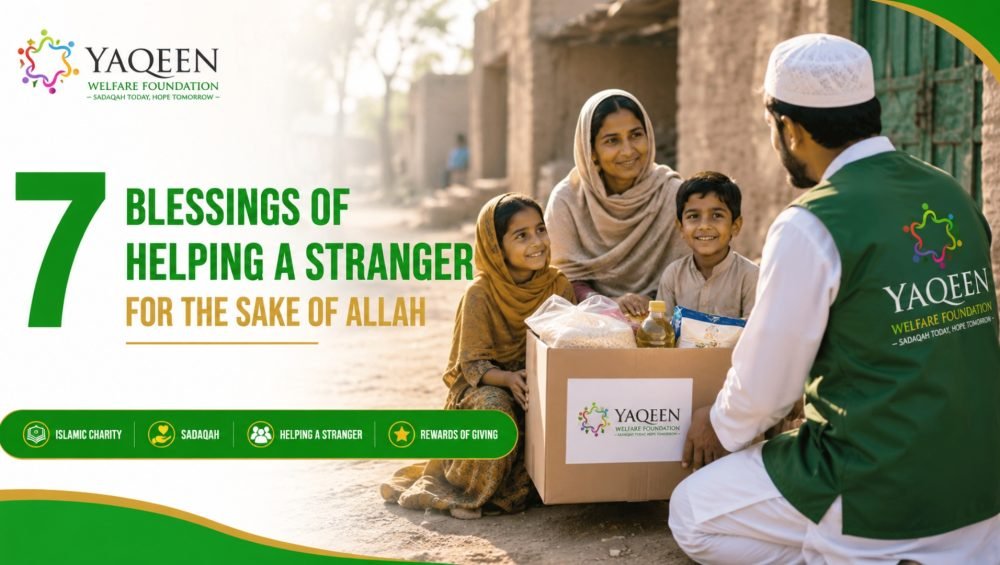
7 Blessings of Helping a Stranger for the Sake of Allah CategoriesBlog

7 Blessings of Helping a Stranger for the Sake of Allah

The 7 Blessings of Helping a stranger for the sake of Allah represent one of the most profound acts a Muslim can perform — a deed witnessed fully only by the One who sees all things. When you reach out to someone you have never met and will never meet again, with no expectation of gratitude or recognition, you place your trust entirely in Allah. And Allah, as the Prophet ﷺ assured us, never leaves such trust unrewarded. At Yaqeen Welfare Foundation, we carry your giving to families across Pakistan — families you will never meet, in cities you may never visit. Every donation, however small, becomes an act of helping a stranger for the sake of Allah alone. This article explores the spiritual weight and divine rewards behind that act, drawing directly from the Quran and the Sunnah of the Prophet ﷺ. What Does It Mean to Help a Stranger for the Sake of Allah? To help someone “for the sake of Allah” (fi sabilillah) means your intention is directed purely toward pleasing Allah — not gaining praise from others, not building a social reputation, and not even witnessing the outcome of your generosity. The stranger you help does not know your name. They do not know what it cost you — whether you gave from abundance or from the little that remained. Yet Allah knows all of it: every hesitation, every sacrifice, every silent intention held within the heart. This kind of giving stands apart from ordinary charity. It is charity at its most sincere because the human scaffolding of reward — gratitude, recognition, reciprocity — has been entirely removed. What remains is the act, the intention, and Allah. The Quran speaks directly to this quality of giving: “Those who spend their wealth in the way of Allah and do not follow up what they have spent with reminders of it or hurt, they will have their reward with their Lord, and there will be no fear concerning them, nor will they grieve.” (Surah Al-Baqarah, 2:262) The 7 Blessings of Helping a Stranger for the Sake of Allah Blessing 1: Allah Relieves Your Burden on the Day of Judgement The first and most extraordinary of the 7 Blessings of Helping is a divine promise of relief when it matters most. The Prophet Muhammad ﷺ said: “Whoever relieves a Muslim of a burden from the burdens of the world, Allah will relieve him of a burden from the burdens on the Day of Judgement.” (Sahih Muslim) When you carry someone else’s hardship — even partially, even for a moment — Allah carries yours on the Day when no human helper can reach you. The stranger you fed, clothed, or supported in this world becomes, through the mercy of Allah, a source of relief for you in the next. This transaction cannot be replicated by any act done purely for human reward. Blessing 2: Allah Becomes Your Aid as Long as You Aid Others Among the most beautiful of the 7 Blessings of Helping is the continuous divine support that follows a generous heart. The Prophet ﷺ said: “Allah is in the aid of His servant as long as His servant is in the aid of his brother.” (Sahih Muslim) This is not a one-time reward but an ongoing state. The moment you turn toward a stranger in their need, something turns toward you. Allah’s help surrounds you in proportion to your willingness to help others. Those who give consistently — through monthly charity, regular food support, or sustained welfare programmes — live continuously within this promise. At Yaqeen Welfare Foundation, our Ongoing Family Food Support programme embodies exactly this principle: consistent help, month after month, for families where poverty is not a crisis but a permanent condition. Blessing 3: The Du’a of a Stranger Is Among the Swiftest to Be Answered When a person in genuine need lifts their hands and makes du’a — for their children, for themselves, and for the stranger who helped them — the scholars of Islam noted that such a supplication carries special weight. The Prophet ﷺ confirmed: “The supplication of the oppressed is not veiled from Allah, even if the person is a sinner.” (Tirmidhi) The stranger you help does not know your name. But their du’a carries you within it — unnamed, unrecognised by any human, yet known to Allah in complete detail. Every prayer they make for “the one who helped me” reaches the One who knows precisely who that is. You receive a share of every word. This is the invisible dimension of charitable giving that human accounting cannot measure — and it is one of the most powerful of all the 7 Blessings of Helping. Blessing 4: Shade on the Day When There Is No Shade But Allah’s The Prophet ﷺ described seven categories of people who will be shaded by Allah on the Day of Judgement — a day so intense that the sun will be brought close to mankind. Among them: “A man who gives in charity so secretly that his left hand does not know what his right hand has given.” (Sahih Bukhari) Helping a stranger is, by its very nature, secret giving. The stranger cannot publicise your generosity. They cannot name you in praise. They received your giving and walked on — and you walked on too. The act was between you and Allah alone. And that shade, on the Day when every other form of comfort will be stripped away, is the return of an act that no one else witnessed. Blessing 5: Your Sadaqah Returns to You Multiplied The Quran uses one of its most vivid images to describe what happens to wealth given in the way of Allah: “The example of those who spend their wealth in the way of Allah is like a seed of grain which grows seven spikes; in each spike is a hundred grains. And Allah multiplies for whom He wills.” (Surah Al-Baqarah, 2:261) A single seed
5 Rewards of Building Hope in Someone's Darkest Moment CategoriesBlog

5 Rewards of Building Hope in Someone’s Darkest Moment

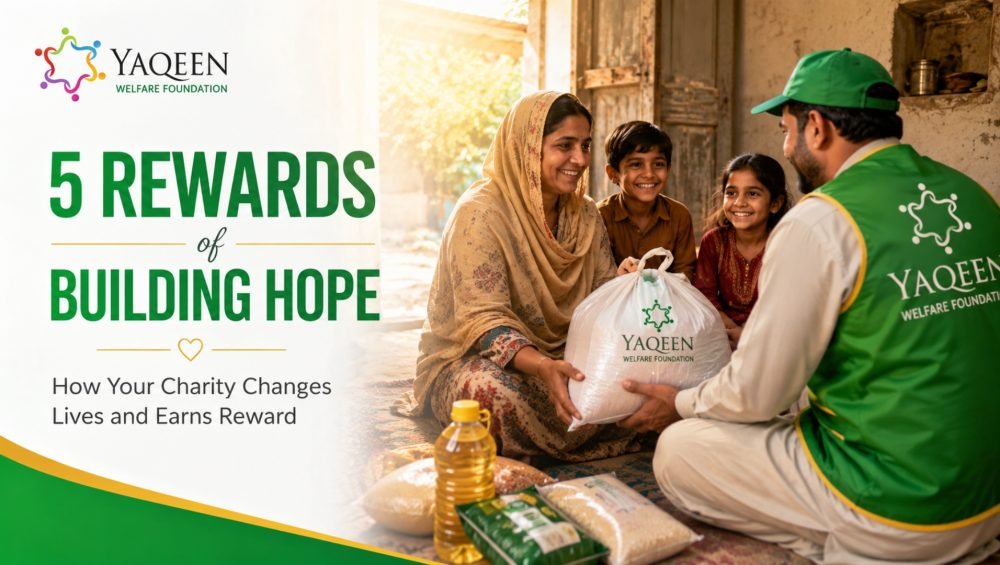
The 5 rewards of building hope in someone’s darkest moment are not theoretical. They are written in the Qurʾān, confirmed in the Sunnah, and felt — quietly, invisibly — in the homes of families whose darkness has turned to light because someone, somewhere, chose to give. This is not a list of benefits designed to persuade you. It is a description of what is already happening when you give to a person in genuine need: a spiritual transaction between you, Allah, and a stranger whose name you may never know. If you have ever wondered whether your charity truly matters — whether a donation made quietly, across a distance, to someone you have never met, carries any weight — this is what Islam teaches about the reward of hope-giving, and what Yaqeen Welfare Foundation witnesses every time a food parcel reaches a family in crisis. What It Means to Give in Someone’s Darkest Moment Before we explore the 5 rewards, it is worth being precise about what we mean by “darkest moment.” In the context of poverty in Pakistan — which is the ground on which Yaqeen Welfare Foundation works — this darkness is not abstract. It is a mother who has made the same small portion of rice last three days and is now wondering how to explain to her children why there is nothing left tonight. It is a widower managing a household that was never designed to rest on one pair of hands, and who has, this week, exhausted the last of what kept things together. It is a family in rural Punjab or interior Sindh that has no food security, no clean water, and no access to medical care — and for whom a single act of charity is not a convenience but a lifeline. When the Qurʾān speaks of giving to those in need, it does not speak in generalities. It speaks of specific people in specific conditions. And it promises specific rewards to those who respond. Here are the 5 rewards Islam teaches us come from building hope in those moments. Reward 1 — You Become the Answer to a Duʿā You Never Heard The 5 Rewards Begin With This: You Were Chosen There is a moment that most people in genuine crisis reach, though the world rarely sees it. A moment when the weight of life — debt unpaid, hunger unmet, illness untreated, grief unaccompanied — presses so heavily that a person turns entirely to Allah. They raise their hands. They do not ask for comfort. They ask for something real: food for their children, relief from the unbearable, a way forward they cannot yet see. And somewhere, without knowing any of this, you gave. The scholars of Islam described the duʿā of the one pressed by need — the prayer that rises from a person who has exhausted every worldly option — as carrying a particular weight and urgency. Such a prayer does not wait. It ascends with a speed that Allah answers swiftly. When you gave to that family, that widow, that child, you became the vehicle of that answer. Not because you were grand. Because you were willing. This is the first of the 5 rewards, and it is not small: you were placed by Allah in the position of being the answer to a desperate prayer. Of all the people in the world, in the moment that a person raised their hands, your giving was the response. The Prophet صلى الله عليه وسلم said: “The most beloved of people to Allah are those who are most beneficial to people.” (Al-Muʿjam al-Awsaṭ, al-Ṭabarānī) Reward 2 — Your Sins Are Extinguished by the Fire of Their Need The 5 Rewards Include Mercy Being Extended to You The Prophet صلى الله عليه وسلم described charity as something with a living quality — not an inert transaction, but a force that moves between people and between worlds. “Charity extinguishes sin as water extinguishes fire.” (Tirmidhī) This is remarkable: the giving you do in someone else’s darkness works on your own. The act of building hope for a stranger is, simultaneously, an act of mercy being extended to you. The sin that rests on your account is not removed because you performed a ritual. It is removed because you acted on behalf of another. He also said: “Protect yourself from the Fire, even with half a date.” (Bukhārī and Muslim) Half a date. The smallest imaginable portion of food — not a feast, not an extraordinary sacrifice. What this teaches is that the scale of your giving and the scale of its reward do not follow the same arithmetic. What is small in the world is not small in what follows. When you give to a family in desperate need, you are not offering a sum of money. You are offering, in that darkest moment, the evidence that they have not been forgotten. The reward of that is not proportional to the cost. It is proportional to the need it met. This is the second of the 5 rewards: your giving becomes protection. Not because giving is a transaction with Allah, but because Allah has told us, through His Prophet صلى الله عليه وسلم, that the act of mercy toward His creation invites mercy upon you. Reward 3 — You Are Counted Among the Seven in Allah’s Shade The 5 Rewards Include a Position That Cannot Be Earned Any Other Way The Prophet صلى الله عليه وسلم described seven types of people who will rest in the shade of Allah on the Day of Judgement — the Day when there is no other shade. Among them: “A man who gives in charity so secretly that his left hand does not know what his right hand has given.” (Bukhārī) This is not a person who gave the most. Not a person who gave most visibly. It is a person who gave so quietly that even their own awareness of the act was minimal. Giving

Sadaqah Jariyah: 5 Forms of Forgotten Charity Allah Never Forgets CategoriesBlog

Sadaqah Jariyah: 5 Forms of Forgotten Charity Allah Never Forgets

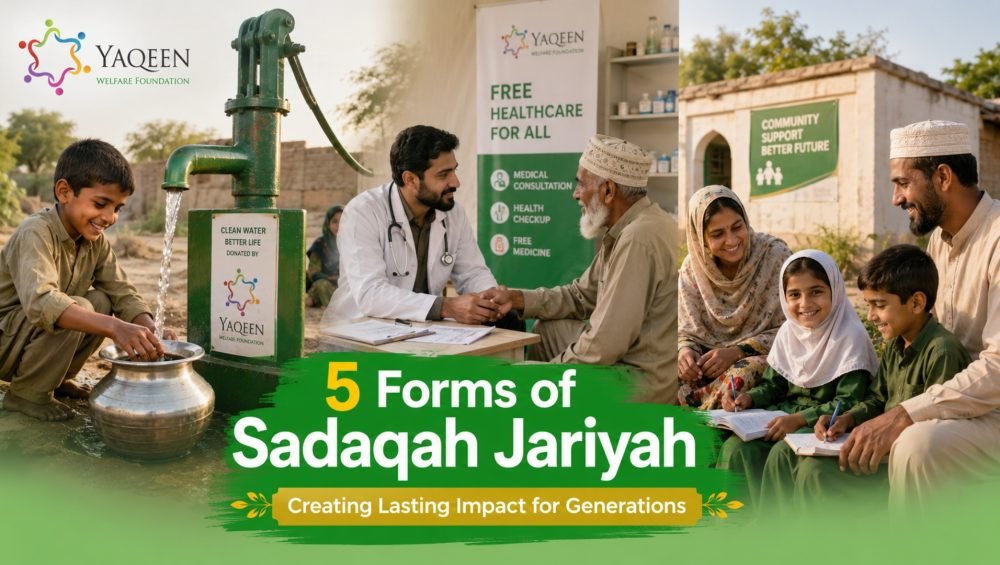
Sadaqah Jariyah is the one kind of giving that does not end when the transaction does. It is the donation you made years ago and have long since forgotten — the one Allah never did. There are deeds you remember giving. And then there are deeds you have long since forgotten. The donation made years ago on a quiet evening. The few pounds given after a Friday khutbah when someone spoke about a well in a faraway village. The amount you rounded up at the end of a campaign because the number felt right. You forgot. Of course you did. Life moved on. The receipt faded from your inbox. The cause slipped from your memory as the next week arrived, and the one after that. But here is what you must understand: Allah did not forget. Not a single reward has been lost. Not a single benefit your charity produced has gone unrecorded. While you moved on with your life — raising your children, navigating your work, carrying your worries — something you set in motion continued to move. Quietly. Faithfully. On your behalf. This is the nature of Sadaqah Jariyah, and it is one of the most extraordinary gifts Allah has placed within human reach. What Makes a Charity “Ongoing”? The Arabic word jariyah carries the image of flowing water — something in continuous motion, never static, never exhausted. Sadaqah Jariyah is not simply a large donation or a noble cause. It is charity that keeps producing benefit after the act of giving has ended. Most of what we do in this world is transactional. We act, the act completes, and the ledger closes. A meal given ends when the plate is empty. A kind word lands and is then carried away by the next conversation. These deeds are not diminished for it — they are beloved acts. But they are finite. Sadaqah Jariyah breaks that pattern entirely. “When a person dies, all their deeds come to an end except three: ongoing charity, beneficial knowledge, or a righteous child who prays for them.” — Sahih Muslim 1631 Read those words again, slowly. All deeds come to an end. The prayers, the fasts, the efforts, the striving — all of it sealed the moment the soul leaves the body. But ongoing charity does not come to an end. It continues. It accumulates. It works for you in the unseen, long after you can work for yourself. This is not poetry. This is a divine promise, delivered through the Prophet ﷺ, about how your account with Allah actually works. Why This Matters More Than You Think Most people assume reward is tied to memory — that you have to remember a good deed for it to “count” toward you. Sadaqah Jariyah dismantles that assumption completely, and that is precisely why it deserves a closer look. The Reward That Was Never Waiting for Your Memory We tend to think of reward as something tied to awareness. We remember a good deed, we feel the weight of it, we hope it was accepted. But Sadaqah Jariyah operates entirely outside of human memory. Consider what this means in practice. Somewhere, a child draws clean water from a pump and carries it home. Your reward is written. A mother in a village you have never heard of washes her infant’s fever with clean water from that same source. Your reward is written again. A patient with no money sits before a doctor in a free clinic and receives care they could not have afforded. Your name is inscribed in a ledger no human eye can read. A family that once faced destitution finds steady ground. Their children grow up with possibilities that did not exist a generation before. Something you gave, perhaps years ago, is part of that story. You do not need to know about any of this. You do not need to remember. The accounting has never depended on you — and that is the quiet power of Sadaqah Jariyah. What Travels With You When Everything Else Stays Behind We spend our lives building things — careers, homes, reputations, savings. We accumulate. And almost all of what we accumulate will remain here, passed to others or dissolved entirely, when we leave. Islamic scholars have long described a person in their grave — unaware of the world above, beyond the reach of human intercession — yet continuing to receive. A stream of reward arriving from a water source still flowing. From a hospital still treating. From a family whose stability still holds. The gift was released once. Its effect was never released. Sadaqah Jariyah is, in the truest sense, the one thing you take with you. Not a record of what you owned. Not a monument to your name. Something far more valuable: an open account, still receiving, long after your capacity to earn has closed. If you are new to the broader landscape of Islamic giving and want to understand how Sadaqah Jariyah fits alongside other obligations, our guide on Best Times and Methods for Giving Sadaqah in Islam is a useful next read. Sadaqah Jariyah vs. Other Forms of Giving It helps to see how ongoing charity compares to other categories of giving in Islam. The table below breaks down the key differences: Type of Giving Is It Obligatory? When Does the Reward End? Typical Example Zakat Yes (annual, on qualifying wealth) Reward is for the single act of payment Annual zakat on savings or gold Sadaqah No (voluntary) Reward is for the single act of giving Cash given to a person in need Sadaqah Jariyah No (voluntary) Reward continues as long as the benefit continues A water pump, a free clinic, a school Waqf (endowment) No (voluntary) Often a permanent form of Sadaqah Jariyah A mosque, a hospital wing, an orphan home Notice the distinguishing feature in the third row: with Sadaqah Jariyah, the reward is not capped by the moment of giving. It is capped only by how long

CategoriesBlog

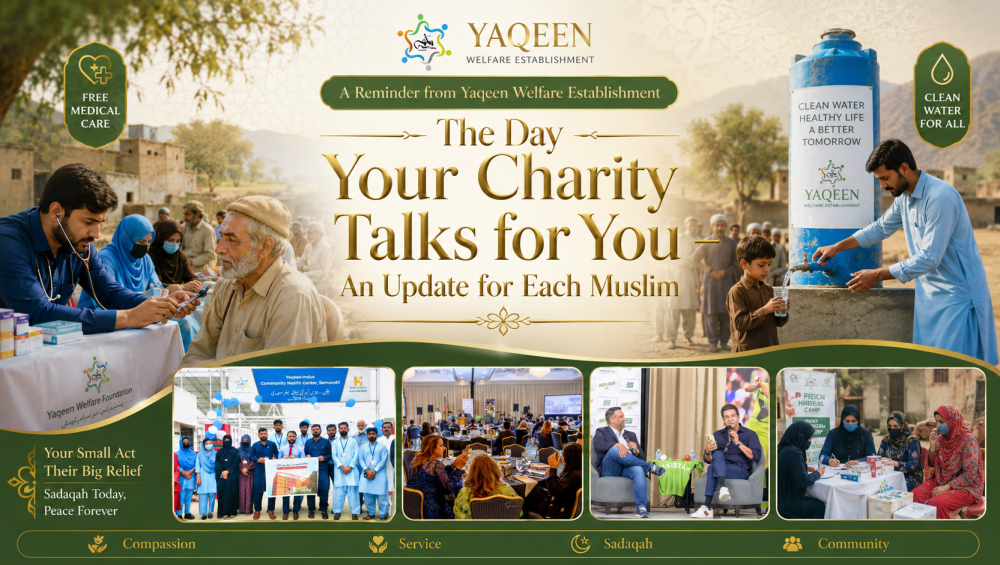
An Update for Every Muslim’s Sadaqah Jariyah

Sadaqah Jariyah is the one investment that does not stop paying out when you do. There will come a moment unlike any moment you have ever lived through — no lawyer standing beside you, no witness who owes you a favor, no chance to change what you said, fix what you chose, or revisit what you dismissed. The record will be sealed. Time will have run out. And the only things that will move — the only things that will rise and speak — are the deeds you sent forward while you still had the chance. Among all of them, charity holds a station unlike any other. It does not simply sit quietly in your record, waiting to be checked. It moves. It stands between you and the fire. It shades you from a heat no ordinary sun could compare to. It speaks — not with a voice, but with something far more powerful: with weight, with impact, with the changed lives it touched long after your hands let it go. This is an update for every Muslim — rich or struggling, healthy or unwell, young or aged — because the moment you have right now is the most valuable asset you possess. A Reminder About Sadaqah Jariyah We often talk about charity from the perspective of the recipient — the family lifted out of poverty, the child who now has clean water, the patient who received treatment they could never afford. All of that is real, and all of it matters. But there is a dimension to giving that we rarely pause long enough to fully absorb: one day, the giver will need what they gave — more urgently, more desperately, than anyone they ever helped. On the Day of Judgment, every soul will be searching for something to speak on its behalf. Wealth will not stand up. Degrees will not stand up. Reputation will not stand up. But Sadaqah Jariyah — ongoing charity given sincerely for the sake of Allah — will rise and present itself before your Lord. If you’re new to this concept, our companion piece on the Islamic blessings of helping the poor is a good starting point before diving deeper into what makes ongoing charity uniquely powerful. The Day When Nothing Else Will Matter Picture standing in a gathering unlike any gathering in history. Every human being who ever lived, assembled in one place. The sun brought near. The wait stretching beyond imagination. And in that moment, all the things that defined you in this world — your career, your assets, your social standing, your network — stripped away entirely. Allah ﷻ describes this Day with a clarity that should shake every heart: “The Day when neither wealth nor children will benefit anyone — except the one who comes to Allah with a sound heart.” (Surah Ash-Shu’ara, 26:88–89) A sound heart is the currency of that Day. And one of the most effective ways to purify and protect the heart in this life is through giving — sincerely, consistently, and without expectation of any worldly return. The Prophet ﷺ described a man who gave charity so secretly that his left hand did not know what his right hand gave, and he will be among the seven whom Allah shades beneath His throne on the Day when there is no shade but His (Sahih al-Bukhari). Not the one who gave the most. Not the one who gave most publicly. The one who gave sincerely. Sadaqah Jariyah in the Time of the Prophet ﷺ The companions of the Prophet ﷺ did not treat generosity as something reserved for moments of surplus. They gave when they had little. They gave when giving meant sacrifice. They gave because they genuinely believed — not theoretically, but in the marrow of their bones — that what they sent forward was more real and more lasting than what they kept. When the Muhajirun arrived in Madinah having left behind their homes, their businesses, and in many cases their families, the Ansar did not offer sympathy and send them on their way. They opened their homes. They divided their land. The Qur’an honored them for something extraordinary: “They give preference to others over themselves, even when they are themselves in need.” (Surah Al-Hashr, 59:9) This was not a one-time act of emergency generosity. It was a culture — a deeply rooted understanding that holding onto the world while a brother or sister suffered was simply not consistent with what it meant to believe. Aisha (RA) reported that the family of Muhammad ﷺ never ate their fill of wheat bread for three consecutive days until he passed from this world. He gave nearly everything away — not out of poverty forced upon him, but as a deliberate, continuous act of trust in Allah. When Charity Became Waqf — The Endowment Model of Sadaqah Jariyah Among the most brilliant institutions ever developed in human history is the Islamic concept of Waqf — a charitable endowment given once but continuing to benefit people for generations. This is Sadaqah Jariyah in its most structural form. The companions understood this concept instinctively. They didn’t just want to help the people of their time — they wanted their giving to outlast them. When Umar ibn al-Khattab (RA) acquired land in Khaybar, one of the finest pieces of land in Arabia, he asked the Prophet ﷺ what he should do with it. The Prophet ﷺ advised him to make the land itself endowed — unchangeable, permanent — and to give its produce to those in need. That land continued to feed and support the poor for generations after Umar (RA) had passed (Sahih al-Bukhari). Uthman ibn Affan (RA) purchased the Well of Rumah at his own expense, freeing it for public use when water access in Madinah was a pressing concern. He sought no repayment, attached no conditions, and gave it entirely for the sake of Allah — and the Prophet ﷺ promised him a spring in Paradise

CategoriesBlog

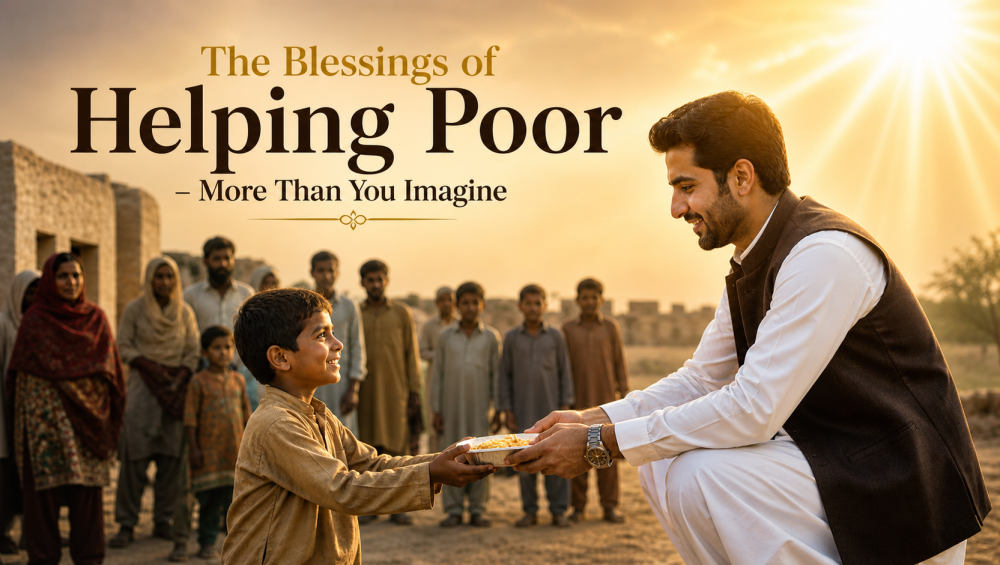
Islamic Blessings Of Helping The Poor

The Islamic blessings of helping the poor are far greater than most of us realize. We tend to think of charity as a one-way transaction: we give, someone else receives, and the story ends there. But in the Islamic worldview, that is only the visible half of the picture. Every rupee spent on a hungry family, every meal handed to a stranger, every school fee quietly paid for an orphan sets in motion a chain of reward, protection, and Barakah that often returns to the giver in ways they never expected — and may never even trace back to its source. At Yaqeen Welfare Foundation, we see both sides of this exchange every day: the immediate relief on the face of a mother who can finally feed her children, and the quiet, almost invisible transformation that takes place in the life of the person who made it possible. This article explores what the Quran and Sunnah teach us about the Islamic blessings of helping the poor, why these blessings matter more than ever in a country like Pakistan, and how you can begin tapping into them today. What Are the Islamic Blessings of Helping the Poor? When we talk about the Islamic blessings of helping the poor, we are not speaking in vague, sentimental terms. Islamic scripture is remarkably specific about the rewards attached to charity: Multiplication of reward — Allah describes charity as a seed that grows into seven hundred-fold reward (Surah Al-Baqarah, 2:261). Protection from calamity — The Prophet ﷺ taught that charity extinguishes sin “as water extinguishes fire” and shields the giver from harm. Barakah in wealth — Far from depleting resources, sincere giving is said to increase the giver’s provision in ways that cannot be measured on a balance sheet. Shade on the Day of Judgment — Charity given sincerely is described as a canopy that shelters the believer on a day when shelter will be scarce. Answered prayers from the recipient — The dua of someone you helped, especially when they had nowhere else to turn, carries a weight that ordinary supplications may not. These are not abstract promises reserved for scholars to debate. They are practical, lived realities that countless Muslims — including donors and field staff at Yaqeen Welfare Foundation — describe experiencing firsthand. The Quranic Foundation: A Loan to Allah One of the most striking metaphors in the Quran compares charity to a loan given directly to Allah: “Who is it that will loan Allah a goodly loan so He may multiply it for him many times over?” (Surah Al-Baqarah, 2:245) This verse reframes the entire act of giving. You are not simply parting with money; you are entering into a transaction with the Creator of wealth itself, who has guaranteed a return that exceeds anything available in this world. This single ayah is the theological backbone behind the Islamic blessings of helping the poor, and it explains why generations of Muslims have built their financial decisions around the principle of giving first and trusting Allah to provide. If you’d like to go deeper into the Quranic verses on charity and their context, our piece on understanding Sadaqah and Zakat in the Quran breaks this down verse by verse. Sadaqah Jariyah: Charity That Keeps Giving Long After You’re Gone Among the deepest Islamic blessings of helping the poor is the concept of Sadaqah Jariyah — ongoing charity whose reward continues to accumulate even after the giver has passed away. A water well dug for a thirsty village, a school built for children who will go on to educate their own children, knowledge shared that spreads across generations — each of these represents an investment whose dividends are paid not in currency, but in reward that compounds indefinitely. The Prophet ﷺ said: “When a person dies, his deeds end except for three: ongoing charity, beneficial knowledge, or a righteous child who prays for him.” (Muslim) This is why Yaqeen Welfare Foundation prioritizes projects like clean water systems and school infrastructure — they are designed specifically to keep generating reward for donors long after the initial donation is made. You can read more about how this works in our article on why Sadaqah Jariyah is the smartest long-term investment a Muslim can make. Historical Proof: How Early Muslims Understood These Blessings The earliest Muslims didn’t treat charity as an afterthought — they built entire civilizations around it. Mukhayriq and the First Waqf One of the earliest recorded acts of institutionalized giving in Islam was the endowment made by Mukhayriq, who donated seven orchards in Medina to the Prophet ﷺ with explicit instructions that their produce benefit the poor. This single act seeded what would become the Waqf system — a network of charitable endowments that would go on to fund hospitals, libraries, mosques, and travelers’ lodges across the entire Islamic world. Uthman ibn Affan and the Well of Rumah When the early Muslim community of Medina suffered from a severe shortage of clean drinking water, Uthman ibn Affan (RA) purchased a privately-owned well and dedicated it as a public trust, free for all to use. Centuries later, a modern agricultural endowment established in his name still operates in Saudi Arabia today — proof that one generous decision, made sincerely for Allah’s sake, can generate benefit for well over a thousand years. The Bimaristans of the Islamic Golden Age The Bimaristans — Islamic hospitals of the Abbasid and Umayyad periods — were funded almost entirely through Waqf endowments from merchants, scholars, and rulers who understood that their wealth was a trust, not a possession. These hospitals treated patients regardless of religion, social class, or ability to pay, and even discharged them with clothing and money to support their recovery. The entire system ran on the belief that helping the sick was an act of worship, and those who financed it were accumulating reward with every patient healed. The Prophet ﷺ told us plainly: “Charity does not decrease wealth.” (Muslim) This is not a metaphor

CategoriesBlog

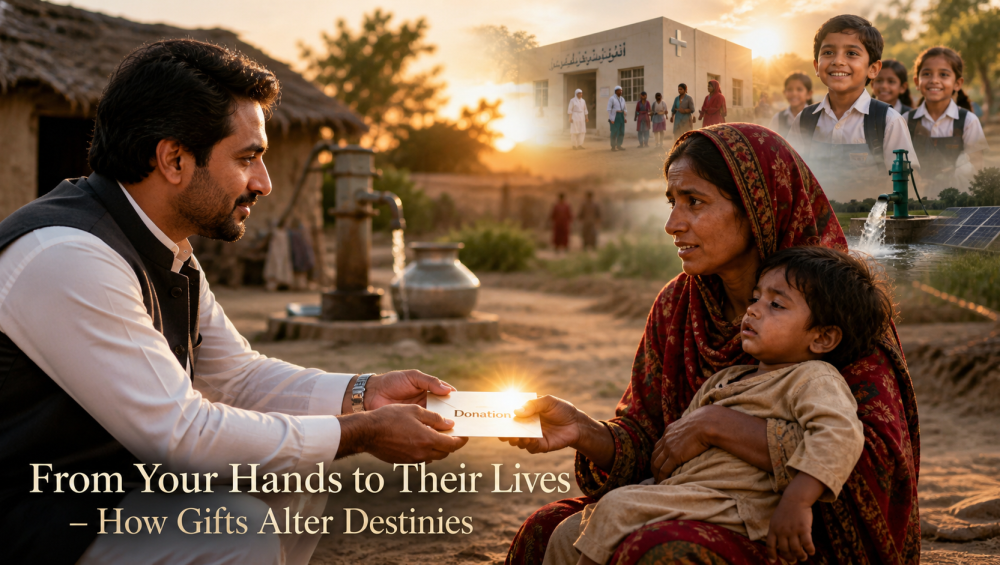
Islamic Giving Their Lives: A History of Transformation

Islamic giving is rarely measured the way the rest of the world measures generosity. Most people think little of the weight carried by a single act of charity. A moment of generosity — however small it feels on your end — carries a force that travels across distances, breaks through walls of despair, and lands in someone’s life like the first rain after a long dry season. At Yaqeen Welfare Foundation, we witness this quiet phenomenon constantly. What leaves your hand as a modest contribution arrives somewhere else as medicine, clean water, a meal, or the first real hope a family has felt in months. The transformation isn’t a metaphor. It’s real, measurable, and lasting. The Legacy of Islamic Giving: A History of Transformation Long before the language of “social impact” entered the world’s vocabulary, Islam had already built an entire civilization on the principle of voluntary generosity. The concept of giving was never passive — it was architecture. Islamic giving built hospitals, sustained libraries, supported the poor, and held entire societies together through a discipline of trust and collective care. The Well of Uthman (RA) When the people of Madinah were struggling to access clean water, Uthman ibn Affan didn’t simply make a donation — he purchased the Well of Rummah from a private owner and declared it a gift for every Muslim, traveler, and soul in need. That single decision, made over 1,400 years ago, continues to ripple forward to this day. The Saudi government later developed the surrounding land, and the proceeds from that very waqf continue to be distributed in Uthman’s name even now. One act. Fourteen centuries of reward. The Bimaristans of the Golden Age The hospitals of the Abbasid era were not charitable afterthoughts — they were architectural marvels, staffed by the era’s finest physicians, and funded entirely through waqf endowments given by merchants, rulers, and ordinary believers alike. Patients were treated regardless of their faith, their wealth, or their background. Musicians were even employed to ease the distress of those who were mentally unwell. Compassion was institutionalized, and it was made possible entirely through the sustained giving of a community that understood a simple truth: wealth is purified when it flows toward others. Fatima al-Fihri and the Power of Education In 859 CE, a Muslim woman named Fatima al-Fihri founded the University of al-Qarawiyyin in Fez — the oldest continuously operating university in the world — using her entire inheritance as an endowment. She fasted every day during its construction and only broke her fast the day its doors opened to students. Her endowment didn’t just feed the hungry; it fed the minds of generations that followed. These three stories alone capture what makes Islamic giving so distinct from charity as the modern world understands it. It was never about a single transaction. It was about building something that would keep giving long after the giver was gone — a principle Islam calls Sadaqah Jariyah. If you’d like to understand that concept in more depth, our article on The Power of Sadaqah Jariyah – A Lifetime of Reward explores exactly how a single act of charity can continue generating reward indefinitely. Where Your Gifts Go at Yaqeen Welfare Foundation Your giving becomes real, tangible change: 💧 Clean Water Projects — Turning unsafe water into a daily source of life. 🏥 Free Healthcare — Providing treatment, medicine, and care for those who cannot afford it. 🍲 Food & Emergency Support — Helping families survive when they have nothing left. 📚 Health Awareness — Teaching communities how to manage their health and prevent future crises. The Prophet ﷺ reminded us: “The best of people are those who bring the most benefit to others.” When you donate through Yaqeen Welfare Foundation, you are not performing a modern transaction. You are joining a legacy of believers whose hands have always reached toward the struggling, the sick, and the overlooked — and whose rewards continue to accumulate long after they have returned to their Lord. The Intersection of Education and Health Care in Pakistan Pakistan stands at a critical crossroads. It is a country of remarkable resilience and talent, yet millions of its people remain trapped in cycles of preventable illness — not because medicine doesn’t exist, but because knowledge hasn’t reached them. Waterborne diseases claim thousands of young lives every year. Maternal mortality rates in rural areas remain heartbreakingly high. Children go malnourished not always because of poverty alone, but often because families lack the information needed to make the most of what they have. This is where health education becomes as life-saving as any surgical procedure. For a closer look at how Yaqeen approaches this gap on the ground, our post on Building a Future for Free Healthcare: Why Modern Infrastructure Is the Key to Healing Pakistan goes deeper into the infrastructure side of this challenge. The Hidden Crisis of Preventable Illness A child doesn’t fall sick simply because bacteria exist in the world. The illness takes hold because a family doesn’t know how to properly store water, or doesn’t recognize the early signs of dehydration, or believes a fever will pass without treatment. When communities receive organized guidance on basic hygiene, nutrition, and preventive care, hospital admission rates in those regions drop measurably. The illness was never inevitable — it was a gap in knowledge. Mothers as the First Healthcare System In rural Pakistan, a mother is often the only healthcare resource a child has access to. She decides what the child eats, how wounds are cleaned, when to seek help, and how to manage illness at home in the hours before a doctor becomes available. When Yaqeen Welfare Foundation reaches a mother with health education — not just pamphlets, but real, practical, culturally sensitive training — that woman becomes a shield for her entire family. Her knowledge compounds over time, passes to her daughters, and spreads through her community. Community Knowledge as Lasting Infrastructure A course of antibiotics heals one patient. A season