Yaqeen Welfare Foundation

7 Mistakes People Make When Calculating Zakat (And How to Fix Them) CategoriesBlog

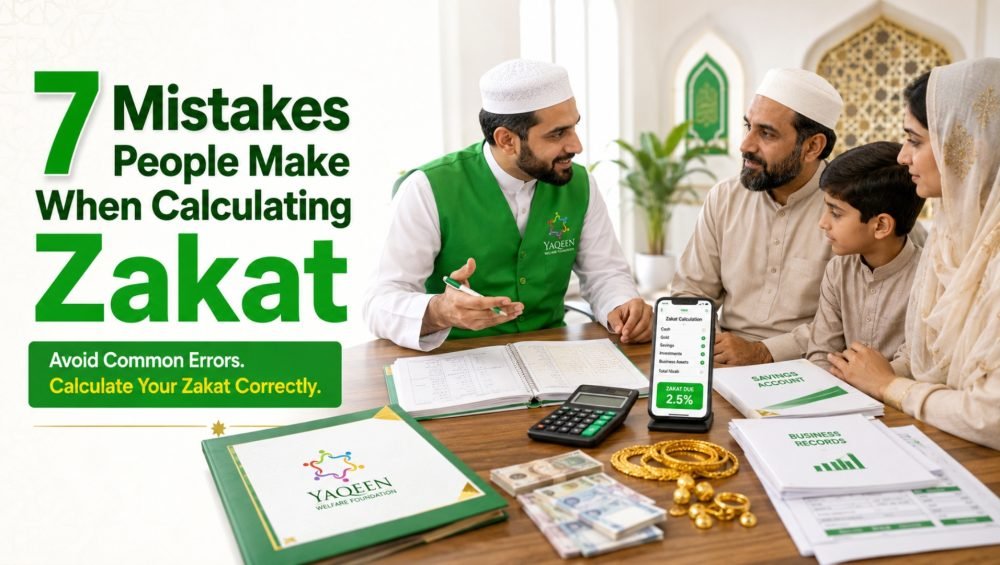
7 Mistakes People Make When Calculating Zakat

Calculating Zakat correctly is one of the most important financial and spiritual responsibilities a Muslim carries every year, yet it is also one of the most commonly miscalculated. Zakat is not a rough estimate or a symbolic gesture — it is a precise obligation, the third pillar of Islam, and a right that the poor have over the wealth of the rich. Small errors in calculating Zakat can mean underpaying what is owed to the needy, overpaying unnecessarily, or missing the obligation entirely for an entire lunar year. At Yaqeen Welfare Foundation, we work directly with underserved communities in Pakistan, and every Zakat contribution we receive is used to fund free medical treatment, clean water projects, and emergency relief for families who have nowhere else to turn. Because so much depends on accuracy, this guide walks through the seven most common mistakes people make when calculating Zakat, why each one matters, and exactly how to correct it — whether you are calculating for the first time or reviewing your approach after several years of giving. Why Calculating Zakat Correctly Matters Zakat is not simply “giving some charity when you feel generous.” It is a fixed, structured obligation: 2.5% of qualifying wealth that has been in your possession for a full lunar year (known as the hawl), once your net assets exceed a minimum threshold called the nisab. Getting this number wrong has real consequences. If you underpay, you fall short of a religious duty and the poor receive less than what is rightfully theirs. If you overpay, you may be giving away money you actually need, or double-counting assets that were never zakatable in the first place. If you miscalculate the timing, you might delay your Zakat past its due date or pay it before it is actually owed. This is precisely why calculating Zakat with care — rather than guessing — protects both your finances and your standing before Allah. Organizations such as Islamic Relief Worldwide note that Zakat is based on the total value of zakatable assets a person owns, including cash, gold, silver, savings, and business assets, minus deductible short-term liabilities. Getting each of those categories right is where most people go wrong. Quick Recap: What Is Zakat and Who Must Pay It Before looking at the mistakes, it helps to recap the basics: Zakat is obligatory on every sane, adult Muslim whose wealth reaches the nisab threshold. The nisab is based on the value of either 87.48 grams of gold or 612.36 grams of silver, according to figures widely cited by Islamic charities and referenced on Wikipedia’s overview of Zakat. Wealth must remain above the nisab for one full lunar (Hijri) year before Zakat becomes due. The Zakat rate is a fixed 2.5% of qualifying net wealth. With that foundation in place, let’s look at where people commonly go wrong when calculating Zakat. 7 Common Mistakes People Make When Calculating Zakat Mistake 1: Not Knowing the Nisab Threshold The single biggest mistake in calculating Zakat is skipping the nisab check altogether. Many people assume they owe Zakat simply because they have savings, without first confirming whether their total wealth actually exceeds the minimum threshold. Others use an outdated nisab figure from a previous year, forgetting that gold and silver prices shift daily. The fix: Check the current gold and silver rates before you begin. Most scholars recommend using the silver nisab (612.36 grams) rather than the gold nisab (87.48 grams), since the silver value is almost always lower — meaning more people qualify to give, and more support reaches those in need. You can use the Yaqeen Zakat Calculator to check this automatically against live rates rather than relying on memory. Mistake 2: Confusing Zakat with Sadaqah or Fitrana Zakat, Sadaqah, and Fitrana are all forms of charity in Islam, but they are not interchangeable, and treating them as the same thing is a frequent error when calculating Zakat. Sadaqah is voluntary charity with no fixed amount or timing. Fitrana (Zakat al-Fitr) is a separate, smaller obligation paid before Eid prayer to ensure every Muslim — rich or poor — can celebrate Eid with dignity. Zakat, by contrast, is calculated annually on wealth and paid at 2.5%. Some people mistakenly count their Fitrana payment toward their Zakat obligation, or assume that any charitable giving throughout the year automatically “covers” their Zakat. It does not. If you want to understand the distinction more fully and calculate Fitrana separately, the Yaqeen Fitrana Calculator is a useful companion tool alongside the Zakat calculator. Mistake 3: Ignoring Debts and Liabilities Another common error is calculating Zakat on gross assets without subtracting short-term debts and liabilities. Zakat is due on net zakatable wealth, not your total account balance. If you owe money that is due imminently — a credit card bill, an overdue loan installment, unpaid rent — that amount can typically be deducted before you calculate your 2.5%. However, this doesn’t mean every debt is deductible. Long-term liabilities like the full remaining balance of a mortgage or student loan are generally not subtracted in full; only the portion that is currently due is deducted. People often make the opposite mistake here too — deducting an entire multi-year loan balance and dramatically underpaying their Zakat as a result. The fix: List your zakatable assets first (cash, savings, gold, silver, investments, business inventory), then subtract only debts and bills that are due imminently, not your entire long-term debt load. Mistake 4: Using the Wrong Zakat Rate It sounds basic, but miscalculating the percentage itself is surprisingly common. Zakat on standard wealth — cash, savings, gold, silver, business assets — is 2.5%. Some people confuse this with the rate applied to agricultural produce (which can be 5% or 10% depending on irrigation method) or with the rate for livestock, which follows an entirely different structure based on the number and type of animals owned. If you are only calculating Zakat on cash, gold, silver, and investments, the rate is a flat 2.5%

CategoriesBlog

Understanding Zakat: Importance, Calculation, and Impact

Understanding Zakat is one of the most important responsibilities a Muslim can undertake — not merely as a religious formality, but as a living, breathing act of justice that connects the prosperous to the vulnerable in ways that ripple across generations. Zakat is not charity in the conventional sense. It is a divinely mandated redistribution of wealth, a recognition encoded in Islamic law that the poor carry an inherent right over the surplus of the rich. Before you calculate a number and transfer a sum, it helps to understand what Zakat truly is, why it exists, and what it sets in motion when it leaves your hands. At Yaqeen Welfare Foundation, we have had the privilege of witnessing something most donors never see — the transformation that unfolds on the other side of a commitment. We see it in families who can finally afford medication, in children eating a proper meal for the first time in days, and in the quiet dignity restored to those the world had forgotten. This guide is your complete resource for understanding Zakat: its sacred foundation, the rules of calculation, the people it reaches, and the unseen effects it produces long after the moment of giving has passed. The Sacred Foundation: What Zakat Means in Islam The word Zakat comes from the Arabic root z-k-w, which carries meanings of growth, increase, and purification. This is not accidental. Zakat is not described in the Quran as a tax, a donation, or even a gift — it is described as purification. The act of releasing a portion of your wealth does not diminish you. It cleanses you. Allah (SWT) commands in the Quran: “Take from their wealth a portion as charity, purifying them and cleansing them thereby, and pray for them.” — Surah At-Tawbah, 9:103 As one of the Five Pillars of Islam, Zakat stands alongside the Shahada, Salah, Sawm, and Hajj as a non-negotiable pillar of the faith. It is obligatory for every sane, adult Muslim whose accumulated wealth meets or exceeds the Nisab threshold and has remained at or above that threshold for a full lunar year. Once those conditions are satisfied, 2.5% of eligible wealth becomes due — not as a favor to the needy, but as their lawful share. Historically, Zakat operated as a robust economic safety net across Muslim societies. During the caliphate of Umar ibn Abd al-Aziz, collectors reportedly returned from certain regions unable to find eligible recipients — a testament to what systematic, faith-driven wealth redistribution can achieve when implemented with integrity and care. This was not coincidence. It was the result of a principle applied with commitment. Understanding Zakat in this historical context reveals something profound: this institution has the power to eliminate poverty entirely, not just reduce it. The question is not whether Zakat works. The question is whether we give it fully, calculate it honestly, and direct it wisely. Who Is Required to Pay Zakat? Zakat becomes obligatory when three conditions are met: 1. Minimum Wealth Threshold (Nisab) Your total zakatable wealth must equal or exceed the Nisab — currently calculated based on the market value of either 87.48 grams of gold or 612.36 grams of silver. Most scholars recommend using the silver Nisab, as it is the lower threshold and therefore more inclusive. 2. Full Lunar Year (Hawl) Your wealth must have remained at or above the Nisab for a complete lunar year. Wealth that comes and goes below the threshold within the year is not subject to Zakat. 3. Full Ownership The wealth must be in your complete ownership — not borrowed, not pledged, not legally encumbered. You must have both physical possession and free disposal of the assets. If all three conditions are met, Zakat is not optional. Withholding it is not simply a lapse in generosity; it is a failure to fulfill a divine obligation. How to Calculate Zakat: A Step-by-Step Guide Understanding Zakat calculation removes the uncertainty that prevents many Muslims from giving the correct amount. The process is straightforward when broken down clearly. Step 1 — Determine Your Zakatable Assets Not all assets qualify. The following categories are subject to Zakat: Asset Category What to Include Rate Cash & Savings Current accounts, savings accounts, cash on hand 2.5% Gold & Silver Jewellery, bullion, coins held as wealth 2.5% Investment Holdings Stocks, rental income, business dividends 2.5% Business Inventory Goods held for commercial sale 2.5% Outstanding Loans Money lent to others expected to be returned 2.5% Exempt Assets Primary home, personal vehicle, clothing, household items Exempt Step 2 — Check Against the Nisab Add up all your zakatable assets. If the total equals or exceeds the Nisab value, you proceed to calculation. If it falls below, no Zakat is due for that year. Step 3 — Apply the 2.5% Rate Zakat is calculated at a fixed rate of 2.5% — one-fortieth of your qualifying wealth. If your total zakatable assets amount to, for example, $20,000, your Zakat due would be $500. You can use the Yaqeen Welfare Foundation Zakat Calculator for a quick and accurate calculation tailored to current Nisab values. One important note: scholars differ on whether gold jewellery worn regularly for personal use is zakatable. If you are uncertain about any specific asset, consult a trusted Islamic scholar for guidance specific to your situation. The Eight Categories of Zakat Recipients The Quran specifies in Surah At-Tawbah (9:60) exactly who is entitled to receive Zakat. These are not general guidelines — they are divine designations: Al-Fuqara (The Deeply Impoverished) — Those who possess less than the Nisab and struggle to meet even the most basic necessities of life. These are people living in severe, ongoing deprivation. Al-Masakeen (The Poor) — Those who have some income or assets but still cannot adequately cover their needs. They may be working but remain in hardship. Al-Amileen (Zakat Administrators) — Those who collect, manage, and distribute Zakat. Their compensation from Zakat funds ensures the system operates with integrity. Al-Muallafatu Qulubuhum (Those Whose Hearts Are