
Yaqeen Welfare Foundation

Sadaqah Jariyah: 5 Forms of Forgotten Charity Allah Never Forgets CategoriesBlog

Sadaqah Jariyah: 5 Forms of Forgotten Charity Allah Never Forgets

Sadaqah Jariyah is the one kind of giving that does not end when the transaction does. It is the donation you made years ago and have long since forgotten — the one Allah never did. There are deeds you remember giving. And then there are deeds you have long since forgotten. The donation made years ago on a quiet evening. The few pounds given after a Friday khutbah when someone spoke about a well in a faraway village. The amount you rounded up at the end of a campaign because the number felt right. You forgot. Of course you did. Life moved on. The receipt faded from your inbox. The cause slipped from your memory as the next week arrived, and the one after that. But here is what you must understand: Allah did not forget. Not a single reward has been lost. Not a single benefit your charity produced has gone unrecorded. While you moved on with your life — raising your children, navigating your work, carrying your worries — something you set in motion continued to move. Quietly. Faithfully. On your behalf. This is the nature of Sadaqah Jariyah, and it is one of the most extraordinary gifts Allah has placed within human reach. What Makes a Charity “Ongoing”? The Arabic word jariyah carries the image of flowing water — something in continuous motion, never static, never exhausted. Sadaqah Jariyah is not simply a large donation or a noble cause. It is charity that keeps producing benefit after the act of giving has ended. Most of what we do in this world is transactional. We act, the act completes, and the ledger closes. A meal given ends when the plate is empty. A kind word lands and is then carried away by the next conversation. These deeds are not diminished for it — they are beloved acts. But they are finite. Sadaqah Jariyah breaks that pattern entirely. “When a person dies, all their deeds come to an end except three: ongoing charity, beneficial knowledge, or a righteous child who prays for them.” — Sahih Muslim 1631 Read those words again, slowly. All deeds come to an end. The prayers, the fasts, the efforts, the striving — all of it sealed the moment the soul leaves the body. But ongoing charity does not come to an end. It continues. It accumulates. It works for you in the unseen, long after you can work for yourself. This is not poetry. This is a divine promise, delivered through the Prophet ﷺ, about how your account with Allah actually works. Why This Matters More Than You Think Most people assume reward is tied to memory — that you have to remember a good deed for it to “count” toward you. Sadaqah Jariyah dismantles that assumption completely, and that is precisely why it deserves a closer look. The Reward That Was Never Waiting for Your Memory We tend to think of reward as something tied to awareness. We remember a good deed, we feel the weight of it, we hope it was accepted. But Sadaqah Jariyah operates entirely outside of human memory. Consider what this means in practice. Somewhere, a child draws clean water from a pump and carries it home. Your reward is written. A mother in a village you have never heard of washes her infant’s fever with clean water from that same source. Your reward is written again. A patient with no money sits before a doctor in a free clinic and receives care they could not have afforded. Your name is inscribed in a ledger no human eye can read. A family that once faced destitution finds steady ground. Their children grow up with possibilities that did not exist a generation before. Something you gave, perhaps years ago, is part of that story. You do not need to know about any of this. You do not need to remember. The accounting has never depended on you — and that is the quiet power of Sadaqah Jariyah. What Travels With You When Everything Else Stays Behind We spend our lives building things — careers, homes, reputations, savings. We accumulate. And almost all of what we accumulate will remain here, passed to others or dissolved entirely, when we leave. Islamic scholars have long described a person in their grave — unaware of the world above, beyond the reach of human intercession — yet continuing to receive. A stream of reward arriving from a water source still flowing. From a hospital still treating. From a family whose stability still holds. The gift was released once. Its effect was never released. Sadaqah Jariyah is, in the truest sense, the one thing you take with you. Not a record of what you owned. Not a monument to your name. Something far more valuable: an open account, still receiving, long after your capacity to earn has closed. If you are new to the broader landscape of Islamic giving and want to understand how Sadaqah Jariyah fits alongside other obligations, our guide on Best Times and Methods for Giving Sadaqah in Islam is a useful next read. Sadaqah Jariyah vs. Other Forms of Giving It helps to see how ongoing charity compares to other categories of giving in Islam. The table below breaks down the key differences: Type of Giving Is It Obligatory? When Does the Reward End? Typical Example Zakat Yes (annual, on qualifying wealth) Reward is for the single act of payment Annual zakat on savings or gold Sadaqah No (voluntary) Reward is for the single act of giving Cash given to a person in need Sadaqah Jariyah No (voluntary) Reward continues as long as the benefit continues A water pump, a free clinic, a school Waqf (endowment) No (voluntary) Often a permanent form of Sadaqah Jariyah A mosque, a hospital wing, an orphan home Notice the distinguishing feature in the third row: with Sadaqah Jariyah, the reward is not capped by the moment of giving. It is capped only by how long
CategoriesBlog

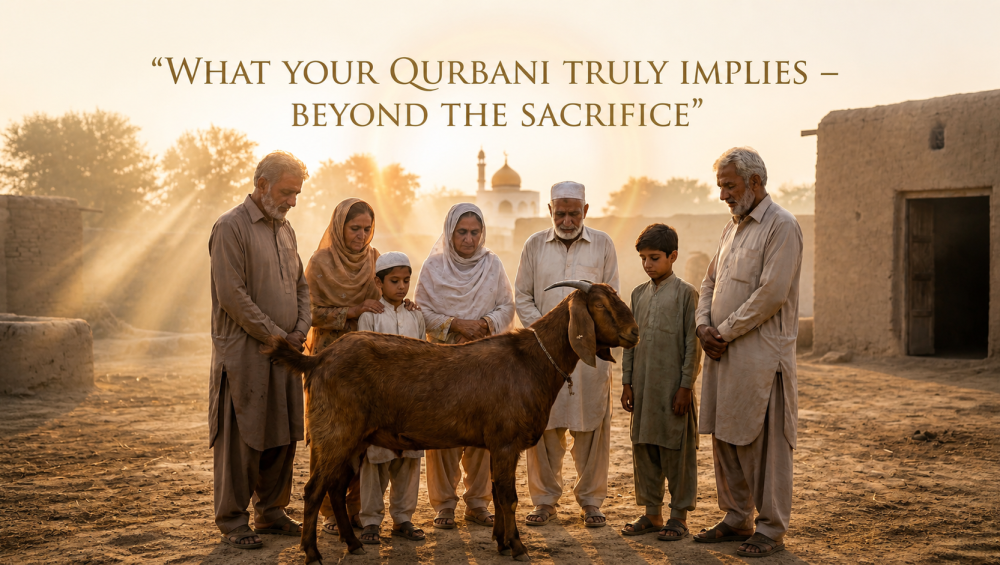
What Your Qurbani Truly Implies — Past the Sacrifice

There are minutes in life that arrive unobtrusively, wrapped in recognition, however carry a weight distant more prominent than we frequently acknowledge. Qurbani is one of them. Each year, as the favored days of Dhul Hijjah draw close, something mixes inside the hearts of Muslims over the world. There is a arrangement — not fair of coordinations, but of the soul. A acknowledgment that something sacrosanct is approaching. Yet, in the surge of every day life, indeed the sacrosanct can gotten to be routine. We set reminders. We exchange funds. We affirm arrangements. And some time recently long, the act is done — checked off, completed, moved past. But Qurbani was never planned to be something you essentially finish. It was planned to reshape something interior you. It was outlined to hinder the clamor of life and return you to what is genuine — to your Maker, to your reason, and to the individuals around the world who are holding up, discreetly and persistently, for a favoring to reach them. The address Qurbani inquires of each Muslim is not fair “Did you do it?” The more profound address is: “Did it do something to you?”   What Is Qurbani — And Why Does It Carry Such Significant Weight? Every year, over each corner of the soil, Muslims assemble amid the days of Eid ul-Adha to perform Qurbani — the custom give up of an creature committed completely to the joy of Allah. At its most obvious layer, the act shows up simple. An creature is chosen. A give up is made. The meat is conveyed — to family, to neighbors, to those in need. But to diminish Qurbani to these steps alone is to miss the endless, living sea underneath the surface. Qurbani is, at its root, a re-enactment of one of the most exceptional tests of confidence ever recorded in human history. It is a story that does not develop ancient, no matter how numerous times it is told — since its truth is timeless. Prophet Ibrahim (AS) was not an standard man. He had as of now strolled through fire — actually — for the purpose of his Ruler. He had cleared out behind consolation, community, and certainty to take after a way that few seem get it. His confidence was not hypothetical. It had been tried, solidified, and demonstrated through decades of sacrifice. Yet, Allah set some time recently him one last, shattering trial. In a dream — unmistakable and verifiable — he gotten a command: give up your child. Not a ownership. Not riches. Not comfort. His child. His child. The one he had held up and supplicated for all through the long a long time of his life. And however, Ibrahim (AS) did not falter. He did not deal or arrange. He did not inquire for time to prepare. He turned to his child, Ismail (AS), and shared what Allah had revealed. What taken after is one of the most breathtaking minutes in all of prophetic history. Ismail (AS) — youthful, steadfast, completely mindful of what was being inquired — reacted without flinching: “O my father, do as you are commanded. You will discover me, if Allah wills, among the persistent.” — Qur’an 37:102 Two individuals. One divine command. And a level of yield that most of us can scarcely start to imagine. As the minute of give up drawn closer and both souls submitted totally, Allah intervened: “O Ibrahim, you have satisfied the vision.” — Qur’an 37:104–105 A smash was given in put of Ismail (AS). The trial was complete. But here is the message that echoes over each Qurbani since: Allah did not require the misfortune of life. He required the yield of the heart. That is what Qurbani commemorates. Not basically a physical act — but a add up to yielding of the self to the will of Allah, indeed when everything inside you trembles.   Beyond the Physical Act: What Allah Genuinely Accepts It is simple, when examining Qurbani, to ended up devoured by the subtle elements of the act itself. Which creature qualifies? What are the conditions? When must it be done? These are substantial questions, and they matter. But if we halt there, we have as it were caught on the shell of Qurbani — not its core. Allah, in His interminable intelligence, has made the genuine nature of this act unmistakably clear: “It is not one or the other their meat nor their blood that comes to Allah, but it is your taqwa — your mindfulness and dedication — that comes to Him.” — Qur’an 22:37 This verse is not a commentary. It is the whole point. The physical give up is the vehicle. The heart is the destination. What this implies in hone is that two individuals can perform the correct same Qurbani — same creature, same time, same prepare — and one act may take off to the sky whereas the other scarcely lifts off the ground. The contrast is not obvious to the human eye. The contrast is intention. It is the inside pose of the individual giving. Are they giving since they truly feel appreciation to Allah for all He has provided? Are they giving with a heart that perceives its reliance on its Creator? Are they giving with an mindfulness that this act is not a exchange — not an trade for favors — but a earnest expression of cherish and devotion? Or are they giving out of social desire, out of propensity, out of a crave to satisfy an commitment and move on? Qurbani, in this sense, is one of the most genuine mirrors a individual can hold up to themselves. It inquires, without statement of regret: Who are you truly doing this for? The reply to that address — whispered in the calm of the heart — is absolutely what comes to Allah.   Qurbani as a Individual Test: What Are You Willing to Let Go? The bequest of Ibrahim