Yaqeen Welfare Foundation

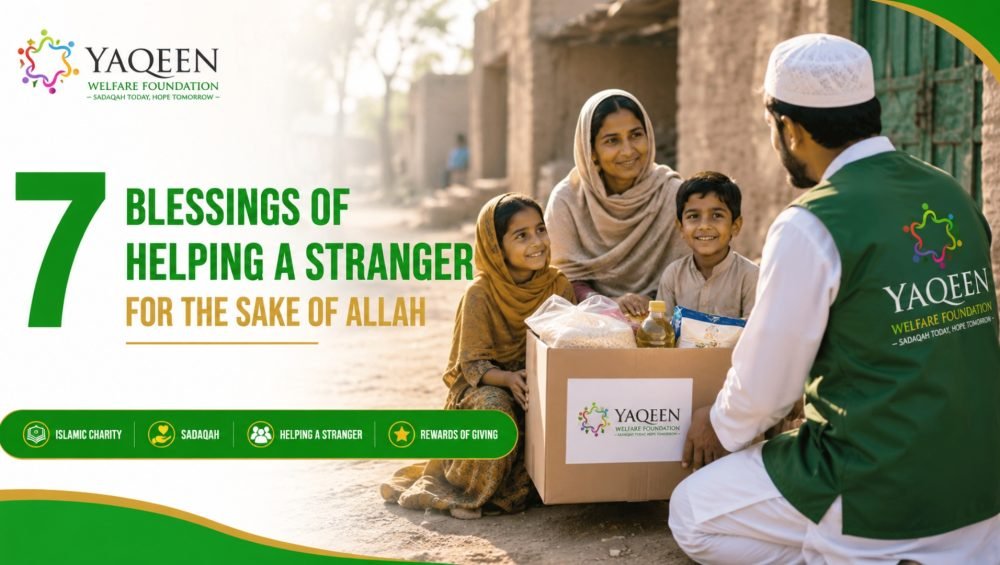
7 Blessings of Helping a Stranger for the Sake of Allah CategoriesBlog

7 Blessings of Helping a Stranger for the Sake of Allah

The 7 Blessings of Helping a stranger for the sake of Allah represent one of the most profound acts a Muslim can perform — a deed witnessed fully only by the One who sees all things. When you reach out to someone you have never met and will never meet again, with no expectation of gratitude or recognition, you place your trust entirely in Allah. And Allah, as the Prophet ﷺ assured us, never leaves such trust unrewarded. At Yaqeen Welfare Foundation, we carry your giving to families across Pakistan — families you will never meet, in cities you may never visit. Every donation, however small, becomes an act of helping a stranger for the sake of Allah alone. This article explores the spiritual weight and divine rewards behind that act, drawing directly from the Quran and the Sunnah of the Prophet ﷺ. What Does It Mean to Help a Stranger for the Sake of Allah? To help someone “for the sake of Allah” (fi sabilillah) means your intention is directed purely toward pleasing Allah — not gaining praise from others, not building a social reputation, and not even witnessing the outcome of your generosity. The stranger you help does not know your name. They do not know what it cost you — whether you gave from abundance or from the little that remained. Yet Allah knows all of it: every hesitation, every sacrifice, every silent intention held within the heart. This kind of giving stands apart from ordinary charity. It is charity at its most sincere because the human scaffolding of reward — gratitude, recognition, reciprocity — has been entirely removed. What remains is the act, the intention, and Allah. The Quran speaks directly to this quality of giving: “Those who spend their wealth in the way of Allah and do not follow up what they have spent with reminders of it or hurt, they will have their reward with their Lord, and there will be no fear concerning them, nor will they grieve.” (Surah Al-Baqarah, 2:262) The 7 Blessings of Helping a Stranger for the Sake of Allah Blessing 1: Allah Relieves Your Burden on the Day of Judgement The first and most extraordinary of the 7 Blessings of Helping is a divine promise of relief when it matters most. The Prophet Muhammad ﷺ said: “Whoever relieves a Muslim of a burden from the burdens of the world, Allah will relieve him of a burden from the burdens on the Day of Judgement.” (Sahih Muslim) When you carry someone else’s hardship — even partially, even for a moment — Allah carries yours on the Day when no human helper can reach you. The stranger you fed, clothed, or supported in this world becomes, through the mercy of Allah, a source of relief for you in the next. This transaction cannot be replicated by any act done purely for human reward. Blessing 2: Allah Becomes Your Aid as Long as You Aid Others Among the most beautiful of the 7 Blessings of Helping is the continuous divine support that follows a generous heart. The Prophet ﷺ said: “Allah is in the aid of His servant as long as His servant is in the aid of his brother.” (Sahih Muslim) This is not a one-time reward but an ongoing state. The moment you turn toward a stranger in their need, something turns toward you. Allah’s help surrounds you in proportion to your willingness to help others. Those who give consistently — through monthly charity, regular food support, or sustained welfare programmes — live continuously within this promise. At Yaqeen Welfare Foundation, our Ongoing Family Food Support programme embodies exactly this principle: consistent help, month after month, for families where poverty is not a crisis but a permanent condition. Blessing 3: The Du’a of a Stranger Is Among the Swiftest to Be Answered When a person in genuine need lifts their hands and makes du’a — for their children, for themselves, and for the stranger who helped them — the scholars of Islam noted that such a supplication carries special weight. The Prophet ﷺ confirmed: “The supplication of the oppressed is not veiled from Allah, even if the person is a sinner.” (Tirmidhi) The stranger you help does not know your name. But their du’a carries you within it — unnamed, unrecognised by any human, yet known to Allah in complete detail. Every prayer they make for “the one who helped me” reaches the One who knows precisely who that is. You receive a share of every word. This is the invisible dimension of charitable giving that human accounting cannot measure — and it is one of the most powerful of all the 7 Blessings of Helping. Blessing 4: Shade on the Day When There Is No Shade But Allah’s The Prophet ﷺ described seven categories of people who will be shaded by Allah on the Day of Judgement — a day so intense that the sun will be brought close to mankind. Among them: “A man who gives in charity so secretly that his left hand does not know what his right hand has given.” (Sahih Bukhari) Helping a stranger is, by its very nature, secret giving. The stranger cannot publicise your generosity. They cannot name you in praise. They received your giving and walked on — and you walked on too. The act was between you and Allah alone. And that shade, on the Day when every other form of comfort will be stripped away, is the return of an act that no one else witnessed. Blessing 5: Your Sadaqah Returns to You Multiplied The Quran uses one of its most vivid images to describe what happens to wealth given in the way of Allah: “The example of those who spend their wealth in the way of Allah is like a seed of grain which grows seven spikes; in each spike is a hundred grains. And Allah multiplies for whom He wills.” (Surah Al-Baqarah, 2:261) A single seed
CategoriesBlog

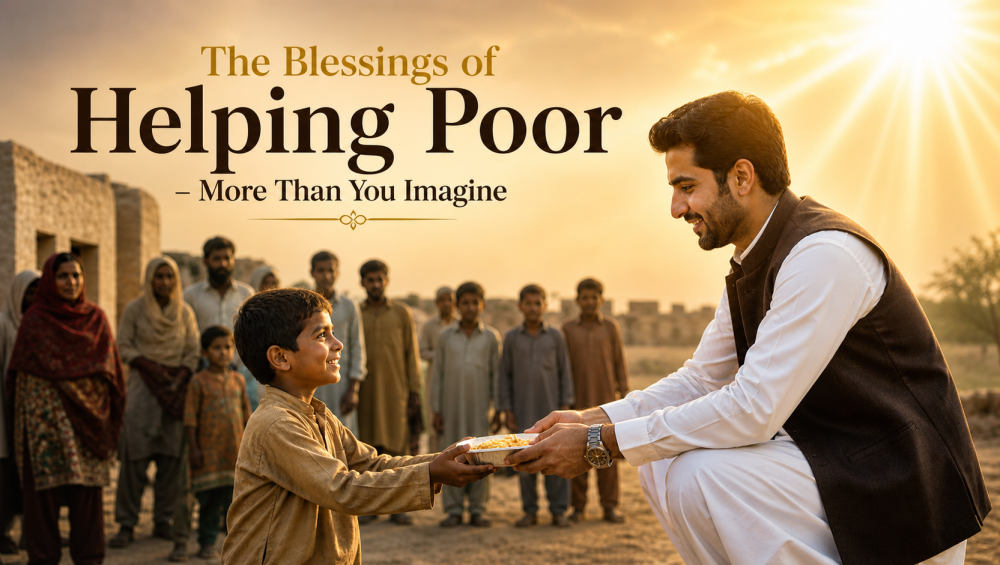
Islamic Blessings Of Helping The Poor

The Islamic blessings of helping the poor are far greater than most of us realize. We tend to think of charity as a one-way transaction: we give, someone else receives, and the story ends there. But in the Islamic worldview, that is only the visible half of the picture. Every rupee spent on a hungry family, every meal handed to a stranger, every school fee quietly paid for an orphan sets in motion a chain of reward, protection, and Barakah that often returns to the giver in ways they never expected — and may never even trace back to its source. At Yaqeen Welfare Foundation, we see both sides of this exchange every day: the immediate relief on the face of a mother who can finally feed her children, and the quiet, almost invisible transformation that takes place in the life of the person who made it possible. This article explores what the Quran and Sunnah teach us about the Islamic blessings of helping the poor, why these blessings matter more than ever in a country like Pakistan, and how you can begin tapping into them today. What Are the Islamic Blessings of Helping the Poor? When we talk about the Islamic blessings of helping the poor, we are not speaking in vague, sentimental terms. Islamic scripture is remarkably specific about the rewards attached to charity: Multiplication of reward — Allah describes charity as a seed that grows into seven hundred-fold reward (Surah Al-Baqarah, 2:261). Protection from calamity — The Prophet ﷺ taught that charity extinguishes sin “as water extinguishes fire” and shields the giver from harm. Barakah in wealth — Far from depleting resources, sincere giving is said to increase the giver’s provision in ways that cannot be measured on a balance sheet. Shade on the Day of Judgment — Charity given sincerely is described as a canopy that shelters the believer on a day when shelter will be scarce. Answered prayers from the recipient — The dua of someone you helped, especially when they had nowhere else to turn, carries a weight that ordinary supplications may not. These are not abstract promises reserved for scholars to debate. They are practical, lived realities that countless Muslims — including donors and field staff at Yaqeen Welfare Foundation — describe experiencing firsthand. The Quranic Foundation: A Loan to Allah One of the most striking metaphors in the Quran compares charity to a loan given directly to Allah: “Who is it that will loan Allah a goodly loan so He may multiply it for him many times over?” (Surah Al-Baqarah, 2:245) This verse reframes the entire act of giving. You are not simply parting with money; you are entering into a transaction with the Creator of wealth itself, who has guaranteed a return that exceeds anything available in this world. This single ayah is the theological backbone behind the Islamic blessings of helping the poor, and it explains why generations of Muslims have built their financial decisions around the principle of giving first and trusting Allah to provide. If you’d like to go deeper into the Quranic verses on charity and their context, our piece on understanding Sadaqah and Zakat in the Quran breaks this down verse by verse. Sadaqah Jariyah: Charity That Keeps Giving Long After You’re Gone Among the deepest Islamic blessings of helping the poor is the concept of Sadaqah Jariyah — ongoing charity whose reward continues to accumulate even after the giver has passed away. A water well dug for a thirsty village, a school built for children who will go on to educate their own children, knowledge shared that spreads across generations — each of these represents an investment whose dividends are paid not in currency, but in reward that compounds indefinitely. The Prophet ﷺ said: “When a person dies, his deeds end except for three: ongoing charity, beneficial knowledge, or a righteous child who prays for him.” (Muslim) This is why Yaqeen Welfare Foundation prioritizes projects like clean water systems and school infrastructure — they are designed specifically to keep generating reward for donors long after the initial donation is made. You can read more about how this works in our article on why Sadaqah Jariyah is the smartest long-term investment a Muslim can make. Historical Proof: How Early Muslims Understood These Blessings The earliest Muslims didn’t treat charity as an afterthought — they built entire civilizations around it. Mukhayriq and the First Waqf One of the earliest recorded acts of institutionalized giving in Islam was the endowment made by Mukhayriq, who donated seven orchards in Medina to the Prophet ﷺ with explicit instructions that their produce benefit the poor. This single act seeded what would become the Waqf system — a network of charitable endowments that would go on to fund hospitals, libraries, mosques, and travelers’ lodges across the entire Islamic world. Uthman ibn Affan and the Well of Rumah When the early Muslim community of Medina suffered from a severe shortage of clean drinking water, Uthman ibn Affan (RA) purchased a privately-owned well and dedicated it as a public trust, free for all to use. Centuries later, a modern agricultural endowment established in his name still operates in Saudi Arabia today — proof that one generous decision, made sincerely for Allah’s sake, can generate benefit for well over a thousand years. The Bimaristans of the Islamic Golden Age The Bimaristans — Islamic hospitals of the Abbasid and Umayyad periods — were funded almost entirely through Waqf endowments from merchants, scholars, and rulers who understood that their wealth was a trust, not a possession. These hospitals treated patients regardless of religion, social class, or ability to pay, and even discharged them with clothing and money to support their recovery. The entire system ran on the belief that helping the sick was an act of worship, and those who financed it were accumulating reward with every patient healed. The Prophet ﷺ told us plainly: “Charity does not decrease wealth.” (Muslim) This is not a metaphor