Yaqeen Welfare Foundation

7 Mistakes People Make When Calculating Zakat (And How to Fix Them) CategoriesBlog

7 Mistakes People Make When Calculating Zakat

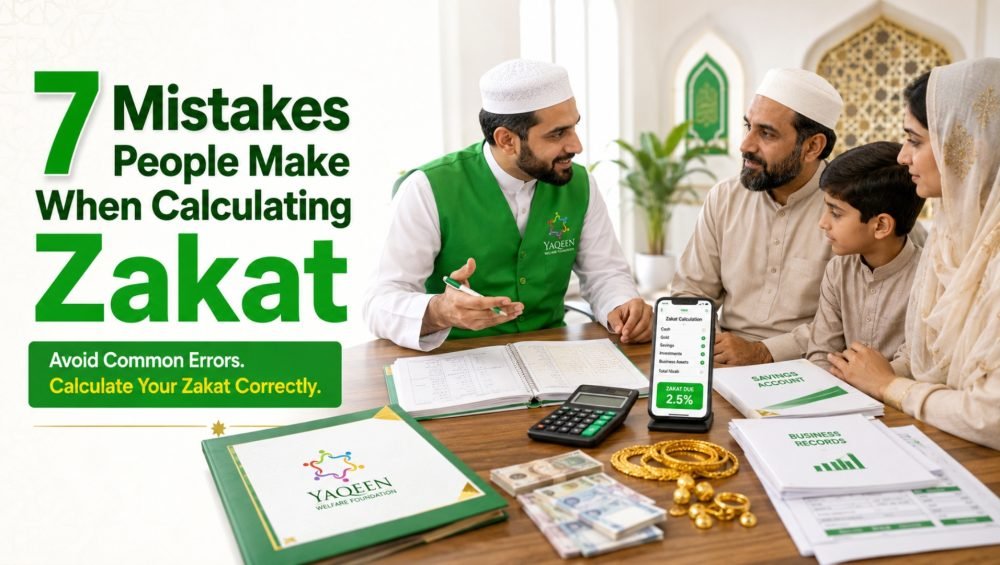
Calculating Zakat correctly is one of the most important financial and spiritual responsibilities a Muslim carries every year, yet it is also one of the most commonly miscalculated. Zakat is not a rough estimate or a symbolic gesture — it is a precise obligation, the third pillar of Islam, and a right that the poor have over the wealth of the rich. Small errors in calculating Zakat can mean underpaying what is owed to the needy, overpaying unnecessarily, or missing the obligation entirely for an entire lunar year. At Yaqeen Welfare Foundation, we work directly with underserved communities in Pakistan, and every Zakat contribution we receive is used to fund free medical treatment, clean water projects, and emergency relief for families who have nowhere else to turn. Because so much depends on accuracy, this guide walks through the seven most common mistakes people make when calculating Zakat, why each one matters, and exactly how to correct it — whether you are calculating for the first time or reviewing your approach after several years of giving. Why Calculating Zakat Correctly Matters Zakat is not simply “giving some charity when you feel generous.” It is a fixed, structured obligation: 2.5% of qualifying wealth that has been in your possession for a full lunar year (known as the hawl), once your net assets exceed a minimum threshold called the nisab. Getting this number wrong has real consequences. If you underpay, you fall short of a religious duty and the poor receive less than what is rightfully theirs. If you overpay, you may be giving away money you actually need, or double-counting assets that were never zakatable in the first place. If you miscalculate the timing, you might delay your Zakat past its due date or pay it before it is actually owed. This is precisely why calculating Zakat with care — rather than guessing — protects both your finances and your standing before Allah. Organizations such as Islamic Relief Worldwide note that Zakat is based on the total value of zakatable assets a person owns, including cash, gold, silver, savings, and business assets, minus deductible short-term liabilities. Getting each of those categories right is where most people go wrong. Quick Recap: What Is Zakat and Who Must Pay It Before looking at the mistakes, it helps to recap the basics: Zakat is obligatory on every sane, adult Muslim whose wealth reaches the nisab threshold. The nisab is based on the value of either 87.48 grams of gold or 612.36 grams of silver, according to figures widely cited by Islamic charities and referenced on Wikipedia’s overview of Zakat. Wealth must remain above the nisab for one full lunar (Hijri) year before Zakat becomes due. The Zakat rate is a fixed 2.5% of qualifying net wealth. With that foundation in place, let’s look at where people commonly go wrong when calculating Zakat. 7 Common Mistakes People Make When Calculating Zakat Mistake 1: Not Knowing the Nisab Threshold The single biggest mistake in calculating Zakat is skipping the nisab check altogether. Many people assume they owe Zakat simply because they have savings, without first confirming whether their total wealth actually exceeds the minimum threshold. Others use an outdated nisab figure from a previous year, forgetting that gold and silver prices shift daily. The fix: Check the current gold and silver rates before you begin. Most scholars recommend using the silver nisab (612.36 grams) rather than the gold nisab (87.48 grams), since the silver value is almost always lower — meaning more people qualify to give, and more support reaches those in need. You can use the Yaqeen Zakat Calculator to check this automatically against live rates rather than relying on memory. Mistake 2: Confusing Zakat with Sadaqah or Fitrana Zakat, Sadaqah, and Fitrana are all forms of charity in Islam, but they are not interchangeable, and treating them as the same thing is a frequent error when calculating Zakat. Sadaqah is voluntary charity with no fixed amount or timing. Fitrana (Zakat al-Fitr) is a separate, smaller obligation paid before Eid prayer to ensure every Muslim — rich or poor — can celebrate Eid with dignity. Zakat, by contrast, is calculated annually on wealth and paid at 2.5%. Some people mistakenly count their Fitrana payment toward their Zakat obligation, or assume that any charitable giving throughout the year automatically “covers” their Zakat. It does not. If you want to understand the distinction more fully and calculate Fitrana separately, the Yaqeen Fitrana Calculator is a useful companion tool alongside the Zakat calculator. Mistake 3: Ignoring Debts and Liabilities Another common error is calculating Zakat on gross assets without subtracting short-term debts and liabilities. Zakat is due on net zakatable wealth, not your total account balance. If you owe money that is due imminently — a credit card bill, an overdue loan installment, unpaid rent — that amount can typically be deducted before you calculate your 2.5%. However, this doesn’t mean every debt is deductible. Long-term liabilities like the full remaining balance of a mortgage or student loan are generally not subtracted in full; only the portion that is currently due is deducted. People often make the opposite mistake here too — deducting an entire multi-year loan balance and dramatically underpaying their Zakat as a result. The fix: List your zakatable assets first (cash, savings, gold, silver, investments, business inventory), then subtract only debts and bills that are due imminently, not your entire long-term debt load. Mistake 4: Using the Wrong Zakat Rate It sounds basic, but miscalculating the percentage itself is surprisingly common. Zakat on standard wealth — cash, savings, gold, silver, business assets — is 2.5%. Some people confuse this with the rate applied to agricultural produce (which can be 5% or 10% depending on irrigation method) or with the rate for livestock, which follows an entirely different structure based on the number and type of animals owned. If you are only calculating Zakat on cash, gold, silver, and investments, the rate is a flat 2.5%
9 Ways Charity Softens the Heart and Changes the Soul CategoriesBlog

9 Ways Charity Softens the Heart and Changes the Soul

There is something no one tells you about charity: it changes you more than it changes the one who receives. Not immediately. Not visibly. But in the quiet that follows an act of sincere charity, something in the chest is different. A softness where there was hardness. A stillness where there was noise. A nearness to Allah that cannot be manufactured by will alone — only by the act of opening the hand. The scholars of Islam spoke of the heart as something that hardens and softens in response to what we do. Not to what we feel, or intend, or believe in the abstract, but to what we actually do. And among the acts most reliably spoken of as softening the heart, the Prophet ﷺ placed charity: the physical, tangible act of releasing what you have toward someone who needs it. This is not metaphor. This is the mechanics of how the soul works, and in this article we’ll walk through nine distinct ways charity reshapes the heart of the one who gives. If you’d like to read more reflections like this one, you can also visit our post on the spiritual rewards of Sadaqah Jariyah or browse the full collection on the Yaqeen Welfare Foundation blog. Why Charity Is the Heart’s Quiet Teacher Before listing the nine ways, it helps to understand the underlying principle. Charity is not simply a transaction of money or food. It is a repeated act of resistance against the self’s instinct to hold on. Every time a person gives, they are training the soul to release rather than grasp. This is why charity, more than almost any other act of worship, is described by scholars as having a direct and measurable effect on the condition of the heart. H6: The Hadith That Started It All The Prophet ﷺ said: “If you want your heart to be soft, feed the poor and pat the head of the orphan.” (Ahmad) Feed the poor. Not theorise about poverty. Not feel sorrow about it from a distance. The act is physical. The hand opens. The food moves. And something in the chest opens with it. The 9 Ways Charity Softens the Heart 1. Charity Breaks the Grip of Scarcity Thinking The first and most immediate effect of charity is on the giver’s relationship with fear. The nafs (the lower self) instinctively treats every act of giving as a loss. But those who practise charity consistently report the opposite experience over time: what once felt precarious begins to feel sufficient. The hand that has practised opening finds it easier to open the next time. 2. Charity Trains the Soul to Expand Rather Than Contract Ibn al-Qayyim, writing on the diseases of the heart, observed that the soul has two fundamental tendencies: to expand and to contract. It expands in the presence of what is true and good; it contracts in the presence of what is false and harmful. Among the acts most consistently associated with expansion of the soul, he placed charity, not for sentimental reasons, but because of what it does structurally to the nafs. 3. Charity Extinguishes the Weight of Sin There is a teaching that should be held alongside every act of giving, not as its motivation, but as its larger context: “Charity extinguishes sin as water extinguishes fire.” (Tirmidhī) The image is vivid and precise. Fire and water do not negotiate. When water meets fire, the fire is extinguished, not gradually reduced while retaining its structure. This is what the Prophet ﷺ said charity does to the sins of the one who gives. Every soul carries weight, and charity moves directly against that weight. 4. Charity Deepens Trust in Allah’s Provision There is a particular quality of trust, tawakkul, that cannot be argued into existence. It is built through repeated experience of giving and then watching provision return, not always immediately, and not always in the same form, but consistently enough that the heart begins to rest in a different way. This is one of the quieter but most lasting effects of regular charity. 5. Charity Increases Awareness of Others A person who gives regularly begins to notice need where they previously did not. The eyes adjust. The neighbour who has gone quiet. The family member who deflects questions about money. The stranger in the market whose clothing speaks of scarcity. Charity, practised consistently, produces a person who sees differently and feels more responsible for what they see. 6. Charity Multiplies Rather Than Diminishes The Prophet ﷺ said: “Charity does not decrease wealth.” (Muslim) This hadith is sometimes understood only as a promise about material provision, that Allah will return what is given. But scholars read it more deeply: charity does not decrease the person who gives. The one who gives does not become less. They become more — more expansive, more open, more capable of receiving both provision and mercy. 7. Charity Sets in Motion Prayers You Will Never Hear One of the most overlooked effects of charity is the duʿa it produces in someone you will never meet. A mother who was given food for her children when there was nothing raises her hands in the night and asks Allah to bless the one who sent it. She does not know your name. She calls you “the one who gave,” and Allah, who knows every name, knows exactly who she means. “Indeed, Allah is Ḥayyū, Karīm. He is too generous to let His servant raise hands to Him and return them empty.” (Abū Dāwūd) 8. Charity Builds a Habit of Giving That Outlasts a Single Moment The long work of charity is not the single act, however significant, but the accumulated effect of a life in which giving is a regular practice. Small, repeated charity, given consistently over months and years, shapes character in a way that one large but isolated gift rarely does. This is why scholars often encourage believers to give little and often rather than waiting for a

Allah-Writes-7-Things-When-You-Feed-the-Hungry. CategoriesBlog

Allah Writes 7 Things When You Feed the Hungry

Allah Writes 7 Things in a believer’s record when they feed the hungry — and this is not a minor footnote in Islamic teaching. It is a promise woven into the Quran, repeated through the Sunnah, and confirmed across centuries of Islamic scholarship. There are acts of worship you perform in private: in the stillness of the night, on the prayer mat, in the quiet of your own heart. And then there are acts of worship that happen at a table. In a kitchen. In a moment of hunger met by generosity. The bowl of food passed to a neighbour in need. The meal prepared for a family who could not prepare their own. The contribution made so that someone, somewhere — a stranger, a child, a mother — would not go to sleep with an empty stomach tonight. You may not think of these moments as acts of profound worship. Allah Writes 7 Things to say otherwise. This article walks through each of those seven recordings — grounded in Hadith and Quranic guidance — and connects them to the very real, very present hunger that persists in Pakistan and across the world. If you have ever wondered whether your small contribution truly reaches the scale of divine reward, what follows is your answer. What the Prophet صلى الله عليه وسلم Said About Feeding Others Allah Writes 7 Things — Beginning With What the Prophet Elevated Above Other Deeds The Prophet صلى الله عليه وسلم did not speak about feeding the hungry as a minor act of social kindness. He spoke about it as a pillar of a life well-lived before Allah. “The best of people are those who are most beneficial to people.” (Al-Tabarani) “Feed the hungry, visit the sick, and free the captive.” (Bukhari) And in one of the most striking narrations — when the Companions asked the Prophet صلى الله عليه وسلم which act of Islam was best — one of his answers was: “That you feed others and greet with peace those you know and those you do not know.” (Bukhari, Muslim) Read that carefully. Not lengthy voluntary prayer. Not an extended fast beyond the obligation. Not a specific ritual act. That you feed others. This is what the Prophet صلى الله عليه وسلم placed at the peak of the question that every sincere believer wants answered. And it is precisely why understanding what Allah Writes 7 Things means — in practice, for each person who gives — matters so deeply. Allah Writes 7 Things: What Is Recorded When You Feed Someone We tend to think of worship as something that happens in a masjid, on a prayer mat, in a state of ritual purity. Islam does not confine ‘ibadah to those formal settings. It extends the definition of worship far into the texture of daily life — and nowhere more powerfully than in how we treat the hungry. When Allah Writes 7 Things in the record of a person who feeds the hungry, each entry is distinct. Each has its own Quranic or Hadith basis. And each is worth understanding on its own terms. 1. Allah Writes Your Sincerity as an Act of Worship The Intention Transforms the Meal Into ‘Ibadah The first of the things Allah Writes 7 Things refers to is the intention itself. When the meal is given not for gratitude or public recognition, not for the praise of people, but because the heart moved toward another human being in their moment of need — that intention is recorded. The Quran points to this directly in Surah Al-Insan: “And they feed, for the love of Allah, the poor, the orphan, and the captive.” (76:8) Not for any return. Not for any visible reward. For the love of Allah. That quality of giving — that direction of the heart — is itself the first entry in the record. Before the food is eaten, before the family is full, the intention has already been written. 2. Allah Writes the Erasure of a Sin Charity Extinguishes Sin the Way Water Extinguishes Fire The second thing Allah Writes 7 Things encompasses is purification. The Prophet صلى الله عليه وسلم taught: “Charity extinguishes sin as water extinguishes fire.” (Tirmidhi) This is not a metaphor for gradual moral improvement. It is a statement about divine mechanism — a structure Allah has built into how generosity is received and responded to. When you feed a genuinely hungry person, Allah writes against that act a purification that He alone measures and grants. For anyone carrying the weight of guilt — anyone who wonders whether their account with Allah is burdened by what they have done or neglected — this is a door that remains open. Not because the sin is overlooked, but because Allah, in His boundless mercy, has attached to the act of giving a means of erasure. A meal given in sincerity becomes a mercy returned. The food nourishes the recipient. The purification nourishes the giver. 3. Allah Writes Protection Over Your Body The Hand That Gives Is Protected in Return The third entry when Allah Writes 7 Things is physical: a protection that returns to the giver’s own body. The Prophet صلى الله عليه وسلم taught: “Treat your sick with charity.” (Abu Dawud, authenticated by scholars) What flows outward from the open hand — the food given, the donation made, the contribution that feeds a family — carries a divine response back to the giver. Not in the form of a guaranteed medical outcome, but as a promise woven into how Allah responds to the generous. The connection between physical wellbeing and spiritual generosity is documented in the Sunnah. When Allah Writes 7 Things in the believer’s record, this protection is among them — a covering the miser does not have access to, a return the generous person may not always be able to trace but is written nonetheless. 4. Allah Writes a Mark at the Gates of Jannah The Generous Have Doors of Their Own