Yaqeen Welfare Foundation

CategoriesBlog

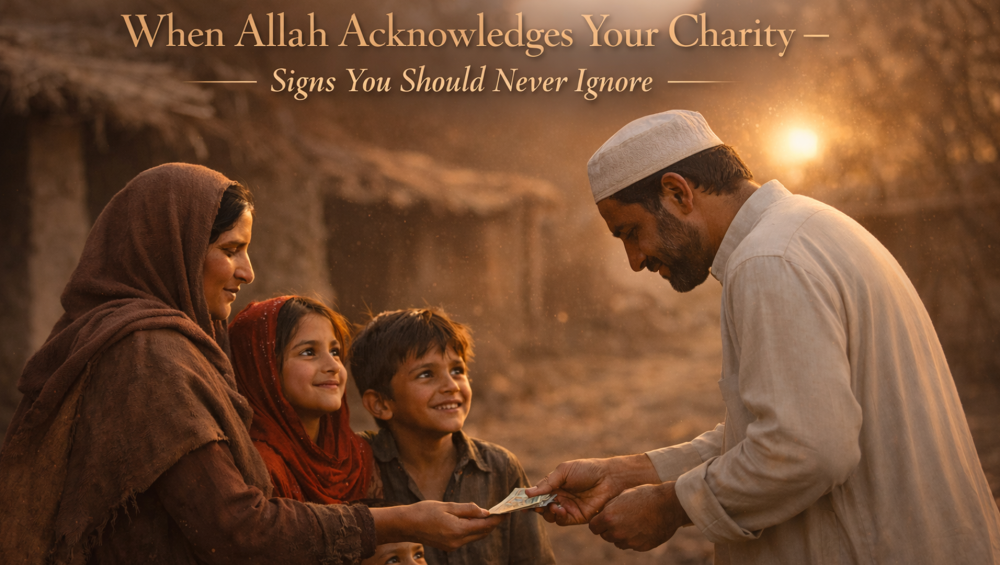
When Allah Acknowledges Your Charity – Signs You Should Never Ignore

Why You Should Never Ignore the Signs When God Acknowledges Your Charity Every act of giving carries an undetectable weight — not measured in cash, but in truthfulness. When you open your hand for the purpose of Allah, a calm address settles in your soul: Did it reach Him? In Islam, the acknowledgment of a deed is distant more prominent than the deed itself. The Companions of the Prophet (PBUH) utilized to fear that their adore would be rejected more than they dreaded committing a sin. Allah reminds us in the Quran: The Importance of Charity in Islam cannot be overstated, as it represents a core act of devotion. Your Islamic donation often functions as a Sadaqah Jariyah—a continuous charity that provides ongoing blessings. Recognizing the significant need, focusing your Charity in Pakistan can transform lives across communities—every aspect of giving highlights the overarching value of charity. “In fact, Allah as it were acknowledges from the honest.” (Surah Al-Ma’idah 5:27) Understanding what acknowledgment looks like is not presumption — it is otherworldly awareness. Sign 1: A Profound, Unexplainable Calm Settles in Your Heart This is not the surge of fulfillment after being lauded, nor the transitory bliss of trending on social media. It is something distant calmer — a stillness that wraps around your chest like warm light. After giving really, numerous devotees portray a sense of otherworldly completeness, as in spite of the fact that a hole they didn’t know existed has been filled. This peace is not made by the intellect; it arrives uninvited, and it waits. It is the kind of quietness the Quran talks of when Allah says He sends down tranquility (Sakinah) into the hearts of devotees. If you encounter this after giving, do not neglect it — it is one of the most insinuate signs between a hireling and his Lord. Sign 2: Your Heart Is Pulled Toward Giving Again There is a excellent design in the lives of the honest: one great deed opens the entryway to another. This is not coincidence — it is divine liberality. When Allah acknowledges an act of revere, He frequently rewards the hireling by making it simpler to adore once more. If you discover yourself drawn back to back causes like Yaqeen Welfare Foundation — not out of propensity or social weight, but from a honest to goodness drag in your heart — recognize this as a significant blessing. It implies the cycle of giving has ended up a living portion of your otherworldly character. The Prophet (PBUH) said: “When a hireling does a great deed, a white dab is set on his heart.” That speck develops. That light duplicates. And some time recently long, the heart that once faltered presently gives freely. Sign 3: Pride Finds No Room in Your Heart Accepted charity does not declare itself. It does not remind you of how much you gave, or compare your commitment to others, or anticipate appreciation from those you made a difference. Instep, it clears out behind a surprising lowliness — a calm acknowledgment that you were essentially chosen as a vessel. The riches was continuously Allah’s. The opportunity was continuously His to give or withhold. You were just the instrument of His benevolence coming to another human being. This understanding — that the genuine Supplier is Allah alone — strips absent pomposity at its root. If after giving you discover yourself considering less of your part and more of Allah’s liberality, that is a sign your charity has traveled where it was implied to go. Sign 4: You Discharge the Memory of the Act One of the most irrational however capable signs of an acknowledged deed is overlooking it. Not since it was immaterial, but since the soul that has genuinely given for Allah does not cling to the memory for approval. You do not replay the minute. You do not bring it up in discussion. You do not rationally return to the sum. You essentially gave, and you let it go. In the mean time, Allah records it in a way that your memory never seem — with full exactness, full setting, and full compensate. This separation from the deed is a check of otherworldly development. It mirrors the exhortation of the Prophet (PBUH) to deliver with your right hand such that your cleared out hand does not know — meaning indeed your claim self image ought to be kept unconscious of your generosity. Sign 5: Unexplained Ease and Favoring Enter Your Life The Quran and Sunnah are filled with updates that charity does not decrease riches — it duplicates it. But this duplication frequently comes in shapes we do not anticipate. A diligent issue discreetly settle itself. A relationship that was strained starts to mend. An uneasiness that felt steadfast gets to be lighter nearly overnight. This is the Barakah — the divine favoring — that streams from true giving. It does not continuously show up as more cash in your account. It shows up as peace in your domestic, clarity in your choices, and vitality in your body. Allah opens entryways through charity that were closed to each other key. And most of the time, we never follow the ease back to the act of giving — which is precisely how Allah planning it to work. Through our diverse projects, your charity creates a lasting legacy, whether by providing clean water, saving lives, or offering Sadaqah Jariyah. Each donation, from a water well to a Qurbani, offers essential support and hope to those in need. We also invite you to explore Sadaqah Jariyah for Deceased Their Rewards Can Still Grow, participate in Sadaqah Jariyah for Water Well in Pakistan, and learn How to Give Sadaqah the Right Way and Maximize Your Rewards. The Bequest of Islamic Giving: A Immortal Tradition Islamic history is, in numerous ways, a history of giving. Charity was never treated as a regular act of goodwill — it was the basic establishment of a fair, working society.

CategoriesBlog

Understanding Zakat: Importance, Calculation, and Impact

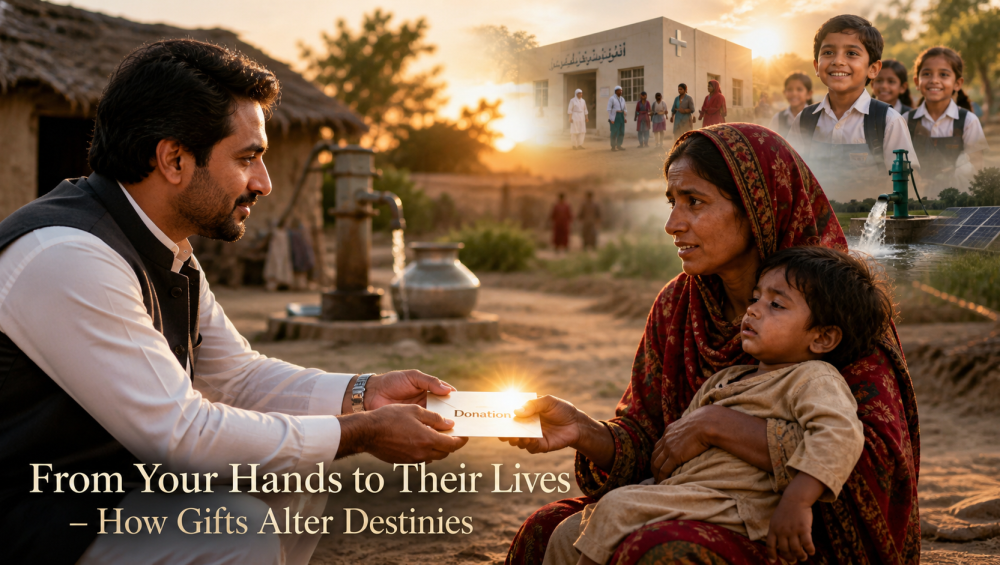
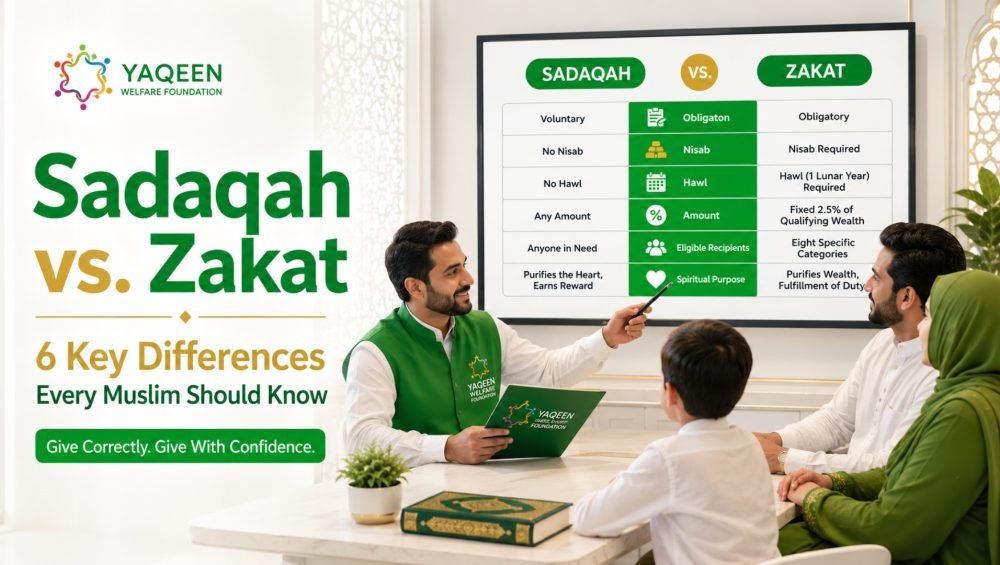
Zakat, a fundamental pillar of Islam, transcends mere financial obligation, embodying a profound act of compassion and social responsibility. The impact of granting Zakat often extends beyond immediate material assistance, fostering community cohesion and alleviating systemic poverty. While the tangible benefits may be observed, the unseen effects, such as the enhancement of social ties and the promotion of a culture of giving, are equally significant. Ultimately, the act of giving Zakat cultivates a more equitable society, reinforcing the interconnectedness of all individuals within the community. Most individuals accept Zakat closes the minute they hand it over. A number is calculated, a exchange is made, a obligation is released — and at that point the day moves on. But that minute of giving is not a conclusion. It is an opening. It is the point at which your riches stops being a private ownership and gets to be a life saver for somebody whose title you may never know. At Yaqeen Welfare Establishment, we witness something most benefactors are never advantaged to see — the change that unfurls on the other side of your commitment. We see it in the faces of families who can at long last bear medication, in the hands of children who get their to begin with legitimate feast in days, and in the calm nobility reestablished to those the world had overlooked. The Sacrosanct Establishment: History and Reason of Zakat in Islam Long some time recently the concept of social welfare got to be a advanced perfect, Islam had as of now laid its engineering in divine law. Zakat is not just liberality dressed in devout clothing — it is a lawfully ordered exchange of riches, a acknowledgment that the destitute carry an inborn right over the overflow of the affluent. It is an affirmation implanted in confidence: what you hold past your needs does not totally have a place to you. Historically, Zakat worked as a vigorous financial security net over Muslim social orders. Amid the caliphate of Umar ibn Abd al-Aziz, collectors allegedly returned from areas incapable to discover qualified beneficiaries — a confirmation to what orderly, faith-driven riches redistribution can accomplish. This was not coincidence; it was approach grounded in principle. As one of the five columns of Islam, Zakat is required for each rational, grown-up Muslim whose collected riches crosses the Nisab limit — identical in esteem to 87.48 grams of gold or 612.36 grams of silver — and has remained at or over that limit for a full lunar year. Once those conditions are met, 2.5% of that qualifying riches gets to be due, not as a favor to the penniless, but as their legitimate share. This is why the Quran outlines it not as an act of charity, but as purification: “Take from their riches a parcel as charity, decontaminating and cleansing them in this manner, and supplicate on their sake.” (Surah At-Tawbah, 9:103) The Arabic root of Zakat itself — z-k-w — carries implications of development, increment, and immaculateness. Giving does not drain you. It refines you. The Travel Your Zakat Takes — From Your Hands to Genuine Lives The minute your Zakat is given, it enters a chain of responsibility, care, and reason. It does not sit sit out of gear. At Yaqeen Welfare Establishment, each commitment is channeled straightforwardly toward the eight categories of beneficiaries characterized in the Quran — from the profoundly devastated (Al-Fuqara) and the battling destitute (Al-Masakeen), to those burdened by obligation, stranded travelers, and uprooted families with no place to turn. Medical Get to for the Vulnerable Illness ought to not be a passing sentence for those without budgetary implies. Through the Yaqeen Indus Wellbeing Clinic, your Zakat stores free interviews, medicine medicine, and symptomatic care for patients who would something else go untreated. For numerous, this clinic is the as it were healthcare they have ever accessed. Nutritional Help for Battling Families Hunger is seldom a feature — it is a calm every day crisis in incalculable homes. Month to month nourishment bundles are amassed and conveyed to families exploring obligation emergencies, sudden work misfortune, or the repercussions of common calamities. These bundles do not fair fill stomachs; they expel one smashing stress from an as of now overpowered household. Clean Water Foundation in Provincial Communities Access to clean drinking water ought to not be a benefit. In farther towns where sullied water sources cause repeating ailment — especially among children — Zakat stores the development of enduring water arrangements: hand pumps, filtration frameworks, and community wells that serve whole neighborhoods for a long time to come. Emergency Back for Uprooted Families War, abuse, and climate catastrophes have cleared out millions without homes, vocations, or steadiness. Displaced person families accepting bolster through Yaqeen Welfare Establishment have frequently misplaced everything. Your Zakat makes a difference modify the nuts and bolts: shield, nourishment, and documentation help so they can start to recover their lives. Understanding What You Owe: Zakat Calculation Made Clear Zakat applies to particular categories of riches that have remained in your ownership for a total lunar year, over the Nisab edge. It is calculated at a settled rate of 2.5% — one fortieth of your qualified resources. Not at all like deliberate charity, this commitment carries weight in Islamic law: withholding it is not just a slip by in liberality, but a disappointment to satisfy a divine duty. Understanding Zakat: Its Importance, Calculation, and Impact Zakat Calculation Reference Table Asset Category What to Include Rate Cash & Savings Current accounts, investment funds, cash on hand 2.5% Gold & Silver Jewelry, bullion, coins held as wealth 2.5% Investment Holdings Stocks, offers, rental salary, commerce dividends 2.5% Business Inventory Goods held for commercial sale 2.5% Outstanding Loans Money loaned to others that is anticipated to be returned 2.5% Exempt Assets Your essential domestic, individual vehicle, clothing, family items Exempt One vital note: researchers vary on whether gold adornments utilized routinely for individual wear is zakatable. If you are questionable, counsel a trusted