Best Charity in Pakistan for Healthcare in 2026
Discover why Yaqeen is the best charity in Pakistan for healthcare in 2026. Learn how donors in the USA can provide medical relief and donate zakat.

 CategoriesBlog
Discover why Yaqeen is the best charity in Pakistan for healthcare in 2026. Learn how donors in the USA can provide medical relief and donate zakat.
 CategoriesBlog
Discover the top zakat accepting organizations in Pakistan for donors in the USA. Learn how to calculate and donate your Zakat safely and effectively in 2026.
 CategoriesBlog
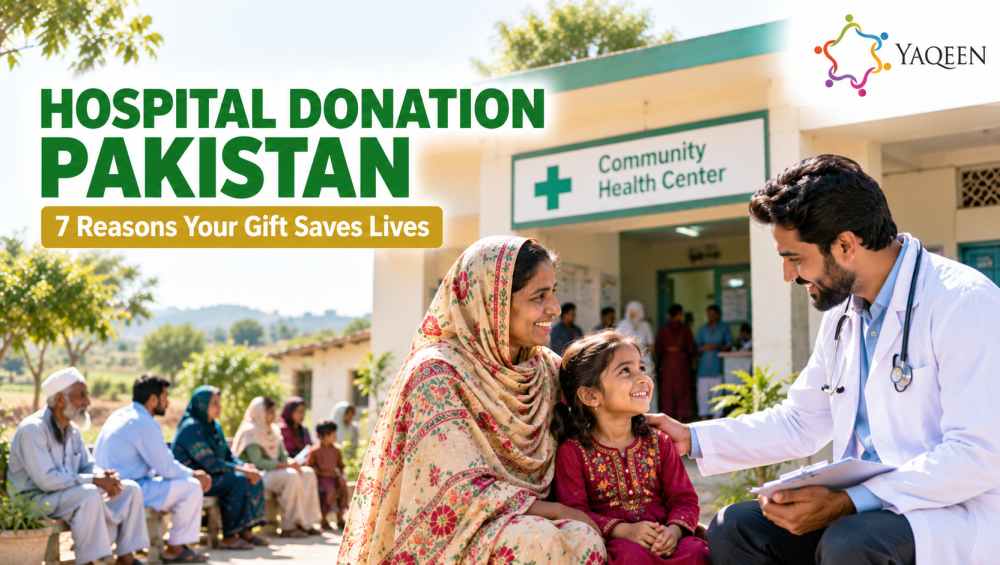
Hospital Donation Pakistan: 7 Reasons Your Gift Saves Lives Hospital Donation Pakistan is one of the most lasting ways to help families who live far from any doctor. In many rural areas, a sick child, a pregnant mother or an elderly father must travel hours to find a qualified medical professional. Many families cannot afford the journey, let alone the treatment. A gift toward a permanent healthcare facility changes this. Instead of helping one patient once, it creates a place that serves thousands of people for years. This guide explains why permanent healthcare infrastructure matters in underserved communities. It covers accessibility, consultations, medicines, diagnostics and preventive care. It also shows how steady donor support helps a facility grow, and how Yaqeen Welfare Foundation turns gifts into free care for people across Pakistan. Why Permanent Healthcare Matters in Pakistan Pakistan has large cities with busy hospitals. Outside those cities, the picture changes. Villages in southern Punjab, the foothills and the river belt often depend on a single basic health unit, if they have one at all. Staff are scarce, medicines run out, and equipment is limited. The World Health Organization describes universal health coverage as ensuring that all people can use the health services they need without suffering financial hardship. You can read the full definition in the WHO universal health coverage fact sheet. For a farming family earning a daily wage, even a small medical bill can be a crisis. That is why free, local care matters so much. Yaqeen Welfare Foundation was founded to close this gap. Its aim is to provide free medical treatment, clean water and other forms of assistance to the people of Pakistan. You can read more about the vision on the Mission and Vision page. The foundation’s board includes physicians in the United States and Pakistan, many of whom grew up in rural Pakistani villages themselves. That experience shapes how projects are chosen and run. A one-off camp can help many people for a few days. A permanent facility is available every day of the year. This is why a long-term Hospital Donation Pakistan plan is different from emergency relief. Both matter, but only a standing facility builds lasting trust and gives families a place to return to. Reason 1: Hospital Donation Pakistan Brings Care Within Reach The first and most obvious reason is distance. Healthcare that is far away is healthcare that many people never receive. A mother with a feverish child may delay the trip because the bus fare is too high. A farmer with chest pain may wait until the pain becomes an emergency. When a facility is built inside or next to the community, the barriers drop. Patients can walk in. Families do not lose a full day of wages. Women, who often cannot travel alone, can reach care more easily. This is the heart of any plan to build hospital Pakistan communities can rely on. This is exactly what the Yaqeen-Indus Community Health Center represents. The project moved from fundraising to construction and then to an opening ceremony. It now serves local families who previously had few options. The foundation’s Yaqeen Health Clinic page documents the journey with photos from the fundraising campaign, the construction phase and the inauguration. Every donor who supports a rural hospital Pakistan families can reach on foot helps remove the most basic barrier to treatment: distance. Reason 2: Free Consultations Remove the Cost Barrier A doctor’s consultation fee may sound small. For a family living on a day laborer’s income, it can mean choosing between seeing a doctor and buying food. Many people simply stay home and hope the illness passes. Free consultations change that decision. When a patient knows the visit costs nothing, they come earlier. Early visits catch infections before they spread, high blood pressure before it causes a stroke, and diabetes before it damages the eyes and kidneys. Treating a problem early is almost always cheaper and safer than treating it late. This is where a donor-funded model shines. A healthcare charity Pakistan families trust does not charge at the door. Your gift covers the doctor’s time, the examination room and the basic equipment, so the patient pays nothing. To see how this works in a village setting, read 7 Ways a Free Health Clinic Can Transform a Rural Community. A permanent facility also allows continuity of care. The same doctor can follow a patient over months and notice changes. A camp cannot do that. When you choose to donate for hospital services, you are paying for this relationship between patient and caregiver, not only for a single visit. Reason 3: Medicines Reach the People Who Need Them A diagnosis is only half the answer. A patient who is told to take an antibiotic or a blood pressure tablet but cannot buy it leaves the clinic no better off. In poor communities, unfilled prescriptions are common. A well-supported facility can stock essential medicines and give them to patients on the spot. This closes the gap between the doctor’s advice and the patient’s treatment. It also protects against the misuse of medicines. When people cannot afford the right drug, they sometimes take leftover tablets, borrow from neighbors or buy unlabeled products from unreliable sellers. Your Hospital Donation Pakistan gift helps keep the pharmacy shelves stocked. Even a modest contribution matters. Donors who want to see how small amounts add up can read $100 Donate to Pakistan Can Make a Difference!. It explains what a single $100 gift can mean for a rural family. Medicines also build confidence. When a mother sees her child recover after a free course of treatment, she tells her neighbors. Trust spreads quickly in small communities, and more families seek care at the right time. Reason 4: Diagnostics Make Treatment Accurate Good treatment starts with a correct diagnosis. Without basic diagnostic tools, doctors in remote areas must guess. A cough could be a simple infection or tuberculosis. Tiredness could be anemia or diabetes. Guesswork leads to wasted
 CategoriesBlog
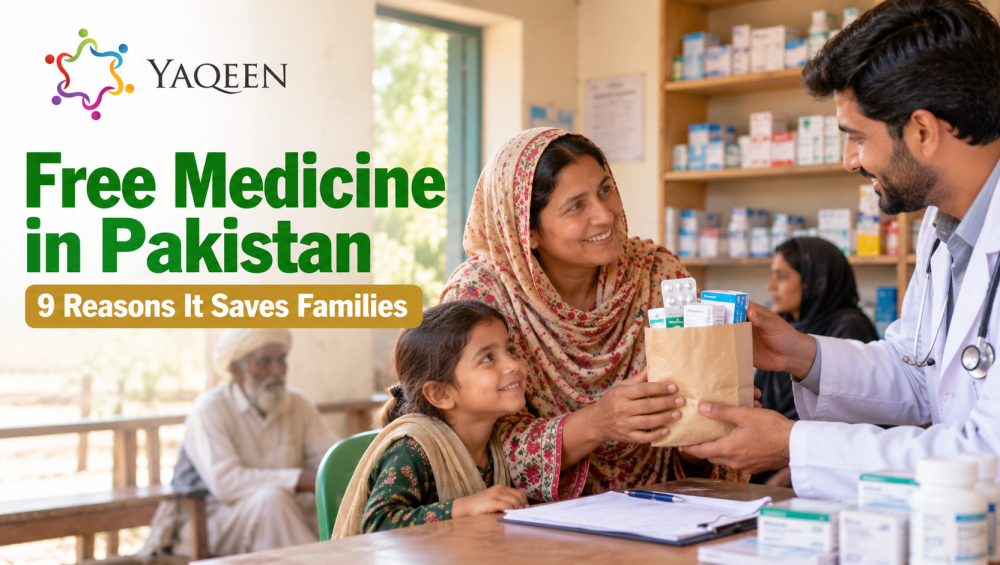
Free Medicine in Pakistan: 9 Reasons It Saves Families Free medicine in Pakistan can decide whether a sick father returns to work, whether a child recovers from a chest infection, and whether a family keeps its small savings. For millions of households living on irregular daily wages, seeing a doctor is only half the battle. The harder half begins at the pharmacy counter, where a single prescription can cost more than several days of income. A free consultation is a real kindness, but without the prescribed tablets, syrups, inhalers or injections, treatment stops before it starts. This is why free medicine in Pakistan is so important to the work of Yaqeen Welfare Foundation. The foundation’s aim is to provide free medical treatment, clean water and other forms of assistance to people across Pakistan, especially in rural and underserved communities. In this guide, we explain how medicine costs affect families with limited incomes, why medicines should be provided alongside free consultations, and how donors can support accessible care. Whether you are a donor, a volunteer or simply someone who wants to help poor patients, this article will show you where your support makes the greatest difference. How Medicine Costs Affect Families With Limited Incomes In many parts of Pakistan, healthcare is paid for largely out of pocket. A family earning a modest daily wage does not have a safety net of insurance, employer benefits or savings to fall back on. When someone falls ill, the family faces several costs at once: transport to the clinic, lost wages for the patient and the person who accompanies them, diagnostic tests and, finally, the medicines themselves. Medicine is often the most repeated and least avoidable of these costs. A consultation happens once, but a prescription may need to be refilled every month for years. Families make painful trade-offs: buy half the course, skip a dose to stretch the supply, choose between medicine and school fees, or borrow money at high interest. Healthcare charities in Pakistan see these choices every day, and they show why free medicine in Pakistan is not a luxury but a basic requirement for dignity and recovery. The World Health Organization explains in its noncommunicable diseases fact sheet that long-term conditions are a major cause of illness and death worldwide, and that people in lower-income settings often face the greatest barriers to treatment. Pakistan reflects this global pattern, which is why medicine access deserves attention alongside doctors and clinics. 9 Reasons Free Medicine in Pakistan Matters for Low-Income Families 1. Medicine Costs Push Families Into Debt The first and most obvious reason is financial. When a family must buy medicine at full price, one illness can drain savings, force the sale of assets or lead to loans. Debt taken for healthcare rarely stays small. A father who borrows to treat his own infection may find his children leaving school to work and repay it. Free medicine in Pakistan breaks this cycle at its source. When the medicine is provided at no cost, the household keeps its limited income for food, rent, school and clean water. A single prescription handed over at a clinic can protect a family’s finances for months. This is one of the strongest arguments for medicine donation in Pakistan: the benefit reaches far beyond the patient. 2. A Free Consultation Without Medicine Is Incomplete Care Many charitable clinics offer free consultations, and that is a valuable service. Yet a diagnosis without treatment can leave a patient worse off, because now they know what is wrong but cannot afford to fix it. A mother may leave with a prescription for her feverish child and no way to fill it. The paper ends up folded in a pocket, and the illness continues. Providing medicines alongside consultations completes the circle of care. The patient is examined, diagnosed and treated in a single visit. This is the model Yaqeen follows through its Health Clinic, where the goal is not only to see patients but to send them home with what they need to get better. Free medicine in Pakistan turns advice into action. 3. Chronic Conditions Need an Uninterrupted Supply Diabetes, high blood pressure, asthma, heart disease and epilepsy are not cured in one visit. They are managed day after day, and the medicines must be taken without gaps. According to the WHO diabetes fact sheet, access to affordable treatment, including essential medicines, is central to preventing serious complications. International estimates suggest that a large share of adults in Pakistan live with diabetes, and many do not know it or cannot afford to manage it. For a low-income patient, a missed refill is not a small inconvenience. Running out of blood pressure tablets can raise the risk of stroke. Running out of insulin or diabetes medicine can lead to dangerous blood sugar swings, kidney damage or vision loss. Free medicine in Pakistan for chronic conditions means a patient can plan ahead, collect a month’s supply and keep working and caring for their family. 4. Common Infections Become Dangerous Without Treatment Respiratory infections, urinary tract infections, stomach infections, skin infections and typhoid are common, especially where clean water and sanitation are limited. Most are treatable with the right medicine, often at modest cost. But when a family cannot afford that medicine, a simple infection can spread, worsen or become life-threatening, particularly in children and older adults. Early treatment also protects the wider community. An untreated infection can pass from one family member to another, and from one household to the next. By offering free medicine in Pakistan at the first sign of infection, charities stop small problems from becoming emergencies and reduce the burden on overstretched hospitals. If you want to understand how emergency and in-patient care fits into this picture, read our post on Hospital Donation Pakistan: 7 Reasons Your Support Matters. 5. Follow-Up Treatment Depends on Affordable Refills Good medicine is rarely a one-time event. A patient recovering from a serious infection may need a second round of antibiotics. A
 CategoriesBlog
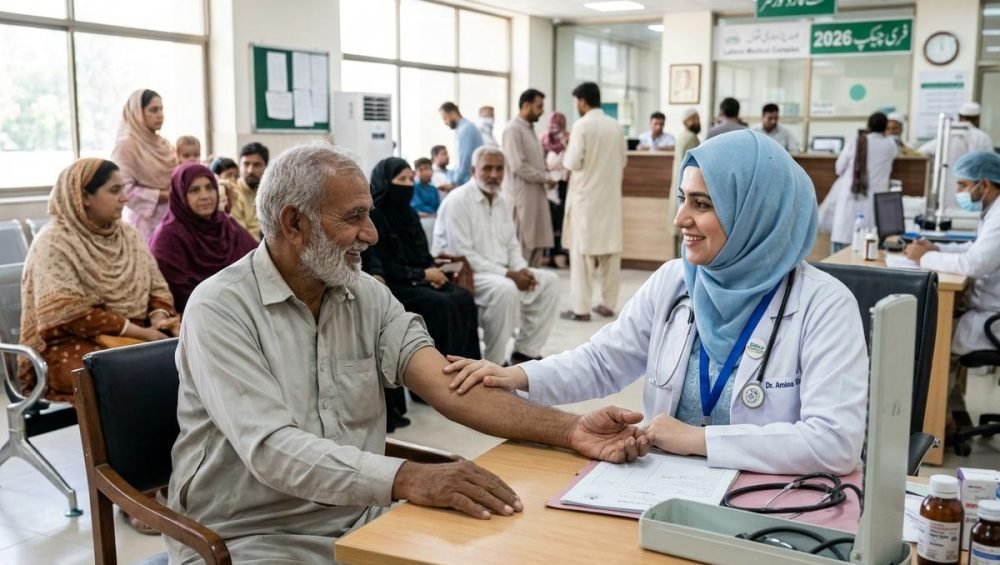
Learn where to find free medical treatment in Pakistan in 2026. See how donors in the USA support Yaqeen Welfare Foundation. Donate to save lives today.
 CategoriesBlog
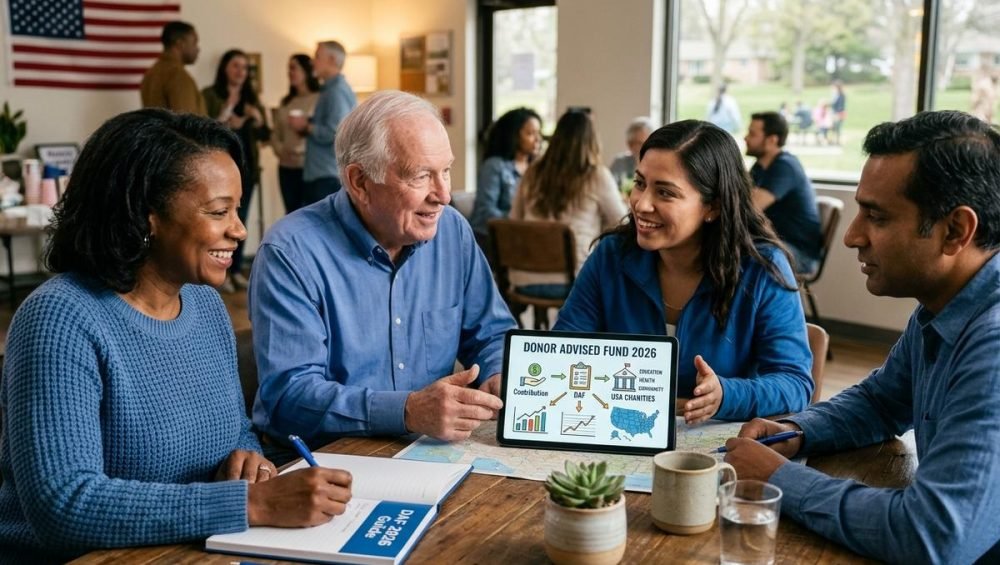
Learn how to use a donor advised fund for charity in the USA in 2026. Optimize tax benefits and support Yaqeen Welfare Foundation with strategic giving.
 CategoriesBlog
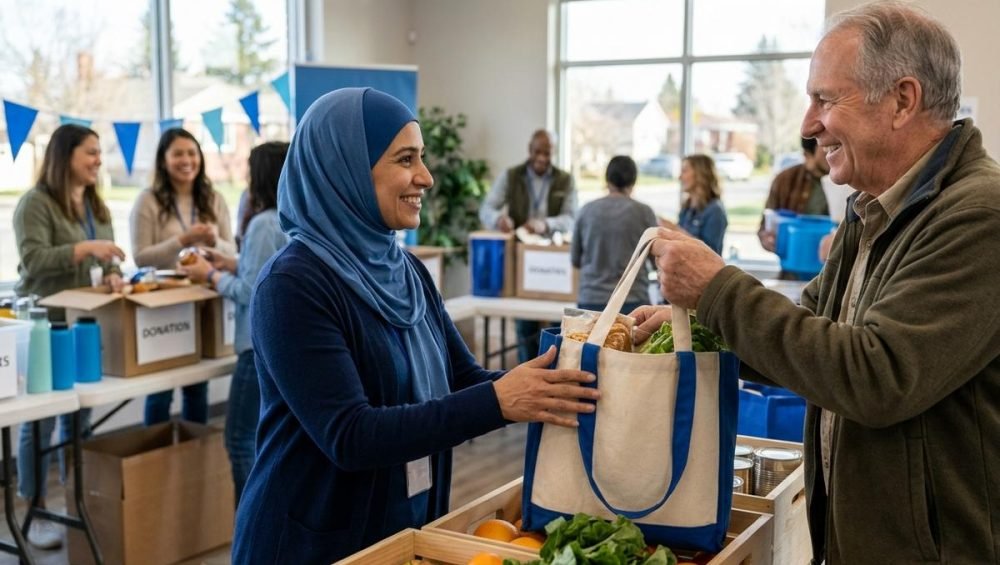
Learn how to verify a zakat eligible charity in the USA for 2026. Discover the criteria for Shariah compliance, transparency, and Zakat calculation.
 CategoriesBlog
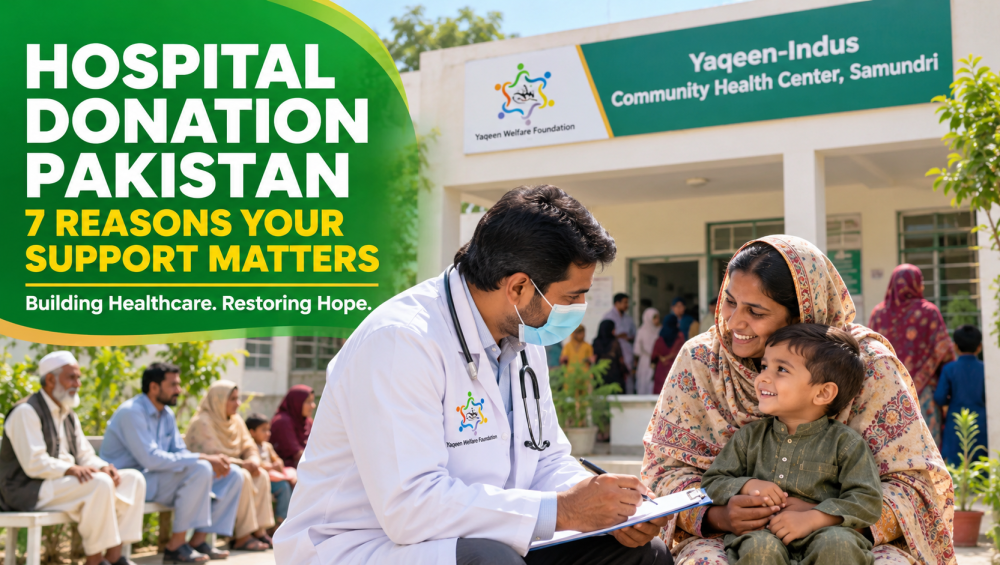
Hospital Donation Pakistan: 7 Reasons Your Support Matters Hospital Donation Pakistan is one of the most direct ways to change the health of a whole village, not just one patient. A single donation to a permanent facility gives families a place to go when a child has a fever at midnight, when a father’s blood pressure spikes, or when a mother needs a safe check-up. In rural Pakistan, that place often does not exist. Where it does, it is frequently too far away, too expensive or too short of medicine to help. At Yaqeen Welfare Foundation, our aim is simple: to provide free medical treatment, clean water and practical assistance to the people of Pakistan. This article explains why permanent healthcare infrastructure matters so much in underserved communities. It covers what a rural facility offers, how it works and how sustained donor support can expand its reach. If you have ever wondered whether you should build a hospital in Pakistan or donate for a hospital project, read on. Why Hospital Donation Pakistan Efforts Begin With Access Ask anyone living in a remote village what healthcare means to them, and the answer is rarely about advanced technology. It is about access. Can I reach a doctor? Can I afford the visit? Will there be medicine when I get there? For many rural families, the answer to all three questions is no. The nearest qualified clinic can be hours away by road. Transport costs money, a day’s wages are lost, and a sick family member may have to travel in poor conditions. By the time a patient arrives, a manageable illness has often become an emergency. This is why Hospital Donation Pakistan campaigns focus on bringing care closer to home. A facility inside or beside the community removes the first and biggest barrier: distance. It also builds trust. When people see the same doctors and staff week after week, they start seeking help earlier, and that is when treatment works best. The World Health Organization’s overview of primary health care makes the same point at a global level: care that is close to people, continuous and affordable keeps communities healthier than care that is distant and fragmented. You can also read about the wider health landscape through WHO’s Pakistan country office and UNICEF Pakistan, which both work on child and community health. What a Rural Hospital Pakistan Facility Actually Provides When donors hear “hospital,” they may picture a large urban building with many floors. In reality, the most valuable rural hospital Pakistan communities can have is often a well-run community health center. It is a permanent site that delivers the essentials reliably. Here is what that looks like in practice. Consultations A consultation is the entry point to everything else. A trained medical professional listens to the patient, examines them, makes a diagnosis and decides on a plan. For many rural patients, this is the first time they have spoken to a qualified doctor about a long-running problem. Free consultations mean that cost never stops a family from asking, “Is this serious?” A good consultation also includes referral. Not every condition can be handled at a village clinic. When a patient needs specialist or hospital-level care, the clinic’s staff can refer them to a tertiary care center. Without that guidance, many families would not know where to go next. Medicines A prescription means little if the patient cannot afford to fill it. Many people in underserved areas stop treatment because they cannot pay for medicine, even when the diagnosis is correct. A facility with its own pharmacy and medicine store removes that obstacle. Patients leave with what they need, not just a piece of paper. Reliable stock matters as much as the pharmacy itself. Chronic conditions such as diabetes and high blood pressure need uninterrupted supplies. Missing a few weeks of medicine can undo months of progress, so a steady donor base is what keeps shelves full. Diagnostics Diagnostics turn guesswork into evidence. Simple tests such as blood sugar, blood pressure readings and basic laboratory work help clinicians catch problems early and monitor those already known. Our own work for families in need includes free medicine and lab tests, as described in Donate to Poor Families in Pakistan | Yaqeen Foundation USA. Preventive Services Prevention is the quiet hero of healthcare. Immunizations for infants and toddlers protect children from diseases that once filled hospital wards. Health education teaches families about hygiene, nutrition and when to seek help. Regular follow-up for people with diabetes, hypertension and high cholesterol prevents complications such as stroke and kidney damage. Every rupee spent on prevention tends to save much more in treatment later. This is a central reason a donate for hospital appeal should always include preventive care in its plan. 7 Reasons Hospital Donation Pakistan Support Matters Now that you know what a rural facility provides, here are seven clear reasons your support makes a difference. 1. It Brings Care to People Who Cannot Travel For a daily-wage worker, a trip to a distant city hospital can mean losing a day’s income, paying for transport and finding someone to watch the children. A local facility ends that trade-off. People get care without giving up the little they have. 2. It Makes Care Truly Free Free care changes behavior. When families know a visit costs nothing, they come earlier, ask more questions and follow treatment through. Hospital Donation Pakistan gifts are what make “free” possible, because patients are not charged and the clinic still pays its staff, buys medicine and keeps the lights on. 3. It Protects Children Early Vaccinations and routine check-ups in infancy and toddlerhood prevent illness that can follow a child for life. This is also why many donors choose to donate to orphans. Read about it in Donate to Orphans: 7 Ways USA Donors Bring Free Medical Care. 4. It Manages Chronic Disease Diabetes, hypertension and high cholesterol are long-term conditions. They need monthly attention, not one-off treatment. A permanent facility is
 CategoriesBlog
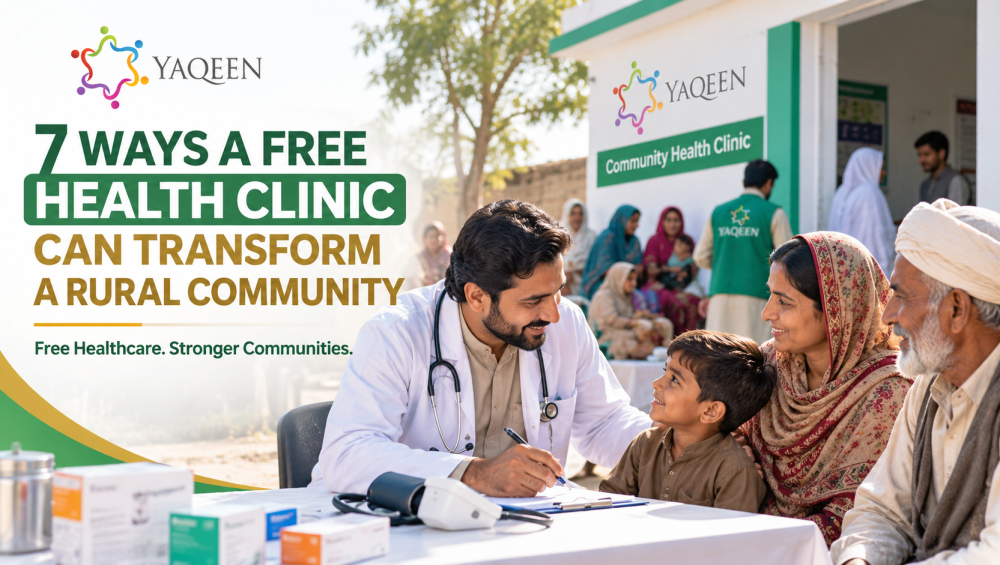
7 Ways a Free Health Clinic Can Transform a Rural Community A free health clinic does far more than treat the person sitting in front of the doctor. In a rural village, it changes how families spend their money, how children grow, how mothers survive childbirth and how neighbours look after one another. Across rural Pakistan, millions of people live with a quiet rule: do not get sick, because we cannot afford it. When a free health clinic opens nearby, that rule begins to break. At Yaqeen Welfare Foundation, we see this change in practice. Our work in free healthcare Pakistan is built on one belief: access to treatment should never depend on a family’s income. This article looks beyond individual patients. It explains seven ways accessible care lifts an entire community, and how your support can make it happen. Why Rural Healthcare Pakistan Needs More Than Hospitals Most major hospitals in Pakistan are in big cities. A farmer, a labourer or a widow in a remote village may have to travel hours, pay for transport, lose a day’s wages and then pay consultation and medicine fees on arrival. For many families, that cost is impossible, so they wait. Waiting is where the damage begins. A cough becomes pneumonia, a fever becomes typhoid, high blood pressure becomes a stroke, and a treatable infection becomes a lifelong condition. This is the central gap in rural healthcare Pakistan: the problem is not only a shortage of doctors, but the distance, cost and fear that keep patients away from the doctors who exist. A free health clinic closes that gap by removing the barriers one at a time. It sits close to people’s homes and charges nothing for consultation, so patients come early. Early care is the starting point of every transformation described below. If you want to see how giving connects to this need, read our blog post Sadaqah That Heals: Support Healthcare In Rural Pakistan Today. 1. A Free Health Clinic Brings Earlier Care and Earlier Diagnosis The first and most important change is timing. When a visit costs nothing, people stop treating the clinic as a last resort and start treating it as a first step. Consider what this means in practice: A persistent cough is checked before it spreads to the rest of the household. Fever and stomach illness are diagnosed before dehydration becomes dangerous. Blood pressure and blood sugar are measured before they cause lasting harm. Infectious diseases such as hepatitis C, malaria and typhoid are found before they spread through a village. Every disease caught early is cheaper, safer and easier to treat. The effect also spreads outward. One diagnosed patient who finishes treatment is one fewer source of infection for neighbours, classmates and relatives. This is why a charity medical clinic in a rural area has such a large effect compared with its size. The clinic is not only treating illness, but also interrupting it before it grows. 2. A Free Health Clinic Lowers Family Expenses and Protects Savings Medical bills are one of the fastest routes into poverty. A family might sell a goat, borrow from a moneylender or pull a child out of school to pay for one serious illness. Even a small bill can mean skipping meals or delaying rent. A free health clinic cuts this pressure at the root. When consultations, tests and medicines cost nothing, families can use their limited income for food, school fees, farming supplies and home repairs. They stop making the impossible choice between “treat the illness” and “feed the family.” The savings also last. Because patients arrive earlier, they avoid the hospital admissions and emergency trips that cost far more. Over months and years, a household that once lived one illness away from crisis builds some stability. For donors, this is a strong reason to give. A single healthcare donation can protect an entire household’s finances, not just one patient’s health. On our website, a $25 gift covers a full day of free consultations for a rural family. 3. A Free Health Clinic Creates Healthier Children Children are the first to suffer when care is out of reach. Their illnesses move quickly, and delays are dangerous. Diarrhoea, respiratory infections, fevers and malnutrition can all be life-threatening when treatment comes late. A free health clinic changes a child’s early years in several ways: Routine check-ups catch problems with growth, nutrition and development. Immunisation protects children against diseases that once filled village funerals. Prompt treatment of infections keeps a child in school instead of at home. Nutrition guidance helps parents feed their children better with what they have. A healthy child attends school more regularly, learns more and grows into a more productive adult. That is why health and education work together. At Yaqeen, our education programmes support students with tuition, books and scholarships, and a healthy child is far better able to use that opportunity. When a free health clinic keeps a child well, it protects their future as well as their present. 4. A Free Health Clinic Supports Mothers Before and After Birth In many rural areas, pregnancy is still faced with fear. Antenatal care may be unavailable, a skilled birth attendant may be far away, and a complication in labour can turn deadly within hours. A free health clinic gives mothers a safe place to turn. Access to care can include: Pregnancy check-ups to monitor mother and baby. Early detection of warning signs such as high blood pressure or anaemia. Guidance on nutrition, hygiene and safe delivery. Postnatal care for the mother and the newborn. Advice on spacing pregnancies and protecting maternal health. When mothers are healthier, entire households are healthier. A mother who is well can care for her children, work, and pass on good health habits. A mother who is lost, or left permanently weakened, changes a family for generations. Supporting women’s health is therefore one of the strongest forms of social investment. It is also one of the clearest examples of how
 CategoriesBlog
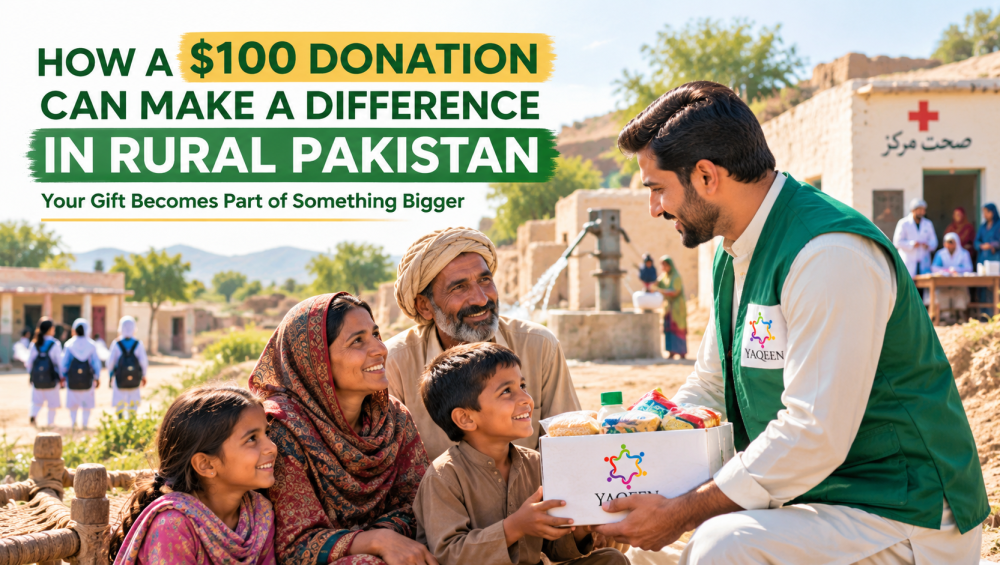
How a $100 Donation Can Make a Difference in Rural Pakistan Donate to Pakistan with $100 and you may wonder whether the gift is too small to matter. It is a fair question. Poverty, healthcare shortages, water insecurity and housing problems are large, and one gift cannot solve them alone. Humanitarian support does not depend on one donor funding an entire project. A single donation becomes part of something larger. One contribution may help support medical services. Another may go toward food assistance. Several donors together may fund a clean-water project. Others may help with school supplies, family assistance or safer housing. A $100 donation does not have to solve every problem to make a meaningful contribution. Combined with responsible humanitarian programs and collective giving, it can become part of lasting change. This article does not promise that $100 will automatically pay for a specific treatment, feed a family for a fixed number of days, build a water well or finance a child’s education. Real impact depends on several factors: Current local costs The type of humanitarian program Location The number of beneficiaries Project requirements Medical or educational needs Transportation and logistics Funding from other donors Yaqeen Welfare Foundation works to provide free medical treatment, clean water and other forms of assistance to people in Pakistan. Below, we describe where your gift can contribute, so you can donate to Pakistan knowing what your money is for. Why Rural Pakistan Needs Support Pakistan has large cities and extensive rural communities, and conditions vary widely by location. Not every rural family is poor or vulnerable. Many communities are resilient and self-sufficient. This article focuses on underserved communities, where households may face barriers such as: Limited access to healthcare Unsafe or unreliable drinking water Food insecurity Educational costs Inadequate housing Long distances to services Limited employment Low household income Gaps in maternal and child health services Little help in emergencies Poverty is usually multidimensional. A family rarely faces just one problem. A household with limited income may also live far from a clinic. Medical bills reduce the money left for food. A child’s schooling becomes harder to maintain. Poor housing or unreliable water adds more pressure. The cycle of poverty often looks like this: Low Income → Limited Healthcare Access → Poor Health → Lost Work → Lower Household Income → Food and Education Pressure → Greater Financial Instability When you donate to Pakistan through a responsible charity, your gift can help address one or more parts of this cycle. Why $100 Can Still Matter Many donors ask, “Is $100 really enough to make a difference?” Charitable impact should not be judged only by whether one gift can finance a whole project. Humanitarian organizations usually pool donations from many supporters: Donor 1 + Donor 2 + Donor 3 + Donor 4 + Many Others → Larger Pool of Support → Medical, Water, Food, Education or Housing Program → Assistance for Eligible Families A donor may not personally fund an entire clinic service, water system, scholarship or home. But that donation can help make those programs possible alongside contributions from others. Small and medium donations become powerful when many people take part. Where Can a $100 Donation Help? Depending on Yaqeen’s current verified programs, a donation may contribute toward the areas below. This table shows the kind of support involved, not a fixed price for each. Area of Support What a Donation May Contribute Toward Main Benefit Free medical care Consultations, medicines, basic diagnostics, maternal and child care Lower healthcare barriers Clean water Wells, pumps, materials, installation, maintenance Safer, closer water access Food assistance Staple foods, family food packages, emergency support Immediate relief Education School supplies, books, student assistance, scholarships Long-term opportunity Safe shelter Repairs, construction support, essential household needs Family stability Emergency relief Food, water, medicine, temporary shelter Urgent help in a crisis 1. Donate to Pakistan to Support Free Medical Care Healthcare can be one of the hardest expenses for a low-income household. A family may need money for: Medical consultations Medicines Diagnostic tests Follow-up appointments Transportation to a clinic Maternal and child healthcare Management of chronic illness When income is limited, even ordinary healthcare creates painful choices. A parent may ask, “Do I pay for medicine or groceries?” or “Can I afford the trip to the clinic and still cover household necessities?” Depending on the verified Yaqeen healthcare program, donations may help support free patient consultations, medicines, basic diagnostic services, preventive care, maternal and child care, community clinic operations, medical supplies and health education. The Impact Can Extend Beyond the Patient A patient is often also a parent, a wage earner, a caregiver, a student or a grandparent supporting a household. Helping that person reach healthcare can have effects beyond their own condition: Medical Assistance → Health Problem Addressed → Better Ability to Perform Daily Activities → Greater Potential to Work or Study → More Household Stability No charity can guarantee recovery, employment or financial outcomes. But reducing medical barriers is a practical form of poverty relief. Healthcare Can Protect Household Finances The financial burden of illness goes beyond doctor fees. There are indirect costs too: lost wages, transportation, caregiving, missed work, repeated clinic visits and medication. When charitable healthcare covers some of these costs, families may keep more of their limited income for food, housing, education, utilities and transport. 2. Expand Access to Clean Water Safe water matters for far more than drinking. Families use it for cooking, washing food, handwashing, bathing, cleaning, laundry, sanitation and caring for children, the elderly and the sick. Where reliable water is scarce, households can face health, financial and time burdens. To donate to Pakistan for clean water is usually to contribute toward a larger project, not to pay for one alone. Depending on Yaqeen’s verified initiatives, funds may support wells, pumps, water-access infrastructure, project materials, installation, community water systems, maintenance and water-quality measures. We will not state that $100 builds a complete well unless Yaqeen has a current verified program where that