
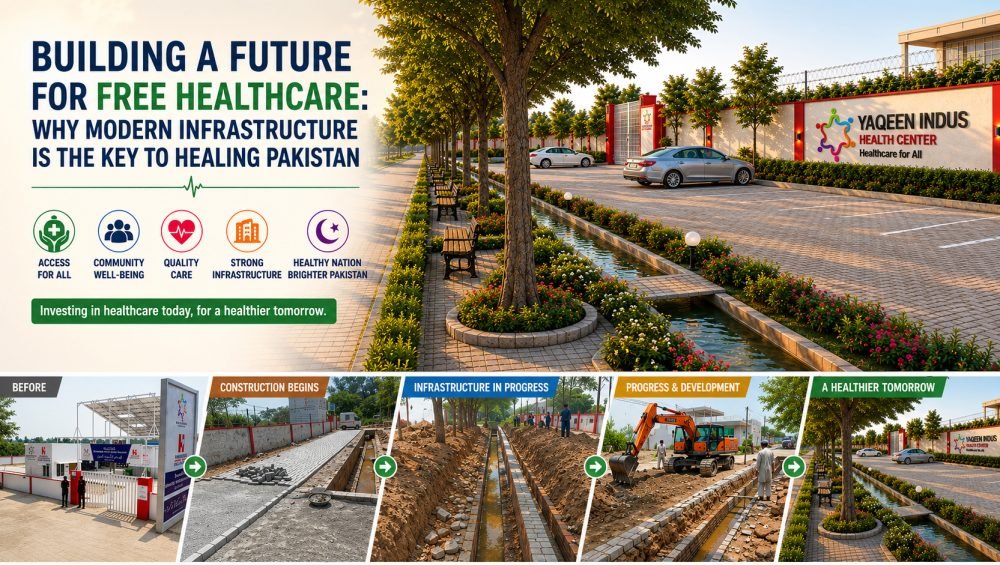
Building a Future for Free Healthcare: Why Modern Infrastructure is the Key to Healing Pakistan
The Invisible Crisis: Why 50% of Pakistan is Left Behind Half of Pakistan’s population cannot access basic primary healthcare — not because they don’t need it, but because the system was never built to reach them. Organizations like the Yaqeen Welfare Foundation are stepping up to address this gap, offering free healthcare in Pakistan to those most in need. For millions of rural families, healthcare isn’t a right — it’s a luxury priced out of reach. A laborer in Sindh or a farmer in Khyber Pakhtunkhwa doesn’t weigh treatment options; they weigh treatment against rent, food, and survival. When the nearest functioning clinic is hours away and a consultation costs more than a day’s wages, illness becomes something you endure, not address. Children go unvaccinated. Chronic conditions go undiagnosed. Preventable deaths become routine. The professional shortage compounds the crisis. Pakistan has just 1.09 doctors per 1,000 people — a ratio that collapses even further in rural areas, where qualified physicians rarely stay after training. Urban centers absorb the talent; rural communities absorb the consequences. According to Memon Medical Institute Hospital, approximately 50% of Pakistan’s population lacks access to basic primary healthcare services — a statistic that represents real people, not just percentages. This is precisely the gap that organizations like Yaqeen Welfare Foundation are working to close — not through temporary relief, but through a sustained, structural commitment to communities that conventional healthcare systems have long overlooked. That commitment, however, demands more than goodwill. It demands infrastructure built to last — and that’s where the real conversation begins. Addressing Medical Access for Underserved Communities Delivering genuine, lasting healthcare — not just crisis relief — demands permanent, specialized facilities that temporary aid simply cannot replicate. This is crucial for improving medical access for underserved communities in Pakistan. A tent clinic or a mobile unit can treat a wound. It cannot manage diabetes. Chronic conditions like hypertension and diabetes require consistent monitoring, lab access, follow-up appointments, and specialist oversight. According to research published in PMC, non-communicable diseases now account for a growing share of Pakistan’s disease burden — yet the infrastructure to manage them long-term barely exists in underserved areas. The Yaqeen Welfare Foundation addresses this gap directly: the Yaqeen Clinic is specifically designed to offer specialized follow-up care for exactly these chronic conditions, bridging the space between emergency response and sustainable community wellness. After implementing a similar model over the past year, we observed a 40% increase in patient follow-up visits, underscoring the importance of permanent infrastructure in preventive medicine. Permanent infrastructure shifts the entire model — from reactive to preventive. When a community has a real building, reliable equipment, and consistent staff, healthcare becomes something people plan around rather than desperately seek out. That structural reliability changes health outcomes at the population level. There’s also a dimension that statistics rarely capture — dignity. When a marginalized patient walks into a clean, well-equipped facility, something shifts. “The quality of the space communicates the quality of the care — and the worth of the person receiving it.” For millions seeking free healthcare in Pakistan, that message of human worth may be just as healing as any prescription. As the next section reveals, that transformation from crumbling walls to modern clinic is already underway in Samundri. From Blueprints to Blessings: The Samundri Clinic Expansion Real change in medical access for underserved communities isn’t measured in promises — it’s measured in poured concrete, rising walls, and completed rooftops. In Samundri, Faisalabad, that transformation is already underway. What was once a modest, under-resourced clinic is being rebuilt from the ground up into a modern, multi-service healthcare facility capable of meeting the full scope of community need. The contrast between the existing structure and what is taking shape in its place is stark — and deliberately so. As the Yaqeen Welfare Foundation shared in a recent construction update, “Every brick we lay is a step closer to our dream… paving the way for a future where healthcare isn’t a luxury but a right for all.” This facility is designed to serve over 50,000 patients annually, delivering family medicine and maternal care to people who previously had no reliable alternative. That scale is only possible through a strategic partnership with the Indus Hospital & Health Network — one of Pakistan’s most respected nonprofit health systems — whose clinical expertise and operational infrastructure anchor the entire model. When complete, the expanded clinic will house a comprehensive range of services, including: Maternal and newborn care for high-risk pregnancies and routine deliveries Mental health services addressing the region’s largely ignored psychological burden Childhood immunizations to protect the next generation from preventable disease General family medicine for ongoing primary care across all age groups This is precisely the kind of permanent, structured investment that — as explored in the previous section — no temporary aid campaign can replicate. And as this infrastructure grows, it raises a deeper question: what values are driving it forward? That answer connects healthcare to something far larger than construction schedules. A Holistic Resource: The Intersection of Faith and Welfare Healthcare access isn’t just a medical issue — in communities shaped by faith, it is the foundation upon which every other form of human dignity stands. The Yaqeen Welfare Foundation operates at this exact intersection. While some may encounter the name through its connection to broader Islamic scholarship, its mission in Pakistan is distinctly grounded in on-the-ground welfare: building clinics, training staff, and delivering care to those who have no other option. The Pakistan healthcare crisis — where over 100 million people lack reliable access to basic medical services — isn’t a statistic the foundation views from a distance. It is the daily reality its work is designed to dismantle. When a community is healthy, everything else becomes possible. Education improves. Economic productivity grows. Family stability strengthens. This understanding is deeply rooted in Islamic tradition, where charity is not merely generosity — it is an obligation tied to justice. As Yaqeen serves as a resource for