
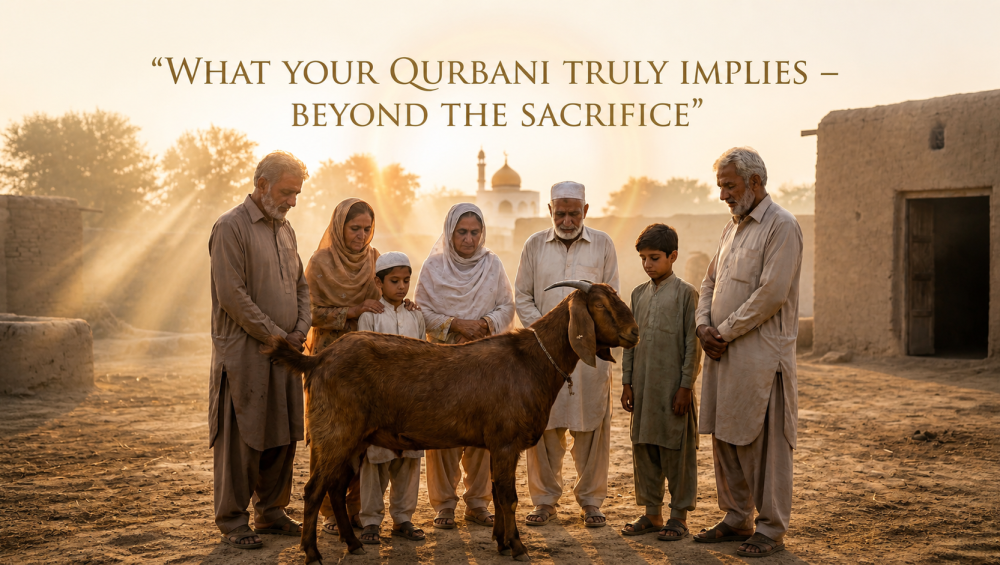
What Your Qurbani Truly Implies — Past the Sacrifice
There are minutes in life that arrive unobtrusively, wrapped in recognition, however carry a weight distant more prominent than we frequently acknowledge. Qurbani is one of them. Each year, as the favored days of Dhul Hijjah draw close, something mixes inside the hearts of Muslims over the world. There is a arrangement — not fair of coordinations, but of the soul. A acknowledgment that something sacrosanct is approaching. Yet, in the surge of every day life, indeed the sacrosanct can gotten to be routine. We set reminders. We exchange funds. We affirm arrangements. And some time recently long, the act is done — checked off, completed, moved past. But Qurbani was never planned to be something you essentially finish. It was planned to reshape something interior you. It was outlined to hinder the clamor of life and return you to what is genuine — to your Maker, to your reason, and to the individuals around the world who are holding up, discreetly and persistently, for a favoring to reach them. The address Qurbani inquires of each Muslim is not fair “Did you do it?” The more profound address is: “Did it do something to you?” What Is Qurbani — And Why Does It Carry Such Significant Weight? Every year, over each corner of the soil, Muslims assemble amid the days of Eid ul-Adha to perform Qurbani — the custom give up of an creature committed completely to the joy of Allah. At its most obvious layer, the act shows up simple. An creature is chosen. A give up is made. The meat is conveyed — to family, to neighbors, to those in need. But to diminish Qurbani to these steps alone is to miss the endless, living sea underneath the surface. Qurbani is, at its root, a re-enactment of one of the most exceptional tests of confidence ever recorded in human history. It is a story that does not develop ancient, no matter how numerous times it is told — since its truth is timeless. Prophet Ibrahim (AS) was not an standard man. He had as of now strolled through fire — actually — for the purpose of his Ruler. He had cleared out behind consolation, community, and certainty to take after a way that few seem get it. His confidence was not hypothetical. It had been tried, solidified, and demonstrated through decades of sacrifice. Yet, Allah set some time recently him one last, shattering trial. In a dream — unmistakable and verifiable — he gotten a command: give up your child. Not a ownership. Not riches. Not comfort. His child. His child. The one he had held up and supplicated for all through the long a long time of his life. And however, Ibrahim (AS) did not falter. He did not deal or arrange. He did not inquire for time to prepare. He turned to his child, Ismail (AS), and shared what Allah had revealed. What taken after is one of the most breathtaking minutes in all of prophetic history. Ismail (AS) — youthful, steadfast, completely mindful of what was being inquired — reacted without flinching: “O my father, do as you are commanded. You will discover me, if Allah wills, among the persistent.” — Qur’an 37:102 Two individuals. One divine command. And a level of yield that most of us can scarcely start to imagine. As the minute of give up drawn closer and both souls submitted totally, Allah intervened: “O Ibrahim, you have satisfied the vision.” — Qur’an 37:104–105 A smash was given in put of Ismail (AS). The trial was complete. But here is the message that echoes over each Qurbani since: Allah did not require the misfortune of life. He required the yield of the heart. That is what Qurbani commemorates. Not basically a physical act — but a add up to yielding of the self to the will of Allah, indeed when everything inside you trembles. Beyond the Physical Act: What Allah Genuinely Accepts It is simple, when examining Qurbani, to ended up devoured by the subtle elements of the act itself. Which creature qualifies? What are the conditions? When must it be done? These are substantial questions, and they matter. But if we halt there, we have as it were caught on the shell of Qurbani — not its core. Allah, in His interminable intelligence, has made the genuine nature of this act unmistakably clear: “It is not one or the other their meat nor their blood that comes to Allah, but it is your taqwa — your mindfulness and dedication — that comes to Him.” — Qur’an 22:37 This verse is not a commentary. It is the whole point. The physical give up is the vehicle. The heart is the destination. What this implies in hone is that two individuals can perform the correct same Qurbani — same creature, same time, same prepare — and one act may take off to the sky whereas the other scarcely lifts off the ground. The contrast is not obvious to the human eye. The contrast is intention. It is the inside pose of the individual giving. Are they giving since they truly feel appreciation to Allah for all He has provided? Are they giving with a heart that perceives its reliance on its Creator? Are they giving with an mindfulness that this act is not a exchange — not an trade for favors — but a earnest expression of cherish and devotion? Or are they giving out of social desire, out of propensity, out of a crave to satisfy an commitment and move on? Qurbani, in this sense, is one of the most genuine mirrors a individual can hold up to themselves. It inquires, without statement of regret: Who are you truly doing this for? The reply to that address — whispered in the calm of the heart — is absolutely what comes to Allah. Qurbani as a Individual Test: What Are You Willing to Let Go? The bequest of Ibrahim