
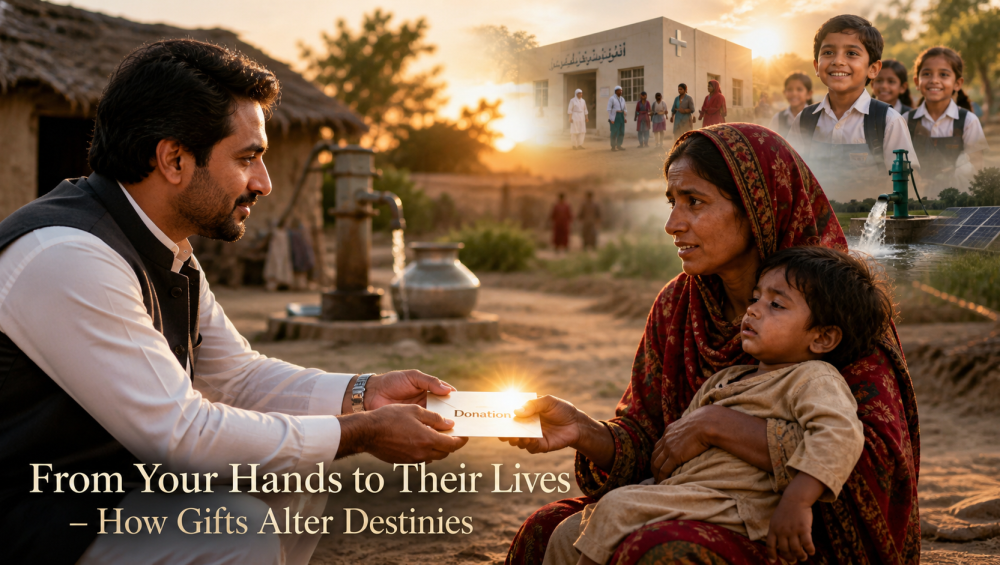
Islamic Giving Their Lives: A History of Transformation
Islamic giving is rarely measured the way the rest of the world measures generosity. Most people think little of the weight carried by a single act of charity. A moment of generosity — however small it feels on your end — carries a force that travels across distances, breaks through walls of despair, and lands in someone’s life like the first rain after a long dry season. At Yaqeen Welfare Foundation, we witness this quiet phenomenon constantly. What leaves your hand as a modest contribution arrives somewhere else as medicine, clean water, a meal, or the first real hope a family has felt in months. The transformation isn’t a metaphor. It’s real, measurable, and lasting. The Legacy of Islamic Giving: A History of Transformation Long before the language of “social impact” entered the world’s vocabulary, Islam had already built an entire civilization on the principle of voluntary generosity. The concept of giving was never passive — it was architecture. Islamic giving built hospitals, sustained libraries, supported the poor, and held entire societies together through a discipline of trust and collective care. The Well of Uthman (RA) When the people of Madinah were struggling to access clean water, Uthman ibn Affan didn’t simply make a donation — he purchased the Well of Rummah from a private owner and declared it a gift for every Muslim, traveler, and soul in need. That single decision, made over 1,400 years ago, continues to ripple forward to this day. The Saudi government later developed the surrounding land, and the proceeds from that very waqf continue to be distributed in Uthman’s name even now. One act. Fourteen centuries of reward. The Bimaristans of the Golden Age The hospitals of the Abbasid era were not charitable afterthoughts — they were architectural marvels, staffed by the era’s finest physicians, and funded entirely through waqf endowments given by merchants, rulers, and ordinary believers alike. Patients were treated regardless of their faith, their wealth, or their background. Musicians were even employed to ease the distress of those who were mentally unwell. Compassion was institutionalized, and it was made possible entirely through the sustained giving of a community that understood a simple truth: wealth is purified when it flows toward others. Fatima al-Fihri and the Power of Education In 859 CE, a Muslim woman named Fatima al-Fihri founded the University of al-Qarawiyyin in Fez — the oldest continuously operating university in the world — using her entire inheritance as an endowment. She fasted every day during its construction and only broke her fast the day its doors opened to students. Her endowment didn’t just feed the hungry; it fed the minds of generations that followed. These three stories alone capture what makes Islamic giving so distinct from charity as the modern world understands it. It was never about a single transaction. It was about building something that would keep giving long after the giver was gone — a principle Islam calls Sadaqah Jariyah. If you’d like to understand that concept in more depth, our article on The Power of Sadaqah Jariyah – A Lifetime of Reward explores exactly how a single act of charity can continue generating reward indefinitely. Where Your Gifts Go at Yaqeen Welfare Foundation Your giving becomes real, tangible change: 💧 Clean Water Projects — Turning unsafe water into a daily source of life. 🏥 Free Healthcare — Providing treatment, medicine, and care for those who cannot afford it. 🍲 Food & Emergency Support — Helping families survive when they have nothing left. 📚 Health Awareness — Teaching communities how to manage their health and prevent future crises. The Prophet ﷺ reminded us: “The best of people are those who bring the most benefit to others.” When you donate through Yaqeen Welfare Foundation, you are not performing a modern transaction. You are joining a legacy of believers whose hands have always reached toward the struggling, the sick, and the overlooked — and whose rewards continue to accumulate long after they have returned to their Lord. The Intersection of Education and Health Care in Pakistan Pakistan stands at a critical crossroads. It is a country of remarkable resilience and talent, yet millions of its people remain trapped in cycles of preventable illness — not because medicine doesn’t exist, but because knowledge hasn’t reached them. Waterborne diseases claim thousands of young lives every year. Maternal mortality rates in rural areas remain heartbreakingly high. Children go malnourished not always because of poverty alone, but often because families lack the information needed to make the most of what they have. This is where health education becomes as life-saving as any surgical procedure. For a closer look at how Yaqeen approaches this gap on the ground, our post on Building a Future for Free Healthcare: Why Modern Infrastructure Is the Key to Healing Pakistan goes deeper into the infrastructure side of this challenge. The Hidden Crisis of Preventable Illness A child doesn’t fall sick simply because bacteria exist in the world. The illness takes hold because a family doesn’t know how to properly store water, or doesn’t recognize the early signs of dehydration, or believes a fever will pass without treatment. When communities receive organized guidance on basic hygiene, nutrition, and preventive care, hospital admission rates in those regions drop measurably. The illness was never inevitable — it was a gap in knowledge. Mothers as the First Healthcare System In rural Pakistan, a mother is often the only healthcare resource a child has access to. She decides what the child eats, how wounds are cleaned, when to seek help, and how to manage illness at home in the hours before a doctor becomes available. When Yaqeen Welfare Foundation reaches a mother with health education — not just pamphlets, but real, practical, culturally sensitive training — that woman becomes a shield for her entire family. Her knowledge compounds over time, passes to her daughters, and spreads through her community. Community Knowledge as Lasting Infrastructure A course of antibiotics heals one patient. A season