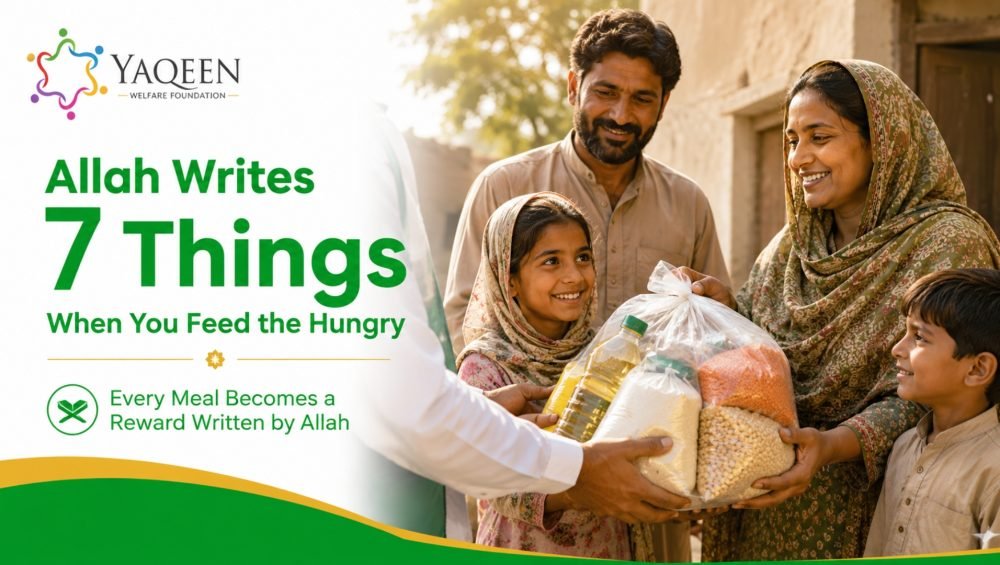
Allah Writes 7 Things When You Feed the Hungry
Allah Writes 7 Things in a believer’s record when they feed the hungry — and this is not a minor footnote in Islamic teaching. It is a promise woven into the Quran, repeated through the Sunnah, and confirmed across centuries of Islamic scholarship. There are acts of worship you perform in private: in the stillness of the night, on the prayer mat, in the quiet of your own heart. And then there are acts of worship that happen at a table. In a kitchen. In a moment of hunger met by generosity. The bowl of food passed to a neighbour in need. The meal prepared for a family who could not prepare their own. The contribution made so that someone, somewhere — a stranger, a child, a mother — would not go to sleep with an empty stomach tonight. You may not think of these moments as acts of profound worship. Allah Writes 7 Things to say otherwise. This article walks through each of those seven recordings — grounded in Hadith and Quranic guidance — and connects them to the very real, very present hunger that persists in Pakistan and across the world. If you have ever wondered whether your small contribution truly reaches the scale of divine reward, what follows is your answer. What the Prophet صلى الله عليه وسلم Said About Feeding Others Allah Writes 7 Things — Beginning With What the Prophet Elevated Above Other Deeds The Prophet صلى الله عليه وسلم did not speak about feeding the hungry as a minor act of social kindness. He spoke about it as a pillar of a life well-lived before Allah. “The best of people are those who are most beneficial to people.” (Al-Tabarani) “Feed the hungry, visit the sick, and free the captive.” (Bukhari) And in one of the most striking narrations — when the Companions asked the Prophet صلى الله عليه وسلم which act of Islam was best — one of his answers was: “That you feed others and greet with peace those you know and those you do not know.” (Bukhari, Muslim) Read that carefully. Not lengthy voluntary prayer. Not an extended fast beyond the obligation. Not a specific ritual act. That you feed others. This is what the Prophet صلى الله عليه وسلم placed at the peak of the question that every sincere believer wants answered. And it is precisely why understanding what Allah Writes 7 Things means — in practice, for each person who gives — matters so deeply. Allah Writes 7 Things: What Is Recorded When You Feed Someone We tend to think of worship as something that happens in a masjid, on a prayer mat, in a state of ritual purity. Islam does not confine ‘ibadah to those formal settings. It extends the definition of worship far into the texture of daily life — and nowhere more powerfully than in how we treat the hungry. When Allah Writes 7 Things in the record of a person who feeds the hungry, each entry is distinct. Each has its own Quranic or Hadith basis. And each is worth understanding on its own terms. 1. Allah Writes Your Sincerity as an Act of Worship The Intention Transforms the Meal Into ‘Ibadah The first of the things Allah Writes 7 Things refers to is the intention itself. When the meal is given not for gratitude or public recognition, not for the praise of people, but because the heart moved toward another human being in their moment of need — that intention is recorded. The Quran points to this directly in Surah Al-Insan: “And they feed, for the love of Allah, the poor, the orphan, and the captive.” (76:8) Not for any return. Not for any visible reward. For the love of Allah. That quality of giving — that direction of the heart — is itself the first entry in the record. Before the food is eaten, before the family is full, the intention has already been written. 2. Allah Writes the Erasure of a Sin Charity Extinguishes Sin the Way Water Extinguishes Fire The second thing Allah Writes 7 Things encompasses is purification. The Prophet صلى الله عليه وسلم taught: “Charity extinguishes sin as water extinguishes fire.” (Tirmidhi) This is not a metaphor for gradual moral improvement. It is a statement about divine mechanism — a structure Allah has built into how generosity is received and responded to. When you feed a genuinely hungry person, Allah writes against that act a purification that He alone measures and grants. For anyone carrying the weight of guilt — anyone who wonders whether their account with Allah is burdened by what they have done or neglected — this is a door that remains open. Not because the sin is overlooked, but because Allah, in His boundless mercy, has attached to the act of giving a means of erasure. A meal given in sincerity becomes a mercy returned. The food nourishes the recipient. The purification nourishes the giver. 3. Allah Writes Protection Over Your Body The Hand That Gives Is Protected in Return The third entry when Allah Writes 7 Things is physical: a protection that returns to the giver’s own body. The Prophet صلى الله عليه وسلم taught: “Treat your sick with charity.” (Abu Dawud, authenticated by scholars) What flows outward from the open hand — the food given, the donation made, the contribution that feeds a family — carries a divine response back to the giver. Not in the form of a guaranteed medical outcome, but as a promise woven into how Allah responds to the generous. The connection between physical wellbeing and spiritual generosity is documented in the Sunnah. When Allah Writes 7 Things in the believer’s record, this protection is among them — a covering the miser does not have access to, a return the generous person may not always be able to trace but is written nonetheless. 4. Allah Writes a Mark at the Gates of Jannah The Generous Have Doors of Their Own