Yaqeen Welfare Foundation

CategoriesBlog

An Update for Every Muslim’s Sadaqah Jariyah

Sadaqah Jariyah is the one investment that does not stop paying out when you do. There will come a moment unlike any moment you have ever lived through — no lawyer standing beside you, no witness who owes you a favor, no chance to change what you said, fix what you chose, or revisit what you dismissed. The record will be sealed. Time will have run out. And the only things that will move — the only things that will rise and speak — are the deeds you sent forward while you still had the chance. Among all of them, charity holds a station unlike any other. It does not simply sit quietly in your record, waiting to be checked. It moves. It stands between you and the fire. It shades you from a heat no ordinary sun could compare to. It speaks — not with a voice, but with something far more powerful: with weight, with impact, with the changed lives it touched long after your hands let it go. This is an update for every Muslim — rich or struggling, healthy or unwell, young or aged — because the moment you have right now is the most valuable asset you possess. A Reminder About Sadaqah Jariyah We often talk about charity from the perspective of the recipient — the family lifted out of poverty, the child who now has clean water, the patient who received treatment they could never afford. All of that is real, and all of it matters. But there is a dimension to giving that we rarely pause long enough to fully absorb: one day, the giver will need what they gave — more urgently, more desperately, than anyone they ever helped. On the Day of Judgment, every soul will be searching for something to speak on its behalf. Wealth will not stand up. Degrees will not stand up. Reputation will not stand up. But Sadaqah Jariyah — ongoing charity given sincerely for the sake of Allah — will rise and present itself before your Lord. If you’re new to this concept, our companion piece on the Islamic blessings of helping the poor is a good starting point before diving deeper into what makes ongoing charity uniquely powerful. The Day When Nothing Else Will Matter Picture standing in a gathering unlike any gathering in history. Every human being who ever lived, assembled in one place. The sun brought near. The wait stretching beyond imagination. And in that moment, all the things that defined you in this world — your career, your assets, your social standing, your network — stripped away entirely. Allah ﷻ describes this Day with a clarity that should shake every heart: “The Day when neither wealth nor children will benefit anyone — except the one who comes to Allah with a sound heart.” (Surah Ash-Shu’ara, 26:88–89) A sound heart is the currency of that Day. And one of the most effective ways to purify and protect the heart in this life is through giving — sincerely, consistently, and without expectation of any worldly return. The Prophet ﷺ described a man who gave charity so secretly that his left hand did not know what his right hand gave, and he will be among the seven whom Allah shades beneath His throne on the Day when there is no shade but His (Sahih al-Bukhari). Not the one who gave the most. Not the one who gave most publicly. The one who gave sincerely. Sadaqah Jariyah in the Time of the Prophet ﷺ The companions of the Prophet ﷺ did not treat generosity as something reserved for moments of surplus. They gave when they had little. They gave when giving meant sacrifice. They gave because they genuinely believed — not theoretically, but in the marrow of their bones — that what they sent forward was more real and more lasting than what they kept. When the Muhajirun arrived in Madinah having left behind their homes, their businesses, and in many cases their families, the Ansar did not offer sympathy and send them on their way. They opened their homes. They divided their land. The Qur’an honored them for something extraordinary: “They give preference to others over themselves, even when they are themselves in need.” (Surah Al-Hashr, 59:9) This was not a one-time act of emergency generosity. It was a culture — a deeply rooted understanding that holding onto the world while a brother or sister suffered was simply not consistent with what it meant to believe. Aisha (RA) reported that the family of Muhammad ﷺ never ate their fill of wheat bread for three consecutive days until he passed from this world. He gave nearly everything away — not out of poverty forced upon him, but as a deliberate, continuous act of trust in Allah. When Charity Became Waqf — The Endowment Model of Sadaqah Jariyah Among the most brilliant institutions ever developed in human history is the Islamic concept of Waqf — a charitable endowment given once but continuing to benefit people for generations. This is Sadaqah Jariyah in its most structural form. The companions understood this concept instinctively. They didn’t just want to help the people of their time — they wanted their giving to outlast them. When Umar ibn al-Khattab (RA) acquired land in Khaybar, one of the finest pieces of land in Arabia, he asked the Prophet ﷺ what he should do with it. The Prophet ﷺ advised him to make the land itself endowed — unchangeable, permanent — and to give its produce to those in need. That land continued to feed and support the poor for generations after Umar (RA) had passed (Sahih al-Bukhari). Uthman ibn Affan (RA) purchased the Well of Rumah at his own expense, freeing it for public use when water access in Madinah was a pressing concern. He sought no repayment, attached no conditions, and gave it entirely for the sake of Allah — and the Prophet ﷺ promised him a spring in Paradise

CategoriesBlog

The Charity Only Allah Sees in Islam

There is the charity only Allah sees — a kind of giving the world never praises. No camera captures it. No name is engraved on a plaque. No crowd gathers to witness the moment. It moves like water through soil — invisible on the surface, yet feeding everything beneath it. It happens in the predawn quiet, when a hand slips something into a tin without anyone watching. It happens in a browser window opened alone, a donation completed, and then closed — no screenshot taken, no story shared. It is giving stripped of performance, offered purely for One. At Yaqeen Welfare Foundation, we are humbled to be the vessel through which thousands of such acts flow. Donors reach us from every corner — some vocal, some invisible. And while every form of generosity is honored, we have come to understand something important: the charity only Allah sees carries a spiritual gravity unlike any other. It is not simply a transfer of wealth. It is a conversation between the servant and the Creator, held entirely in private. What Is “The Charity Only Allah Sees” in Islam? At its core, this form of giving — often called silent or secret charity — is the act of giving without seeking any return from the world: not praise, not gratitude, not even acknowledgment. The left hand truly does not know what the right hand has done. The deed is completed, and the giver walks away without leaving a trace. This is not merely an act of humility. In Islamic teaching, it is a spiritual discipline — a way of purifying the deed from the one contamination that can quietly destroy it: the desire for human approval. Allah (SWT) speaks about this directly in the Qur’an: “To give charity publicly is good, but to give to the poor secretly is better for you, and will absolve you of your sins. And Allah is All-Aware of what you do.” (Surah Al-Baqarah, 2:271) Notice the precision of this verse. It does not say public giving is wrong — it says private giving is better. The comparison is not between permissible and forbidden, but between good and greater, between the acceptable and the elevated. This distinction matters deeply, because it reveals that Islam is not just concerned with whether we give, but with the inner state we bring to the act of giving. Recognizing the charity only Allah sees asks us to answer a difficult question honestly: who am I really doing this for? If you’d like to explore the broader spiritual economy of giving, our earlier piece on the Islamic blessings of helping the poor lays out the foundational rewards tied to charity in general. Why Giving in Silence Feels Different Most of us have felt it — that quiet pull after doing something kind. The subtle urge to mention it, share it, let it be known. It is entirely human; we are social beings wired for affirmation. There is no shame in feeling it. But Islam asks us to notice that pull, and then release it. The Prophet ﷺ described one of the seven types of people who will be shaded under Allah’s throne on the Day of Judgment — a day when the sun will be brought so close that people will drown in their own sweat — as: “A person who gives charity so secretly that his left hand does not know what his right hand has given.” (Bukhari & Muslim) What strikes you about this description is not just the act, but the degree of hiddenness. It isn’t simply “don’t post about it.” It is a level of inner secrecy so complete that even the giver’s own awareness of the deed barely lingers. Give, and let it go. Donate, and forget. Give as though the act belongs entirely to Allah — because it does. When you give in silence, you are not suppressing your humanity. You are elevating it. You are choosing the eternal witness over the temporary audience. That choice — that single moment of spiritual courage — is what makes the charity only Allah sees feel so profoundly different: lighter, somehow, yet weightier at the same time. The Hidden Impact: Protection You Cannot See We tend to measure the value of charity by what it builds: a well dug, a family fed, a child educated. Those outcomes are real and deeply important. But Islamic wisdom teaches us that the ripple of sincere giving moves in directions we cannot observe, touching the life of the giver just as much as the life of the recipient. The Prophet ﷺ said: “Give in charity without delay, for it stands in the way of calamity.” (Tirmidhi) This is not metaphor. It is a spiritual principle: hidden acts of generosity become a barrier between you and hardship that has not yet arrived. They deflect what you never even saw coming. To learn more about this protective dimension of giving, see our related article on how Sadaqah shields against unseen hardship. Beyond protection, silent charity works on the inner landscape of the soul in ways no other act quite replicates. It Dismantles the Ego The ego thrives on recognition. It wants a record, a receipt, a reputation. When you give and tell no one, you deny the ego its currency. Over time, this practice makes the heart softer, more open, and less cluttered with self-importance. It Invites Barakah — Divine Increase Barakah is not just abundance in money; it is effectiveness in all things. The home where it resides feels calm. The time in it stretches. The relationships inside it hold. Many people live with unexplained ease and contentment — and their secret, perhaps, is a long history of quiet, anonymous generosity. It Strengthens Your Connection to Allah When no human can credit you for a good deed, only One remains who knows of it. That awareness — that Allah alone has seen this — builds a relationship of closeness with the Divine unlike anything else.

CategoriesBlog

Islamic Blessings Of Helping The Poor

The Islamic blessings of helping the poor are far greater than most of us realize. We tend to think of charity as a one-way transaction: we give, someone else receives, and the story ends there. But in the Islamic worldview, that is only the visible half of the picture. Every rupee spent on a hungry family, every meal handed to a stranger, every school fee quietly paid for an orphan sets in motion a chain of reward, protection, and Barakah that often returns to the giver in ways they never expected — and may never even trace back to its source. At Yaqeen Welfare Foundation, we see both sides of this exchange every day: the immediate relief on the face of a mother who can finally feed her children, and the quiet, almost invisible transformation that takes place in the life of the person who made it possible. This article explores what the Quran and Sunnah teach us about the Islamic blessings of helping the poor, why these blessings matter more than ever in a country like Pakistan, and how you can begin tapping into them today. What Are the Islamic Blessings of Helping the Poor? When we talk about the Islamic blessings of helping the poor, we are not speaking in vague, sentimental terms. Islamic scripture is remarkably specific about the rewards attached to charity: Multiplication of reward — Allah describes charity as a seed that grows into seven hundred-fold reward (Surah Al-Baqarah, 2:261). Protection from calamity — The Prophet ﷺ taught that charity extinguishes sin “as water extinguishes fire” and shields the giver from harm. Barakah in wealth — Far from depleting resources, sincere giving is said to increase the giver’s provision in ways that cannot be measured on a balance sheet. Shade on the Day of Judgment — Charity given sincerely is described as a canopy that shelters the believer on a day when shelter will be scarce. Answered prayers from the recipient — The dua of someone you helped, especially when they had nowhere else to turn, carries a weight that ordinary supplications may not. These are not abstract promises reserved for scholars to debate. They are practical, lived realities that countless Muslims — including donors and field staff at Yaqeen Welfare Foundation — describe experiencing firsthand. The Quranic Foundation: A Loan to Allah One of the most striking metaphors in the Quran compares charity to a loan given directly to Allah: “Who is it that will loan Allah a goodly loan so He may multiply it for him many times over?” (Surah Al-Baqarah, 2:245) This verse reframes the entire act of giving. You are not simply parting with money; you are entering into a transaction with the Creator of wealth itself, who has guaranteed a return that exceeds anything available in this world. This single ayah is the theological backbone behind the Islamic blessings of helping the poor, and it explains why generations of Muslims have built their financial decisions around the principle of giving first and trusting Allah to provide. If you’d like to go deeper into the Quranic verses on charity and their context, our piece on understanding Sadaqah and Zakat in the Quran breaks this down verse by verse. Sadaqah Jariyah: Charity That Keeps Giving Long After You’re Gone Among the deepest Islamic blessings of helping the poor is the concept of Sadaqah Jariyah — ongoing charity whose reward continues to accumulate even after the giver has passed away. A water well dug for a thirsty village, a school built for children who will go on to educate their own children, knowledge shared that spreads across generations — each of these represents an investment whose dividends are paid not in currency, but in reward that compounds indefinitely. The Prophet ﷺ said: “When a person dies, his deeds end except for three: ongoing charity, beneficial knowledge, or a righteous child who prays for him.” (Muslim) This is why Yaqeen Welfare Foundation prioritizes projects like clean water systems and school infrastructure — they are designed specifically to keep generating reward for donors long after the initial donation is made. You can read more about how this works in our article on why Sadaqah Jariyah is the smartest long-term investment a Muslim can make. Historical Proof: How Early Muslims Understood These Blessings The earliest Muslims didn’t treat charity as an afterthought — they built entire civilizations around it. Mukhayriq and the First Waqf One of the earliest recorded acts of institutionalized giving in Islam was the endowment made by Mukhayriq, who donated seven orchards in Medina to the Prophet ﷺ with explicit instructions that their produce benefit the poor. This single act seeded what would become the Waqf system — a network of charitable endowments that would go on to fund hospitals, libraries, mosques, and travelers’ lodges across the entire Islamic world. Uthman ibn Affan and the Well of Rumah When the early Muslim community of Medina suffered from a severe shortage of clean drinking water, Uthman ibn Affan (RA) purchased a privately-owned well and dedicated it as a public trust, free for all to use. Centuries later, a modern agricultural endowment established in his name still operates in Saudi Arabia today — proof that one generous decision, made sincerely for Allah’s sake, can generate benefit for well over a thousand years. The Bimaristans of the Islamic Golden Age The Bimaristans — Islamic hospitals of the Abbasid and Umayyad periods — were funded almost entirely through Waqf endowments from merchants, scholars, and rulers who understood that their wealth was a trust, not a possession. These hospitals treated patients regardless of religion, social class, or ability to pay, and even discharged them with clothing and money to support their recovery. The entire system ran on the belief that helping the sick was an act of worship, and those who financed it were accumulating reward with every patient healed. The Prophet ﷺ told us plainly: “Charity does not decrease wealth.” (Muslim) This is not a metaphor

CategoriesBlog

Islamic Giving Their Lives: A History of Transformation

Islamic giving is rarely measured the way the rest of the world measures generosity. Most people think little of the weight carried by a single act of charity. A moment of generosity — however small it feels on your end — carries a force that travels across distances, breaks through walls of despair, and lands in someone’s life like the first rain after a long dry season. At Yaqeen Welfare Foundation, we witness this quiet phenomenon constantly. What leaves your hand as a modest contribution arrives somewhere else as medicine, clean water, a meal, or the first real hope a family has felt in months. The transformation isn’t a metaphor. It’s real, measurable, and lasting. The Legacy of Islamic Giving: A History of Transformation Long before the language of “social impact” entered the world’s vocabulary, Islam had already built an entire civilization on the principle of voluntary generosity. The concept of giving was never passive — it was architecture. Islamic giving built hospitals, sustained libraries, supported the poor, and held entire societies together through a discipline of trust and collective care. The Well of Uthman (RA) When the people of Madinah were struggling to access clean water, Uthman ibn Affan didn’t simply make a donation — he purchased the Well of Rummah from a private owner and declared it a gift for every Muslim, traveler, and soul in need. That single decision, made over 1,400 years ago, continues to ripple forward to this day. The Saudi government later developed the surrounding land, and the proceeds from that very waqf continue to be distributed in Uthman’s name even now. One act. Fourteen centuries of reward. The Bimaristans of the Golden Age The hospitals of the Abbasid era were not charitable afterthoughts — they were architectural marvels, staffed by the era’s finest physicians, and funded entirely through waqf endowments given by merchants, rulers, and ordinary believers alike. Patients were treated regardless of their faith, their wealth, or their background. Musicians were even employed to ease the distress of those who were mentally unwell. Compassion was institutionalized, and it was made possible entirely through the sustained giving of a community that understood a simple truth: wealth is purified when it flows toward others. Fatima al-Fihri and the Power of Education In 859 CE, a Muslim woman named Fatima al-Fihri founded the University of al-Qarawiyyin in Fez — the oldest continuously operating university in the world — using her entire inheritance as an endowment. She fasted every day during its construction and only broke her fast the day its doors opened to students. Her endowment didn’t just feed the hungry; it fed the minds of generations that followed. These three stories alone capture what makes Islamic giving so distinct from charity as the modern world understands it. It was never about a single transaction. It was about building something that would keep giving long after the giver was gone — a principle Islam calls Sadaqah Jariyah. If you’d like to understand that concept in more depth, our article on The Power of Sadaqah Jariyah – A Lifetime of Reward explores exactly how a single act of charity can continue generating reward indefinitely. Where Your Gifts Go at Yaqeen Welfare Foundation Your giving becomes real, tangible change: 💧 Clean Water Projects — Turning unsafe water into a daily source of life. 🏥 Free Healthcare — Providing treatment, medicine, and care for those who cannot afford it. 🍲 Food & Emergency Support — Helping families survive when they have nothing left. 📚 Health Awareness — Teaching communities how to manage their health and prevent future crises. The Prophet ﷺ reminded us: “The best of people are those who bring the most benefit to others.” When you donate through Yaqeen Welfare Foundation, you are not performing a modern transaction. You are joining a legacy of believers whose hands have always reached toward the struggling, the sick, and the overlooked — and whose rewards continue to accumulate long after they have returned to their Lord. The Intersection of Education and Health Care in Pakistan Pakistan stands at a critical crossroads. It is a country of remarkable resilience and talent, yet millions of its people remain trapped in cycles of preventable illness — not because medicine doesn’t exist, but because knowledge hasn’t reached them. Waterborne diseases claim thousands of young lives every year. Maternal mortality rates in rural areas remain heartbreakingly high. Children go malnourished not always because of poverty alone, but often because families lack the information needed to make the most of what they have. This is where health education becomes as life-saving as any surgical procedure. For a closer look at how Yaqeen approaches this gap on the ground, our post on Building a Future for Free Healthcare: Why Modern Infrastructure Is the Key to Healing Pakistan goes deeper into the infrastructure side of this challenge. The Hidden Crisis of Preventable Illness A child doesn’t fall sick simply because bacteria exist in the world. The illness takes hold because a family doesn’t know how to properly store water, or doesn’t recognize the early signs of dehydration, or believes a fever will pass without treatment. When communities receive organized guidance on basic hygiene, nutrition, and preventive care, hospital admission rates in those regions drop measurably. The illness was never inevitable — it was a gap in knowledge. Mothers as the First Healthcare System In rural Pakistan, a mother is often the only healthcare resource a child has access to. She decides what the child eats, how wounds are cleaned, when to seek help, and how to manage illness at home in the hours before a doctor becomes available. When Yaqeen Welfare Foundation reaches a mother with health education — not just pamphlets, but real, practical, culturally sensitive training — that woman becomes a shield for her entire family. Her knowledge compounds over time, passes to her daughters, and spreads through her community. Community Knowledge as Lasting Infrastructure A course of antibiotics heals one patient. A season

CategoriesBlog

The Power of Sadaqah Jariyah – A Lifetime of Reward

There are two kinds of charity in this world. One feeds a person for a day. The other feeds a community for generations. One ends the moment your hand opens and closes again. The other keeps moving long after your eyes have closed for the final time. Sadaqah Jariyah is the name Islam gives to that second kind of giving — charity that doesn’t stop when you stop. At Yaqeen Welfare Foundation, we see this form of generosity reshape destinies every single day, quietly and relentlessly, long after the person who gave it has moved on with their life — or left this world entirely. Because some acts of charity don’t just help people in the moment. They echo through time, touching lives that haven’t even begun yet. What Is Sadaqah Jariyah? The word jariyah comes from an Arabic root meaning “to flow” — like a river that never runs dry. Sadaqah Jariyah, then, is flowing charity: a single act of giving that doesn’t end when the transaction ends, but keeps generating benefit for others again and again, indefinitely. Unlike one-time acts of charity — which are valuable and necessary in their own right — Sadaqah Jariyah carries a quality nothing else can claim: it outlives the person who gave it. The Prophet ﷺ said: “When a person dies, all their deeds come to an end except three: ongoing charity, beneficial knowledge, or a righteous child who prays for them.” (Muslim) Sit with that for a moment. All deeds come to an end — except these three. Everything else is sealed the instant the soul departs. But ongoing charity? It stays open. Active. Accumulating. This isn’t a metaphor or a hopeful saying. It’s a divine promise — that what you give for the wellbeing of others doesn’t disappear with you. It travels ahead of you, recording your account before you even arrive. If you’re new to the broader concept of charitable giving in Islam, our guide on Best Times and Methods for Giving Sadaqah in Islam is a useful starting point before diving deeper into Sadaqah Jariyah specifically. Why One Act of Charity Can Last a Lifetime There is something quietly extraordinary about a gift that multiplies without ever being spent again. When you establish Sadaqah Jariyah, you’re not giving once — you’re creating a source of benefit that renews itself naturally, on its own, without end. Picture what that looks like in real life: A child drinks clean water before school — and your reward is recorded. A mother fills her cooking pot without walking three miles under the sun — and your reward is recorded again. A patient in a rural clinic receives medicine they couldn’t otherwise afford — and your name is written into an account you will never see. A family breaks free from a cycle of poverty because they had access to consistent support — and something shifts, not just for them, but for their children, and their children’s children. Every single time that benefit reaches someone, a reward is logged. Not proportional to the size of your gift. Not limited by how many years have passed. Not dependent on whether you’re even alive to witness it. That is the essential difference between charity that helps and Sadaqah Jariyah — charity that never stops helping. The Charity That Follows You Beyond This World We spend our lives accumulating things. We build wealth, build careers, build reputations, and leave behind physical traces of our time here. But most of what we build stays here. Property transfers to heirs. Careers end at retirement. Reputation fades within a generation or two. Sadaqah Jariyah is different. It is, in the truest sense, portable. It doesn’t stay behind in this world — it travels with you. It enters your Hisaab — your account with Allah — and speaks on your behalf at a time when nothing else you’ve done or said can intervene for you. Islamic scholars have described it beautifully: a person resting in their grave, unaware of the world moving on above them, yet still receiving a steady stream of reward — from a water source that flows, from knowledge that has spread, from a structure that still shelters people. The charity you released into the world has become an advocate for your soul. Long after your name has faded from human memory, your charity continues its quiet work. Long after the world has moved past your story, your story is still being written — in the lives of people you may never meet. A Real Impact: The Story of One Well Let’s make this tangible. There was a village — unremarkable by most standards — where clean water simply wasn’t within reach. The nearest source was far. Children who should have been in school spent hours of their day fetching water that wasn’t even safe to drink. Waterborne illness was common. Mothers rationed every drop that came into the home. Then someone, somewhere, made a choice. A single donation funded the installation of a water pump in that village. What happened next wasn’t dramatic. There was no ceremony, no crowd gathered to watch. Just water — clean, reliable, close. Families no longer rationed or risked illness with every sip. Girls who once carried water containers for miles started attending school instead. Rates of preventable disease steadily declined. Mothers gained back hours of every day that had been consumed by the struggle to survive. The person who funded that pump may live on the other side of the world. They may have given on a quiet evening, clicked a button, and gone back to their day without a second thought. They may no longer be alive at all. But the water still flows. And with every container filled, every wound washed, every meal cooked using that water, a reward is recorded for the person who made it possible — without them lifting a finger again. One decision. One gift. A story that never stops being written. For

water-well-donation CategoriesBlog

Water Well Donation in Pakistan: Give Clean Water & Save Lives

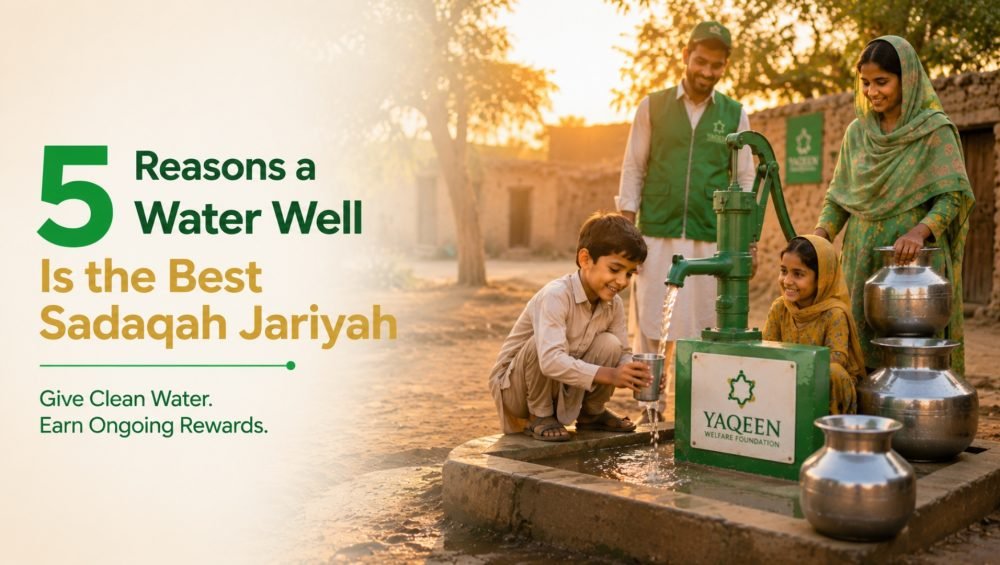
Imagine waking up before sunrise every single morning — not to pray, not to prepare breakfast — but to walk. Sometimes forty-five minutes. Sometimes over an hour. Just to reach water that is not even safe to drink. This is not a story from another century. This is the daily reality for millions of families across rural Pakistan right now. At Yaqeen Welfare Foundation we have seen it firsthand — children getting sick from contaminated sources, women spending hours of every day just collecting water, and entire villages where clean water has simply never existed. A water well donation changes all of that. One decision. One act of giving. And a family drinks safely for years. That is what we do. That is why we are asking you to help us do more of it. The Clean Water Crisis in Pakistan Pakistan is facing a water crisis that most city dwellers never see — because it is happening in the villages, the remote areas, the places nobody photographs unless something goes catastrophically wrong. The scale of it is hard to fully absorb. You will not have to look far for evidence of Pakistan’s water crisis, as the latest from UNICEF and the WHO put it in stark terms: millions here are yet to get their hands on safe, clean drinking water. In the countryside in particular, it is a daily reality for families to be dependent on sources that are anything but pure. And while waterborne illnesses pose a very real danger to children and those most at risk throughout the nation, experts are at pains to point out how dire the situation has become. For all the communities whose health and schooling are being compromised by this shortage, one could say there is not enough being made of the problem. What Unsafe Water Does to a Real Family Nobody tells you what that number looks like inside one house. So let us be honest about it. A mother collects water from a contaminated stream because there is no other option. She boils what she can. But she cannot boil everything, every time, with the fuel she has. Her youngest gets diarrhoea. Then again two weeks later. Then again. His growth slows. His immunity weakens. She watches it happen and has no way to stop it. Typhoid. Cholera. Hepatitis A. Dysentery. These are not historical diseases in Pakistan. They are active, current threats — and almost all of them are transmitted through contaminated water. The women and girls who collect water are also losing something invisible — time. Hours every day that could go toward education, income, rest or simply being present with their families. A clean water donation gives that time back. How Your Water Well Donation Helps Families When a water well arrives in a village — the change is not gradual. It is immediate. The morning walk disappears. The water is clean. The children stop getting sick as often. The mother who used to spend three hours collecting water now has those hours back. The father does not have to choose between buying medicine and buying food as frequently. The whole texture of daily life shifts. What Nobody Tells You About Clean Water A water well donation does not just provide water. It sets off a chain of changes that reaches further than most donors ever realise. When children are healthier — they attend school more consistently. When girls are not sent to collect water — they stay in class longer. When women have more time — they find ways to contribute to household income. When a community has clean water — hygiene improves, disease decreases and the local health burden drops significantly. One water well. One village. And life quietly becomes different — not all at once but in ways that keep growing. At Yaqeen Welfare Foundation this is what we see every time a pump goes in. Not just water. A different kind of life becoming possible. Water Well Donation as Sadaqah Jariyah This is the part that changes how a Muslim thinks about giving. Most acts of charity are completed in a moment. You give food — it is eaten. You give clothes — they are worn. The act ends. The reward is written. Beautiful. Real. But finished. A water well donation does not finish. The Prophet ﷺ said: “When a person dies, all their deeds come to an end except three — ongoing charity, knowledge that benefits others, or a righteous child who prays for them.” (Sahih Muslim) A water well is one of the most direct forms of that ongoing charity — Sadaqah Jariyah. Every morning a family wakes up and uses that water, the reward flows back to the donor. Every child who drinks from it and stays healthy. Every woman who no longer walks an hour in the heat. Every prayer made with water from that well. You could be asleep. Years have gone by in this world. And the reward is still moving. The Prophet ﷺ was also asked what the best charity is. Providing water was among his answers. This is not a coincidence. Water is life. And giving life — giving it in a form that continues — is among the greatest things a person can do with their wealth. A Sadaqah Jariyah for water well through Yaqeen Welfare Foundation is not just charity. It is an investment in your akhirah that pays forward every single day. How Yaqeen Welfare Foundation Builds Water Wells We want you to know exactly what happens when your water well donation reaches us. Transparency is not optional for us — it is the foundation of trust. Step 1 — Donation Received Your donation arrives and is allocated specifically to our clean water programme. Every rupee is tracked and accounted for. Step 2 — Village Identification It is the job of our ground teams to zero in on the villages that have the greatest need. We are looking for places with

sadaqah-jariyah-free-clinic-pakistan CategoriesBlog

Sadaqah Jariyah Free Clinic Saving Lives in Pakistan

Picture this. A woman walks into a clinic somewhere in rural Pakistan. She has been ignoring a pain in her chest for three months. Not because she did not care. Because every time she thought about going to a doctor she thought about the cost and turned back home. Today she walks in. She is seen. She is tested. She gets medicine. She walks out with answers she has been afraid to look for. That moment — that one moment — is someone’s Sadaqah Jariyah. Not just a past deed. Not just a good intention. It is an active, living reward being written right now for the person who helped make that clinic possible. At Yaqeen Welfare Foundation, we see this impact every day. This is what we want to talk about today. Not only what Sadaqah Jariyah means, because most people already know the definition, but how a free clinic in Pakistan can become one of the most powerful forms of ongoing charity you will ever come across. Why Healthcare Is One of the Heaviest Needs in Pakistan Before we get into the reward side of things — let us just be honest about what is happening on the ground. Pakistan has over 220 million people. A huge portion of them — especially in rural areas — have no real access to healthcare. Not because hospitals do not exist somewhere. But because getting there will cost money. The consultation costs money. The tests cost money. The medicine costs money. And for a daily wage worker or a family living on the edge — that money simply does not exist. So people wait. They manage. They pray the pain goes away. And sometimes it does. And sometimes it does not — and by the time they get help it is too late. A free clinic does not just treat illness. It removes the one thing standing between a sick person and getting better — the cost. And when that barrier comes down everything changes. How a Free Clinic Becomes Sadaqah Jariyah Here is the thing about most acts of giving. They are beautiful but they end. You feed someone — they eat — the reward is written — the moment passes. That is not a small thing. But it is a completed thing. A free clinic works differently. When you contribute towards building or running a free clinic — you are not funding one moment. You are funding hundreds of moments every single week. Every patient who walks in. Every diagnosis. Every prescription filled. Every person who goes home healthier than they came. Every child who gets treated before something small becomes something serious. All of that — every single instance — is counted for you. Not once. Every time. And it does not stop when you stop thinking about it. The clinic opens its doors on Monday morning, whether you remember your donation or not. The reward keeps coming whether you are awake or asleep. Whether you are in Pakistan or on the other side of the world. Whether you are alive or gone. That is what makes it Sadaqah Jariyah. The giving happened once. The reward never stopped. The Reward Multiplies in Ways You Cannot Track Think about one patient. Just one. She comes in with a condition that gets treated properly. She recovers. She goes back to her children. She raises them. One of them grows up to be someone who does good in the world. Another learns from her how to be kind to others. Did your clinic donation cause all of that? In a way — yes. It kept her alive and well enough to be present for her family. The chain of goodness that started with her treatment goes further than any of us can see. This is why the Prophet ﷺ placed so much emphasis on acts that benefit others in lasting ways. Because the ripple effect of genuine good is something only Allah can fully measure, and He measures all of it. Give Towards a Free Clinic in Someone’s Name A lot of people think about this when they have lost someone. A parent. A spouse. A child. Someone who needed medical care — or someone who gave it, or someone who simply deserved better than they got. Giving towards a free clinic in their name is one of the most fitting tributes you can offer. Every patient treated carries a piece of that reward to them. Every person who walks out healthier than they walked in is a gift you are sending across. You cannot call them anymore. You cannot do anything new with them in this world. But you can do this. And this — as small as a donation might feel — reaches further than you know. Yaqeen Welfare Foundation and the Yaqeen Indus Health Clinic This is exactly why Yaqeen Welfare Foundation built the Yaqeen Indus Health Clinic — to give people in underserved communities access to free medical care they could never afford on their own. Alhamdulillah the clinic is operational, the doors are open, and patients are being treated every week. For anyone looking to turn their giving into real lasting Sadaqah Jariyah — this is one of the most direct ways to do it. What Kind of Giving Goes Into a Free Clinic People sometimes assume you have to fund an entire clinic to get the reward. You do not. Contributing towards medicine for one month. Funding the salary of a nurse for a week. Donating towards medical equipment. Giving towards the running costs that keep the lights on and the doors open. All of it counts. All of it becomes part of the ongoing reward because all of it keeps the clinic serving people. Small consistent giving into something that keeps running is worth more in Sadaqah Jariyah than a single large donation into something that ends. That is just the math of ongoing charity. Final Thought Somewhere in Pakistan right now there

sadaqah-jariyah-for-water-well CategoriesBlog

Sadaqah Jariyah for Water Well in Pakistan | Donate Now

There is a village about three hours from Lahore. No proper road to get there. No hospital nearby. And until two years ago — no clean water either. Women wake up early and walk far just to get some water  Every single day. Rain or shine. Summer heat that hits fifty degrees. They did it because there was no other choice. Then someone built a water well there. One donor. One decision. And everything changed. At Yaqeen Welfare Foundation, we’ve seen this again and again. Every time, it reminds us of one clear truth — building a water well isn’t just charity. It is a lasting act of Sadaqah Jariyah for Water Well that can truly change lives. And with our Water Well program, giving has become simple, easy, and meaningful. What Is Sadaqah Jariyah for a Water Well Sadaqah Jariyah… it just means ongoing charity. A reward that does not stop. But a water well is one of the most specific and most recommended examples of it — and for good reason.TheProphet ﷺ was once asked what the best form of charity is. One of the things he mentioned was giving water. Clean water is not a luxury. For millions of people in Pakistan, it is a daily crisis. When you fund a water well, you are solving that crisis — not for one day but for years. Every single person who drinks from it, every family that cooks with it, every child who does not fall sick because the water is clean — all of that comes back to you as a reward. And it does not stop when you stop thinking about it. It just keeps going. Why Pakistan Needs Water Wells So Badly This is something people living in cities do not always feel in their bones. Turn on a tap and water comes out. Simple. Normal. In the countryside of Sindh, in some parts of Balochistan, and in the more isolated spots of Khyber Pakhtunkhwa, water isn’t something you can just rely on. In fact, millions of people across Pakistan still can’t get water that’s safe to drink, and they are forced to use water that’s been dirtied by pollution. Because of this, kids become ill. And women have to devote hours and hours of each day to obtaining water, time that could be used for other things. Sadly, illnesses you get from the water are a major reason for children dying in these locations. This is not a small problem. It is a daily reality for a huge portion of this country. Yaqeen Welfare Foundation works directly in these communities. We’re not just sending money off somewhere and hoping for the best. Our teams are actually there — going into the areas that need it most, setting up wells and pumps, and checking back to make sure everything keeps working the way it should. The Reward Does Not Stop — Ever Here is the thing about a water well that makes it different from most forms of giving. When you give money to feed someone, they eat, they are grateful, and the moment passes. Beautiful act. Real reward. But it ends. A water well does not end. If it is maintained well, it can serve a community for ten, fifteen or twenty years. Every morning when a family wakes up and uses that water, you get a reward. Every time a child drinks clean water instead of dirty water and stays healthy, you get a reward. Every ablution someone makes before prayer using that water, some scholars say, you get a reward for those prayers too. You give once. The reward multiplies for the rest of your life and continues after your death. That is the definition of Sadaqah Jariyah, and a water well is one of its purest forms. Give a Water Well in the Name of Someone You Lost A lot of people who come to Yaqeen Welfare Foundation want to give a water well for a parent who has passed away. A mother. A father. A spouse. Someone they miss every day. And this is one of the most beautiful things we get to be part of. Because that person is in their grave, their book of deeds is still open because of you. Every drop of water from that well is a gift you are sending them. You cannot call them. You cannot hug them. But you can do this. You can give something in their name that serves hundreds of people and sends a reward to them for years. We have had donors tell us it gave them peace they could not find anywhere else. Not just grief. Not just loss. But a feeling that the connection is still alive somehow. That they are still doing something for the person they love. What Does It Cost to Build a Water Well in Pakistan The cost varies depending on the location, the depth of the well, and the type of pump needed. Some areas need hand pumps. Others need solar-powered systems because electricity does not reach them. At Yaqeen Welfare Foundation, we make sure every rupee goes where it is supposed to go. We share updates with donors. We send photos. We show you exactly where your well was built and who it is serving. Because you deserve to know that your Sadaqah Jariyah is real and it is working. If you cannot afford a full well on your own, you can contribute towards one. Group donations are completely valid. Your share of the reward is yours regardless of how many people contributed. Final Thought That village is three hours from Lahore — the one with no road, no hospital, no clean water. The woman who walked forty-five minutes every morning. They do not do that anymore. One donor changed that. One decision. One act of Sadaqah Jariyah. The donor does not know those women by name. He probably never will. But somewhere right now, a family is drinking

give-sadaqah-the-right-way CategoriesBlog

How to Give Sadaqah the Right Way and Maximize Your Rewards

Most people think giving Sadaqah is simple. You have some extra money, you hand it to someone, done. And yes — at its core it really is that simple. But if you want to actually maximize your rewards, if you want every rupee and every small act to count as much as possible, there is a right way to do it. At Yaqeen Welfare Foundation, we have seen thousands of people give. Some give sadaqah a little and get so much reward. Others give a lot but miss the mark completely. The difference is almost always in how they give — not how much. So let us talk about that. Start With Your Intention Before deciding who to give to, just fix your intention first. Most people usually don’t even think about it. Why are you giving? Is it because someone is watching? Is it to feel good about yourself? Or is it genuinely because you want to please Allah and help another human being? The Prophet ﷺ said intentions judge actions. That is not just a nice quote — it is the entire engine behind your reward. The same amount of money given by two people can earn completely different rewards based on what was in their hearts when they gave it. So before you give anything, stop for one second and make that intention clean. You Do Not Need a Lot of Money This is something we want people to really hear. Sadaqah is not for the rich. It never was. The Prophet ﷺ taught us that even giving half a charity date can protect a person from hellfire. Think about how small that is. If you have ten rupees, give two. If you have food, share a little. If you have knowledge — pass it on. Yaqeen Welfare Foundation started because a few people believed that small, consistent giving builds something bigger than one giant donation ever could. And that belief has been proven right every single year. Do not wait until you are wealthy to start giving. Start now with what you have. That habit is worth more than a big future check. Give Quietly When You Can The Quran talks about people who give so quietly that even their left hand doesn’t know what their right hand gave. That’s how private charity should be. Why? Because when nobody knows — not your friends, not your family, not your followers on Instagram — then the only reason you gave was for Allah. There is no ego in it. No clout. Just pure intention. Of course, giving openly is also allowed, especially when it encourages others to give. But if you can — give quietly. Just keep it between you and Allah. That’s what really counts. Who Should You Give Sadaqah To This is where a lot of people overthink it. The honest answer is — give to whoever needs it most and whoever is closest to you first. Start with your own family if they are in need. Then your neighbors. Then your wider community. The Prophet ﷺ taught us to start with those closest to us first. Beyond that… look for people whose need is real, and urgent. A sick person who cannot afford medicine. A child missing school because of fees. A family that just… lost everything in a flood. These are not hard to find in Pakistan. They are everywhere around us. At Yaqeen Welfare Foundation, we work in healthcare, education, and housing — three areas where honestly, the need never stops. When you give through a trusted organization, you know your Sadaqah is actually reaching people who genuinely qualify and genuinely need it. And that peace of mind, well, it matters more than people realize. Give Consistently — Even If It Is Small One of the most overlooked pieces of advice on how to give Sadaqah comes directly from the Prophet ﷺ. He said the most beloved deeds to Allah are those done consistently — even if they are small. Not the biggest donation. Not the most impressive one. The consistent one. So set something up. Even fifty rupees a week. A small monthly amount to a cause you trust. A habit of giving every Friday. Whatever works for your life — make it regular because that consistency is what builds real reward over time and what actually changes lives on the ground. Do Not Cancel Your Sadaqah With Ego This one is hard to hear, but it needs to be said. Allah tells us in the Quran not to follow our charity with reminders of it, or with harm. Meaning — do not give someone food and then make them feel small for needing it.. Do not donate and then bring it up every chance you get. That behavior can wipe out the reward of your giving completely. The person you helped deserved their dignity along with your help. Real Sadaqah lifts people — it does not make them feel like they owe you something. At Yaqeen Welfare Foundation, we train our teams on this. When we hand someone medicine or help a family with their rent, we do it with respect. Because the reward is not just in the giving, it is in how you give. Sadaqah Jariyah — Give Once, Earn Forever If you really want to maximize your rewards, look into Sadaqah Jariyah. This is an ongoing charity. You give something once, and as long as people benefit from it, the reward just keeps flowing back to you — even long after you are gone. Fund a water pump in a village. Sponsor a child’s education. Contribute to a medical clinic… somewhere out there, in a rural area where it is truly needed. Every patient treated, every child educated, every thirsty person who drinks — that reward goes back to you. Donate NOW Yaqeen Welfare Foundation has projects built exactly around this. Donors who contributed to our healthcare units years ago are still earning rewards today because

different-between-zakat-and-sadaqah CategoriesBlog

What Is the Difference Between Zakat and Sadaqah in Islam?

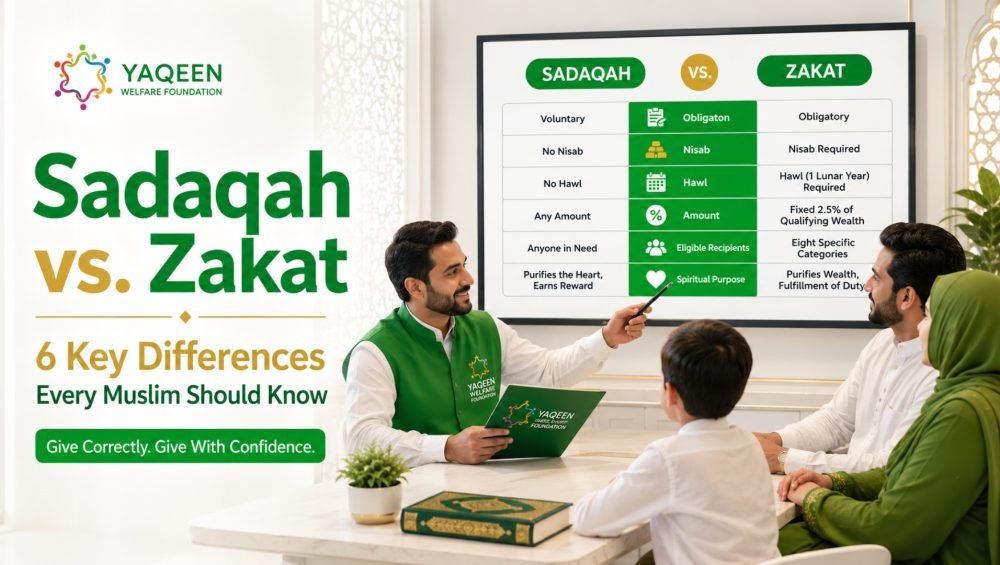
Every Muslim gives. But not every Muslim gives correctly — and that difference matters more than most people realise. At Yaqeen Welfare Foundation, Pakistan’s trusted name in free healthcare and clean water access, we see this confusion every single day. People mix up Zakat and Sadaqah. They use them interchangeably. Sometimes they give one thinking it counts as the other. It does not. Understanding the difference between Zakat and Sadaqah is not just a religious technicality — it is the foundation of giving that actually reaches the right people the right way. We built Yaqeen Indus Health Clinic and our clean water projects on exactly that principle. Your giving should count fully. So let us make sure it does together. The Core Difference Between Zakat and Sadaqah What Makes Them Fundamentally Different Zakat is an obligation. Sadaqah is a choice. That single line carries everything. Zakat is one of the Five Pillars of Islam — as foundational as Salah and Sawm. If you qualify, you must give it. There is no negotiating, no postponing without consequence, no replacing it with something else. Sadaqah sits in a completely different category. It is voluntary. Open. Flexible. You give it when your heart moves you, in whatever form you choose, to whoever needs it. Both are acts of worship. Both carry enormous rewards. But they are not the same act — and treating them as if they are leads to real gaps in both your obligation and your impact. Understanding Zakat — The Obligatory Pillar Who Must Give Zakat Zakat applies to every sane adult Muslim who has held wealth above the Nisab threshold for one complete lunar year. Nisab is currently calculated at the value of 87.48 grams of gold or 612.36 grams of silver — whichever is lower according to the scholarly position most beneficial to the poor. The amount is fixed — 2.5% of total qualifying wealth. This includes savings, gold, silver, business inventory and certain investments. It does not include your home, your car or personal items you use daily. What the Quran Says About Zakat Allah does not leave room for ambiguity here: “Take from their wealth a charity by which you purify them and cause them to increase.” (Surah At-Tawbah 9:103) Zakat is described as purification — not generosity. The poor have a right to your wealth that was always theirs. Zakat is simply the mechanism by which that right is fulfilled. Who Can Receive Zakat The Quran specifies eight categories in Surah At-Tawbah 9:60 — the poor, the needy, those in debt, travellers in need and others. This is not a loose list. Giving Zakat outside these categories does not fulfil the obligation. This specificity is why Yaqeen Welfare Foundation maintains strict Zakat distribution protocols — ensuring every rupee given as Zakat reaches a qualifying recipient through our healthcare and clean water programmes. Understanding Sadaqah — The Open Door Why Sadaqah Is Different From Zakat Sadaqah is derived from the Arabic root, Sidq , which means truthfulness and sincerity. By giving Sadaqah, we prove that our faith is genuine. That our faith in Allah’s generosity encourages us to give from what we have. The Prophet ﷺ said: “Every act of goodness is Sadaqah.” (Sahih Muslim) A smile. Removing something harmful from the road. Sharing knowledge. Giving a meal. All of it counts. Sadaqah has no minimum, no fixed amount, no single form. Sadaqah Jariyah — The Sadaqah That Never Stops Within Sadaqah there is a category that carries a special weight — Sadaqah Jariyah, or ongoing charity. The Prophet ﷺ said: “When a person dies, all their deeds come to an end except three — ongoing charity, knowledge that benefits others, or a righteous child who prays for them.” (Sahih Muslim) A water well. A free clinic. A funded classroom. These are not acts that end when you give them. They keep giving. And every time they give — the reward flows back to you. At Yaqeen Welfare Foundation, our clean water projects and Yaqeen Indus Health Clinic are built precisely as vehicles for Sadaqah Jariyah. Donors who gave towards our water pumps two years ago are still earning a reward today — because those pumps are still running and those families are still drinking clean water every single morning. Can Sadaqah Replace Zakat No. This is one of the most common and most costly misunderstandings in Islamic giving. No matter how much Sadaqah you give — ten times the Zakat amount, every Ramadan, every Friday — it does not cancel your Zakat obligation. They are separate doors. You cannot enter one through the other. If Zakat is due on you and unpaid, that obligation remains. Scholars consider unpaid Zakat a serious matter — a debt to Allah that does not disappear until it is fulfilled. What About Giving Both Yes — and this is where giving becomes truly powerful. Give your Zakat as an obligation fulfilled correctly. Then give Sadaqah from a place of love and choice. One is the floor. The other is everything you build above it. At Yaqeen Welfare Foundation we accept both — and we ensure each is used correctly and transparently according to its category. The Difference Between Zakat and Sadaqah in Everyday Giving Here is what this looks like practically. Your colleague at work is struggling. You give him money. If he qualifies as a Zakat recipient — that can count as Zakat. If not — it counts as Sadaqah. Both carry reward. But only one fulfils the pillar. You sponsor a child’s school fees. That is Sadaqah — educational support does not fall under Zakat categories. But if that child’s family qualifies under the poor or needy category and you give directly to them — that can be Zakat. The intention and the recipient both matter. Clarity is not bureaucracy. It is respect for the obligation. How Yaqeen Welfare Foundation Uses Your Giving When you give to Yaqeen Welfare Foundation — whether Zakat or Sadaqah — here