Yaqeen Welfare Foundation

Your Charity Saved Lives 8 Heartwarming Stories CategoriesBlog

Your Charity Saved Lives: 8 Heartwarming Stories

Your Charity has a way of arriving exactly where it is needed, often without the giver ever knowing what it became. Behind every donation is a real family, a real moment of relief, and a real story that continues long after the gift was sent. Below are 8 heartwarming stories showing what your charity has done — and what Islamic tradition says about the meeting that one day awaits the giver and the one who was helped. If you have ever wondered whether your charity truly reaches the people who need it most, these stories — and the deeper meaning behind them — answer that question directly. Why Your Charity Is More Than a Donation Before the stories, it helps to understand the framework Yaqeen Welfare Foundation operates within. Charity, or sadaqah, is not treated as a simple financial transaction in Islamic teaching. It is recorded in full detail — the circumstances of the giver, the sincerity behind the act, and the relief it brings to the one who receives it. “Allah does not look at your forms or your wealth, but He looks at your hearts and your deeds.” (Muslim) This is the foundation for everything that follows. Each story below shows charity functioning exactly as it was meant to — quietly, precisely, and permanently. Story 1 — The Family at the End of the Unpaved Road In a village far from any main road, a family had reached a point where there was nothing left to give the children for dinner. An emergency food parcel, funded entirely through charity, arrived within days. It was not a large sum by international standards — but in that household, it was the difference between an empty table and a full one. H6: What This Story Teaches About Charity Charity does not need to be large to be transformative. It needs to arrive at the right moment, for the right family, with sincerity behind it. Story 2 — The Widow Who Was Not Forgotten A widow raising three children alone had quietly stopped expecting help from anyone. When monthly food support began arriving through a charity programme, it did more than fill her cupboard — it told her, in a language stronger than words, that she had not been forgotten. Within a few months, her household routine stabilised, and she began planning for her children’s future again instead of just surviving the week. Story 3 — The Fasting Family in Ramadan During Ramadan, a fasting family in a remote village had nothing to break their fast with beyond plain water. Through Ramadan-specific charity distribution, a parcel arrived just before Maghrib. Tradition holds that the prayer of a fasting person at the moment of breaking fast ascends with particular speed — and this family’s prayer that evening was for the unknown donor whose charity reached them in time. Story 4 — The Orphan Who Was Fed An orphan in a household stretched thin by loss had grown used to going without. A charity-funded meal programme changed that. The hadith says: “If you want your heart to be soft, feed the poor and pat the head of the orphan.” (Ahmad) This story is a direct illustration of that teaching — the orphan was fed, and somewhere, a donor’s heart was softened by the act of giving. Story 5 — The Household Saved From Collapse Sometimes charity does not just relieve hunger — it prevents a household from breaking apart entirely. A family facing eviction and an empty pantry at the same time received emergency support that addressed both. The father, who had begun apologising nightly to his children, was finally able to sleep without that weight. Story 6 — The Village With No Clean Water Charity is not only about food. In one village, families had been drinking from a contaminated source for years. A clean water initiative, funded through ongoing charity, gave the entire community access to safe water for the first time. Children who had been frequently ill began attending school consistently again. Story 7 — The Child Who Remembers the Relief A young girl, now grown, recalls little about the specific donations that reached her household during difficult years — but she remembers the feeling. The arithmetic of poverty, briefly, became bearable. That memory of relief, made possible entirely through charity, shaped how she views generosity today. Story 8 — The Family Your Charity Has Not Yet Reached The final story has not been written yet. It belongs to a family who, right now, is waiting — for a food parcel, for a month of support, for the simple message that the world has not passed them by. This story depends on whether charity continues to move forward, and whether the next gift is sent. What These 8 Stories Have in Common Each story shares a structure: a real need, a moment of crisis, and an act of charity that arrived at precisely the right time. The table below summarises how each story connects to a specific form of charity. Story Type of Need Form of Charity Outcome 1. The Unpaved Road Family Acute hunger Emergency food parcel Household stabilised within days 2. The Widow Long-term poverty Monthly food support Restored sense of being cared for 3. The Fasting Family Ramadan hardship Ramadan food distribution Fast broken on time, prayer answered 4. The Orphan Chronic neglect Ongoing meal support Physical and emotional relief 5. The Household at Risk Eviction + hunger Emergency combined support Household kept intact 6. The Village Unsafe water Clean water project Reduced illness, improved school attendance 7. The Grown Child Childhood poverty Past sustained charity Lasting positive impact on adult life 8. The Next Family Unmet, ongoing Future charity Depends on continued giving The Deeper Meaning Behind Every Act of Charity In Islamic teaching, charity is described as something that is never lost, even when the giver never learns the outcome. The Prophet ﷺ said: “Protect yourself from the Fire, even with half a date.” (Bukhārī
One Meal, One Prayer 5 Incredible Reasons One Life Changed Forever CategoriesBlog

One Meal, One Prayer: 5 Incredible Reasons One Life Changed Forever

One Meal, One Prayer — these four words describe a moment small enough to miss and powerful enough to change everything. Not the meal itself. Not the food in the parcel or the warmth of the plate. What changes everything is what the meal carries with it: the evidence, arriving into a home that had almost stopped believing, that someone moved. That Allah heard. That the duʿā was not lost in the air. You may never know that you were that evidence. You may never learn the name of the family, or see the face of the child who ate because you gave. But in the invisible architecture of what Allah arranges, your giving and their need were placed in the same moment — and a life, quietly, was changed. This is the story of one meal, one prayer, and the five incredible reasons it can transform a life forever. If you have ever wondered whether a small act of charity truly matters, this article — rooted in the Qurʾān, the Sunnah, and the real work of Yaqeen Welfare Foundation — will show you exactly how far one meal can travel. Reason 1: The Weight a Single Meal Carries Let us speak plainly about what hunger actually feels like — not as an abstraction, but as a physical condition of the body and the home. It is a mother rationing the same handful of flour across three days, calculating in silence whether there is enough for tonight. It is a father sitting in a room that has gone quiet in the way rooms only go quiet when there is nothing being prepared — no sound of cooking, no warmth rising from a pot, no small mercy waiting in the kitchen. It is children who have learned not to ask. Who sense the tension without understanding it, and carry that weight in their sleep. Into this specific darkness, a meal arrives. And what it brings is not only food — it is proof that the world is not indifferent to their suffering. Islamic scholars have long observed that hope is not a feeling that comes on its own. It requires something to rest on — a reason, a signal, a moment when the world that has been contracting opens slightly. A meal, at the right moment, is that opening. It is tangible hope: held in the hands, carried home, and eaten. This is the first reason one meal, one prayer is never a small thing. It is the difference between a household that has been forgotten and one that has been remembered. H5: Why Hunger Is Never “Just” a Physical Problem Hunger erodes more than the body. It erodes patience, dignity, and the ability to believe that tomorrow will be different. A single delivered meal interrupts that erosion — even if only for a day — and gives a family room to breathe. Reason 2: One Prayer, Rising Before the parcel arrived, there was a prayer. Raised in private — perhaps at Fajr, perhaps in the quiet desperation of an afternoon that had no answer in it. Not a formal prayer, but the kind that comes from a person who has exhausted every worldly option and turned, with nothing left, entirely toward Allah. “Indeed, Allah is Ḥayyī, Karīm. He is too generous to let His servant raise hands to Him and return them empty.” (Abū Dāwūd) Scholars have described the duʿā of the one in genuine need as carrying a particular quality — a weight and urgency that ascends with speed. Not because of who is making it, but because of the condition from which it rises: the desperation of a person who has nothing left to try. Allah, who hears every prayer, who holds every need, who moves provision across distances invisible to us, placed their duʿā and your giving in the same moment. You did not know them. You did not hear their prayer. You simply gave, for the sake of Allah. And that was enough. That was the answer to one meal, one prayer. H6: The Hidden Connection Between Giver and Receiver Neither party usually meets. Yet a real connection exists — formed not through conversation, but through the timing Allah arranges between a person’s need and another person’s willingness to give. Reason 3: What the Prophet ﷺ Said About the Smallest Gift There is a teaching that should permanently change how we think about the scale of our giving: “Protect yourself from the Fire, even with half a date.” (Bukhārī and Muslim) Half a date. The smallest imaginable portion of food. Not a feast. Not an extraordinary sacrifice. And yet the Prophet ﷺ placed this act alongside protection from the Fire — because the scale of giving in this world and the scale of its reward in the next do not follow the same arithmetic. What is small here is not small there. What costs you a little may mean everything to a family that had nothing. And what that family feels — the specific relief of a need met — rises back to Allah as gratitude, as duʿā, as a prayer for the one who gave. “Charity extinguishes sin as water extinguishes fire.” (Tirmidhī) The act of bringing light into someone else’s darkness works, simultaneously, on your own. The mercy you extend outward returns inward — another layer of why one meal, one prayer is such a complete cycle of mercy. If you want to read the full hadith collections referenced throughout this article, Sunnah.com maintains an authenticated, searchable archive of these narrations. Reason 4: The Life That Is Changed — And How Here is what happens in the home after the parcel arrives. The children eat. Not a rationed portion, not a careful half, but a full meal. For one evening, the calculation stops. The quiet in the kitchen breaks. There is warmth. The mother, who has been holding herself together with the particular tension of someone who cannot afford to break, feels something
9 Ways Charity Softens the Heart and Changes the Soul CategoriesBlog

9 Ways Charity Softens the Heart and Changes the Soul

There is something no one tells you about charity: it changes you more than it changes the one who receives. Not immediately. Not visibly. But in the quiet that follows an act of sincere charity, something in the chest is different. A softness where there was hardness. A stillness where there was noise. A nearness to Allah that cannot be manufactured by will alone — only by the act of opening the hand. The scholars of Islam spoke of the heart as something that hardens and softens in response to what we do. Not to what we feel, or intend, or believe in the abstract, but to what we actually do. And among the acts most reliably spoken of as softening the heart, the Prophet ﷺ placed charity: the physical, tangible act of releasing what you have toward someone who needs it. This is not metaphor. This is the mechanics of how the soul works, and in this article we’ll walk through nine distinct ways charity reshapes the heart of the one who gives. If you’d like to read more reflections like this one, you can also visit our post on the spiritual rewards of Sadaqah Jariyah or browse the full collection on the Yaqeen Welfare Foundation blog. Why Charity Is the Heart’s Quiet Teacher Before listing the nine ways, it helps to understand the underlying principle. Charity is not simply a transaction of money or food. It is a repeated act of resistance against the self’s instinct to hold on. Every time a person gives, they are training the soul to release rather than grasp. This is why charity, more than almost any other act of worship, is described by scholars as having a direct and measurable effect on the condition of the heart. H6: The Hadith That Started It All The Prophet ﷺ said: “If you want your heart to be soft, feed the poor and pat the head of the orphan.” (Ahmad) Feed the poor. Not theorise about poverty. Not feel sorrow about it from a distance. The act is physical. The hand opens. The food moves. And something in the chest opens with it. The 9 Ways Charity Softens the Heart 1. Charity Breaks the Grip of Scarcity Thinking The first and most immediate effect of charity is on the giver’s relationship with fear. The nafs (the lower self) instinctively treats every act of giving as a loss. But those who practise charity consistently report the opposite experience over time: what once felt precarious begins to feel sufficient. The hand that has practised opening finds it easier to open the next time. 2. Charity Trains the Soul to Expand Rather Than Contract Ibn al-Qayyim, writing on the diseases of the heart, observed that the soul has two fundamental tendencies: to expand and to contract. It expands in the presence of what is true and good; it contracts in the presence of what is false and harmful. Among the acts most consistently associated with expansion of the soul, he placed charity, not for sentimental reasons, but because of what it does structurally to the nafs. 3. Charity Extinguishes the Weight of Sin There is a teaching that should be held alongside every act of giving, not as its motivation, but as its larger context: “Charity extinguishes sin as water extinguishes fire.” (Tirmidhī) The image is vivid and precise. Fire and water do not negotiate. When water meets fire, the fire is extinguished, not gradually reduced while retaining its structure. This is what the Prophet ﷺ said charity does to the sins of the one who gives. Every soul carries weight, and charity moves directly against that weight. 4. Charity Deepens Trust in Allah’s Provision There is a particular quality of trust, tawakkul, that cannot be argued into existence. It is built through repeated experience of giving and then watching provision return, not always immediately, and not always in the same form, but consistently enough that the heart begins to rest in a different way. This is one of the quieter but most lasting effects of regular charity. 5. Charity Increases Awareness of Others A person who gives regularly begins to notice need where they previously did not. The eyes adjust. The neighbour who has gone quiet. The family member who deflects questions about money. The stranger in the market whose clothing speaks of scarcity. Charity, practised consistently, produces a person who sees differently and feels more responsible for what they see. 6. Charity Multiplies Rather Than Diminishes The Prophet ﷺ said: “Charity does not decrease wealth.” (Muslim) This hadith is sometimes understood only as a promise about material provision, that Allah will return what is given. But scholars read it more deeply: charity does not decrease the person who gives. The one who gives does not become less. They become more — more expansive, more open, more capable of receiving both provision and mercy. 7. Charity Sets in Motion Prayers You Will Never Hear One of the most overlooked effects of charity is the duʿa it produces in someone you will never meet. A mother who was given food for her children when there was nothing raises her hands in the night and asks Allah to bless the one who sent it. She does not know your name. She calls you “the one who gave,” and Allah, who knows every name, knows exactly who she means. “Indeed, Allah is Ḥayyū, Karīm. He is too generous to let His servant raise hands to Him and return them empty.” (Abū Dāwūd) 8. Charity Builds a Habit of Giving That Outlasts a Single Moment The long work of charity is not the single act, however significant, but the accumulated effect of a life in which giving is a regular practice. Small, repeated charity, given consistently over months and years, shapes character in a way that one large but isolated gift rarely does. This is why scholars often encourage believers to give little and often rather than waiting for a

Your Simple Donation Can Transform an Entire Village CategoriesBlog

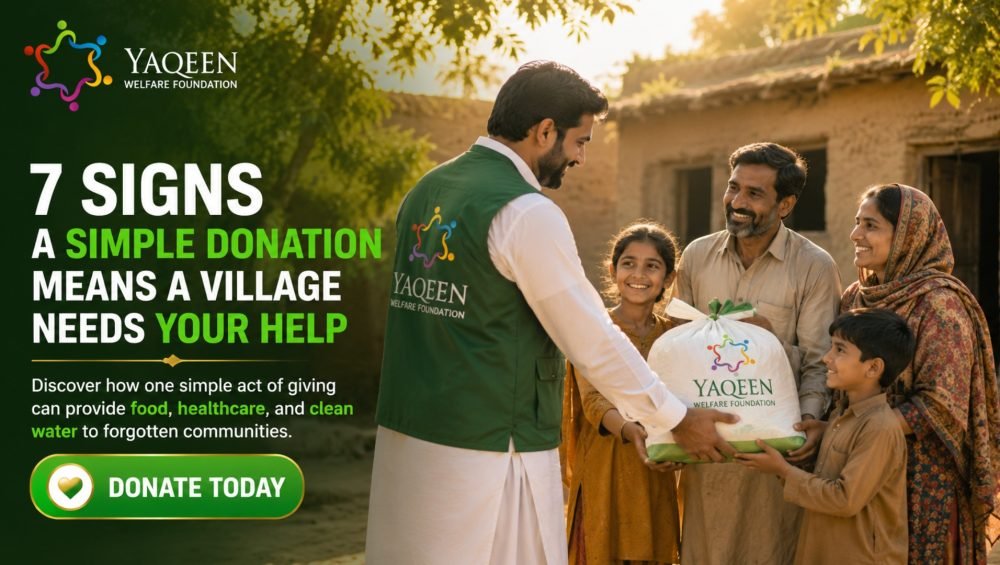
7 Signs A Simple Donation, Village Needs Your Help

A donation can travel where almost nothing else can — past unpaved roads, past surveys that never reach certain doors, past the silence of villages that no government list remembers. If you have ever wondered whether your giving truly matters, the honest answer is this: somewhere right now, a household is waiting for exactly the kind of help a simple donation provides. This article walks through seven unmistakable signs that a village needs your help, why each sign matters, and how your donation through Yaqeen Welfare Foundation can reach the people who need it most. Yaqeen Welfare Foundation exists to provide free medical treatment, clean water, and essential assistance to the people of Pakistan, with a particular focus on communities that larger organisations often overlook. Before we explore the seven signs, it helps to understand why some villages remain invisible in the first place — and why your donation is often the only thing standing between a family and another day of going without. Why Some Villages Never Receive Help Not every village in need appears on a map that aid agencies actually use. Not every family in crisis appears on a government list. Surveyors go where roads allow them to go; journalists go where cameras can follow. The result is a quiet, persistent gap — villages that are poor, hungry, and without basic services, yet completely outside the reach of conventional aid networks. This is exactly where a donation routed through a partner with verified, on-the-ground presence becomes essential. According to Yaqeen Welfare Foundation’s own blog content at the Yaqeen Welfare Foundation website, the organisation’s programmes are built specifically around reaching households that other networks miss. If you’d like to understand how this on-the-ground model works in practice, our article on Emergency Food Parcels explains the process from request to delivery. Sign 1: There Is No Functioning Clinic Nearby H5: The First Sign — Healthcare Has Disappeared When a village has no clinic, or the nearest one is hours away by foot, even minor illnesses become dangerous. A fever that would be treated in an afternoon anywhere else can become a medical emergency. This is one of the clearest, most urgent signals that a community needs outside support, because healthcare gaps compound every other form of poverty in the household. A donation directed toward medical outreach can fund mobile clinics, basic medicines, and emergency transport — the difference between a treatable condition and a tragedy. If you want to read more about how medical aid reaches isolated communities, see our related post on Clean Water and Community Health Initiatives. Sign 2: Children Are Missing School Because of Hunger H6: A Quiet but Telling Indicator Hunger does not always look dramatic. Often it looks like a child who stops attending school because there is no energy to walk there, or because the family needs an extra pair of hands at home to manage the day’s scarcity. When school attendance drops in a village not because of distance or lack of interest, but because of food insecurity, it is a strong sign that a donation of food assistance is urgently needed. Our piece on Ongoing Family Food Support explains how monthly support helps stabilise households so that children can return to school and stay there. Sign 3: The Village Has No Reliable Clean Water Source H6: Water Scarcity as a Warning Sign When families are walking long distances for water, or relying on sources that are not safe to drink, illness spreads quickly — particularly among children. Waterborne disease is one of the most preventable causes of suffering in under-resourced villages, and it is also one of the most directly solvable through targeted aid. A single donation toward a well or water filtration system can serve an entire community for years. Sign 4: Widows and Elderly Residents Have No Support Network H5: The Households Most Easily Overlooked In many forgotten villages, widows and elderly residents without close family support are the most vulnerable and the least likely to ask for help. They are often skipped over even by informal community support because there is simply not enough to go around. This is precisely the gap that Yaqeen Welfare Foundation’s Widow and Vulnerable Household Support programme is designed to close, and it is one of the most meaningful places a donation can go. Sign 5: Food Insecurity Has Become the Norm, Not the Exception When a household’s hunger has been ongoing for so long that it stops being treated as a crisis and starts being treated as simply “how things are,” that normalisation is itself a sign of how urgently help is needed. A one-time gift can offer temporary relief, but a sustained, monthly donation changes the pattern entirely — it removes the daily calculation of who eats and how much. Sign 6: There Is No Local Source of Income During Certain Seasons Many villages depend on agricultural cycles, and during lean seasons, families with no savings and no alternative income fall into acute crisis. Recognising these seasonal gaps — and timing your donation to arrive before the lean season peaks — can prevent a family from sliding into long-term hardship. Programmes like the Ramadan Food Distribution initiative are specifically timed around these predictable periods of need. Sign 7: The Village Has Gone Unvisited by Aid Organisations for Years Perhaps the clearest sign of all: when a community has simply never received outside assistance, despite visible poverty. These are the places Yaqeen Welfare Foundation actively seeks out, because they are the places least likely to be reached by anyone else. A donation to an organisation with dedicated outreach into unregistered, unmapped communities is often the only realistic path for help to arrive. Quick Reference: Signs a Village Needs Help and How a Donation Responds Sign Observed What It Indicates How a Donation Helps No functioning clinic Healthcare access gap Funds mobile medical outreach Children missing school due to hunger Acute food insecurity Provides emergency food parcels No clean water source Risk

7 Blessings of Helping a Stranger for the Sake of Allah CategoriesBlog

7 Blessings of Helping a Stranger for the Sake of Allah

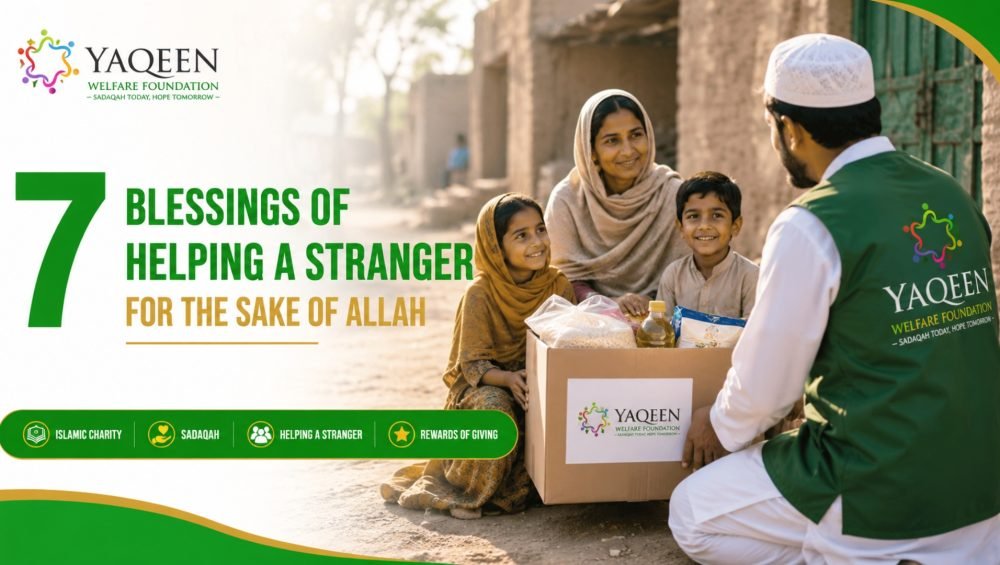
The 7 Blessings of Helping a stranger for the sake of Allah represent one of the most profound acts a Muslim can perform — a deed witnessed fully only by the One who sees all things. When you reach out to someone you have never met and will never meet again, with no expectation of gratitude or recognition, you place your trust entirely in Allah. And Allah, as the Prophet ﷺ assured us, never leaves such trust unrewarded. At Yaqeen Welfare Foundation, we carry your giving to families across Pakistan — families you will never meet, in cities you may never visit. Every donation, however small, becomes an act of helping a stranger for the sake of Allah alone. This article explores the spiritual weight and divine rewards behind that act, drawing directly from the Quran and the Sunnah of the Prophet ﷺ. What Does It Mean to Help a Stranger for the Sake of Allah? To help someone “for the sake of Allah” (fi sabilillah) means your intention is directed purely toward pleasing Allah — not gaining praise from others, not building a social reputation, and not even witnessing the outcome of your generosity. The stranger you help does not know your name. They do not know what it cost you — whether you gave from abundance or from the little that remained. Yet Allah knows all of it: every hesitation, every sacrifice, every silent intention held within the heart. This kind of giving stands apart from ordinary charity. It is charity at its most sincere because the human scaffolding of reward — gratitude, recognition, reciprocity — has been entirely removed. What remains is the act, the intention, and Allah. The Quran speaks directly to this quality of giving: “Those who spend their wealth in the way of Allah and do not follow up what they have spent with reminders of it or hurt, they will have their reward with their Lord, and there will be no fear concerning them, nor will they grieve.” (Surah Al-Baqarah, 2:262) The 7 Blessings of Helping a Stranger for the Sake of Allah Blessing 1: Allah Relieves Your Burden on the Day of Judgement The first and most extraordinary of the 7 Blessings of Helping is a divine promise of relief when it matters most. The Prophet Muhammad ﷺ said: “Whoever relieves a Muslim of a burden from the burdens of the world, Allah will relieve him of a burden from the burdens on the Day of Judgement.” (Sahih Muslim) When you carry someone else’s hardship — even partially, even for a moment — Allah carries yours on the Day when no human helper can reach you. The stranger you fed, clothed, or supported in this world becomes, through the mercy of Allah, a source of relief for you in the next. This transaction cannot be replicated by any act done purely for human reward. Blessing 2: Allah Becomes Your Aid as Long as You Aid Others Among the most beautiful of the 7 Blessings of Helping is the continuous divine support that follows a generous heart. The Prophet ﷺ said: “Allah is in the aid of His servant as long as His servant is in the aid of his brother.” (Sahih Muslim) This is not a one-time reward but an ongoing state. The moment you turn toward a stranger in their need, something turns toward you. Allah’s help surrounds you in proportion to your willingness to help others. Those who give consistently — through monthly charity, regular food support, or sustained welfare programmes — live continuously within this promise. At Yaqeen Welfare Foundation, our Ongoing Family Food Support programme embodies exactly this principle: consistent help, month after month, for families where poverty is not a crisis but a permanent condition. Blessing 3: The Du’a of a Stranger Is Among the Swiftest to Be Answered When a person in genuine need lifts their hands and makes du’a — for their children, for themselves, and for the stranger who helped them — the scholars of Islam noted that such a supplication carries special weight. The Prophet ﷺ confirmed: “The supplication of the oppressed is not veiled from Allah, even if the person is a sinner.” (Tirmidhi) The stranger you help does not know your name. But their du’a carries you within it — unnamed, unrecognised by any human, yet known to Allah in complete detail. Every prayer they make for “the one who helped me” reaches the One who knows precisely who that is. You receive a share of every word. This is the invisible dimension of charitable giving that human accounting cannot measure — and it is one of the most powerful of all the 7 Blessings of Helping. Blessing 4: Shade on the Day When There Is No Shade But Allah’s The Prophet ﷺ described seven categories of people who will be shaded by Allah on the Day of Judgement — a day so intense that the sun will be brought close to mankind. Among them: “A man who gives in charity so secretly that his left hand does not know what his right hand has given.” (Sahih Bukhari) Helping a stranger is, by its very nature, secret giving. The stranger cannot publicise your generosity. They cannot name you in praise. They received your giving and walked on — and you walked on too. The act was between you and Allah alone. And that shade, on the Day when every other form of comfort will be stripped away, is the return of an act that no one else witnessed. Blessing 5: Your Sadaqah Returns to You Multiplied The Quran uses one of its most vivid images to describe what happens to wealth given in the way of Allah: “The example of those who spend their wealth in the way of Allah is like a seed of grain which grows seven spikes; in each spike is a hundred grains. And Allah multiplies for whom He wills.” (Surah Al-Baqarah, 2:261) A single seed

Allah-Writes-7-Things-When-You-Feed-the-Hungry. CategoriesBlog

Allah Writes 7 Things When You Feed the Hungry

Allah Writes 7 Things in a believer’s record when they feed the hungry — and this is not a minor footnote in Islamic teaching. It is a promise woven into the Quran, repeated through the Sunnah, and confirmed across centuries of Islamic scholarship. There are acts of worship you perform in private: in the stillness of the night, on the prayer mat, in the quiet of your own heart. And then there are acts of worship that happen at a table. In a kitchen. In a moment of hunger met by generosity. The bowl of food passed to a neighbour in need. The meal prepared for a family who could not prepare their own. The contribution made so that someone, somewhere — a stranger, a child, a mother — would not go to sleep with an empty stomach tonight. You may not think of these moments as acts of profound worship. Allah Writes 7 Things to say otherwise. This article walks through each of those seven recordings — grounded in Hadith and Quranic guidance — and connects them to the very real, very present hunger that persists in Pakistan and across the world. If you have ever wondered whether your small contribution truly reaches the scale of divine reward, what follows is your answer. What the Prophet صلى الله عليه وسلم Said About Feeding Others Allah Writes 7 Things — Beginning With What the Prophet Elevated Above Other Deeds The Prophet صلى الله عليه وسلم did not speak about feeding the hungry as a minor act of social kindness. He spoke about it as a pillar of a life well-lived before Allah. “The best of people are those who are most beneficial to people.” (Al-Tabarani) “Feed the hungry, visit the sick, and free the captive.” (Bukhari) And in one of the most striking narrations — when the Companions asked the Prophet صلى الله عليه وسلم which act of Islam was best — one of his answers was: “That you feed others and greet with peace those you know and those you do not know.” (Bukhari, Muslim) Read that carefully. Not lengthy voluntary prayer. Not an extended fast beyond the obligation. Not a specific ritual act. That you feed others. This is what the Prophet صلى الله عليه وسلم placed at the peak of the question that every sincere believer wants answered. And it is precisely why understanding what Allah Writes 7 Things means — in practice, for each person who gives — matters so deeply. Allah Writes 7 Things: What Is Recorded When You Feed Someone We tend to think of worship as something that happens in a masjid, on a prayer mat, in a state of ritual purity. Islam does not confine ‘ibadah to those formal settings. It extends the definition of worship far into the texture of daily life — and nowhere more powerfully than in how we treat the hungry. When Allah Writes 7 Things in the record of a person who feeds the hungry, each entry is distinct. Each has its own Quranic or Hadith basis. And each is worth understanding on its own terms. 1. Allah Writes Your Sincerity as an Act of Worship The Intention Transforms the Meal Into ‘Ibadah The first of the things Allah Writes 7 Things refers to is the intention itself. When the meal is given not for gratitude or public recognition, not for the praise of people, but because the heart moved toward another human being in their moment of need — that intention is recorded. The Quran points to this directly in Surah Al-Insan: “And they feed, for the love of Allah, the poor, the orphan, and the captive.” (76:8) Not for any return. Not for any visible reward. For the love of Allah. That quality of giving — that direction of the heart — is itself the first entry in the record. Before the food is eaten, before the family is full, the intention has already been written. 2. Allah Writes the Erasure of a Sin Charity Extinguishes Sin the Way Water Extinguishes Fire The second thing Allah Writes 7 Things encompasses is purification. The Prophet صلى الله عليه وسلم taught: “Charity extinguishes sin as water extinguishes fire.” (Tirmidhi) This is not a metaphor for gradual moral improvement. It is a statement about divine mechanism — a structure Allah has built into how generosity is received and responded to. When you feed a genuinely hungry person, Allah writes against that act a purification that He alone measures and grants. For anyone carrying the weight of guilt — anyone who wonders whether their account with Allah is burdened by what they have done or neglected — this is a door that remains open. Not because the sin is overlooked, but because Allah, in His boundless mercy, has attached to the act of giving a means of erasure. A meal given in sincerity becomes a mercy returned. The food nourishes the recipient. The purification nourishes the giver. 3. Allah Writes Protection Over Your Body The Hand That Gives Is Protected in Return The third entry when Allah Writes 7 Things is physical: a protection that returns to the giver’s own body. The Prophet صلى الله عليه وسلم taught: “Treat your sick with charity.” (Abu Dawud, authenticated by scholars) What flows outward from the open hand — the food given, the donation made, the contribution that feeds a family — carries a divine response back to the giver. Not in the form of a guaranteed medical outcome, but as a promise woven into how Allah responds to the generous. The connection between physical wellbeing and spiritual generosity is documented in the Sunnah. When Allah Writes 7 Things in the believer’s record, this protection is among them — a covering the miser does not have access to, a return the generous person may not always be able to trace but is written nonetheless. 4. Allah Writes a Mark at the Gates of Jannah The Generous Have Doors of Their Own

5 Rewards of Building Hope in Someone's Darkest Moment CategoriesBlog

5 Rewards of Building Hope in Someone’s Darkest Moment

The 5 rewards of building hope in someone’s darkest moment are not theoretical. They are written in the Qurʾān, confirmed in the Sunnah, and felt — quietly, invisibly — in the homes of families whose darkness has turned to light because someone, somewhere, chose to give. This is not a list of benefits designed to persuade you. It is a description of what is already happening when you give to a person in genuine need: a spiritual transaction between you, Allah, and a stranger whose name you may never know. If you have ever wondered whether your charity truly matters — whether a donation made quietly, across a distance, to someone you have never met, carries any weight — this is what Islam teaches about the reward of hope-giving, and what Yaqeen Welfare Foundation witnesses every time a food parcel reaches a family in crisis. What It Means to Give in Someone’s Darkest Moment Before we explore the 5 rewards, it is worth being precise about what we mean by “darkest moment.” In the context of poverty in Pakistan — which is the ground on which Yaqeen Welfare Foundation works — this darkness is not abstract. It is a mother who has made the same small portion of rice last three days and is now wondering how to explain to her children why there is nothing left tonight. It is a widower managing a household that was never designed to rest on one pair of hands, and who has, this week, exhausted the last of what kept things together. It is a family in rural Punjab or interior Sindh that has no food security, no clean water, and no access to medical care — and for whom a single act of charity is not a convenience but a lifeline. When the Qurʾān speaks of giving to those in need, it does not speak in generalities. It speaks of specific people in specific conditions. And it promises specific rewards to those who respond. Here are the 5 rewards Islam teaches us come from building hope in those moments. Reward 1 — You Become the Answer to a Duʿā You Never Heard The 5 Rewards Begin With This: You Were Chosen There is a moment that most people in genuine crisis reach, though the world rarely sees it. A moment when the weight of life — debt unpaid, hunger unmet, illness untreated, grief unaccompanied — presses so heavily that a person turns entirely to Allah. They raise their hands. They do not ask for comfort. They ask for something real: food for their children, relief from the unbearable, a way forward they cannot yet see. And somewhere, without knowing any of this, you gave. The scholars of Islam described the duʿā of the one pressed by need — the prayer that rises from a person who has exhausted every worldly option — as carrying a particular weight and urgency. Such a prayer does not wait. It ascends with a speed that Allah answers swiftly. When you gave to that family, that widow, that child, you became the vehicle of that answer. Not because you were grand. Because you were willing. This is the first of the 5 rewards, and it is not small: you were placed by Allah in the position of being the answer to a desperate prayer. Of all the people in the world, in the moment that a person raised their hands, your giving was the response. The Prophet صلى الله عليه وسلم said: “The most beloved of people to Allah are those who are most beneficial to people.” (Al-Muʿjam al-Awsaṭ, al-Ṭabarānī) Reward 2 — Your Sins Are Extinguished by the Fire of Their Need The 5 Rewards Include Mercy Being Extended to You The Prophet صلى الله عليه وسلم described charity as something with a living quality — not an inert transaction, but a force that moves between people and between worlds. “Charity extinguishes sin as water extinguishes fire.” (Tirmidhī) This is remarkable: the giving you do in someone else’s darkness works on your own. The act of building hope for a stranger is, simultaneously, an act of mercy being extended to you. The sin that rests on your account is not removed because you performed a ritual. It is removed because you acted on behalf of another. He also said: “Protect yourself from the Fire, even with half a date.” (Bukhārī and Muslim) Half a date. The smallest imaginable portion of food — not a feast, not an extraordinary sacrifice. What this teaches is that the scale of your giving and the scale of its reward do not follow the same arithmetic. What is small in the world is not small in what follows. When you give to a family in desperate need, you are not offering a sum of money. You are offering, in that darkest moment, the evidence that they have not been forgotten. The reward of that is not proportional to the cost. It is proportional to the need it met. This is the second of the 5 rewards: your giving becomes protection. Not because giving is a transaction with Allah, but because Allah has told us, through His Prophet صلى الله عليه وسلم, that the act of mercy toward His creation invites mercy upon you. Reward 3 — You Are Counted Among the Seven in Allah’s Shade The 5 Rewards Include a Position That Cannot Be Earned Any Other Way The Prophet صلى الله عليه وسلم described seven types of people who will rest in the shade of Allah on the Day of Judgement — the Day when there is no other shade. Among them: “A man who gives in charity so secretly that his left hand does not know what his right hand has given.” (Bukhārī) This is not a person who gave the most. Not a person who gave most visibly. It is a person who gave so quietly that even their own awareness of the act was minimal. Giving
DONATE-AN-ORPHAN CategoriesBlog

Donate an Orphan: 1 Child You Help May Pray for You Forever!

When you donate an orphan the chance at a safe, stable, and dignified childhood, you are not simply giving money. You are stepping into the life of a child who has no parent to greet them in the morning, no one to ask about their school day, and no one whose face lights up when they walk into a room. To donate an orphan a future is one of the few acts of worship the Prophet ﷺ described as bringing a believer close enough to him in Paradise that there is no gap left between them at all. This is the heart of what it means to donate an orphan support through Yaqeen Welfare Foundation: a single act of generosity that does not end when the transaction does, but continues to grow, multiply, and return to you in ways you may never see in this life. Note: throughout Islamic literature, “sponsoring,” “caring for,” and “donating for” an orphan are used interchangeably to describe the same act of worship — supporting a child who has lost one or both parents. This article uses these terms together to reflect how scholars and hadith describe the deed. Why You Should Donate an Orphan Today There are acts of worship that ask very little of you. A meal placed in small hands. A school fee paid so a child does not lose their place. A coat given before winter. A home made warm for someone who had none. The child who receives these things may not know your name. They may never cross your path again. They will grow up not knowing what their life might have been without that moment of generosity. But they will make duʼa. And duʼa travels. This is why so many Muslims around the world choose to donate an orphan a sponsorship rather than a one-time gift — because consistency, not size, is what transforms a child’s circumstances permanently. What the Prophet ﷺ Said About the Orphan The Prophet ﷺ did not speak about orphans as a charitable category to consider at one’s leisure. He spoke about them as a measure of a person’s nearness to him — and to Allah. “I and the one who sponsors an orphan will be in Paradise like these two.” And he ﷺ indicated with his index and middle fingers, holding them together. (Bukhari) “The one who strives to help the widow and the poor is like the one who strives in Allah’s path.” (Bukhari, Muslim) Consider what is being said. Not that the person who cares for orphans is rewarded, or that they are praised — but that they will stand beside the Prophet ﷺ in Paradise. Two fingers, held together. No gap between them. If there is a closer promise in all of the hadith literature, it would be difficult to name it. You can read the full chain of narration for this hadith on Sunnah.com, which hosts authenticated hadith collections in both Arabic and English for anyone who wants to verify the wording themselves. 5 Reasons Why You Should Donate an Orphan This Year Below is a quick breakdown of what scholars and hadith literature say is written for the person who chooses to donate an orphan their time, money, or sponsorship. # What Happens When You Donate an Orphan Why It Matters 1 You are brought close to the Prophet ﷺ himself A promise given to almost no other single deed 2 A duʼa is born that reaches you without knowing your name The child’s gratitude becomes a prayer that travels 3 A hardened heart is softened The Prophet ﷺ named this as the remedy for spiritual hardness 4 A Sadaqah Jariyah flows from a life transformed The good a grown orphan does later is credited to you 5 You are counted among the best households The Prophet ﷺ defined “the best home” by this standard alone You Are Brought Close to the Prophet ﷺ Himself This is not a metaphor. The promise is literal. Two fingers, no distance. The one who honours the orphan earns a closeness to the Prophet ﷺ in the next life that is given to almost no other deed. This alone should stop us in our tracks before scrolling past another opportunity to give. A Duʼa Is Born That Does Not Know Your Name but Reaches You Anyway The orphan who receives care makes duʼa in ways they may not even articulate as duʼa. Gratitude lifted to Allah from a heart that has been given reason to hope is itself a duʼa. A child sleeping without hunger makes a duʼa without words. These prayers travel. They are heard. They are answered. And the one who made the care possible receives their portion of every single one. A Hardened Heart Is Softened The Prophet ﷺ was asked about the remedy for a hard heart. He said: to stroke the head of an orphan, and to feed the poor. In an age when we cannot always reach out a physical hand, our wealth can become our hand instead. When you donate an orphan support, you are softening the distance between your own heart and Allah. A Sadaqah Jariyah Flows From Every Life Changed The orphan who is educated does not remain a child forever. They grow. They work. They raise families. They give back. The good that flows from a life transformed is ongoing — and the one who made that transformation possible holds a thread of every good that comes from it afterward. One act of care. A lifetime of consequences written in your favour. If you want to understand more about how this principle works more broadly, our earlier article, Sadaqah Jariyah: 5 Forms of Forgotten Charity Allah Never Forgets, breaks down the categories of ongoing charity in more depth. You Are Counted Among the Best The Prophet ﷺ described the best household as one in which an orphan is treated well. Not the wealthiest. Not the most educated. Not the most distinguished

What Are the Best Charities to Give To in Islam CategoriesBlog

What Are the Best Charities to Give To in Islam?

Giving in Islam is not optional. It is woven into the faith at every level — from the obligatory Zakat that purifies wealth to the voluntary Sadaqah that softens hearts and builds communities. But giving well requires more than intention. It requires choosing where your donation goes with the same care you would give to any important decision in your life. Because not every charity delivers what it promises. Not every donation reaches the person it was meant for. And not every cause creates the kind of change that lasts beyond the day of giving. The question of what are the best charities to give to is one that every conscious Muslim donor eventually asks. The answer depends on several things — the nature of the need, the trustworthiness of the organization, the sustainability of the impact, and the Islamic reward attached to the cause. At Yaqeen Welfare Foundation, we work in two of the most impactful areas of charitable giving — free healthcare through the Yaqeen Health Clinic and clean water access through water well projects across Pakistan. In this guide we break down how to evaluate charities, which causes carry the greatest reward and impact, and how to make sure your giving reaches someone who genuinely needs it. Understanding Charity in Islam: Giving That Creates Real Impact Charity in Islam is not simply an act of generosity. It is an act of worship — carrying the same spiritual weight as prayer, fasting and pilgrimage when performed with the right intention and directed toward genuine need. Charity as Worship, Not Only Generosity The Quran describes spending in the way of Allah as one of the defining characteristics of the believer: “Those who spend their wealth in the way of Allah and then do not follow up what they have spent with reminders of it or injury — they will have their reward with their Lord.” (Surah Al-Baqarah 2:262) This framing matters. Charity is not something you do when you have surplus. It is something you do because you believe — because you trust that what you give for Allah’s sake returns to you multiplied in ways this world cannot always show. Why Intention and Benefit Work Together Intention alone is not enough to make giving impactful. The Prophet ﷺ said: “The most beloved deeds to Allah are those done consistently, even if they are small.” (Bukhari and Muslim) Consistent, intentional giving to causes that produce lasting benefit is the model Islam endorses. Not emotional one-time reactions to appeals. Not giving to feel good in the moment. Giving that is purposeful, sustainable and directed toward real change. Understanding this principle is the first step toward answering what the best charities to give to are — because impact and intention are not separate considerations. They work together. How to Decide Which Charity Deserves Your Donation Before choosing where to give, every donor needs a framework. Emotion is a starting point — not an endpoint. Here is what to look at before committing your Sadaqah. Transparency and Accountability A trustworthy charity shows you where your money went. Not vague reports. Not generic impact statements. Specific documentation — photographs, location records, beneficiary numbers, financial breakdowns. If an organization cannot show you what your donation did, that is a serious warning sign. At Yaqeen Welfare Foundation, every project is documented. Donors receive confirmation when contributions arrive and updates showing exactly where and how they were used. Direct Community Impact The closer a charity operates to the people it serves, the less is lost in the gap between donation and delivery. Organizations with on-the-ground presence — teams that identify need directly, install projects themselves and follow up afterward — create more reliable outcomes than those working through multiple intermediary layers. Sustainable Results A donation that creates temporary relief is valuable. A donation that creates lasting change is more valuable. Evaluate charities based on whether the impact they create continues after the donation has been spent. A water well that runs for fifteen years. A clinic that treats patients every week. These are not one-time acts — they are ongoing investments in human wellbeing. Urgent Needs vs Long-Term Change Both matter. Emergency relief during floods or crises saves lives immediately. Long-term projects build resilience that reduces the need for emergency relief in the future. The best giving portfolio includes both — responsive to immediate suffering and committed to structural change. Quick checklist before donating: Does the charity publish financial reports and project updates? Do they have a verified on-ground presence? Can you track the specific outcome of your donation? Does the cause align with your Islamic giving priorities? Is the impact ongoing or one-time? Read our full guide on how to give Sadaqah for a practical breakdown of giving with maximum reward and impact. The Most Meaningful Charities to Support in Islam Every cause deserves giving. But some causes carry unique weight — either in the scale of human need they address, the Islamic reward attached to them or the sustainability of the change they create. Here is an honest look at the most impactful categories. Clean Water Projects Water is described in the Quran as the foundation of all living things. And in Pakistan — where millions of rural families rely on contaminated sources — providing clean water is not an act of generosity. It is an act of restoration. The Prophet ﷺ was asked what the best Sadaqah was for a deceased loved one. His answer was a single word: “Water.” (Abu Dawud) Water charity in Islam carries a unique reward because it addresses a continuous, universal need. A water well or pump installed in a village does not serve one person. It serves every person in that community — every morning, every day, for years. Each use generates ongoing reward for the donor. This is Sadaqah Jariyah at its most direct. Beyond the Islamic reward — the practical transformation a water project delivers is extraordinary. Women who spent hours daily collecting water

Your Donation 1 Night a Family Slept Without Hunger CategoriesBlog

Your Donation: 1 Night a Family Slept Without Hunger

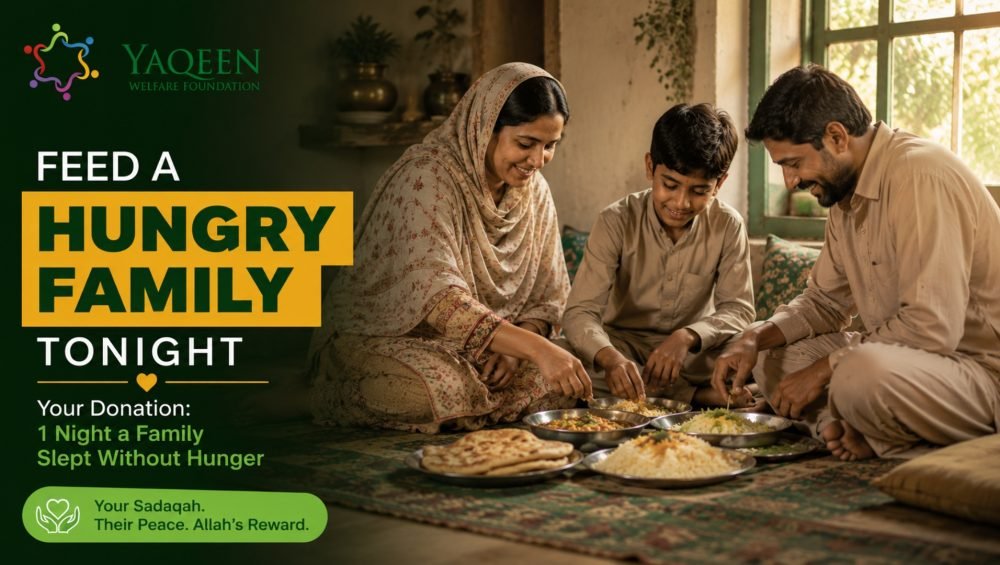
Your Donation: To feed a hungry family is not a single act that begins and ends with a meal. It is a decision that reaches into a home you will never see, on a night you will never witness, and changes everything for the people inside it. There are moments that do not announce themselves. A pot filled. A table set. A mother who has not slept in three days because the worry would not let her — finally closing her eyes. Children who fell asleep last night asking whether there would be food tomorrow, tonight sleeping without that question on their lips. These moments do not make the news. They leave no record in the world. And yet in the ledger that Allah keeps — the one that catches what the eye misses and the tongue cannot express — they are written in full. You may never know that you were the reason a family slept peacefully tonight. But Allah knows. And that is precisely the point of choosing to feed a hungry family when you have the means to do so. Why Choosing to Feed a Hungry Family Matters So Much in Islam The Prophet ﷺ did not speak of feeding the poor as one option among many. He spoke of it as a mark of faith itself — its presence or absence a measure of who a person truly is. “The best of people are those who are most beneficial to people.” (Al-Mu’jam al-Awsat) “Whoever relieves a Muslim of a burden from the burdens of the world, Allah will relieve him of a burden from the burdens on the Day of Judgement.” (Muslim) Consider what is being promised. Not simply a reward recorded in a book. But a direct exchange — your relief of another’s suffering, met with Allah’s relief of yours on the day when relief will matter most. The family that sleeps without hunger tonight because you chose to feed a hungry family is not a side effect of your charity. They are the very reason the reward exists. If you want to understand more broadly when and how this kind of giving is most rewarded, our earlier post on the Best Times and Methods for Giving Sadaqah in Islam walks through the seasons and methods that multiply the reward of every act of charity. What Hunger Actually Looks Like It is easy to hold hunger as an abstraction. A statistic. A category on a donation page. But hunger is not abstract to the mother who measures out the last of the rice and knows it will not stretch to morning. It is not abstract to the child who learns to go quiet when their stomach hurts, because they have learned that asking changes nothing. Hunger is the weight of a father who leaves the house before dawn so his children do not see him weep. It is the oldest daughter who pretends she has already eaten so her younger siblings can have more. It is a family that has learned to sleep early, because sleep is the only thing that costs nothing. This is not a rare story in Pakistan. According to the World Food Programme’s Pakistan country page, record-high food and fuel prices, worsened by climate shocks, have pushed many of the country’s most vulnerable households deeper into food insecurity, with WFP working alongside local partners to reach families who would otherwise go without. This is the reality that your decision to feed a hungry family reaches. Not a category. A family. Real people, in a real home, waiting for someone to remember them. The Quran does not allow us the comfort of distance. Surah Al-Insan describes the believers as those who feed others — despite their own need. You can read the full chapter on Quran.com, Surah Al-Insan, where the believers are described as giving food to the poor, the orphan, and the captive, purely for the love of Allah. Not because it is easy. Not because they have surplus. But because they understand that what they give for Allah is never truly lost. What Is Written When You Feed a Hungry Family The deed of feeding someone is not a simple transaction that begins and ends at the moment of giving. It opens a door that does not close easily. A duʿa is made that travels without a map When a mother who has been carrying the weight of an empty home finally lays her children down to sleep with full stomachs, her gratitude to Allah is a duʿa. She may not say your name. She may not know it. But the one who made her relief possible receives a share of every word lifted to Allah from that moment of peace. A burden is lifted — and Allah promises to lift yours in return The Prophet ﷺ tied the relief of worldly burdens directly to divine relief on the Day of Judgement. That is not a metaphor. It is a promise given by the most truthful of all creation. Children who are fed grow up to give A child who knows what it is to receive care learns what it means to give it. The family you help today does not simply survive. They carry forward. The son who remembered a season of hunger grows into a man who cannot pass suffering without responding to it. The thread of your decision to feed a hungry family runs through what he becomes — and through everyone he reaches. Your heart is softened toward Allah The Prophet ﷺ connected the act of feeding the poor directly to the remedy for a hardened heart. Giving does not only benefit the one who receives. It transforms the one who gives. Something shifts when generosity becomes habitual — when the instinct to open a hand becomes the instinct of a soul oriented toward Allah. A Real Night: The Family That Did Not Expect Anyone to Come Let us make this real. A family of