Yaqeen Welfare Foundation

Sadaqah Jariyah: 5 Forms of Forgotten Charity Allah Never Forgets CategoriesBlog

Sadaqah Jariyah: 5 Forms of Forgotten Charity Allah Never Forgets

Sadaqah Jariyah is the one kind of giving that does not end when the transaction does. It is the donation you made years ago and have long since forgotten — the one Allah never did. There are deeds you remember giving. And then there are deeds you have long since forgotten. The donation made years ago on a quiet evening. The few pounds given after a Friday khutbah when someone spoke about a well in a faraway village. The amount you rounded up at the end of a campaign because the number felt right. You forgot. Of course you did. Life moved on. The receipt faded from your inbox. The cause slipped from your memory as the next week arrived, and the one after that. But here is what you must understand: Allah did not forget. Not a single reward has been lost. Not a single benefit your charity produced has gone unrecorded. While you moved on with your life — raising your children, navigating your work, carrying your worries — something you set in motion continued to move. Quietly. Faithfully. On your behalf. This is the nature of Sadaqah Jariyah, and it is one of the most extraordinary gifts Allah has placed within human reach. What Makes a Charity “Ongoing”? The Arabic word jariyah carries the image of flowing water — something in continuous motion, never static, never exhausted. Sadaqah Jariyah is not simply a large donation or a noble cause. It is charity that keeps producing benefit after the act of giving has ended. Most of what we do in this world is transactional. We act, the act completes, and the ledger closes. A meal given ends when the plate is empty. A kind word lands and is then carried away by the next conversation. These deeds are not diminished for it — they are beloved acts. But they are finite. Sadaqah Jariyah breaks that pattern entirely. “When a person dies, all their deeds come to an end except three: ongoing charity, beneficial knowledge, or a righteous child who prays for them.” — Sahih Muslim 1631 Read those words again, slowly. All deeds come to an end. The prayers, the fasts, the efforts, the striving — all of it sealed the moment the soul leaves the body. But ongoing charity does not come to an end. It continues. It accumulates. It works for you in the unseen, long after you can work for yourself. This is not poetry. This is a divine promise, delivered through the Prophet ﷺ, about how your account with Allah actually works. Why This Matters More Than You Think Most people assume reward is tied to memory — that you have to remember a good deed for it to “count” toward you. Sadaqah Jariyah dismantles that assumption completely, and that is precisely why it deserves a closer look. The Reward That Was Never Waiting for Your Memory We tend to think of reward as something tied to awareness. We remember a good deed, we feel the weight of it, we hope it was accepted. But Sadaqah Jariyah operates entirely outside of human memory. Consider what this means in practice. Somewhere, a child draws clean water from a pump and carries it home. Your reward is written. A mother in a village you have never heard of washes her infant’s fever with clean water from that same source. Your reward is written again. A patient with no money sits before a doctor in a free clinic and receives care they could not have afforded. Your name is inscribed in a ledger no human eye can read. A family that once faced destitution finds steady ground. Their children grow up with possibilities that did not exist a generation before. Something you gave, perhaps years ago, is part of that story. You do not need to know about any of this. You do not need to remember. The accounting has never depended on you — and that is the quiet power of Sadaqah Jariyah. What Travels With You When Everything Else Stays Behind We spend our lives building things — careers, homes, reputations, savings. We accumulate. And almost all of what we accumulate will remain here, passed to others or dissolved entirely, when we leave. Islamic scholars have long described a person in their grave — unaware of the world above, beyond the reach of human intercession — yet continuing to receive. A stream of reward arriving from a water source still flowing. From a hospital still treating. From a family whose stability still holds. The gift was released once. Its effect was never released. Sadaqah Jariyah is, in the truest sense, the one thing you take with you. Not a record of what you owned. Not a monument to your name. Something far more valuable: an open account, still receiving, long after your capacity to earn has closed. If you are new to the broader landscape of Islamic giving and want to understand how Sadaqah Jariyah fits alongside other obligations, our guide on Best Times and Methods for Giving Sadaqah in Islam is a useful next read. Sadaqah Jariyah vs. Other Forms of Giving It helps to see how ongoing charity compares to other categories of giving in Islam. The table below breaks down the key differences: Type of Giving Is It Obligatory? When Does the Reward End? Typical Example Zakat Yes (annual, on qualifying wealth) Reward is for the single act of payment Annual zakat on savings or gold Sadaqah No (voluntary) Reward is for the single act of giving Cash given to a person in need Sadaqah Jariyah No (voluntary) Reward continues as long as the benefit continues A water pump, a free clinic, a school Waqf (endowment) No (voluntary) Often a permanent form of Sadaqah Jariyah A mosque, a hospital wing, an orphan home Notice the distinguishing feature in the third row: with Sadaqah Jariyah, the reward is not capped by the moment of giving. It is capped only by how long
Free Healthcare 10 Reasons for Donation in Pakistan CategoriesBlog

Free Healthcare: 10 Reasons for Donation in Pakistan

A free healthcare donation is one of the simplest ways an ordinary person can save a life they will never meet. Across Pakistan, millions of families live within reach of a hospital they can never afford to walk into. A fever that should cost a few hundred rupees to treat turns into a crisis. A pregnancy that should be routine becomes dangerous. This is the gap that a free healthcare donation closes, and it is why organizations like the Yaqeen Welfare Foundation exist — to turn small, consistent generosity into clinics, doctors, medicine, and clean water for the people who need it most. In this guide, we walk through ten clear reasons a free healthcare donation matters right now, show you exactly how your contribution is used, and answer the most common questions people ask before they give. By the end, you will understand not just why to donate, but how your free healthcare donation becomes a real outcome for a real family in Pakistan. Why a Free Healthcare Donation Matters More Than Ever Pakistan’s public health system is stretched thin, particularly in rural districts where the nearest functioning hospital can be hours away. According to the World Health Organization’s work on universal health coverage, at least half the world’s population still lacks access to essential health services, and out-of-pocket health costs push around 100 million people into extreme poverty every year. Pakistan is one of the countries where this gap is most visible — and most solvable, when donors step in. That is the core idea behind every free healthcare donation: it does not just pay for treatment, it prevents a family from being pushed deeper into poverty by a medical bill they never planned for. 10 Reasons for Free Healthcare Donation 1. A Free Healthcare Donation Saves Lives Immediately Unlike many forms of charitable giving, a free healthcare donation has an almost instant, measurable effect. Funds go directly toward consultations, diagnostics, medicine, and emergency care at facilities such as the Yaqeen Health Clinic. A child with a treatable infection, an elderly patient with high blood pressure, or a laborer injured on a job site — each of them can be seen by a doctor the same day a clinic is funded and staffed. 2. It Reduces Child and Maternal Mortality Maternal and infant health outcomes depend heavily on access to basic prenatal and postnatal care. The UNICEF Pakistan health program highlights how preventable causes still account for a large share of child deaths in the country, many of which are avoidable with timely checkups, vaccinations, and skilled birth attendance. A free healthcare donation funds exactly this kind of preventive care, often the difference between a routine delivery and a tragedy. 3. It Protects Families From Medical Debt In communities without insurance or government-subsidized care, a single hospital visit can wipe out a family’s savings or push them into informal, high-interest borrowing. As covered in our earlier post, Benefits of Free Healthcare and Why It Matters, removing the cost barrier means parents no longer have to choose between feeding their children and treating them. A free healthcare donation removes that impossible choice entirely. 4. It Builds Long-Term Community Health, Not Just One-Time Relief Sustainable impact requires more than a single visit from a mobile clinic. Recurring free healthcare donations fund ongoing operations — staffed clinics, regular medicine stock, and follow-up care — so that a community’s health improves year over year rather than spiking briefly after a single charity drive. 5. It Fulfills Sadaqah and Zakat Obligations Meaningfully For many Muslim donors, a free healthcare donation is also a way to fulfill religious obligations of giving. As explained in Best Times and Methods for Giving Sadaqah in Islam, Sadaqah given consistently — even in small amounts — carries lasting spiritual reward. Likewise, you can use the Zakat Calculator to direct your obligatory Zakat toward healthcare projects that qualify, combining worship with tangible relief. Our post Allah Acknowledges Charity – You Should Never Ignore goes deeper into the spiritual weight behind every act of giving. 6. It Strengthens Disease Prevention and Health Awareness Clinics funded through donations don’t just treat illness — they prevent it. Health education sessions on hygiene, nutrition, and vaccination reduce the spread of preventable diseases in communities that previously had no access to this information. A free healthcare donation effectively funds two outcomes at once: treatment today and prevention tomorrow. 7. It Provides Access to Specialist Doctors Many Families Never See Yaqeen’s network includes volunteer physicians across specialties — neurology, cardiology, pulmonology, ophthalmology, and internal medicine, among others — who donate their expertise to underserved patients. A free healthcare donation helps cover the logistics, equipment, and facility costs that make these specialist visits possible in areas that would otherwise never see a cardiologist or neurologist in person. 8. It Works Hand-in-Hand With Clean Water Initiatives Health and water access are deeply connected. Waterborne illness remains one of the leading causes of preventable disease in rural Pakistan. That’s why donations are also directed toward projects described in Donate Water Through Our Foundation Across Pakistan — because a free healthcare donation is far more effective when paired with access to clean drinking water in the same village. 9. It Creates Sustainable Healthcare Infrastructure Rather than one-off aid, donations fund infrastructure: clinic buildings, equipment, transport for mobile health units, and trained local staff. As outlined in Your Donation Free Healthcare in Pakistan, this is a “working pipeline” — donations convert into permanent capacity that keeps serving patients long after the initial gift is made. 10. It Multiplies Impact Through Transparent, Trackable Giving Modern donation platforms make it possible to give online, track where funds go, and see real reporting on outcomes. Our post on the Donation Center for Online Sadaqah & Free Healthcare explains how online giving has made a free healthcare donation more transparent and accessible than ever — you no longer need to be physically present in Pakistan to directly fund a patient’s treatment. How a

Clean Water Donation Water Charity Sadaqah Jariyah Donate Water Water Well Donation Clean Water Pakistan Islamic Charity CategoriesBlog

1 Drop Clean Water Donation – A Sea of Reward

Clean water donations are not simply acts of generosity — in Islam, they are among the highest, most enduring forms of worship a person can perform. They are the gifts that outlive the giver. They are the rewards that do not stop flowing when the moment of giving has passed. This is the story of what happens when you give water. The Thirst You Cannot See From Here It is possible to live an entire life in a place where clean water simply appears when you turn a tap. To never once consider where it comes from. To have never known thirst that lasts beyond a moment’s inconvenience. But for hundreds of millions of people — including vast numbers across rural Pakistan — this is not the reality. According to the World Health Organization (WHO), approximately 2 billion people worldwide lack access to safe drinking water at home. In Pakistan specifically, UNICEF estimates that over 40 million people lack access to clean water, and waterborne diseases remain one of the leading causes of illness and childhood mortality. Behind those numbers are real people: Families drawing water from rivers shared with livestock Children whose bodies carry parasites from the only water available to them Women spending four to eight hours each day walking to collect water — hours stolen from education, from rest, from the possibility of something more Entire communities where the absence of clean water is the root cause of poverty, illness, and despair And here is what Islam says to those of us who turn a tap and think nothing of it: “And We made from water every living thing.” (Surah Al-Anbiya, 21:30) Water is not merely a resource. It is a trust. Allah created every living thing from it and has placed in the hands of those with access a profound responsibility toward those without. To give clean water is to restore what was always meant to be shared. What the Prophet ﷺ Said About Water The Prophet Muhammad ﷺ did not speak about water as a minor matter. He spoke about it as one of the most enduring gifts a person could leave behind — a gift that outlives the giver and keeps rewarding them long after they are gone. “The best of charity is giving water.” (Abu Dawud, Ibn Majah) Not a good charity. Not a noble charity. The best. He also narrated the story of a man who came across a thirsty dog panting beside a well. The man descended into the well, filled his shoe with water, and gave it to the dog. Allah thanked him for that deed and forgave him. (Bukhari, Muslim) One man. One act of water given to an animal. And Allah forgave him. If that is what is written for a single moment of mercy toward a thirsty animal — consider what Allah writes for a person who brings clean water to an entire community of human beings in need. What Is Written When You Give Clean Water Donations We speak of worship as something with a beginning and an end. A prayer is prayed. A fast is broken. A deed is done. But clean water donations do not work that way. Their reward flows continuously — in this world and the next. A Sadaqah Jariyah Is Born The Prophet ﷺ taught that when a person dies, all deeds are cut off except three — and one of them is ongoing charity that continues to benefit others. A well. A water pump. A filtration system. Every time someone drinks from what you gave, the reward flows back to you. You do not need to be alive for this to continue. The water keeps giving. So does the reward. If you want to understand more about the transformative power of this kind of giving, read our blog: A Single Gift, A Lifetime of Reward – The Power of Sadaqah Jariyah Sins May Be Washed Away Charity extinguishes sin the way water extinguishes fire — and there is a profound fittingness in this image. The very substance we give — water — is the same image the Prophet ﷺ used to describe the spiritual purification that comes from generosity. What flows outward in giving returns inward as forgiveness. The Sick Are Healed — and the Giver Is Protected “Treat your sick with charity,” the Prophet ﷺ taught. Clean water is medicine. In communities where waterborne illness devastates children and families, access to clean water is not a luxury — it is the difference between health and sickness, life and death. When your donation brings that water, you are healing people in this world while building reward in the next. For a deeper exploration of how charity heals in Islam, read: The Blessings of Helping Poor – More Than You Imagine A Record Is Kept That You Will Not See Until You Need It Most You will not stand at the well and hear the du’a made over it. You will not see the child whose fever broke because the family finally stopped drinking contaminated water. You will not know the name of the mother who wept with relief when the hand pump was installed. But the ledger that Allah keeps misses nothing. The reward is written whether you witness it or not. As our blog reminds us: The Charity Only Allah Sees: The Power of Giving in Silence The Water Crisis in Pakistan: The Facts Behind the Need Before giving, it helps to understand the scale of the need your clean water donation is answering. Here is a summary of the clean water crisis in Pakistan: Indicator Data People without safe water access in Pakistan Over 40 million Leading cause of under-5 mortality in Pakistan Waterborne diseases (diarrhea, cholera, typhoid) Average distance women walk for water in rural areas 4 – 8 km per day Hours lost per day to water collection (per household) 4 – 8 hours Children missing school due to water collection duties Millions annually Percentage

Donate Water Through Our Foundation Across Pakistan CategoriesBlog

Donate Water Through Our Foundation Across Pakistan

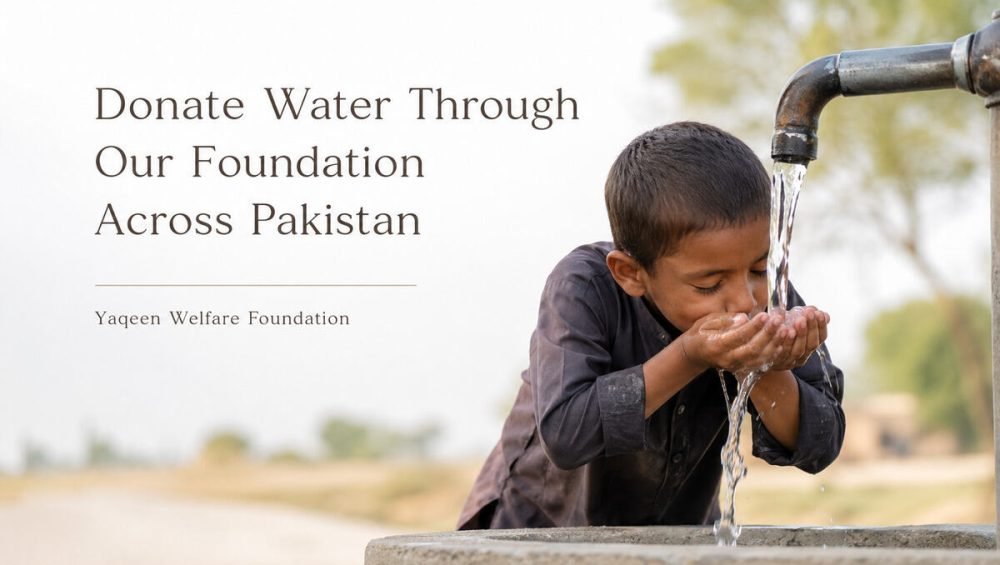
Clean water is something most of us never think about. We turn on a tap. We fill a glass. We move on. But across Pakistan — in villages hours from the nearest city, in homes where children drink from the same source animals use — clean water is not a given. It is a daily crisis. Families walk miles in the heat that reaches forty-five degrees just to collect water that makes them sick. Women wake before sunrise for a journey that takes three hours and delivers water that is unsafe to drink. Children miss school. Mothers fall ill. The elderly suffer from conditions that are worsened by contaminated water every year. When you donate water through Yaqeen Welfare Foundation, you are not just giving a resource. You are removing a burden that has defined daily life for entire communities. You are fulfilling one of the most rewarded acts of charity in Islam. And you are building something — a pump, a well, a clean water source — that serves families not for one day but for years. Why Water Is One of Allah’s Greatest Blessings Before talking about what your donation does — it is worth understanding what water means in Islam. Donating water as an act of charity carries spiritual weight unlike almost any other form of giving. Water Is Mentioned Throughout the Quran Allah says: “And We made from water every living thing.“ (Surah Al-Anbiya 21:30) This is not metaphor. It is a statement of complete dependence. When you provide water to someone who has none — you are participating in one of the most essential acts of sustaining life that exists. Every Living Thing Depends on Water The Quran returns to water again and again — as a blessing, as mercy, as a sign of Allah’s provision. Rain is described as a gift. Rivers as pathways. Clean water as sustenance. Water is not incidental to life. It is life itself. The Responsibility to Help Those in Need With blessing comes responsibility. When Allah gives you access to clean water — reliable, safe, available at any hour — He also gives you the capacity to extend that blessing to someone without it. Islamic charity is built exactly on this principle. Gratitude for the Blessings We Often Overlook Gratitude in Islam is expressed through action. The person who recognizes clean water as a gift from Allah — and then uses their resources to give that gift to someone else — is performing one of the deepest forms of shukr. The Reward of Donating Water in Islam The Prophet ﷺ was asked what the best Sadaqah is. Among his answers — he mentioned giving water. And when Sa’d ibn Ubadah asked what the best charity was on behalf of his deceased mother, the Prophet ﷺ replied with one word: “Water.“ (Abu Dawud) Not food. Not clothing. Not money. Water. Water Charity as Sadaqah Jariyah Sadaqah Jariyah is an ongoing charity — the kind that continues rewarding the donor even after death. A water source is one of the clearest examples of it.   The Prophet ﷺ said: “When a person dies, all their deeds come to an end except three — ongoing charity, knowledge that benefits others, or a righteous child who prays for them.“ (Sahih Muslim) Every morning, a family uses the water you funded — you receive a reward. Every child who drinks safely — reward. Every prayer made with that water — reward. You could be years gone from this world and the reward keeps moving. A Meaningful Charity for Loved Ones Many donors choose to donate water in the name of a parent or loved one who has passed. The prophetic precedent is explicit — water is among the most recommended Sadaqah for the deceased. Every person who drinks from a well dedicated to them sends a reward forward continuously. To understand more about giving on behalf of a loved one — read our post on Sadaqah Jariyah for the deceased. The Reality of Water Scarcity Across Pakistan Villages Still Living Without Reliable Water Sources According to recent UNICEF and WHO reports, millions of people in Pakistan — particularly in rural Sindh, Balochistan and southern Punjab — still lack access to safe and reliable drinking water. These are not remote edge cases. They are entire communities where clean water infrastructure has simply never been built. Women and Children Carrying the Burden In most affected communities it is women and girls who bear the practical weight of the water shortage in Pakistan. Hours every day spent collecting water instead of earning income, studying or resting. Girls who miss school because water collection falls to them. When a clean water project arrives — those hours return to families in a form they can actually use. Health Challenges Caused by Unsafe Water Waterborne diseases — typhoid, cholera, hepatitis A, chronic diarrhea — are direct consequences of contaminated water. Children under five are most vulnerable. The health burden falls heaviest on families least equipped to handle it medically or financially.   What Happens When a Community Gets Clean Water Improved Health and Hygiene Waterborne illness rates drop immediately. Families that were spending money treating preventable conditions stop needing that treatment as frequently. Health improves — and with it, every other aspect of life. Better Opportunities for Children When girls no longer spend hours collecting water they go to school. When boys are not sick from contaminated water they attend class consistently. Clean water projects in Pakistan create educational ripple effects that extend a generation forward. Stronger and More Self-Reliant Communities Less time lost to illness. Less money spent on treatment. More energy available for work and education. A single water source can shift the trajectory of an entire village — not for one season but permanently. See how consistent giving builds this kind of impact in our guide on how to give Sadaqah. Donate Water and Change Lives Across Pakistan How Your Water Donation Helps Families When you

CategoriesBlog

Your Donation Free Healthcare in Pakistan

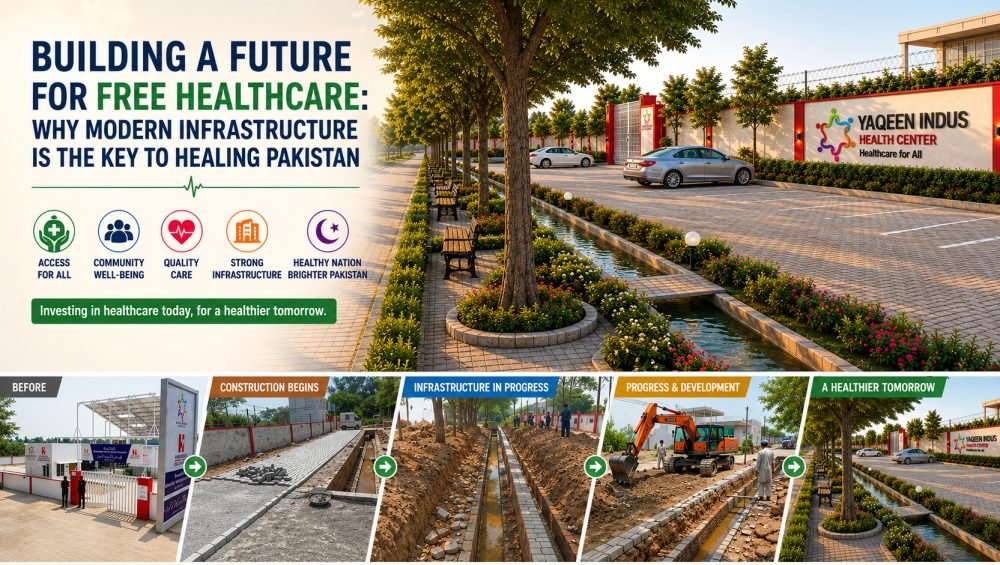
Your donation free healthcare in Pakistan is not a slogan — it is a working pipeline that converts generosity into finished clinic walls, working diagnostic machines, and thousands of patients receiving care they could not otherwise afford. If you have ever wondered whether your contribution actually reaches the people who need it most, this article answers that question in full. We walk through the medical access crisis driving the need, the step-by-step journey of a donation from your account to a patient’s treatment, the specific services your money funds, and the Islamic giving framework that makes this one of the most spiritually meaningful ways to fulfill your religious obligations. Why Donation-Funded Free Healthcare in Pakistan Is No Longer Optional Pakistan faces a healthcare access emergency that public budgets alone cannot resolve. According to the World Health Organization, the country maintains approximately 1.09 doctors per 1,000 people — a ratio well below international standards and concentrated almost entirely in urban centers like Karachi, Lahore, and Islamabad. Rural Sindh, southern Punjab, and the more remote districts of Khyber Pakhtunkhwa receive a fraction of the medical workforce available in those cities. Nearly half of Pakistan’s entire population lacks dependable access to basic primary healthcare. According to data from the World Bank’s health financing indicators (https://data.worldbank.org/indicator/SH.XPD.OOPC.CH.ZS), out-of-pocket spending dominates how Pakistani families pay for medical care — meaning that when someone gets sick, they either pay out of savings they often do not have, or they go without treatment entirely. Government clinics in underserved areas are frequently underfunded, understaffed, or simply absent. This is the gap that your donation free healthcare in Pakistan steps into. Donor-funded clinics do not replace the government’s responsibility — they respond to a medical emergency that cannot wait for policy reform. The families currently going without care cannot pause their illnesses while systemic change catches up. They need a clinic now. That is what donations build. The Journey of Your Donation Free Healthcare in Pakistan: From Gift to Patient Many donors assume their contribution disappears into a general fund once it leaves their account. In a well-run charitable model, the exact opposite is true. Every gift moves through a specific, traceable sequence from online transaction to finished medical outcome. Step One: You Give Online The process begins the moment you make a contribution through a secure digital platform. Donations can be one-time gifts, recurring monthly contributions, or structured giving tied to Islamic obligations like Zakat. The flexibility of the giving model is central to what makes donation-based free healthcare in Pakistan sustainable over the long term — it does not rely on a single annual fundraising drive, but on a continuous and diversified stream of contributions arriving at every scale. Step Two: Construction and Equipment Procurement Once received, funds are directed toward verified facility construction, medical equipment procurement, and supply chain logistics. This is the stage where your donation physically becomes a building — foundations poured, walls raised, electrical and plumbing systems installed, diagnostic equipment delivered and calibrated. Strategic partnerships with established clinical networks like the Indus Hospital & Health Network compress overhead at this stage significantly. Shared procurement channels and existing logistics infrastructure mean a larger share of every donated rupee reaches the construction site rather than administrative costs. Step Three: Patients Receive Free Care The final step is where your donation free healthcare in Pakistan becomes tangible for the families it was always intended to serve. A patient walks through the clinic’s door and receives a consultation, medication, immunization, or specialist referral — entirely free, with no co-pay, no registration fee, and no hidden charge. This is the moment the entire donation chain was built to produce, and it is repeated for thousands of patients every month once a facility is fully operational. If you want to understand the specific digital tracking mechanisms that keep each transaction auditable from donor to patient, read our detailed guide: Donation Center for Online Sadaqah and Free Healthcare — How the Platform Works. A Real Project Built on Donation Free Healthcare in Pakistan: Samundri, Faisalabad Abstract models become easier to trust when there is a physical project to examine. In Samundri, Faisalabad, that project is already underway. A small, under-resourced local clinic is being rebuilt from the ground up into a modern, multi-service healthcare facility — a direct and visible example of donation free healthcare in Pakistan moving from blueprint to building in real time. The expanded Samundri facility is designed to serve more than 50,000 patients annually once construction and staffing are complete. The scale of that ambition is only achievable because of the operational partnership with the Indus Hospital & Health Network, which brings established clinical governance, evidence-based protocols, and accountability structures that ensure donor funds are spent according to medical standards already tested and proven elsewhere in Pakistan. When finished, the Samundri clinic will offer: Maternal and newborn care for routine deliveries and high-risk pregnancies Mental health services addressing a need that remains almost entirely unmet across rural Pakistan Childhood immunizations protecting the next generation from diseases that are entirely preventable General family medicine for ongoing primary care across all age groups None of this would exist without sustained donor contributions arriving consistently throughout the construction timeline. This is the clearest possible example of how your donation free healthcare in Pakistan moves from digital transaction to concrete medical reality — not through a single large grant, but through thousands of individual gifts accumulating into something that will serve patients for decades. What Your Donation Free Healthcare in Pakistan Specifically Funds It is worth being concrete about where money actually goes rather than leaving it as an abstraction. A typical contribution to a free healthcare project in Pakistan funds some or all of the following: Facility construction — walls, roofing, electrical systems, plumbing, and the physical infrastructure required to operate a clinic safely and consistently Medical equipment — diagnostic tools, maternal care equipment, vaccine refrigeration units, and basic surgical supplies that make a range of services possible Staffing

sadaqah-jariyah-for-deceased CategoriesBlog

Sadaqah Jariyah for Deceased | Their Rewards Can Still Grow

When my colleague lost her father last year, the first thing she asked was — Is there anything I can still do for him? Not the funeral. Not the prayers. After all of that. Just — is there anything left? That question stays with us at Yaqeen Welfare Foundation because we hear it all the time from sons, daughters, widows and grieving mothers. And the answer — alhamdulillah — is yes. Sadaqah Jariyah for Deceased is something you can still do. And it is more powerful than most people realize. What Exactly Is Sadaqah Jariyah Jariyah means flowing like a river. It does not stop. Sadaqah Jariyah is a charity that keeps giving… long after you give it. A water pump that runs for years.A clinic that treats patients every single week. A child whose education you funded who goes on to do good in the world. Every time any of that happens, the reward goes back to whoever it was given to. The Prophet ﷺ said, when a person dies, three things stay open. One of them is Sadaqah Jariyah. Everything else closes. This one stays. That is the whole thing. That is why it matters so much. Your Loved One Cannot Give Anymore. But You Can This is the part that hits people hard when they really think about it. Your father cannot make a new dua anymore. Your mother cannot give a new sadaqah. Whatever they did in this world, that is what they have. The book is closed on their end. But not on yours. When you give Sadaqah Jariyah in their name, you are adding to their book from this side. You are reaching across and doing something for them that they physically cannot do for themselves anymore. And Allah accepts it. The reward goes to them. Scholars across every major school of thought agree on this. It is not a cultural tradition or a hope — it is confirmed. Think about what that means… for a second. Your person is gone. But their deeds are still growing because of you. What Actually Counts as Sadaqah Jariyah People overthink this. It does not have to be grand. It just has to keep benefiting someone over time. Clean water is probably the most recommended one. A water pump in a village where people walk miles for water. Every single person who drinks from it — that reward goes to your loved one. Yaqeen Welfare Foundation has clean water projects running in some of the most remote areas of Pakistan. Families who have nothing. And donors who gave years ago are still getting a reward because those pumps are still running. Healthcare is another one. Medicine for someone who cannot afford it. A free checkup for a patient in a rural area. We run free medical camps and our donors — many of whom gave in the name of someone they lost — their reward does not stop when the camp ends. It continues with every patient who got treatment and got better. Education too. One child whose school fees you cover can go on to teach others, raise good children and contribute to their community. The chain does not end with them. Even sharing something useful — a piece of Islamic knowledge, a skill, something your loved one taught you that you pass on — that counts. Knowledge that travels is Sadaqah Jariyah, too. You Do Not Need a Big Amount Honestly… size does not matter as much as people think. What matters is that it keeps going. A small monthly contribution to a project that serves hundreds of people is worth more in ongoing reward than one large donation to something that ends after a day. At Yaqeen Welfare Foundation, we have donors who give a few hundred rupees every month in the name of their parents. That is it. And because those rupees go into projects that keep running, the reward keeps coming. Consistently. Quietly. Long after the donation was made. Start small if you have to. Just start. When Should You Give Anytime. There is no waiting period. No specific date you have to hit. Give when you miss them. Give on their birthday. Give when something good happens, and you want to share the moment with them somehow. Give in Ramadan when everything is multiplied.Give on a random Tuesday because something reminded you of them.There is no wrong time to do something good for someone you love. Final Thought There is a water pump somewhere in rural Pakistan right now. It has been running for three years. Families come to it every single morning. Children drink from it before school. Women who used to walk an hour for water now have it close to home. The man it was built for has been gone for four years. His daughter gave it in his name after he passed. She had no idea it would still be running. She just wanted to do something for him. That is Sadaqah Jariyah. That is what it looks like when it is real. At Yaqeen Welfare Foundation, we exist to make that possible for as many people as we can — both the ones receiving help and the ones giving it in memory of someone they loved. If you have someone you want to give to — do not wait. The door is open. They are waiting… on the other side of it. May Allah accept it from you and reunite you with your loved ones in Jannah. Ameen. Donate Now The Prophet ﷺ confirmed that the deceased can benefit from charity given on their behalf — whether it is a waqf of a Mus-haf, digging a well, or planting a tree, whether done during their lifetime or by someone else after their death. Source: Orphans in Need FAQs About Sadaqah Jariyah for the Deceased Q1. Does the reward actually reach a deceased person?  Yes, it does. And honestly… this is not just a comforting belief.

Donation Center for Online Sadaqah & Free Healthcare CategoriesBlog

Donation Center for Online Sadaqah & Free Healthcare

Most people picture a donation Center as a physical building — a place you walk into, hand something over and leave hoping it reaches someone in need. That model still exists. But it is no longer the only one. Today a donation Center can be entirely digital — faster, wider and more transparent than any physical location could be. At Yaqeen Welfare Foundation, we built exactly that. A system where your online Sadaqah moves directly into free healthcare delivery through the Yaqeen Health Clinic — providing consultations, medicines and treatment to patients who have no other option. If you have ever wanted your giving to reach someone real, in real time, with real results — this is what that looks like. What Is a Donation Center? A donation Center is simply a place — physical or digital — where charitable contributions are collected and directed toward people or causes in need. Physical vs Online Donation Centers The traditional model is familiar. A building, a collection point, a team that redistributes what comes in. It works for local communities. But it has clear limits — geography, opening hours, slow distribution and limited transparency about where donations actually end up. Online donation Centers changed that model fundamentally. They removed the walls. A donor in any country can now give to a cause in Pakistan within minutes. Funds move faster. Impact is documented. And the connection between giving and receiving is direct in a way that physical systems rarely achieve. Why People Look for a Donation Center People searching for a donation Center are not just looking for a place to drop something off. They are looking for trust. They want to know their contribution will be handled properly, used correctly and make a real difference for the people it was meant to reach. That intent — to help, to donate, to support something meaningful — is exactly what a well-run online donation Center is built to honour. How Online Donation Works Online giving follows a straightforward path — and understanding it builds the confidence to give without hesitation. The Basic Flow A donor visits a verified platform, selects a cause, chooses an amount and completes a secure payment. Within seconds the donation is received, recorded and allocated to an active project. No delay. No physical transfer. No uncertainty about whether it arrived. Transparency as the Foundation What makes online donation Centers trustworthy is documentation. Every contribution should be traceable — from the moment it is received to the moment it is used. Donors should receive confirmation, project updates and clarity about exactly how their money was spent. Without that transparency an online platform is just a collection box with a website. At Yaqeen Welfare Foundation every donation is tracked and directed to specific operational needs. Donors receive confirmation at the point of giving and updates as projects move forward. This documented trail is what separates a functional donation Center from a vague charitable appeal. Why Online Is Faster and More Scalable Emergency healthcare cannot wait for a monthly collection drive. An online donation Center receives funds continuously — 24 hours a day, seven days a week — and allocates them in real time. That speed matters most when the need is urgent. It also means a single platform can serve thousands of donors simultaneously, scaling impact in ways no physical location could match. To understand more about giving with clarity and intention — read our guide on the difference between Zakat and Sadaqah. Free Healthcare Through Donation Support This is where online giving stops being abstract and becomes something a patient actually feels. Introducing Yaqeen Health Clinic The Yaqeen Health Clinic — Yaqeen Indus Health Clinic — is the healthcare delivery arm of Yaqeen Welfare Foundation. It provides completely free medical services to communities across Pakistan where affordable care has never existed. Not subsidized. Not reduced rate. Free. Because the cost is covered by donors. What the Clinic Provides Every service at the Yaqeen Health Clinic runs on donation support: Free consultations — qualified doctors see patients who cannot pay a single rupee Medicines — prescriptions are filled through clinic pharmacy support at no cost Basic treatment and diagnosis — conditions are properly identified and treated Emergency support — urgent cases are handled with the urgency they deserve Who It Reaches The patients walking through the clinic doors are not people who chose to avoid healthcare. They are people for whom healthcare was never a realistic option. Daily wage workers. Mothers in rural areas who have never had a proper checkup. Children were sick for weeks because treatment was unaffordable. Elderly patients were managing serious conditions because medicine was out of reach. Every donation becomes a consultation. Every consultation is with a person who gets better. That is not a campaign line — it is the direct operational reality of how this clinic runs. For a deeper understanding of why giving healthcare carries such profound Islamic reward — read our post on how to give Sadaqah and the methods that maximize impact. Where Donations Are Used When a donation reaches Yaqeen Welfare Foundation it does not sit in a general fund. It moves into specific active needs — all of them traceable, all of them connected to real people. Patient treatment is the first priority. Every consultation at the Yaqeen Health Clinic has an operational cost — staff time, facility running costs, and equipment. Donations cover that cost so patients pay nothing. Medicines are the second. A diagnosis is only useful if the patient can afford what is prescribed. The clinic’s pharmacy support ensures medicine reaches patients regardless of their financial situation. Clinic operations keep the doors open. Electricity, maintenance, and administrative costs — the practical infrastructure that allows the clinic to function every single week is sustained by donor contributions. Emergency care covers urgent cases that arrive without warning and cannot be deferred. Donors make that immediate response possible. Water well donations extend the impact beyond the clinic walls —

Best Times and Methods for Giving Sadaqah in Islam CategoriesBlog

Best Times and Methods for Giving Sadaqah in Islam

Sadaqah is one of the most powerful acts a Muslim can perform — not just for the person receiving it but for the soul giving it. It purifies wealth, softens hearts and builds a direct connection between a believer and Allah that no other act quite replicates. At Yaqeen Welfare Foundation your Sadaqah supports people who need it most in Pakistan — including life-changing projects like the Yaqeen Health Clinic providing completely free medical care to communities that have never had a doctor within reach. Understanding Best Times and Methods for Giving Sadaqah is not just about reward — it is about giving with the right intention and method that makes every single rupee count for this world and the next. Understanding Sadaqah in Islam What Sadaqah Really Means The word Sadaqah comes from the Arabic root Sidq — meaning sincerity and truth. When a believer gives Sadaqah they are not just transferring money or resources. They are making a statement about their faith — that they trust Allah enough to give from what they have, that they believe His promise of reward, and that they genuinely care about the human being in front of them. Sadaqah in Islam covers a remarkably wide spectrum. The Prophet ﷺ said: “Every act of goodness is Sadaqah.” (Sahih Muslim) A smile toward your brother. Removing a harmful object from the road. Sharing knowledge. Giving food. Donating money. Funding a water well. All of it counts. All of it is Sadaqah. How Sadaqah Differs From Zakat This distinction matters practically. Zakat is an obligation — a fixed 2.5% of qualifying wealth held above Nisab for one lunar year, distributed to eight specific categories defined in the Quran. It is a pillar of Islam. Non-negotiable. Due whether you feel like giving or not. Sadaqah is voluntary. No fixed amount. No specific timing. No restricted recipients. You give what you want, when you want, to whoever needs it. A non-Muslim neighbour in need. A stray animal that is thirsty. A child who needs school supplies. Sadaqah reaches all of them. The key practical point — Sadaqah can never replace Zakat. They are separate acts serving separate purposes. Why Sadaqah Transforms the Giver The Quran describes charity not as a loss but as a loan to Allah: “Who is it that would loan Allah a goodly loan so He may multiply it for him many times over?” (Surah Al-Baqarah 2:245) The spiritual benefits of giving Sadaqah are documented across dozens of authentic narrations. It extinguishes sins the way water extinguishes fire. It protects from calamity. It opens doors of provision that were previously closed. The Prophet ﷺ told us that charity does not decrease wealth — and those who give consistently find this truth confirmed in their own lives in ways they cannot always explain. Best Times  for Giving Sadaqah Why Timing Your Sadaqah Matters Islam is a religion of intentionality. The same act performed at different times can carry vastly different rewards — and knowing when Allah has made certain times more blessed is not a technicality. It is wisdom. Giving Sadaqah Daily The Prophet ﷺ said that every day the sun rises, giving Sadaqah is an obligation on every joint of the human body — and that two rakats of Duha prayer covers this. But voluntary daily giving — even something small — is among the most beloved acts to Allah. He ﷺ said: “The most beloved deeds to Allah are those done consistently, even if they are small.” (Bukhari and Muslim) A small daily Sadaqah — even fifty rupees, even a kind word — maintained consistently outweighs a large occasional donation in terms of spiritual development and closeness to Allah. Fridays — A Weekly Window of Blessing Friday is the most blessed day of the week in Islam. It is the day of Jummah, the day Adam ﷺ was created, the day that holds a hidden hour when every dua is accepted. Giving Sadaqah on Fridays carries extra weight — and making it a weekly habit is one of the simplest and most effective giving practices a Muslim can build. Ramadan — When Every Good Deed Multiplies The Prophet ﷺ was described as being more generous during Ramadan than the wind that brings rain. Every act of worship is multiplied during this month — and Sadaqah is no exception. Ramadan is when Yaqeen Welfare Foundation sees the most impact from donations — because the spirit of giving is alive in donors and because the need in Pakistan’s rural communities does not pause for any season. Muharram — A Sacred Month Often Overlooked Muharram is one of the four sacred months in Islam. Charitable acts during this month carry immense spiritual reward — yet it is among the least discussed times for giving Sadaqah. The 10th of Muharram — Ashura — is a day of particular significance, marked by fasting and increased worship. Giving generously during Muharram is a practice the Prophet ﷺ encouraged through his own example of increased worship in this month. If you have been meaning to give Sadaqah but have not yet — today is a good day to start. You can give right now to support people in rural Pakistan through Yaqeen Welfare Foundation and let your giving reach someone who genuinely has nothing else.   Methods of Giving Sadaqah Effectively Cash Giving — Direct and Immediate Handing money directly to someone in need is the most immediate form of Sadaqah. The eye contact. The human moment. The direct transfer from your hand to theirs. There is something about that which no digital transaction fully replicates. But cash giving has real limitations — you can only reach the people immediately around you. For those who want their Sadaqah to go further, other methods carry equal or greater reward. Online Giving — Sadaqah Without Borders Online giving has transformed charitable access. A Muslim in London, Karachi or Dubai can now direct their Sadaqah to a family in interior Sindh within

CategoriesBlog

Allah Acknowledges Charity – You Should Never Ignore

Allah acknowledges charity in ways that transcend the visible world. Every act of giving carries an invisible weight — not measured in currency, but in sincerity. When you open your hand for the sake of Allah, a quiet question settles in your soul: Did it reach Him? In Islam, the acknowledgment of a deed carries far greater significance than the deed itself. The Companions of the Prophet ﷺ used to fear that their worship might be rejected more than they feared committing a sin. They understood something we must rediscover: that giving without acceptance is like planting seeds in concrete. The action is there, but the growth never comes. Allah reminds us in the Quran: “Indeed, Allah only accepts from the righteous.” — Surah Al-Ma’idah 5:27 Understanding what divine acknowledgment looks like is not spiritual arrogance. It is spiritual awareness — and it is something every sincere Muslim should actively seek. In this blog, we walk through five profound signs that Allah has accepted your charity, explore the timeless legacy of Islamic giving, and show you how your donation today continues a tradition that has shaped civilisations for over fourteen centuries. Why the Question of Acceptance Matters So Deeply in Islam Before we explore the signs, we must understand why the concept of qabool (acceptance) holds such weight in Islamic thought. The Quran does not simply command us to give. It commands us to give rightly — from what we genuinely love, with intentions aimed entirely at Allah, free from the desire to be seen or praised. This is why two people can give identical amounts in identical circumstances, yet stand in vastly different positions before Allah. The Prophet ﷺ said: “Actions are judged by intentions, and every person will get the reward according to what he has intended.” — Sahih al-Bukhari This hadith is not merely a theological footnote. It is the foundation upon which the entire edifice of accepted worship is built. Charity given to be praised, to feel superior, or to trend on social media carries almost no spiritual value. Charity given in the quiet hours — for no audience but Allah — is elevated to a form of worship that can surpass donations of far greater monetary value. When Allah acknowledges charity, He does not announce it with fanfare. He whispers it into the heart of the giver through signs that only the sincerely attentive believer will recognise. Sign 1: A Deep, Unexplainable Calm Settles in Your Heart The first and perhaps most intimate sign is a stillness that arrives uninvited. This is not the temporary rush of being publicly thanked. It is not the brief satisfaction of watching your donation confirmation email arrive. It is something far quieter — a warmth that wraps around your chest like morning light, a completeness that was not there before you gave. Many believers describe this feeling after giving truly and sincerely: a sense as though a gap they never knew existed has been filled. This peace is not manufactured by the mind. It does not respond to logic or effort. It simply settles — and it waits. This is the Sakinah — the divine tranquillity — that Allah sends down into the hearts of His sincere servants. The Quran refers to this peace repeatedly, always tying it to nearness to Allah and righteous action. If you experience this after giving, do not dismiss it as a mood or a coincidence. It is one of the most intimate signs between a servant and his Lord — a quiet confirmation that your sincerity was seen. Related reading: The Importance of Charity in Islam – A Complete Guide Sign 2: Your Heart Is Pulled Toward Giving Again There is a beautiful pattern in the lives of the genuinely charitable: one good deed opens the door to another. This is not coincidence. It is divine generosity responding to human sincerity. When Allah acknowledges charity, He often rewards the giver by making it easier — and more beloved — to give again. The Prophet ﷺ said: “When a servant does a good deed, a white dot is placed on his heart.” — Ibn Majah That dot grows. That light multiplies. A heart that once hesitated before giving now gives freely — not because the act became financially easier, but because Allah made generosity beloved to it. If you find yourself drawn back to supporting causes — clean water projects, medical care for the poor, education for children who have nothing — not out of social obligation or habit, but from a genuine pull in your chest, recognise that as a profound blessing. The cycle of giving has become woven into your spiritual character. This is exactly the kind of sustained generosity that allows organisations like Yaqeen Welfare Foundation to continue transforming lives in Pakistan and beyond. Related reading: How to Give Sadaqah the Right Way and Maximise Your Rewards Sign 3: Pride Finds No Room in Your Heart Accepted charity does not celebrate itself. It does not remind you how much you gave. It does not compare your contribution to others. It does not wait anxiously to be thanked by those you helped. Instead, it leaves behind a quiet, unexpected humility — a calm recognition that you were simply chosen as a vessel for Allah’s mercy to reach another human being. The wealth was always Allah’s. The opportunity to give was His to grant or withhold. You were the instrument, not the source. This understanding — that the true Provider is Allah alone — strips pride away at its root. The ego finds nothing to grip when the heart truly believes that it contributed nothing of its own. If after giving you find yourself thinking less about your generosity and more about Allah’s — that is a sign your charity has traveled exactly where it was meant to go. This is precisely why the Prophet ﷺ advised giving with your right hand so privately that your left hand does not know. Even

CategoriesBlog

What Your Qurbani Truly Implies — Past the Sacrifice

There are minutes in life that arrive unobtrusively, wrapped in recognition, however carry a weight distant more prominent than we frequently acknowledge. Qurbani is one of them. Each year, as the favored days of Dhul Hijjah draw close, something mixes inside the hearts of Muslims over the world. There is a arrangement — not fair of coordinations, but of the soul. A acknowledgment that something sacrosanct is approaching. Yet, in the surge of every day life, indeed the sacrosanct can gotten to be routine. We set reminders. We exchange funds. We affirm arrangements. And some time recently long, the act is done — checked off, completed, moved past. But Qurbani was never planned to be something you essentially finish. It was planned to reshape something interior you. It was outlined to hinder the clamor of life and return you to what is genuine — to your Maker, to your reason, and to the individuals around the world who are holding up, discreetly and persistently, for a favoring to reach them. The address Qurbani inquires of each Muslim is not fair “Did you do it?” The more profound address is: “Did it do something to you?”   What Is Qurbani — And Why Does It Carry Such Significant Weight? Every year, over each corner of the soil, Muslims assemble amid the days of Eid ul-Adha to perform Qurbani — the custom give up of an creature committed completely to the joy of Allah. At its most obvious layer, the act shows up simple. An creature is chosen. A give up is made. The meat is conveyed — to family, to neighbors, to those in need. But to diminish Qurbani to these steps alone is to miss the endless, living sea underneath the surface. Qurbani is, at its root, a re-enactment of one of the most exceptional tests of confidence ever recorded in human history. It is a story that does not develop ancient, no matter how numerous times it is told — since its truth is timeless. Prophet Ibrahim (AS) was not an standard man. He had as of now strolled through fire — actually — for the purpose of his Ruler. He had cleared out behind consolation, community, and certainty to take after a way that few seem get it. His confidence was not hypothetical. It had been tried, solidified, and demonstrated through decades of sacrifice. Yet, Allah set some time recently him one last, shattering trial. In a dream — unmistakable and verifiable — he gotten a command: give up your child. Not a ownership. Not riches. Not comfort. His child. His child. The one he had held up and supplicated for all through the long a long time of his life. And however, Ibrahim (AS) did not falter. He did not deal or arrange. He did not inquire for time to prepare. He turned to his child, Ismail (AS), and shared what Allah had revealed. What taken after is one of the most breathtaking minutes in all of prophetic history. Ismail (AS) — youthful, steadfast, completely mindful of what was being inquired — reacted without flinching: “O my father, do as you are commanded. You will discover me, if Allah wills, among the persistent.” — Qur’an 37:102 Two individuals. One divine command. And a level of yield that most of us can scarcely start to imagine. As the minute of give up drawn closer and both souls submitted totally, Allah intervened: “O Ibrahim, you have satisfied the vision.” — Qur’an 37:104–105 A smash was given in put of Ismail (AS). The trial was complete. But here is the message that echoes over each Qurbani since: Allah did not require the misfortune of life. He required the yield of the heart. That is what Qurbani commemorates. Not basically a physical act — but a add up to yielding of the self to the will of Allah, indeed when everything inside you trembles.   Beyond the Physical Act: What Allah Genuinely Accepts It is simple, when examining Qurbani, to ended up devoured by the subtle elements of the act itself. Which creature qualifies? What are the conditions? When must it be done? These are substantial questions, and they matter. But if we halt there, we have as it were caught on the shell of Qurbani — not its core. Allah, in His interminable intelligence, has made the genuine nature of this act unmistakably clear: “It is not one or the other their meat nor their blood that comes to Allah, but it is your taqwa — your mindfulness and dedication — that comes to Him.” — Qur’an 22:37 This verse is not a commentary. It is the whole point. The physical give up is the vehicle. The heart is the destination. What this implies in hone is that two individuals can perform the correct same Qurbani — same creature, same time, same prepare — and one act may take off to the sky whereas the other scarcely lifts off the ground. The contrast is not obvious to the human eye. The contrast is intention. It is the inside pose of the individual giving. Are they giving since they truly feel appreciation to Allah for all He has provided? Are they giving with a heart that perceives its reliance on its Creator? Are they giving with an mindfulness that this act is not a exchange — not an trade for favors — but a earnest expression of cherish and devotion? Or are they giving out of social desire, out of propensity, out of a crave to satisfy an commitment and move on? Qurbani, in this sense, is one of the most genuine mirrors a individual can hold up to themselves. It inquires, without statement of regret: Who are you truly doing this for? The reply to that address — whispered in the calm of the heart — is absolutely what comes to Allah.   Qurbani as a Individual Test: What Are You Willing to Let Go? The bequest of Ibrahim