Yaqeen Welfare Foundation

Donation Center for Online Sadaqah & Free Healthcare CategoriesBlog

Donation Center for Online Sadaqah & Free Healthcare

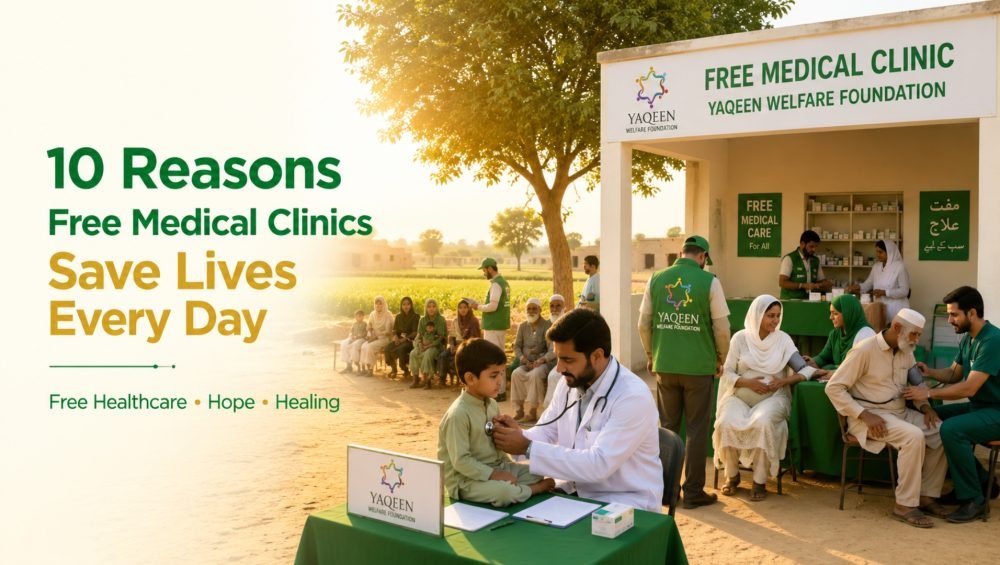
Most people picture a donation Center as a physical building — a place you walk into, hand something over and leave hoping it reaches someone in need. That model still exists. But it is no longer the only one. Today a donation Center can be entirely digital — faster, wider and more transparent than any physical location could be. At Yaqeen Welfare Foundation, we built exactly that. A system where your online Sadaqah moves directly into free healthcare delivery through the Yaqeen Health Clinic — providing consultations, medicines and treatment to patients who have no other option. If you have ever wanted your giving to reach someone real, in real time, with real results — this is what that looks like. What Is a Donation Center? A donation Center is simply a place — physical or digital — where charitable contributions are collected and directed toward people or causes in need. Physical vs Online Donation Centers The traditional model is familiar. A building, a collection point, a team that redistributes what comes in. It works for local communities. But it has clear limits — geography, opening hours, slow distribution and limited transparency about where donations actually end up. Online donation Centers changed that model fundamentally. They removed the walls. A donor in any country can now give to a cause in Pakistan within minutes. Funds move faster. Impact is documented. And the connection between giving and receiving is direct in a way that physical systems rarely achieve. Why People Look for a Donation Center People searching for a donation Center are not just looking for a place to drop something off. They are looking for trust. They want to know their contribution will be handled properly, used correctly and make a real difference for the people it was meant to reach. That intent — to help, to donate, to support something meaningful — is exactly what a well-run online donation Center is built to honour. How Online Donation Works Online giving follows a straightforward path — and understanding it builds the confidence to give without hesitation. The Basic Flow A donor visits a verified platform, selects a cause, chooses an amount and completes a secure payment. Within seconds the donation is received, recorded and allocated to an active project. No delay. No physical transfer. No uncertainty about whether it arrived. Transparency as the Foundation What makes online donation Centers trustworthy is documentation. Every contribution should be traceable — from the moment it is received to the moment it is used. Donors should receive confirmation, project updates and clarity about exactly how their money was spent. Without that transparency an online platform is just a collection box with a website. At Yaqeen Welfare Foundation every donation is tracked and directed to specific operational needs. Donors receive confirmation at the point of giving and updates as projects move forward. This documented trail is what separates a functional donation Center from a vague charitable appeal. Why Online Is Faster and More Scalable Emergency healthcare cannot wait for a monthly collection drive. An online donation Center receives funds continuously — 24 hours a day, seven days a week — and allocates them in real time. That speed matters most when the need is urgent. It also means a single platform can serve thousands of donors simultaneously, scaling impact in ways no physical location could match. To understand more about giving with clarity and intention — read our guide on the difference between Zakat and Sadaqah. Free Healthcare Through Donation Support This is where online giving stops being abstract and becomes something a patient actually feels. Introducing Yaqeen Health Clinic The Yaqeen Health Clinic — Yaqeen Indus Health Clinic — is the healthcare delivery arm of Yaqeen Welfare Foundation. It provides completely free medical services to communities across Pakistan where affordable care has never existed. Not subsidized. Not reduced rate. Free. Because the cost is covered by donors. What the Clinic Provides Every service at the Yaqeen Health Clinic runs on donation support: Free consultations — qualified doctors see patients who cannot pay a single rupee Medicines — prescriptions are filled through clinic pharmacy support at no cost Basic treatment and diagnosis — conditions are properly identified and treated Emergency support — urgent cases are handled with the urgency they deserve Who It Reaches The patients walking through the clinic doors are not people who chose to avoid healthcare. They are people for whom healthcare was never a realistic option. Daily wage workers. Mothers in rural areas who have never had a proper checkup. Children were sick for weeks because treatment was unaffordable. Elderly patients were managing serious conditions because medicine was out of reach. Every donation becomes a consultation. Every consultation is with a person who gets better. That is not a campaign line — it is the direct operational reality of how this clinic runs. For a deeper understanding of why giving healthcare carries such profound Islamic reward — read our post on how to give Sadaqah and the methods that maximize impact. Where Donations Are Used When a donation reaches Yaqeen Welfare Foundation it does not sit in a general fund. It moves into specific active needs — all of them traceable, all of them connected to real people. Patient treatment is the first priority. Every consultation at the Yaqeen Health Clinic has an operational cost — staff time, facility running costs, and equipment. Donations cover that cost so patients pay nothing. Medicines are the second. A diagnosis is only useful if the patient can afford what is prescribed. The clinic’s pharmacy support ensures medicine reaches patients regardless of their financial situation. Clinic operations keep the doors open. Electricity, maintenance, and administrative costs — the practical infrastructure that allows the clinic to function every single week is sustained by donor contributions. Emergency care covers urgent cases that arrive without warning and cannot be deferred. Donors make that immediate response possible. Water well donations extend the impact beyond the clinic walls —

Best Times and Methods for Giving Sadaqah in Islam CategoriesBlog

Best Times and Methods for Giving Sadaqah in Islam

Sadaqah is one of the most powerful acts a Muslim can perform — not just for the person receiving it but for the soul giving it. It purifies wealth, softens hearts and builds a direct connection between a believer and Allah that no other act quite replicates. At Yaqeen Welfare Foundation your Sadaqah supports people who need it most in Pakistan — including life-changing projects like the Yaqeen Health Clinic providing completely free medical care to communities that have never had a doctor within reach. Understanding Best Times and Methods for Giving Sadaqah is not just about reward — it is about giving with the right intention and method that makes every single rupee count for this world and the next. Understanding Sadaqah in Islam What Sadaqah Really Means The word Sadaqah comes from the Arabic root Sidq — meaning sincerity and truth. When a believer gives Sadaqah they are not just transferring money or resources. They are making a statement about their faith — that they trust Allah enough to give from what they have, that they believe His promise of reward, and that they genuinely care about the human being in front of them. Sadaqah in Islam covers a remarkably wide spectrum. The Prophet ﷺ said: “Every act of goodness is Sadaqah.” (Sahih Muslim) A smile toward your brother. Removing a harmful object from the road. Sharing knowledge. Giving food. Donating money. Funding a water well. All of it counts. All of it is Sadaqah. How Sadaqah Differs From Zakat This distinction matters practically. Zakat is an obligation — a fixed 2.5% of qualifying wealth held above Nisab for one lunar year, distributed to eight specific categories defined in the Quran. It is a pillar of Islam. Non-negotiable. Due whether you feel like giving or not. Sadaqah is voluntary. No fixed amount. No specific timing. No restricted recipients. You give what you want, when you want, to whoever needs it. A non-Muslim neighbour in need. A stray animal that is thirsty. A child who needs school supplies. Sadaqah reaches all of them. The key practical point — Sadaqah can never replace Zakat. They are separate acts serving separate purposes. Why Sadaqah Transforms the Giver The Quran describes charity not as a loss but as a loan to Allah: “Who is it that would loan Allah a goodly loan so He may multiply it for him many times over?” (Surah Al-Baqarah 2:245) The spiritual benefits of giving Sadaqah are documented across dozens of authentic narrations. It extinguishes sins the way water extinguishes fire. It protects from calamity. It opens doors of provision that were previously closed. The Prophet ﷺ told us that charity does not decrease wealth — and those who give consistently find this truth confirmed in their own lives in ways they cannot always explain. Best Times  for Giving Sadaqah Why Timing Your Sadaqah Matters Islam is a religion of intentionality. The same act performed at different times can carry vastly different rewards — and knowing when Allah has made certain times more blessed is not a technicality. It is wisdom. Giving Sadaqah Daily The Prophet ﷺ said that every day the sun rises, giving Sadaqah is an obligation on every joint of the human body — and that two rakats of Duha prayer covers this. But voluntary daily giving — even something small — is among the most beloved acts to Allah. He ﷺ said: “The most beloved deeds to Allah are those done consistently, even if they are small.” (Bukhari and Muslim) A small daily Sadaqah — even fifty rupees, even a kind word — maintained consistently outweighs a large occasional donation in terms of spiritual development and closeness to Allah. Fridays — A Weekly Window of Blessing Friday is the most blessed day of the week in Islam. It is the day of Jummah, the day Adam ﷺ was created, the day that holds a hidden hour when every dua is accepted. Giving Sadaqah on Fridays carries extra weight — and making it a weekly habit is one of the simplest and most effective giving practices a Muslim can build. Ramadan — When Every Good Deed Multiplies The Prophet ﷺ was described as being more generous during Ramadan than the wind that brings rain. Every act of worship is multiplied during this month — and Sadaqah is no exception. Ramadan is when Yaqeen Welfare Foundation sees the most impact from donations — because the spirit of giving is alive in donors and because the need in Pakistan’s rural communities does not pause for any season. Muharram — A Sacred Month Often Overlooked Muharram is one of the four sacred months in Islam. Charitable acts during this month carry immense spiritual reward — yet it is among the least discussed times for giving Sadaqah. The 10th of Muharram — Ashura — is a day of particular significance, marked by fasting and increased worship. Giving generously during Muharram is a practice the Prophet ﷺ encouraged through his own example of increased worship in this month. If you have been meaning to give Sadaqah but have not yet — today is a good day to start. You can give right now to support people in rural Pakistan through Yaqeen Welfare Foundation and let your giving reach someone who genuinely has nothing else.   Methods of Giving Sadaqah Effectively Cash Giving — Direct and Immediate Handing money directly to someone in need is the most immediate form of Sadaqah. The eye contact. The human moment. The direct transfer from your hand to theirs. There is something about that which no digital transaction fully replicates. But cash giving has real limitations — you can only reach the people immediately around you. For those who want their Sadaqah to go further, other methods carry equal or greater reward. Online Giving — Sadaqah Without Borders Online giving has transformed charitable access. A Muslim in London, Karachi or Dubai can now direct their Sadaqah to a family in interior Sindh within

CategoriesBlog

Allah Acknowledges Charity – You Should Never Ignore

Allah acknowledges charity in ways that transcend the visible world. Every act of giving carries an invisible weight — not measured in currency, but in sincerity. When you open your hand for the sake of Allah, a quiet question settles in your soul: Did it reach Him? In Islam, the acknowledgment of a deed carries far greater significance than the deed itself. The Companions of the Prophet ﷺ used to fear that their worship might be rejected more than they feared committing a sin. They understood something we must rediscover: that giving without acceptance is like planting seeds in concrete. The action is there, but the growth never comes. Allah reminds us in the Quran: “Indeed, Allah only accepts from the righteous.” — Surah Al-Ma’idah 5:27 Understanding what divine acknowledgment looks like is not spiritual arrogance. It is spiritual awareness — and it is something every sincere Muslim should actively seek. In this blog, we walk through five profound signs that Allah has accepted your charity, explore the timeless legacy of Islamic giving, and show you how your donation today continues a tradition that has shaped civilisations for over fourteen centuries. Why the Question of Acceptance Matters So Deeply in Islam Before we explore the signs, we must understand why the concept of qabool (acceptance) holds such weight in Islamic thought. The Quran does not simply command us to give. It commands us to give rightly — from what we genuinely love, with intentions aimed entirely at Allah, free from the desire to be seen or praised. This is why two people can give identical amounts in identical circumstances, yet stand in vastly different positions before Allah. The Prophet ﷺ said: “Actions are judged by intentions, and every person will get the reward according to what he has intended.” — Sahih al-Bukhari This hadith is not merely a theological footnote. It is the foundation upon which the entire edifice of accepted worship is built. Charity given to be praised, to feel superior, or to trend on social media carries almost no spiritual value. Charity given in the quiet hours — for no audience but Allah — is elevated to a form of worship that can surpass donations of far greater monetary value. When Allah acknowledges charity, He does not announce it with fanfare. He whispers it into the heart of the giver through signs that only the sincerely attentive believer will recognise. Sign 1: A Deep, Unexplainable Calm Settles in Your Heart The first and perhaps most intimate sign is a stillness that arrives uninvited. This is not the temporary rush of being publicly thanked. It is not the brief satisfaction of watching your donation confirmation email arrive. It is something far quieter — a warmth that wraps around your chest like morning light, a completeness that was not there before you gave. Many believers describe this feeling after giving truly and sincerely: a sense as though a gap they never knew existed has been filled. This peace is not manufactured by the mind. It does not respond to logic or effort. It simply settles — and it waits. This is the Sakinah — the divine tranquillity — that Allah sends down into the hearts of His sincere servants. The Quran refers to this peace repeatedly, always tying it to nearness to Allah and righteous action. If you experience this after giving, do not dismiss it as a mood or a coincidence. It is one of the most intimate signs between a servant and his Lord — a quiet confirmation that your sincerity was seen. Related reading: The Importance of Charity in Islam – A Complete Guide Sign 2: Your Heart Is Pulled Toward Giving Again There is a beautiful pattern in the lives of the genuinely charitable: one good deed opens the door to another. This is not coincidence. It is divine generosity responding to human sincerity. When Allah acknowledges charity, He often rewards the giver by making it easier — and more beloved — to give again. The Prophet ﷺ said: “When a servant does a good deed, a white dot is placed on his heart.” — Ibn Majah That dot grows. That light multiplies. A heart that once hesitated before giving now gives freely — not because the act became financially easier, but because Allah made generosity beloved to it. If you find yourself drawn back to supporting causes — clean water projects, medical care for the poor, education for children who have nothing — not out of social obligation or habit, but from a genuine pull in your chest, recognise that as a profound blessing. The cycle of giving has become woven into your spiritual character. This is exactly the kind of sustained generosity that allows organisations like Yaqeen Welfare Foundation to continue transforming lives in Pakistan and beyond. Related reading: How to Give Sadaqah the Right Way and Maximise Your Rewards Sign 3: Pride Finds No Room in Your Heart Accepted charity does not celebrate itself. It does not remind you how much you gave. It does not compare your contribution to others. It does not wait anxiously to be thanked by those you helped. Instead, it leaves behind a quiet, unexpected humility — a calm recognition that you were simply chosen as a vessel for Allah’s mercy to reach another human being. The wealth was always Allah’s. The opportunity to give was His to grant or withhold. You were the instrument, not the source. This understanding — that the true Provider is Allah alone — strips pride away at its root. The ego finds nothing to grip when the heart truly believes that it contributed nothing of its own. If after giving you find yourself thinking less about your generosity and more about Allah’s — that is a sign your charity has traveled exactly where it was meant to go. This is precisely why the Prophet ﷺ advised giving with your right hand so privately that your left hand does not know. Even

CategoriesBlog

What Your Qurbani Truly Implies — Past the Sacrifice

There are minutes in life that arrive unobtrusively, wrapped in recognition, however carry a weight distant more prominent than we frequently acknowledge. Qurbani is one of them. Each year, as the favored days of Dhul Hijjah draw close, something mixes inside the hearts of Muslims over the world. There is a arrangement — not fair of coordinations, but of the soul. A acknowledgment that something sacrosanct is approaching. Yet, in the surge of every day life, indeed the sacrosanct can gotten to be routine. We set reminders. We exchange funds. We affirm arrangements. And some time recently long, the act is done — checked off, completed, moved past. But Qurbani was never planned to be something you essentially finish. It was planned to reshape something interior you. It was outlined to hinder the clamor of life and return you to what is genuine — to your Maker, to your reason, and to the individuals around the world who are holding up, discreetly and persistently, for a favoring to reach them. The address Qurbani inquires of each Muslim is not fair “Did you do it?” The more profound address is: “Did it do something to you?”   What Is Qurbani — And Why Does It Carry Such Significant Weight? Every year, over each corner of the soil, Muslims assemble amid the days of Eid ul-Adha to perform Qurbani — the custom give up of an creature committed completely to the joy of Allah. At its most obvious layer, the act shows up simple. An creature is chosen. A give up is made. The meat is conveyed — to family, to neighbors, to those in need. But to diminish Qurbani to these steps alone is to miss the endless, living sea underneath the surface. Qurbani is, at its root, a re-enactment of one of the most exceptional tests of confidence ever recorded in human history. It is a story that does not develop ancient, no matter how numerous times it is told — since its truth is timeless. Prophet Ibrahim (AS) was not an standard man. He had as of now strolled through fire — actually — for the purpose of his Ruler. He had cleared out behind consolation, community, and certainty to take after a way that few seem get it. His confidence was not hypothetical. It had been tried, solidified, and demonstrated through decades of sacrifice. Yet, Allah set some time recently him one last, shattering trial. In a dream — unmistakable and verifiable — he gotten a command: give up your child. Not a ownership. Not riches. Not comfort. His child. His child. The one he had held up and supplicated for all through the long a long time of his life. And however, Ibrahim (AS) did not falter. He did not deal or arrange. He did not inquire for time to prepare. He turned to his child, Ismail (AS), and shared what Allah had revealed. What taken after is one of the most breathtaking minutes in all of prophetic history. Ismail (AS) — youthful, steadfast, completely mindful of what was being inquired — reacted without flinching: “O my father, do as you are commanded. You will discover me, if Allah wills, among the persistent.” — Qur’an 37:102 Two individuals. One divine command. And a level of yield that most of us can scarcely start to imagine. As the minute of give up drawn closer and both souls submitted totally, Allah intervened: “O Ibrahim, you have satisfied the vision.” — Qur’an 37:104–105 A smash was given in put of Ismail (AS). The trial was complete. But here is the message that echoes over each Qurbani since: Allah did not require the misfortune of life. He required the yield of the heart. That is what Qurbani commemorates. Not basically a physical act — but a add up to yielding of the self to the will of Allah, indeed when everything inside you trembles.   Beyond the Physical Act: What Allah Genuinely Accepts It is simple, when examining Qurbani, to ended up devoured by the subtle elements of the act itself. Which creature qualifies? What are the conditions? When must it be done? These are substantial questions, and they matter. But if we halt there, we have as it were caught on the shell of Qurbani — not its core. Allah, in His interminable intelligence, has made the genuine nature of this act unmistakably clear: “It is not one or the other their meat nor their blood that comes to Allah, but it is your taqwa — your mindfulness and dedication — that comes to Him.” — Qur’an 22:37 This verse is not a commentary. It is the whole point. The physical give up is the vehicle. The heart is the destination. What this implies in hone is that two individuals can perform the correct same Qurbani — same creature, same time, same prepare — and one act may take off to the sky whereas the other scarcely lifts off the ground. The contrast is not obvious to the human eye. The contrast is intention. It is the inside pose of the individual giving. Are they giving since they truly feel appreciation to Allah for all He has provided? Are they giving with a heart that perceives its reliance on its Creator? Are they giving with an mindfulness that this act is not a exchange — not an trade for favors — but a earnest expression of cherish and devotion? Or are they giving out of social desire, out of propensity, out of a crave to satisfy an commitment and move on? Qurbani, in this sense, is one of the most genuine mirrors a individual can hold up to themselves. It inquires, without statement of regret: Who are you truly doing this for? The reply to that address — whispered in the calm of the heart — is absolutely what comes to Allah.   Qurbani as a Individual Test: What Are You Willing to Let Go? The bequest of Ibrahim

CategoriesBlog

Understanding Zakat: Importance, Calculation, and Impact

Understanding Zakat is one of the most important responsibilities a Muslim can undertake — not merely as a religious formality, but as a living, breathing act of justice that connects the prosperous to the vulnerable in ways that ripple across generations. Zakat is not charity in the conventional sense. It is a divinely mandated redistribution of wealth, a recognition encoded in Islamic law that the poor carry an inherent right over the surplus of the rich. Before you calculate a number and transfer a sum, it helps to understand what Zakat truly is, why it exists, and what it sets in motion when it leaves your hands. At Yaqeen Welfare Foundation, we have had the privilege of witnessing something most donors never see — the transformation that unfolds on the other side of a commitment. We see it in families who can finally afford medication, in children eating a proper meal for the first time in days, and in the quiet dignity restored to those the world had forgotten. This guide is your complete resource for understanding Zakat: its sacred foundation, the rules of calculation, the people it reaches, and the unseen effects it produces long after the moment of giving has passed. The Sacred Foundation: What Zakat Means in Islam The word Zakat comes from the Arabic root z-k-w, which carries meanings of growth, increase, and purification. This is not accidental. Zakat is not described in the Quran as a tax, a donation, or even a gift — it is described as purification. The act of releasing a portion of your wealth does not diminish you. It cleanses you. Allah (SWT) commands in the Quran: “Take from their wealth a portion as charity, purifying them and cleansing them thereby, and pray for them.” — Surah At-Tawbah, 9:103 As one of the Five Pillars of Islam, Zakat stands alongside the Shahada, Salah, Sawm, and Hajj as a non-negotiable pillar of the faith. It is obligatory for every sane, adult Muslim whose accumulated wealth meets or exceeds the Nisab threshold and has remained at or above that threshold for a full lunar year. Once those conditions are satisfied, 2.5% of eligible wealth becomes due — not as a favor to the needy, but as their lawful share. Historically, Zakat operated as a robust economic safety net across Muslim societies. During the caliphate of Umar ibn Abd al-Aziz, collectors reportedly returned from certain regions unable to find eligible recipients — a testament to what systematic, faith-driven wealth redistribution can achieve when implemented with integrity and care. This was not coincidence. It was the result of a principle applied with commitment. Understanding Zakat in this historical context reveals something profound: this institution has the power to eliminate poverty entirely, not just reduce it. The question is not whether Zakat works. The question is whether we give it fully, calculate it honestly, and direct it wisely. Who Is Required to Pay Zakat? Zakat becomes obligatory when three conditions are met: 1. Minimum Wealth Threshold (Nisab) Your total zakatable wealth must equal or exceed the Nisab — currently calculated based on the market value of either 87.48 grams of gold or 612.36 grams of silver. Most scholars recommend using the silver Nisab, as it is the lower threshold and therefore more inclusive. 2. Full Lunar Year (Hawl) Your wealth must have remained at or above the Nisab for a complete lunar year. Wealth that comes and goes below the threshold within the year is not subject to Zakat. 3. Full Ownership The wealth must be in your complete ownership — not borrowed, not pledged, not legally encumbered. You must have both physical possession and free disposal of the assets. If all three conditions are met, Zakat is not optional. Withholding it is not simply a lapse in generosity; it is a failure to fulfill a divine obligation. How to Calculate Zakat: A Step-by-Step Guide Understanding Zakat calculation removes the uncertainty that prevents many Muslims from giving the correct amount. The process is straightforward when broken down clearly. Step 1 — Determine Your Zakatable Assets Not all assets qualify. The following categories are subject to Zakat: Asset Category What to Include Rate Cash & Savings Current accounts, savings accounts, cash on hand 2.5% Gold & Silver Jewellery, bullion, coins held as wealth 2.5% Investment Holdings Stocks, rental income, business dividends 2.5% Business Inventory Goods held for commercial sale 2.5% Outstanding Loans Money lent to others expected to be returned 2.5% Exempt Assets Primary home, personal vehicle, clothing, household items Exempt Step 2 — Check Against the Nisab Add up all your zakatable assets. If the total equals or exceeds the Nisab value, you proceed to calculation. If it falls below, no Zakat is due for that year. Step 3 — Apply the 2.5% Rate Zakat is calculated at a fixed rate of 2.5% — one-fortieth of your qualifying wealth. If your total zakatable assets amount to, for example, $20,000, your Zakat due would be $500. You can use the Yaqeen Welfare Foundation Zakat Calculator for a quick and accurate calculation tailored to current Nisab values. One important note: scholars differ on whether gold jewellery worn regularly for personal use is zakatable. If you are uncertain about any specific asset, consult a trusted Islamic scholar for guidance specific to your situation. The Eight Categories of Zakat Recipients The Quran specifies in Surah At-Tawbah (9:60) exactly who is entitled to receive Zakat. These are not general guidelines — they are divine designations: Al-Fuqara (The Deeply Impoverished) — Those who possess less than the Nisab and struggle to meet even the most basic necessities of life. These are people living in severe, ongoing deprivation. Al-Masakeen (The Poor) — Those who have some income or assets but still cannot adequately cover their needs. They may be working but remain in hardship. Al-Amileen (Zakat Administrators) — Those who collect, manage, and distribute Zakat. Their compensation from Zakat funds ensures the system operates with integrity. Al-Muallafatu Qulubuhum (Those Whose Hearts Are

CategoriesBlog

An Update for Every Muslim’s Sadaqah Jariyah

Sadaqah Jariyah is the one investment that does not stop paying out when you do. There will come a moment unlike any moment you have ever lived through — no lawyer standing beside you, no witness who owes you a favor, no chance to change what you said, fix what you chose, or revisit what you dismissed. The record will be sealed. Time will have run out. And the only things that will move — the only things that will rise and speak — are the deeds you sent forward while you still had the chance. Among all of them, charity holds a station unlike any other. It does not simply sit quietly in your record, waiting to be checked. It moves. It stands between you and the fire. It shades you from a heat no ordinary sun could compare to. It speaks — not with a voice, but with something far more powerful: with weight, with impact, with the changed lives it touched long after your hands let it go. This is an update for every Muslim — rich or struggling, healthy or unwell, young or aged — because the moment you have right now is the most valuable asset you possess. A Reminder About Sadaqah Jariyah We often talk about charity from the perspective of the recipient — the family lifted out of poverty, the child who now has clean water, the patient who received treatment they could never afford. All of that is real, and all of it matters. But there is a dimension to giving that we rarely pause long enough to fully absorb: one day, the giver will need what they gave — more urgently, more desperately, than anyone they ever helped. On the Day of Judgment, every soul will be searching for something to speak on its behalf. Wealth will not stand up. Degrees will not stand up. Reputation will not stand up. But Sadaqah Jariyah — ongoing charity given sincerely for the sake of Allah — will rise and present itself before your Lord. If you’re new to this concept, our companion piece on the Islamic blessings of helping the poor is a good starting point before diving deeper into what makes ongoing charity uniquely powerful. The Day When Nothing Else Will Matter Picture standing in a gathering unlike any gathering in history. Every human being who ever lived, assembled in one place. The sun brought near. The wait stretching beyond imagination. And in that moment, all the things that defined you in this world — your career, your assets, your social standing, your network — stripped away entirely. Allah ﷻ describes this Day with a clarity that should shake every heart: “The Day when neither wealth nor children will benefit anyone — except the one who comes to Allah with a sound heart.” (Surah Ash-Shu’ara, 26:88–89) A sound heart is the currency of that Day. And one of the most effective ways to purify and protect the heart in this life is through giving — sincerely, consistently, and without expectation of any worldly return. The Prophet ﷺ described a man who gave charity so secretly that his left hand did not know what his right hand gave, and he will be among the seven whom Allah shades beneath His throne on the Day when there is no shade but His (Sahih al-Bukhari). Not the one who gave the most. Not the one who gave most publicly. The one who gave sincerely. Sadaqah Jariyah in the Time of the Prophet ﷺ The companions of the Prophet ﷺ did not treat generosity as something reserved for moments of surplus. They gave when they had little. They gave when giving meant sacrifice. They gave because they genuinely believed — not theoretically, but in the marrow of their bones — that what they sent forward was more real and more lasting than what they kept. When the Muhajirun arrived in Madinah having left behind their homes, their businesses, and in many cases their families, the Ansar did not offer sympathy and send them on their way. They opened their homes. They divided their land. The Qur’an honored them for something extraordinary: “They give preference to others over themselves, even when they are themselves in need.” (Surah Al-Hashr, 59:9) This was not a one-time act of emergency generosity. It was a culture — a deeply rooted understanding that holding onto the world while a brother or sister suffered was simply not consistent with what it meant to believe. Aisha (RA) reported that the family of Muhammad ﷺ never ate their fill of wheat bread for three consecutive days until he passed from this world. He gave nearly everything away — not out of poverty forced upon him, but as a deliberate, continuous act of trust in Allah. When Charity Became Waqf — The Endowment Model of Sadaqah Jariyah Among the most brilliant institutions ever developed in human history is the Islamic concept of Waqf — a charitable endowment given once but continuing to benefit people for generations. This is Sadaqah Jariyah in its most structural form. The companions understood this concept instinctively. They didn’t just want to help the people of their time — they wanted their giving to outlast them. When Umar ibn al-Khattab (RA) acquired land in Khaybar, one of the finest pieces of land in Arabia, he asked the Prophet ﷺ what he should do with it. The Prophet ﷺ advised him to make the land itself endowed — unchangeable, permanent — and to give its produce to those in need. That land continued to feed and support the poor for generations after Umar (RA) had passed (Sahih al-Bukhari). Uthman ibn Affan (RA) purchased the Well of Rumah at his own expense, freeing it for public use when water access in Madinah was a pressing concern. He sought no repayment, attached no conditions, and gave it entirely for the sake of Allah — and the Prophet ﷺ promised him a spring in Paradise

CategoriesBlog

The Charity Only Allah Sees in Islam

There is the charity only Allah sees — a kind of giving the world never praises. No camera captures it. No name is engraved on a plaque. No crowd gathers to witness the moment. It moves like water through soil — invisible on the surface, yet feeding everything beneath it. It happens in the predawn quiet, when a hand slips something into a tin without anyone watching. It happens in a browser window opened alone, a donation completed, and then closed — no screenshot taken, no story shared. It is giving stripped of performance, offered purely for One. At Yaqeen Welfare Foundation, we are humbled to be the vessel through which thousands of such acts flow. Donors reach us from every corner — some vocal, some invisible. And while every form of generosity is honored, we have come to understand something important: the charity only Allah sees carries a spiritual gravity unlike any other. It is not simply a transfer of wealth. It is a conversation between the servant and the Creator, held entirely in private. What Is “The Charity Only Allah Sees” in Islam? At its core, this form of giving — often called silent or secret charity — is the act of giving without seeking any return from the world: not praise, not gratitude, not even acknowledgment. The left hand truly does not know what the right hand has done. The deed is completed, and the giver walks away without leaving a trace. This is not merely an act of humility. In Islamic teaching, it is a spiritual discipline — a way of purifying the deed from the one contamination that can quietly destroy it: the desire for human approval. Allah (SWT) speaks about this directly in the Qur’an: “To give charity publicly is good, but to give to the poor secretly is better for you, and will absolve you of your sins. And Allah is All-Aware of what you do.” (Surah Al-Baqarah, 2:271) Notice the precision of this verse. It does not say public giving is wrong — it says private giving is better. The comparison is not between permissible and forbidden, but between good and greater, between the acceptable and the elevated. This distinction matters deeply, because it reveals that Islam is not just concerned with whether we give, but with the inner state we bring to the act of giving. Recognizing the charity only Allah sees asks us to answer a difficult question honestly: who am I really doing this for? If you’d like to explore the broader spiritual economy of giving, our earlier piece on the Islamic blessings of helping the poor lays out the foundational rewards tied to charity in general. Why Giving in Silence Feels Different Most of us have felt it — that quiet pull after doing something kind. The subtle urge to mention it, share it, let it be known. It is entirely human; we are social beings wired for affirmation. There is no shame in feeling it. But Islam asks us to notice that pull, and then release it. The Prophet ﷺ described one of the seven types of people who will be shaded under Allah’s throne on the Day of Judgment — a day when the sun will be brought so close that people will drown in their own sweat — as: “A person who gives charity so secretly that his left hand does not know what his right hand has given.” (Bukhari & Muslim) What strikes you about this description is not just the act, but the degree of hiddenness. It isn’t simply “don’t post about it.” It is a level of inner secrecy so complete that even the giver’s own awareness of the deed barely lingers. Give, and let it go. Donate, and forget. Give as though the act belongs entirely to Allah — because it does. When you give in silence, you are not suppressing your humanity. You are elevating it. You are choosing the eternal witness over the temporary audience. That choice — that single moment of spiritual courage — is what makes the charity only Allah sees feel so profoundly different: lighter, somehow, yet weightier at the same time. The Hidden Impact: Protection You Cannot See We tend to measure the value of charity by what it builds: a well dug, a family fed, a child educated. Those outcomes are real and deeply important. But Islamic wisdom teaches us that the ripple of sincere giving moves in directions we cannot observe, touching the life of the giver just as much as the life of the recipient. The Prophet ﷺ said: “Give in charity without delay, for it stands in the way of calamity.” (Tirmidhi) This is not metaphor. It is a spiritual principle: hidden acts of generosity become a barrier between you and hardship that has not yet arrived. They deflect what you never even saw coming. To learn more about this protective dimension of giving, see our related article on how Sadaqah shields against unseen hardship. Beyond protection, silent charity works on the inner landscape of the soul in ways no other act quite replicates. It Dismantles the Ego The ego thrives on recognition. It wants a record, a receipt, a reputation. When you give and tell no one, you deny the ego its currency. Over time, this practice makes the heart softer, more open, and less cluttered with self-importance. It Invites Barakah — Divine Increase Barakah is not just abundance in money; it is effectiveness in all things. The home where it resides feels calm. The time in it stretches. The relationships inside it hold. Many people live with unexplained ease and contentment — and their secret, perhaps, is a long history of quiet, anonymous generosity. It Strengthens Your Connection to Allah When no human can credit you for a good deed, only One remains who knows of it. That awareness — that Allah alone has seen this — builds a relationship of closeness with the Divine unlike anything else.

CategoriesBlog

Islamic Blessings Of Helping The Poor

The Islamic blessings of helping the poor are far greater than most of us realize. We tend to think of charity as a one-way transaction: we give, someone else receives, and the story ends there. But in the Islamic worldview, that is only the visible half of the picture. Every rupee spent on a hungry family, every meal handed to a stranger, every school fee quietly paid for an orphan sets in motion a chain of reward, protection, and Barakah that often returns to the giver in ways they never expected — and may never even trace back to its source. At Yaqeen Welfare Foundation, we see both sides of this exchange every day: the immediate relief on the face of a mother who can finally feed her children, and the quiet, almost invisible transformation that takes place in the life of the person who made it possible. This article explores what the Quran and Sunnah teach us about the Islamic blessings of helping the poor, why these blessings matter more than ever in a country like Pakistan, and how you can begin tapping into them today. What Are the Islamic Blessings of Helping the Poor? When we talk about the Islamic blessings of helping the poor, we are not speaking in vague, sentimental terms. Islamic scripture is remarkably specific about the rewards attached to charity: Multiplication of reward — Allah describes charity as a seed that grows into seven hundred-fold reward (Surah Al-Baqarah, 2:261). Protection from calamity — The Prophet ﷺ taught that charity extinguishes sin “as water extinguishes fire” and shields the giver from harm. Barakah in wealth — Far from depleting resources, sincere giving is said to increase the giver’s provision in ways that cannot be measured on a balance sheet. Shade on the Day of Judgment — Charity given sincerely is described as a canopy that shelters the believer on a day when shelter will be scarce. Answered prayers from the recipient — The dua of someone you helped, especially when they had nowhere else to turn, carries a weight that ordinary supplications may not. These are not abstract promises reserved for scholars to debate. They are practical, lived realities that countless Muslims — including donors and field staff at Yaqeen Welfare Foundation — describe experiencing firsthand. The Quranic Foundation: A Loan to Allah One of the most striking metaphors in the Quran compares charity to a loan given directly to Allah: “Who is it that will loan Allah a goodly loan so He may multiply it for him many times over?” (Surah Al-Baqarah, 2:245) This verse reframes the entire act of giving. You are not simply parting with money; you are entering into a transaction with the Creator of wealth itself, who has guaranteed a return that exceeds anything available in this world. This single ayah is the theological backbone behind the Islamic blessings of helping the poor, and it explains why generations of Muslims have built their financial decisions around the principle of giving first and trusting Allah to provide. If you’d like to go deeper into the Quranic verses on charity and their context, our piece on understanding Sadaqah and Zakat in the Quran breaks this down verse by verse. Sadaqah Jariyah: Charity That Keeps Giving Long After You’re Gone Among the deepest Islamic blessings of helping the poor is the concept of Sadaqah Jariyah — ongoing charity whose reward continues to accumulate even after the giver has passed away. A water well dug for a thirsty village, a school built for children who will go on to educate their own children, knowledge shared that spreads across generations — each of these represents an investment whose dividends are paid not in currency, but in reward that compounds indefinitely. The Prophet ﷺ said: “When a person dies, his deeds end except for three: ongoing charity, beneficial knowledge, or a righteous child who prays for him.” (Muslim) This is why Yaqeen Welfare Foundation prioritizes projects like clean water systems and school infrastructure — they are designed specifically to keep generating reward for donors long after the initial donation is made. You can read more about how this works in our article on why Sadaqah Jariyah is the smartest long-term investment a Muslim can make. Historical Proof: How Early Muslims Understood These Blessings The earliest Muslims didn’t treat charity as an afterthought — they built entire civilizations around it. Mukhayriq and the First Waqf One of the earliest recorded acts of institutionalized giving in Islam was the endowment made by Mukhayriq, who donated seven orchards in Medina to the Prophet ﷺ with explicit instructions that their produce benefit the poor. This single act seeded what would become the Waqf system — a network of charitable endowments that would go on to fund hospitals, libraries, mosques, and travelers’ lodges across the entire Islamic world. Uthman ibn Affan and the Well of Rumah When the early Muslim community of Medina suffered from a severe shortage of clean drinking water, Uthman ibn Affan (RA) purchased a privately-owned well and dedicated it as a public trust, free for all to use. Centuries later, a modern agricultural endowment established in his name still operates in Saudi Arabia today — proof that one generous decision, made sincerely for Allah’s sake, can generate benefit for well over a thousand years. The Bimaristans of the Islamic Golden Age The Bimaristans — Islamic hospitals of the Abbasid and Umayyad periods — were funded almost entirely through Waqf endowments from merchants, scholars, and rulers who understood that their wealth was a trust, not a possession. These hospitals treated patients regardless of religion, social class, or ability to pay, and even discharged them with clothing and money to support their recovery. The entire system ran on the belief that helping the sick was an act of worship, and those who financed it were accumulating reward with every patient healed. The Prophet ﷺ told us plainly: “Charity does not decrease wealth.” (Muslim) This is not a metaphor

CategoriesBlog

Islamic Giving Their Lives: A History of Transformation

Islamic giving is rarely measured the way the rest of the world measures generosity. Most people think little of the weight carried by a single act of charity. A moment of generosity — however small it feels on your end — carries a force that travels across distances, breaks through walls of despair, and lands in someone’s life like the first rain after a long dry season. At Yaqeen Welfare Foundation, we witness this quiet phenomenon constantly. What leaves your hand as a modest contribution arrives somewhere else as medicine, clean water, a meal, or the first real hope a family has felt in months. The transformation isn’t a metaphor. It’s real, measurable, and lasting. The Legacy of Islamic Giving: A History of Transformation Long before the language of “social impact” entered the world’s vocabulary, Islam had already built an entire civilization on the principle of voluntary generosity. The concept of giving was never passive — it was architecture. Islamic giving built hospitals, sustained libraries, supported the poor, and held entire societies together through a discipline of trust and collective care. The Well of Uthman (RA) When the people of Madinah were struggling to access clean water, Uthman ibn Affan didn’t simply make a donation — he purchased the Well of Rummah from a private owner and declared it a gift for every Muslim, traveler, and soul in need. That single decision, made over 1,400 years ago, continues to ripple forward to this day. The Saudi government later developed the surrounding land, and the proceeds from that very waqf continue to be distributed in Uthman’s name even now. One act. Fourteen centuries of reward. The Bimaristans of the Golden Age The hospitals of the Abbasid era were not charitable afterthoughts — they were architectural marvels, staffed by the era’s finest physicians, and funded entirely through waqf endowments given by merchants, rulers, and ordinary believers alike. Patients were treated regardless of their faith, their wealth, or their background. Musicians were even employed to ease the distress of those who were mentally unwell. Compassion was institutionalized, and it was made possible entirely through the sustained giving of a community that understood a simple truth: wealth is purified when it flows toward others. Fatima al-Fihri and the Power of Education In 859 CE, a Muslim woman named Fatima al-Fihri founded the University of al-Qarawiyyin in Fez — the oldest continuously operating university in the world — using her entire inheritance as an endowment. She fasted every day during its construction and only broke her fast the day its doors opened to students. Her endowment didn’t just feed the hungry; it fed the minds of generations that followed. These three stories alone capture what makes Islamic giving so distinct from charity as the modern world understands it. It was never about a single transaction. It was about building something that would keep giving long after the giver was gone — a principle Islam calls Sadaqah Jariyah. If you’d like to understand that concept in more depth, our article on The Power of Sadaqah Jariyah – A Lifetime of Reward explores exactly how a single act of charity can continue generating reward indefinitely. Where Your Gifts Go at Yaqeen Welfare Foundation Your giving becomes real, tangible change: 💧 Clean Water Projects — Turning unsafe water into a daily source of life. 🏥 Free Healthcare — Providing treatment, medicine, and care for those who cannot afford it. 🍲 Food & Emergency Support — Helping families survive when they have nothing left. 📚 Health Awareness — Teaching communities how to manage their health and prevent future crises. The Prophet ﷺ reminded us: “The best of people are those who bring the most benefit to others.” When you donate through Yaqeen Welfare Foundation, you are not performing a modern transaction. You are joining a legacy of believers whose hands have always reached toward the struggling, the sick, and the overlooked — and whose rewards continue to accumulate long after they have returned to their Lord. The Intersection of Education and Health Care in Pakistan Pakistan stands at a critical crossroads. It is a country of remarkable resilience and talent, yet millions of its people remain trapped in cycles of preventable illness — not because medicine doesn’t exist, but because knowledge hasn’t reached them. Waterborne diseases claim thousands of young lives every year. Maternal mortality rates in rural areas remain heartbreakingly high. Children go malnourished not always because of poverty alone, but often because families lack the information needed to make the most of what they have. This is where health education becomes as life-saving as any surgical procedure. For a closer look at how Yaqeen approaches this gap on the ground, our post on Building a Future for Free Healthcare: Why Modern Infrastructure Is the Key to Healing Pakistan goes deeper into the infrastructure side of this challenge. The Hidden Crisis of Preventable Illness A child doesn’t fall sick simply because bacteria exist in the world. The illness takes hold because a family doesn’t know how to properly store water, or doesn’t recognize the early signs of dehydration, or believes a fever will pass without treatment. When communities receive organized guidance on basic hygiene, nutrition, and preventive care, hospital admission rates in those regions drop measurably. The illness was never inevitable — it was a gap in knowledge. Mothers as the First Healthcare System In rural Pakistan, a mother is often the only healthcare resource a child has access to. She decides what the child eats, how wounds are cleaned, when to seek help, and how to manage illness at home in the hours before a doctor becomes available. When Yaqeen Welfare Foundation reaches a mother with health education — not just pamphlets, but real, practical, culturally sensitive training — that woman becomes a shield for her entire family. Her knowledge compounds over time, passes to her daughters, and spreads through her community. Community Knowledge as Lasting Infrastructure A course of antibiotics heals one patient. A season

CategoriesBlog

The Power of Sadaqah Jariyah – A Lifetime of Reward

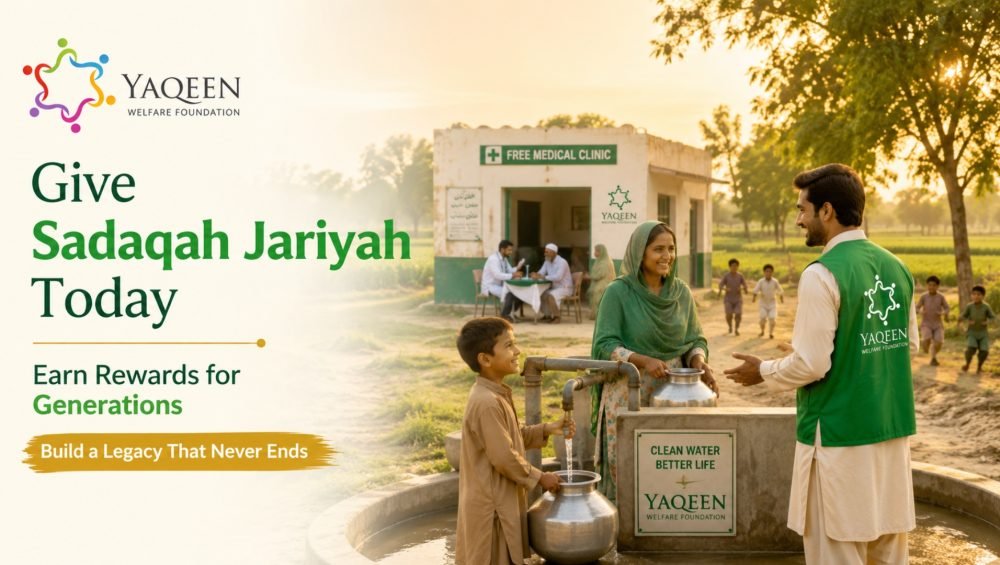
There are two kinds of charity in this world. One feeds a person for a day. The other feeds a community for generations. One ends the moment your hand opens and closes again. The other keeps moving long after your eyes have closed for the final time. Sadaqah Jariyah is the name Islam gives to that second kind of giving — charity that doesn’t stop when you stop. At Yaqeen Welfare Foundation, we see this form of generosity reshape destinies every single day, quietly and relentlessly, long after the person who gave it has moved on with their life — or left this world entirely. Because some acts of charity don’t just help people in the moment. They echo through time, touching lives that haven’t even begun yet. What Is Sadaqah Jariyah? The word jariyah comes from an Arabic root meaning “to flow” — like a river that never runs dry. Sadaqah Jariyah, then, is flowing charity: a single act of giving that doesn’t end when the transaction ends, but keeps generating benefit for others again and again, indefinitely. Unlike one-time acts of charity — which are valuable and necessary in their own right — Sadaqah Jariyah carries a quality nothing else can claim: it outlives the person who gave it. The Prophet ﷺ said: “When a person dies, all their deeds come to an end except three: ongoing charity, beneficial knowledge, or a righteous child who prays for them.” (Muslim) Sit with that for a moment. All deeds come to an end — except these three. Everything else is sealed the instant the soul departs. But ongoing charity? It stays open. Active. Accumulating. This isn’t a metaphor or a hopeful saying. It’s a divine promise — that what you give for the wellbeing of others doesn’t disappear with you. It travels ahead of you, recording your account before you even arrive. If you’re new to the broader concept of charitable giving in Islam, our guide on Best Times and Methods for Giving Sadaqah in Islam is a useful starting point before diving deeper into Sadaqah Jariyah specifically. Why One Act of Charity Can Last a Lifetime There is something quietly extraordinary about a gift that multiplies without ever being spent again. When you establish Sadaqah Jariyah, you’re not giving once — you’re creating a source of benefit that renews itself naturally, on its own, without end. Picture what that looks like in real life: A child drinks clean water before school — and your reward is recorded. A mother fills her cooking pot without walking three miles under the sun — and your reward is recorded again. A patient in a rural clinic receives medicine they couldn’t otherwise afford — and your name is written into an account you will never see. A family breaks free from a cycle of poverty because they had access to consistent support — and something shifts, not just for them, but for their children, and their children’s children. Every single time that benefit reaches someone, a reward is logged. Not proportional to the size of your gift. Not limited by how many years have passed. Not dependent on whether you’re even alive to witness it. That is the essential difference between charity that helps and Sadaqah Jariyah — charity that never stops helping. The Charity That Follows You Beyond This World We spend our lives accumulating things. We build wealth, build careers, build reputations, and leave behind physical traces of our time here. But most of what we build stays here. Property transfers to heirs. Careers end at retirement. Reputation fades within a generation or two. Sadaqah Jariyah is different. It is, in the truest sense, portable. It doesn’t stay behind in this world — it travels with you. It enters your Hisaab — your account with Allah — and speaks on your behalf at a time when nothing else you’ve done or said can intervene for you. Islamic scholars have described it beautifully: a person resting in their grave, unaware of the world moving on above them, yet still receiving a steady stream of reward — from a water source that flows, from knowledge that has spread, from a structure that still shelters people. The charity you released into the world has become an advocate for your soul. Long after your name has faded from human memory, your charity continues its quiet work. Long after the world has moved past your story, your story is still being written — in the lives of people you may never meet. A Real Impact: The Story of One Well Let’s make this tangible. There was a village — unremarkable by most standards — where clean water simply wasn’t within reach. The nearest source was far. Children who should have been in school spent hours of their day fetching water that wasn’t even safe to drink. Waterborne illness was common. Mothers rationed every drop that came into the home. Then someone, somewhere, made a choice. A single donation funded the installation of a water pump in that village. What happened next wasn’t dramatic. There was no ceremony, no crowd gathered to watch. Just water — clean, reliable, close. Families no longer rationed or risked illness with every sip. Girls who once carried water containers for miles started attending school instead. Rates of preventable disease steadily declined. Mothers gained back hours of every day that had been consumed by the struggle to survive. The person who funded that pump may live on the other side of the world. They may have given on a quiet evening, clicked a button, and gone back to their day without a second thought. They may no longer be alive at all. But the water still flows. And with every container filled, every wound washed, every meal cooked using that water, a reward is recorded for the person who made it possible — without them lifting a finger again. One decision. One gift. A story that never stops being written. For